Tag Archives: Alienation

330. AFTER HOURS (1985)

“Different rules apply when it gets this late. You know what I mean? It’s like, after hours.”–After Hours

Must See

DIRECTED BY:

FEATURING: , , John Heard, Linda Fiorentino, Terri Garr, , Verna Bloom, , Tommy Chong

PLOT: Paul meets an attractive woman in a Manhattan coffee shop after he gets off work. Under the pretext of his buying a paperweight from her roommate, she gives him her number. He calls her, is invited over to her SoHo loft, loses his money on the cab ride over, and is plagued by a bizarre series of missteps and coincidences that result in a dead body and his pursuit by a lynch mob as he tries in vain to make his way back home.

Still from After Hours (1985)

BACKGROUND:

  • Originally titles Lies, the script for After Hours was Joseph Minion’s thesis project for Columbia Film School. His professor was . He got an “A.”
  • Minion lifted about a third of the film (much of Marcy’s character) from a radio monologue by Joe Frank, who won a plagiarism lawsuit against the producers.
  • Minion would go on to write the script for another Certified Weird pick: Vampire’s Kiss (1988).
  • Griffin Dunne and Amy Robinson, then-struggling actors who took up producing, optioned Minion’s screenplay. They pitched the project to Martin Scorsese, but when they did not hear back from him they began negotiations with , who had yet to make a feature film at the time. Months later, when Scorsese’s first attempt to make The Last Temptation of Christ fell apart, he expressed interest in the project. When Burton heard this news he gracefully withdrew, saying he did not want to stand in the way of Scorsese.
  • The ending of After Hours had not been decided on when shooting began. (One proposed, and unused, surrealistic ending had Paul climbing into Verna Bloom’s womb and being reborn uptown). The first cut used a downbeat attempt at a conclusion that bombed with test audiences. Scorsese then went back and re-shot the ending we see today. (Director suggested the resolution Scorsese finally used).
  • Scorsese won the “Best Director” award at the Cannes Film Festival for After Hours.

INDELIBLE IMAGE: Kiki’s papier-mâché sculpture of a man staring up at the sky, mouth agape and gnarled fingers held before his face, like a flash-fried Pompeii victim preserved in ash. Paul thinks it looks like a three-dimensional version of “The Shriek.” The statue turns up unexpectedly later in the night, and an eerily and ironically similar piece plays a key role in the climax.

THREE WEIRD THINGS: Burn victim?; “Surrender Dorothy”; mummified escape

WHAT MAKES IT WEIRD: No other black comedy has ever captured such a perfect mix of unease, absurdity, melancholy, and danger with the light, unforced touch that Scorsese does here. Man’s fate in an uncaring universe ruled by the iron fist of coincidence has never seemed so horrifyingly hilarious.


Original trailer for After Hours

COMMENTS: Years ago, I wrote an article for this site about Continue reading 330. AFTER HOURS (1985)

300. THE TENANT (1976)

Le Locataire

“Many would attest that The Pianist is Polanski’s most personal work, given the obvious Holocaust subject matter, but look beneath the surface, and when the window curtains are drawn aside, Polanski’s The Tenant shines brightest as the work closest to his being.”–Adam Lippe, A Regrettable Moment of Sincerity

Recommended

DIRECTED BY:

FEATURING: , , , , Jo Van Fleet

PLOT: Meek clerk Trelkovsky rents an apartment in Paris that’s only available because the previous tenant threw herself out the window. He takes it upon himself to visit the woman, who has just awakened from a coma; while there, he meets Stella, a friend of the pre-deceased, with whom he embarks on an awkward romantic relationship. After the previous tenant passes Trelkovsky moves into the apartment, where his odd neighbors are obsessed with keeping the grounds quiet, and finds himself slowly taking on the personality of the previous tenant.

Still from The Tenant (1976)

BACKGROUND:

  • Based on the 1964 novel Le Locataire Chimérique by Panic Movement member . Polanski co-wrote the screenplay, rewrote the main character to be a Polish immigrant rather than a Russian, and cast himself in the lead.
  • Because of its apartment setting, The Tenant is considered part of Polanski’s unofficial “apartment trilogy,” which also includes Repulsion (1965) and Rosemary’s Baby (1968).
  • The film was shot in English, but most of the French actors were dubbed over by American voice talent. (Polanski dubbed himself in French for that language’s version).
  • Lensed by Sven Nykvist, ‘s favorite cinematographer.

INDELIBLE IMAGE: Unfortunately (because as a looker he’s no Dustin Hoffman, or even ) it’s the sight of Polanski in drag, particularly as he admires himself in the mirror, hiking up his dress to reveal his garter and stockings, and concludes “I think I’m pregnant.”

THREE WEIRD THINGS: Tooth in the wall; toilet mummy; high-bouncing head

WHAT MAKES IT WEIRD: Take a novel by Surrealist writer Roland Topor and give the property to Roman Polanski to adapt and star in while he’s having an anxiety attack, sprinkle lightly with hallucinations, and you get The Tenant. It’s a little Kafka, a little Repulsion, a little Bergman, a little cross-dressing exhibition, and very weird.


Original trailer for The Tenant

COMMENTS: Trelkovsky—no first name—is an improbably quiet Continue reading 300. THE TENANT (1976)

251. PLAYTIME (1967)

(G. Smalley contributed additional commentary and background to this article.)

Play Time

Playtime is a film that comes from another planet, where they make films differently.”–attributed to Francois Truffaut

Recommended

DIRECTED BY:

FEATURING: Jacques Tati, Barbara Dennek

PLOT: A nearly plotless “day in the life” of 1967 Paris: a group of American tourists arrive in the city, but instead of visiting the monuments they are taken to a complex of skyscrapers to shop. Meanwhile, Monsieur Hulot is trying to keep an appointment, but gets lost in a mazelike building in the same downtown complex. After business hours, everyone converges on a restaurant on its opening night for a chaotic celebration as the building falls apart around them.

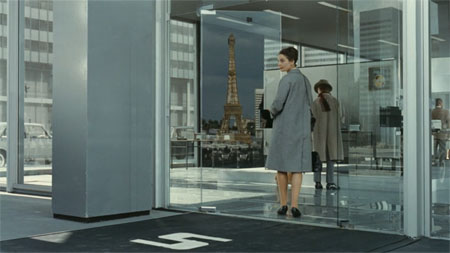
Still from Playtime (1967)

BACKGROUND:

  • The third of four features in which Jacques Tati played the affable, bumbling Monsieur Hulot.
  • Playtime was in production for three years; the downtown sets were constructed by hundreds of workers and were nicknamed “Tativille” among the crew.
  • The film was incredibly expensive to make and Tati took out personal loans to finance it; it was a disappointment at the box office and he went into bankruptcy, giving away Playtime‘s rights in the process.
  • Tati shot the film in 70mm (which was capable of a 2.20:1 aspect ratio, one of the widest formats), and initially insisted the film be screened only in that format in venues with stereophonic sound, despite the fact that very few theaters could meet these specifications. (Partially for this reason, the movie was not screened at all in the United States until 1972). He later relented and allowed 35mm prints to be struck.
  • Humorist and newspaper columnist Art Buchwald wrote the English dialogue for Tati.

INDELIBLE IMAGE: Many people will best remember Hulot’s view from the second-floor view of a factory-like job site composed of a maze of cubicles—a workplace prophecy that’s come true. We chose a scene—one of three in the film—where straggling Barbara opens a door to one of her tour’s commercialized sightseeing destinations, only to see the Eiffel Tower (or the Arc de Triomphe, or the Sacré Coeur) perfectly reflected in the plate glass. These shots express Tati’s theme of the disappearance of culture under the ugliness of modernity, while retaining the wistful hopefulness that is characteristic of his work.

THREE WEIRD THINGS: Faux Hulots; cubicle labyrinth; doorman with no door

WHAT MAKES IT WEIRD: Playtime is about the alienating, isolating influence technology has on human beings. It’s not the standard elements of plot, narrative, character development or dialogue that pulls an equally alienated audience into this unfurling drama, but the careful choreography of hapless humans navigating a barely recognizable hypermodern Paris. Play Time is a sort of anti-Brazil.


Short Clip from Playtime

COMMENTS: Do you remember when watching “Tom and Jerry” on Continue reading 251. PLAYTIME (1967)

CAPSULE: SAFE (1995)

Recommended

DIRECTED BY: Todd Haynes

FEATURING: , Xander Berkeley, Peter Friedman

PLOT: A wealthy woman who finds herself suffering from nosebleeds, vomiting and other unexplained maladies is drawn into a New Age cult that promises to deliver her from her “environmental sickness.”

Still from Safe (1995)

WHY IT WON’T MAKE THE LIST: Like its protagonist’s non-specific malaise, Safe has an uneasy, hard-to-pin-down tone that’s subtly disquieting. Whatever is plaguing Carol, however, we aren’t comfortable with a final diagnosis of “weird.”

COMMENTS: Safe is a movie in two parts. In the first half, Carol, a bored housew—um, homemaker—sleepwalks through a wan, bourgeois existence. Sex with her affluent but uninspiring husband is unfulfilling, the furniture store inexplicably delivers the wrong couch, and post-aerobic conversations with her friends revolve largely around upcoming baby showers and fad fruit diets. Finally, the wrong kind of excitement enters her life: she begins suffering unexplained nosebleeds, vomiting, and wheezing panic attacks. The doctors are nonplussed by her vague symptoms, and allergy tests turn up negative (except for milk). Still, she’s hospitalized after suffering a seizure at a dry cleaners; she has something.

At this point, the film changes focus when Carol investigates a  health club flyer with the intriguing title, “are you allergic to the 20th century?” At first she attends lectures about “environmental sickness” or “multiple chemical sensitivity,” educates herself in the pseudo-scientific jargon about “body load” and “getting clear”; eventually, she declares herself a candidate for the expensive health retreat of Wrenwood, a “non-profit communal settlement dedicated to the healing individual.” Rather than getting better, however, Carol gets progressively sicklier the longer she stays within the carefully controlled atmosphere of the retreat: her body turns bony, her skin blotchy, she takes to lugging around an oxygen tank, and the slightest accidental sniff of fumes from a passing truck sends her into a wheezing spell. The psychobabble therapy—which insists that the patient’s illness is a result of negative emotions and of not loving themselves enough—keeps the residents in state of infantile dependency. Carol’s sickness actually gives her, for the first time in the movie, a sense of purpose and identity; her deterioration is, therefore, not surprising.

Haynes’ camera is deliberate; the film is shot mostly in clinical long shots, with very slow, ian pans. The soundtrack is low, rumbling synthetic drones, with vapid soft rock interludes. The feeling is of distant, gathering doom. The themes suggest layers of interpretation: the story could be a bourgeois satire, New Age satire, feminist allegory, AIDS allegory, or an existential nightmare manifesting itself as body horror. At Safe‘s heart are the subconscious concepts of “purity” and “contamination” (whether environmental, spiritual, or even demographic), and a warning about the danger of yearning for utopian homogeneity and withdrawal from the chaotic world. Ambiguous and creepy, Safe is a call to danger. In these gluten-wary times, Haynes’ message is still vital.

WHAT THE CRITICS SAY:

“Alas, one waits through the entire two hours hoping that [Haynes] will save himself by puncturing his own balloon of self-seriousness with some of the bizarre humor and inventive genre-bending that has characterized his films to date. But it never comes.”–Todd McCarty, Variety (contemporaneous)

(This movie was nominated for review by Eric Gabbard , who said “It features a great performance from Julianne Moore as a neurotic germophobe who becomes so paranoid in living in a modern industrialized society that she is shipped off to this naturalist colony where other neurotics wander around in these weird body suits that protect them from harmful pollutants in the air.” Suggest a weird movie of your own here.)

CAPSULE: CRAVE (2012)

366 Weird Movies may earn commissions from purchases made through product links.

DIRECTED BY: Charles de Lauzirika

FEATURING: Josh Lawson, Emma Lung, ,

PLOT: A freelance crime-scene photographer romances a younger woman in his apartment building, while suffering delusions and fantasizing about becoming a vigilante.

Still from Crave (2012)
WHY IT WON’T MAKE THE LIST: This movie is trying so hard to be like its big brother Taxi Driver that it’s embarrassing to watch at times; it has a certain grotty charm and good performances, but needs a huge wallop of subtlety. Its hallucinations are so clearly marked off as fantasies that they never threaten to swallow up the viewer, leaving its weird effect highly attenuated.

COMMENTS: An internal monologue of a disaffected white guy who’s convinced that humanity is rotten. The antihero drives aimlessly through the city at night, searching for scenes of depravity to reinforce his misanthropic vision. He awkwardly romances a beautiful woman who’s out of his league. He plans a crime, practices the exact words he will say to his victim. The delusional self-appointed vigilante eventually wreaks a gruesome vengeance on an absuer of women. Stop me if you’ve heard this before.

Taxi Driver was the deconstructed, arthouse revision of puerile crime-anxiety thrillers like Death Wish; Crave is an unneeded, on-the-nose reconstruction of Taxi Driver for the modern age. Crave‘s chief problem, for a movie whose promotional material promises that its photographer protagonist Aiden will be a hero whose “dark imagination starts to leak into reality,” is that the line between fantasy and reality isn’t blurry for the viewer—when redheads tear off their blouses and fall to their knees and Bill Gates shows up offering Aiden bags of cash, it’s fantasy. The clarity of that line and the lack of a radical subjective perspective removes a lot of potential tension that might result if we are wondering if what is happening is really inside Aiden’s head. Nor is Aiden delusional enough to create suspense via the gap between the dangers the audience recognizes and what our protagonist comprehends; he not only realizes his grip on his emotional throttle is slipping, he agonizes about it endlessly in voiceovers and heart-to-hearts with his tough-but-wise stereotype cop buddy. And some of the stuff that clearly is intended to happen in reality doesn’t make a lot of sense, like his hot neighbor’s spur-of-the-moment decision to screw Aiden senseless one afternoon just because he’s not terrible-looking and not obviously a psychopath. That’s bad writing, though, not dark imagination.

The script’s lack of originality and subtlety is a shame, because there is a lot of talent here. Josh Lawson is not bad as Aiden, although he lacks the scruffy anti-charisma necessary to take the role over the top. The supporting players fare better. Adorable Emma Lung somehow comes across as a real person, despite the fact that the only character trait the script gives her to work with is a baffling bad taste in men. Edward Furlong, who we last saw in the miserable This Is Not a Movie, redeems himself here as a hipster cad who nonetheless doesn’t deserve his torturous fate. Ron Perlman’s square mug is, as always, a welcome sight; inhabiting his character with ease, he lends instant credibility to any project. The movie’s technical qualities are pro throughout. The neon-noir vistas of Chicago streets at night are memorable, as is the shot of spinning pinwheels reflected in Aiden’s eye. De Lauzirika, who has previously specialized in directing special features for major DVD releases (including Alien, Blade Runner, and three of the extras on the “Twin Peaks” Gold Box set), is a talented director who shoots a good-looking film and elicits fine performances from his actors. But, he may better serve his career in the future by directing scripts written by someone else.

WHAT THE CRITICS SAY:

“[The performances are] undermined by not just the clichéd story but director/co-writer Charles de Lauzirika’s misguided tone, which veers from straight-up impotent fury to a clunky humor that’s just not funny in the story’s overall context.”–Maitland McDonagh, Film Journal International (contemporaneous)