CAPSULE: TEETH (2007)

DIRECTED BY: Mitchell Lichtenstein

FEATURING: , John Hensley

PLOT: A teenage girl involved in the abstinence movement discovers that she has an unusual mutation—teeth hidden inside her vagina, which clamp down on intruders.

Still from Teeth (2007)
WHY IT WON’T MAKE THE LIST: It’s got an odd little premise, but not enough bite (c’mon, you had to see that one coming.)

COMMENTS: If you’re going to make a film about a girl who discovers she has ravenous teeth inside her vagina—you know, a poonfang flick—you have a serious decision to make about tone. The concept is so ridiculous that it can’t be done realistically: the best you could do would be to make it into a sci-fi version of a “disease of the week” movie. Writer/director Mitchell Lichtenstein chooses to play the concept (mostly) as a straight horror movie. Since the other possibility would be to go for a horror/comedy hybrid that would inevitably degenerate into juvenile genitalia jokes, his choice seems like it should be the correct one; but based on the results here, I’m not so sure this material wouldn’t have played better with more icky genital wackiness (a la Bad Biology).

Teeth is technically well-made and benefits greatly from an all-in performance by Heather Graham lookalike Jess Weixler as Dawn, who undertakes a sexually confused journey from idealistic prude to reluctant predator. But the way Teeth handles the inherent absurdity of its situation is problematic. There are no real scares—though prosthetic penises provide some gross-out moments—but there are no big laughs either. It’s impossible to be horrified by the girl’s ridiculous condition, and only slightly easier to be amused. You might involuntarily guffaw when young Dawn decides to visit a gynecologist (“I think their might be something weird going on inside”) rather than a dentist. Some may find the straight-faced parody of the teen abstinence movement in the first act mildly amusing. The movie also hits all the b-movie monster movie cliches, like overdramatic musical cues at the moment of revelation and a cutaway to a forensic scientist providing stilted explication to an investigating detective, although those segments play as much as homage as satire.

The film’s message about the patriarchy’s fear of female sexuality is pure symbolism 101; its implication that all men are potential rapists may strike some as offensive (although this feature may result more from the awkward demands of the plot than from any anti-male ideology). While it would make good copy to quip that movie’s shock and comedy aspirations merge about as well as teeth and vaginas, that’s not really the case. Teeth isn’t a triumph, but nor is it a disaster—which is a real problem for critics when trying to discuss a movie that offers so many opportunities for dentition related puns. You can’t imagine how many reviewers were secretly hoping this movie would be a disaster so that they could be the first to quip “Teeth bites” or “the rotten Teeth should be yanked.”

It’s worth noting once more that Jess Weixler’s portrayal of troubled innocence is a key to making Teeth work, to the extent it does. With a lesser actress in the role, the film might have ended up as pure dreck. The 2007 Sundance Film Festival jury agreed, honoring Weixler with a special jury award for “dramatic acting.”

WHAT THE CRITICS SAY:

“It’s definitely not for Aunt Minnie, but cult movie mavens will appreciate director Mitchell Lichtenstein’s willingness to push the boundaries of bad taste.”–Colin Covert, Minneapolis Star-Tribune (contemporaneous)

(This movie was nominated for review by Mr. Worf, who described it as “[p]art dark comedy, part horror film. Becoming a young woman is tough, especially for Dawn who is ‘very different.'” Suggest a weird movie of your own here.)

366 UNDERGROUND: FAITH OF OUR FATHERS (1997)

DIRECTED BY: Hamilton Sterling

FEATURING: Jeff Hawk, George Gerlernter, James Geralden, Cassandra Joy, Noel Webb, Clement Blake

PLOT: A satiric parable wherein naive innocent chimney-sweeper Charles is schooled in the ways of the world and business by a cynical benefactor, Nick, who encourages him to bring back the tradition of ‘climbing boys’ when a rich client expresses a wish for ‘the old days’. Charles complies with the exploitation of a child, but at a cost to himself and those around him.

IS IT WEIRD?:  Not really. Pretentious, certainly; but there’s nothing new brought to the table in terms of weirdness.

COMMENTS:  At first glance, Faith of Our Fathers appears to be very timely and prescient, considering that the film was completed in 1996, went out on the festival circuit where it did get some very good critical notice but no release until 2013, when it could be seen as an “I-told-you-so” roadmap to the current economic/political/cultural climate (much like how Richard Brooks’ reviled Wrong is Right from 1982 turned out to be a not-that-exaggerated look at what the Millennium-Ought decade held in store for everyone). It’s really hard to fault the filmmakers’ intentions, as there is a concerted effort on everyone’s part to make this a meaningful project.

Faith of Our FathersUnfortunately, for me those intentions fall short in the experience of watching this play out. I suspect those who would enjoy watching this film would also be rabid fans of hardcore symbolic European art-house films, which are usually very slowly paced, populated with metaphors instead of characters and with degrees of inscrutability. My failure to connect here is probably a failing of this viewer. It’s a film that I really wanted to like, especially since items like composition, nuanced acting and craftsmanship are usually in short supply in the majority of work that gets the “Underground” label. But honestly, I just couldn’t enjoy it, despite the impressive craft on display (the cinematography, score, and a performance by Gerlernter as fallen priest/satanic provocateur Nicholas Nickelby).

It also doesn’t help when you have this as your logline:

” …this surreal and politically prescient film deconstructs the language of religious and economic America, finding artistic alternatives within the ethos of art.”

If this sentence gets you pumped to see what might follow, instead of rolling your eyes from the stench of pretension, then you’ll enjoy the journey. Much as I wanted to, I couldn’t get past it—so fair warning.

Faith of Our Fathers was self-released by writer/director Hamilton Sterling on DVD and Blu-ray, and the presentation is of very high-quality. One thing missing is a director’s commentary, which I think really would’ve helped—not that Sterling would’ve needed to spoonfeed us every single symbol in the film, but some context certainly would’ve been appreciated, especially explanations for the jumping back and forth between color and black and white, and sequences such as the one where one of the main characters has a dialogue with Napoleon Bonaparte in the park.

Helikon Sound – Hamilton Sterling’s site. Sterling has worked as a sound tech on films like Magnolia, The Tree of Life, Gangs of New York, and The Dark Knight, amongst others.

Faith of Our Fathers Facebook page

WEIRD HORIZON FOR THE WEEK OF 2/14/2014

Our weekly look at what’s weird in theaters, on hot-off-the-presses DVDs, and on more distant horizons…

Trailers of new release movies are generally available on the official site links.

SCREENINGS – (Cinefamily, Los Angeles, CA, Feb. 19):

A Report on the Party and Guests (1966): Read the certified weird review. If you’re in L.A. you should make it a point to check out this rare screening of ‘s anti-totalitarian classic about a group of carefree picnickers who are gradually absorbed into a frightening new social structure. Here’s the Cinefamily’s report on Report, and be sure to check the Jan Nemec Retrospective Tour page for upcoming dates in other U.S. cities.

NEW ON DVD:

“The Cinema of Jean Rollin: The Vampire Films”: Here are Rollin’s four major vampire pics together in one bundle: Rape of the Vampire, The Nude Vampire, Shiver of the Vampire and Requiem for a Vampire. One of these (or more?) is almost certain to make the List, but which? Buy the whole set and decide for yourself. Buy “The Cinema of Jean Rollin: The Vampire Films”

Successive Slidings of Pleasure [Glissements Progressifs du Plaisir] (1974): The police investigate a woman suspected of being a witch, whose roommate has turned up naked and dead. After writing Last Year at Marienbad, novelist Alain Robbe-Grillet went on to become a director of surreal sadomasochistic soft-porn; we’re excited that Redemption is re-releasing his hard-to-find features. Buy Successive Slidings of Pleasure.

Trans-Europ-Express (1967): The story concerns to sets of travelers on a train: one set is a drug dealer and his sexual captive, the other a writer and film producer who are making up the story during the trip. More Robbe-Grillet from Redemption; this was hot enough to get banned in Britain back in the day, although it’s (somewhat) tame by today’s standards. Buy Trans-Europ-Express.

NEW ON BLU-RAY:

“The Cinema of Jean Rollin: The Vampire Films”: See description in DVD above. Buy “The Cinema of Jean Rollin: The Vampire Films” [Blu-ray].

Successive Slidings of Pleasure [Glissements Progressifs du Plaisir] (1974): See description in DVD above. Buy Successive Slidings of Pleasure [Blu-ray].

Trans-Europ-Express (1967): See description in DVD above. Buy Trans-Europ-Express [Blu-ray].

What are you looking forward to? If you have any weird movie leads that I have overlooked, feel free to leave them in the COMMENTS section.

ANTHONY MANN’S MAN OF THE WEST (1958)

When the subject of Anthony Mann’s contribution to the western genre is explored, it is his cycle with James Stewart that is inevitably brought up. Indeed, the Stewart collaboration Naked Spur (1953) remains Mann’s highest praised achievement in the great American genre. However, it is his nearly forgotten, last true western, Man of the West (1958), starring , that is his most strikingly modern achievement. A telling sign of this film’s greatness lies in the fact that its status is still debated decades later.

Mann’s casting of Cooper is nothing less than inspired, although it probably cost the film box office revenue. Mann and Stewart had fallen out during the making of the previous year’s Night Passage, but by then audiences had come to accept Mann’s reinvention of Stewart’s on-screen persona. Starting in 1950, under Mann’s direction, Stewart had been portrayed as violent, selfish, cynical and remarkably complex.

In 1958, Gary Cooper was nearing the end of his career, and no director had manipulated Cooper’s screen personality in the way Mann had done with Stewart. , a competent journeyman director who, nevertheless, lacked a real consistent vision, had come closest in Springfield Rifle (1952), where he portrayed Cooper’s character as an accused coward in the first half of the film. That turned out to be an undercover ploy to smoke out the real traitors, however, so Cooper retained his pure-as-the-driven-snow nobility after all. Still, even then, neither audiences nor critics bought it. Laconic simplicity and nobility were Cooper’s well-established trademarks. Mann took advantage of what was already established, and manipulated it with a darkly hued underbelly. Under Mann’s direction, the “yup” mannerisms of Cooper’s Link Jones convey evasiveness in an attempt to hide a less than noble past.

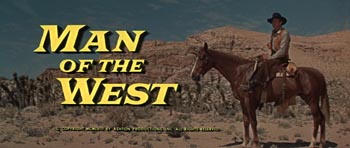
Title from Man of the West (1955)Link Jones is about to catch a train headed for Texas. He is on a mission to find a school teacher for his small town’s new school, and is carrying the funds to pay for her. A Marshall at the local train station thinks he recognizes Link, asks Link his name, inquires into Link’s past, and asks him if he knows the fugitive Doc Tobin (Lee J. Cobb). Link cautiously shakes his head, lies, squints, and evades the Marshall’s penetrating looks. Mann’s expert manipulation of Cooper’s personality traits is so subtle as to be believable and, thus, unnerving. It was unsettling enough for 1958 audiences to reject it, and even contemporary critics have often lamented the casting of Cooper, as opposed to Stewart, in this film. Stewart would not have worked nearly as well, simply because his casting would have been acceptable, even expected.

Cooper’s Link Jones consistently plays dumb throughout the film, first to evade discovery, then out of sheer necessity, for survival. We believe that he hides a sordid past. Link’s trip is cut short when bandits rob the train. Link, saloon singer Billie (Julie London) and con man Sam (Arthur O’ Connell) are left stranded. Link recognizes the nearby area as his one-time home. Knowing the nearest town is 100 miles away, Link leads his fellow Continue reading ANTHONY MANN’S MAN OF THE WEST (1958) →

Celebrating the cinematically surreal, bizarre, cult, oddball, fantastique, strange, psychedelic, and the just plain WEIRD!