Category Archives: Canonically Weird (The List)

331. DARK CITY (1998)

Recommended

“The fleetingly improvised men are transient figures of human shape, which naturally disappear or slowly dissolve after a short period of existence. Their appearance always is the result of a wonder.

Fleetingly improvised men lead a dream life. As a result, they are incapable of entering a regular conversation with people around them.

Fleetingly improvised men sometimes resemble dead people.”–M. Rautenberg, Daniel Paul Schreber: Beginner’s Guide to Memoirs of My Nervous Illness

DIRECTED BY: Alex Proyas

FEATURING: , Jennifer Connelly, William Hurt, Kiefer Sutherland, Richard O’Brien,

PLOT: John Murdoch awakens in a bathtub, remembering nothing: certainly not the reason why the dead, mutilated woman is in the other room. As he travels through a night-cursed city to discover his identity, John is simultaneously pursued by a dogged police detective, a psychiatrist who knows more than he lets on, and a coterie of very pale gentlemen in black coats and hats. Ultimately he discovers that his alleged past is just that—and that the forces behind the frame-up are responsible for something far more grand and sinister.

Still from Dark City (1998)

BACKGROUND:

  • The opening narration, included over Alex Proyas’ objections, was included at the insistence of producers who feared the audience would be confused by being thrown into this world. Many fans think it’s a spoiler of the worst kind. Proyas’ director’s cut of the film excises the exposition.
  • Proyas based the Strangers’ looks and mannerisms on Richard O’Brien’s “Riff Raff” from Rocky Horror Picture Show. Proyas also wrote the role of “Mr. Hand” specifically for O’Brien.
  • The Matrix not only ripped off did a variation of Dark City’s central premise, it also re-used a number of its actual sets after Dark City‘s production had wrapped up.
  • Kiefer Sutherland’s character, Dr. Daniel Schreber, was named after an early 20th-century schizophrenic who wrote a memoir of his illness.
  • Proyas intended the final showdown between John Murdoch and Mr Book to be an homage to the famed manga comic (and anime) Akira.

INDELIBLE IMAGE: We’ll cast aside the montages of warping buildings, stylish noir streets, and sinister Stranger gatherings in favor of the mirroring scenes of Mr. Hand and John Murdoch after their respective imprints. Both rise from the gurney with comparable looks of grim determination, after painfully twitching through a series of forced memories.

THREE WEIRD THINGS: Steampunk brain syringes; quick-rise concrete; creepy kid with teeth

WHAT MAKES IT WEIRD: About five years ago we argued that Dark City shouldn’t make the list. Since then, our minds have been changed—possibly while we were asleep. Any movie the plot of which can be described as “telekinetic collective memory space jelly bugs abduct tens of thousands of earthlings to populate a jumble-Noir cityscape in perpetual darkness in order to find out more about us” deserves a slot on the list of the weirdest movies ever made. The fact that it follows its dream logic into uncanny valley Gothic visuals is to its credit as well.


Original trailer for Dark City

COMMENTS: Focus. Focus. Every event flows into, bolsters, and undermines every other event. John Murdoch can defeat the Strangers Continue reading 331. DARK CITY (1998) →

330. AFTER HOURS (1985)

“Different rules apply when it gets this late. You know what I mean? It’s like, after hours.”–After Hours

Must See

DIRECTED BY:

FEATURING: , , John Heard, Linda Fiorentino, Terri Garr, , Verna Bloom, , Tommy Chong

PLOT: Paul meets an attractive woman in a Manhattan coffee shop after he gets off work. Under the pretext of his buying a paperweight from her roommate, she gives him her number. He calls her, is invited over to her SoHo loft, loses his money on the cab ride over, and is plagued by a bizarre series of missteps and coincidences that result in a dead body and his pursuit by a lynch mob as he tries in vain to make his way back home.

Still from After Hours (1985)

BACKGROUND:

  • Originally titles Lies, the script for After Hours was Joseph Minion’s thesis project for Columbia Film School. His professor was . He got an “A.”
  • Minion lifted about a third of the film (much of Marcy’s character) from a radio monologue by Joe Frank, who won a plagiarism lawsuit against the producers.
  • Minion would go on to write the script for another Certified Weird pick: Vampire’s Kiss (1988).
  • Griffin Dunne and Amy Robinson, then-struggling actors who took up producing, optioned Minion’s screenplay. They pitched the project to Martin Scorsese, but when they did not hear back from him they began negotiations with , who had yet to make a feature film at the time. Months later, when Scorsese’s first attempt to make The Last Temptation of Christ fell apart, he expressed interest in the project. When Burton heard this news he gracefully withdrew, saying he did not want to stand in the way of Scorsese.
  • The ending of After Hours had not been decided on when shooting began. (One proposed, and unused, surrealistic ending had Paul climbing into Verna Bloom’s womb and being reborn uptown). The first cut used a downbeat attempt at a conclusion that bombed with test audiences. Scorsese then went back and re-shot the ending we see today. (Director suggested the resolution Scorsese finally used).
  • Scorsese won the “Best Director” award at the Cannes Film Festival for After Hours.

INDELIBLE IMAGE: Kiki’s papier-mâché sculpture of a man staring up at the sky, mouth agape and gnarled fingers held before his face, like a flash-fried Pompeii victim preserved in ash. Paul thinks it looks like a three-dimensional version of “The Shriek.” The statue turns up unexpectedly later in the night, and an eerily and ironically similar piece plays a key role in the climax.

THREE WEIRD THINGS: Burn victim?; “Surrender Dorothy”; mummified escape

WHAT MAKES IT WEIRD: No other black comedy has ever captured such a perfect mix of unease, absurdity, melancholy, and danger with the light, unforced touch that Scorsese does here. Man’s fate in an uncaring universe ruled by the iron fist of coincidence has never seemed so horrifyingly hilarious.


Original trailer for After Hours

COMMENTS: Years ago, I wrote an article for this site about Continue reading 330. AFTER HOURS (1985) →

329. THE TESTAMENT OF ORPHEUS (1960)

Weirdest!

Le testament d’Orphée, ou ne me demandez pas pourquoi!

“Man seeks to escape himself in myth, and does so by any means at his disposal. Drugs, alcohol, or lies. Unable to withdraw into himself, he disguises himself. Lies and inaccuracy give him a few moments of comfort.”–Jean Cocteau, Diary of an Unknown

DIRECTED BY:

FEATURING: Jean Cocteau, , ,

PLOT: Time-traveling poet Jean Cocteau visits a professor and asks to be shot with his faster-than-light bullets in hopes of escaping the condition of timelessness. After the bullet frees him from his 19th century garb, he wanders outside, witnesses a strange gypsy ritual, and unknowingly summons Cégeste, a character from his movie and play Orpheus. Cégeste orders him to travel to the goddess Minerva with an offering, but along the way they are detained and interrogated by Death and her chauffeur Heurtebise (two other characters from Orpheus), among other surreal encounters.

Still from The Testament of Orpheus (1960)

BACKGROUND:

  • Testament is the third part of Jean Cocteau’s “Orphic trilogy,” which begins with The Blood of a Poet (1930) and peaked with its second entry, Orpheus (1950). Since characters from Orpheus play a role in Testament, this film will be much more meaningful to those who saw the second installment. Blood of a Poet has no narrative connection to the others, only a thematic one, and can be viewed in any order.
  • Cocteau was 71 when he made this film, which he intended to be his final statement in cinema. He wrote that the title Testament of Orpheus “has no direct connection to my film. It meant that I was bequeathing this last visual poem to all the young people who have believed in me, despite the total incomprehension with which I am surrounded on the part of my contemporaries.” Cocteau died three years after Testament was released.
  • Reportedly, when the production was short on funds, François Truffaut invested some of his profits from his recent hit The 400 Blows so Cocteau could complete his Testament.
  • The film’s French subtitle (or alternate title), “ne me demandez pas pourquoi,” translates to “do not ask me why.”
  • Besides Cocteau, the cast is uncredited. At the end, Cocteau says that “Any celebrities who you may see along the way appear not because they are famous, but because they fit the roles they play and because they are my friends.” Among the cameo appearances: musician Charles Aznavour, Brigitte Bardot, Yul Brynner, Pablo Picasso, and director . Former Orpheus appears briefly as Oedipus.
  • Edouard Dermithe, who plays the key role of Cégeste, was Cocteau’s adopted son, a fact alluded to in the script.

INDELIBLE IMAGE: Cocteau stages his own funeral. His pallbearers are lanky black horse-men. The mourners are gypsies. His corpse exhales smoke. He doesn’t stay dead long.

THREE WEIRD THINGS: The Poet as time-traveling fop; pantomime horse boy toys; Athena’s jet javelin

WHAT MAKES IT WEIRD: In his final film, a giant of the avant-garde unapologetically indulges himself in a surrealistic journey through a misty netherworld bordered by dreams, imagination, and narcissism.

Brief clip from The Testament of Orpheus

COMMENTS: The Testament of Orpheus is, beyond question, a self-indulgent film. “Testament” has a dual meaning: it is a statement of Continue reading 329. THE TESTAMENT OF ORPHEUS (1960) →

328. ARISE! THE SUBGENIUS MOVIE (1992)

AKA Arise! The Sub Genius Video;  Arise! SubGenius Recruitment Film #16

“Stand erect for your own abnormality, WISE UP! They’re out to get you. The ‘different’ are being silenced by a global conspiracy. WEIRD-MEN ARISE!”–The Book of the SubGenius : The Sacred Teachings of J.R. ‘Bob’ Dobbs

RecommendedWeirdest!

DIRECTED BY: Rev. Cordt Holland, Rev. Ivan Stang

FEATURING: Dr. Howl (Hal Robbins), Rev. Ivan Stang (Douglass Smith), Pope David Meyer II, , Philo Drummond

PLOT: The video begins with five minutes of instructions (e.g., “do not operate a motor vehicle following viewing,” “the demons you may see during the initial hallucination sequence are not real.”) Then, we are introduced to the Church dogma, beginning with an alarmed news anchor who succinctly describes the Church as a cult led by J.R. “Bob” Dobbs, “a comic book character who speaks with aliens and worships money.” Amid mind-melting montages, taped sermons, country/punk “hymns,” and stock footage from old B-movies, the Church doctrine is gradually (if confusedly) revealed, including the concepts of “Slack,” “the Conspiracy,” “the Elder Gods,” and “X-day.”

Still from Arise! the Subgenius Movie (1992)

BACKGROUND:

  • The Church of the SubGenius is a long-running satirical cult, a multimedia performance art circus comprising radio broadcasts, books, associated musical acts (“Doktor bands”), happenings (called “devivals”), pop-surreal art collages, a website, and this movie (with more to come). It is said to have been founded in Dallas TX in 1979 by Rev. Ivan Stang (pseudonym for Douglass Smith), Philo Drummond, and “Dr. X.” Stang quickly became the dominant figure in the movement, and, now in his mid-sixties, is still active in the Church.
  • The Church of the SubGenius is an offshoot of another fake religion, Discordianism, founded in 1963 by Greg Hill and Kerry Wendell Thornley. Discordianism’s most famous proponent is writer Robert Anton Wilson, co-author of the The Illuminatus! Trilogy.
  • Co-director/”editor in the spirit” Cordt Holland is a pop-art collagist whose work can be found here.
  • Much of the narration was taken from radio broadcasts from Stang’s “Hour of Slack” and text from The Book of the SubGenius. The environmentally-conscious Church continually recycles and remixes its material into new, mutated combinations.
  • The appearance of President George W. Bush in this 1992 movie was not a prophecy; the video was updated with new material in 2005. (VHS copies will have less material.)
  • Arise! was originally distributed by Polygram, until the Conspiracy caught on and squashed the plan. Reportedly, 800 rental copies were returned to the Church when Blockbuster video went “clean” and apparently deemed the videos deviant and offensive to Christians.
  • In 2017 a Kickstarter campaign to create a “serious” documentary about the history of the Church was successfully funded. Look for Slacking Towards Bethlehem: J.R. ‘Bob’ Dobbs and the Church of the SubGenius to appear sometime in 2018 (we’ll alert you when the time comes).

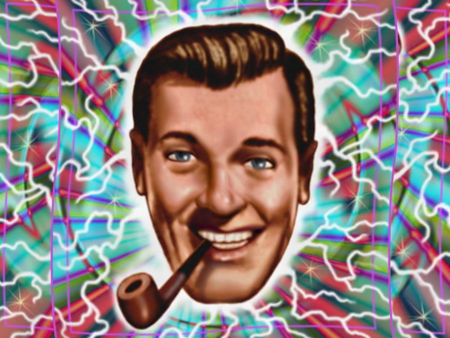
INDELIBLE IMAGE: Obviously, it’s “Bob”‘s generic, white-bread, smug, pipe-sucking face, which is pixilated, melted, multilated, and pasted over other character’s heads throughout the movie.

THREE WEIRD THINGS: Pipe-smoking sex god “Bob”; the world ended on July 5, 1998; video evidence of “Bob”‘s martyrdom?

WHAT MAKES IT WEIRD: The world’s only absurdist recruitment video for the world’s largest absurdist cult, Arise! is too potent to play in Conspiracy theaters. It has circulated for over 25 years through that secret samizdat network known only as “the Internet.” Arise! will teach you about the genetic secret that makes you better than the “Normals” and about the long past/soon to come X-Day flying saucer apocalypse, puzzle you with the mysterious riddles posed by Old Testament alien JHVH-1, and give you the key to acquiring slack. All of this propaganda is scored to terribly annoying but hilarious music and illustrated with mind-melting psychedelic collages and subliminal images intended to put you into trance so that J.R. “Bob” Dobbs can insert the deeper, more esoteric meanings behind this lucrative cult directly into your forebrain and teach you to embrace your inner weirdness. Plus, live nude girls scattered throughout!


Excerpt from Arise! The SubGenius Movie

COMMENTS: I was lucky enough to discover the Church of the SubGenius near the very beginning. I’ve had Slack ever since. In 1986 I Continue reading 328. ARISE! THE SUBGENIUS MOVIE (1992) →

327. GODMONSTER OF INDIAN FLATS (1973)

366 Weird Movies may earn commissions from purchases made through product links.

“Once upon a time, director FREDRIC HOBBS made a sex film called Roseland that turned out to be one of the weirdest, wackiest, oddballest sex films ever made. This time he’s made a monster movie called Godmonster of Indian Flats that, no surprise, is one of the weirdest, wackiest, oddballest monster movies ever made.”–“Something Weird” ad copy for Godmonster of Indian Flats

DIRECTED BY: Fredric Hobbs

FEATURING: , , , Steven Kent Browne, Karen Ingenthron

PLOT: When a cowboy is cheated out of his casino winnings by the rough crowd at the local saloon, he drunkenly falls asleep in a nearby stable, where he wakes up next to a strange mutant sheep embryo. A scientist comes across the pair and transports them back to his cavern laboratory, where he attempts to grow the sheep to full size in an effort to exploit its size and strength for good—or evil. Meanwhile, a ruthless land baron schemes to keep his tight grip on his town, using his power and wiles to shut down the machinations of speculators from back east, particularly the credulous representative sent to acquire the property.

Still from The Godmonster of Indian Flats (1973)

BACKGROUND:

  • Auteur Fredric Hobbs is a respected artist and sculptor, with work in the permanent collection of the Fine Art Museums of San Francisco. He proposed a school of thought called ART ECO, which combines fine art with environmentally conscious living.
  • Hobbs released two films in 1973. The other, Alabama’s Ghost, has been described as a “magic/vampire/voodoo/Nazi/musical blaxploitation tale”. His X-rated musical comedy Roseland from 1971 has never been released on DVD and is hard to find even on VHS, while his first experimental film, 1969’s Troika, is now little more than a lonely IMDB entry. He never made another film after Godmonster.
  • Godmonster is set in and around Virginia City, Nevada, a historic town where Samuel Clemens famously introduced his pen name, Mark Twain. Today, it serves primarily as a tourist district, featuring re-creations of an Old West town, which Hobbs incorporated into the film.
  • icon Erica Gavin has a brief appearance as a bar girl. She’s hard to spot, although she has helpfully posted the first six minutes of the film online to help narrow the search. (Stuart Lancaster was also a Meyer regular.)
  • Ingenue Karen Ingenthron is Hollywood royalty, the granddaughter of The Munsters’ Grandpa Al Lewis.

INDELIBLE IMAGE: A bunch of apple-cheeked youngsters enjoying an all-American picnic under the midday sun, blissfully unaware of the mutated, woolly, camel-faced abomination lumbering toward them.

THREE WEIRD THINGS: Fake funeral for a furry friend; Mariposa dances with mutton; riot at the old dump

WHAT MAKES IT WEIRD: Godmonster of Indian Flats has no idea what it’s doing, and it does so with tremendous confidence, flair, and reckless abandon. Cross-breeding two radically different notions—a blatantly silly monster movie and what is either an angry screed against or a secret manifesto for fascist leadership—results in scenes that consistently blow the mind, culminating in a finale that is justly remembered for being outrageously outré.


Something Weird trailer for Godmonster of Indian Flats

COMMENTS: Like the very best of truly bad movies, Godmonster is a Continue reading 327. GODMONSTER OF INDIAN FLATS (1973) →