Category Archives: Capsules

CAPSULE: WAR WITCH (2012)

Rebelle

Recommended

DIRECTED BY: Kim Nguyen

FEATURING: Rachel Mwanza, Serge Kanyinda

PLOT: Rebels abduct a 12-year old girl from her African village and force her to become a soldier; when her military commanders decide she has magical powers, she is declared the army’s “war witch.”

Still from War Witch (2012)

WHY IT WON’T MAKE THE LIST: The tiny dash of magic realism that’s added to soften the blow of the tragic realism isn’t enough to turn this all-too-believable drama into a weird movie.

COMMENTS: The blank-faced girl begins narrating her story to her unborn baby, in the process praying, “I hope God will give me the strength to love you.” It’s a harsh opening for a hard movie, but despite the themes of war, cruelty, and child slavery, War Witch finds ways to not be a complete downer. The plot has three clearly defined acts, each tracking a year of Komona’s life. It begins at the age of 12, when armed men in canoes storm the riverside shantytown she lives in, killing most of the residents and carrying her off as a slave. By 13 she has found a beau and hope for the future in the person of a young albino magician (named “Magician”) who courts her according to folk traditions, and by age 14 she is a woman of the world, having suffered enough pain and heartbreak for two lifetimes. Writer/director Kim Nguyen delivers plenty of gruesome and cruel moments but chooses not to linger over them, and lets beams of light pierce the darkness. The sunny Congolese locations, from the mysterious forest full of ghosts to the field of boulders (also full of ghosts) can be sublime. Komona and Magician (first time actors Rachel Mwanza and Serge Kanyinda) both do well and share a touchingly naïve romance, especially in light of the awful things they have suffered and the awful things they have been forced to do. There is a minor fairytale ambiance to the proceedings, what with the child witches and wizards, accusatory ghosts, and an evil warlord (known by the sobriquet “the Great Tiger”) ensconced in an improbably grand tower in the middle of the jungle. A visit to a hidden albino village to find a semi-mythological creature provides another fable-like moment. The movie accepts the existence of magic and never questions local superstitions; for example, a man casually asks for a gris-gris to protect him against war as payment for helping the children. After drinking “magic milk” (the hallucinogenic sap of a local tree), Komona gains the ability to see ghosts. The apparitions, corpses caked in white clay with blank eyes, are simple and effective, and they begin to haunt the girl everywhere. They warn her of an ambush set by government soldiers, allowing her alone to escape and giving her the reputation of a witch. The movie never gives us any reason to question the accuracy of Komona’s visions, which in the end take on a crucial psychological importance for the girl. Nguyen mixes childish imagination and voodoo practices with military reality to brew up a unique world we have not seen on film before. Unfortunately, with the fantasy elements stripped away, this world is far too recognizable from cable news broadcasts. “It’s a hard world for little things,” mourned Rachel Cooper in Depression-era Appalachia in Night of the Hunter; on another continent, in another millennium, her pronouncement still rings sadly true in War Witch.

At no point in War Witch does the movie explain what country it is set in, or who the rebels are or what they are supposedly fighting for. The movie was shot in the Democratic Republic of the Congo (DRC), however, and clues suggest that the action is set there, including the fact that the rebels fund their insurgency by mining coltan, an exotic mineral found mostly in the Congo. The Second Congo War, which officially ended in 2003, still lingers on with outbreaks of ethnic violence and warlordism to this day; it has been called the deadliest conflict since World War II. Some 30,000 children have been conscripted to shed blood for both sides. The notorious Joseph Kony, the cult leader of the Lord’s Resistance Army, has operated out of the DRC, and may be the model for War Witch‘s Great Tiger.

WHAT THE CRITICS SAY:

“… [a] gripping, surreal African child soldier drama…”-Ky N. Ngyuen, Washington Diplomat (contemporaneous)

CAPSULE: STOKER (2013)

DIRECTED BY:

FEATURING: , ,

PLOT: A girl’s father dies on her 18th birthday; the uncle she never knew she had shows up soon thereafter and installs himself in the isolated house she lives in with her lonely mother.

Still from Stoker (2013)
WHY IT WON’T MAKE THE LIST: It’s not weird enough, although Chan-wook Park fans should find enough perversion, violence and sublime cinematography to keep themselves engaged in it.

COMMENTS: From the long-lost uncle right out of Shadow of a Doubt to a subversive quotation to Psycho‘s shower scene, Stoker is Chan-wook Park’s Hitchcock tribute movie. But where Hitch was a master of plotting as well as suspense, Park substitutes high stylization and on-the-nose perversity for carefully shaded storytelling. The events of Stoker are highly implausible, and the characters act like dancers in a psychosexual ballet rather than three people mourning the loss of a beloved breadwinner. The triangular character structure draws you in, presenting sets of relations—mother/daughter, uncle/niece, and widow/brother-in-law—which shift throughout the tale. Allies will become enemies, buried family secrets will be uncovered, and Uncle Charlie, naturally, is not what he seems. Oh, and blood will flow when longings grow unchecked. Stoker unavoidably flirts with the Electra complex, as mother and daughter compete for the attentions of the surrogate father figure, the new Man of the house. Mysterious Uncle Charlie, whose very existence was unknown until he showed up at his brother’s funeral, is a figure of fear and desire to young India. The way he tries to win the 18-year old’s allegiance by waiting for her in his convertible parked next to the school bus would creep out Chris Hansen, and the way newly widowed and prematurely lonely mom Evelyn courts Uncle’s attention would boil Hamlet’s blood. There are a lot of naughty, nasty possibilities in a tale that teases a potential transformation into a taboo love triangle, but it has less transgressive sting because nothing onscreen bears much relationship to reality. Characters show up as if by magic when the script calls for it, ominous music plays for no obvious reason, and no one’s reactions are very believable. (You’ve got to call the police when you find that first body, folks!) The way India’s feelings for Charlie flow from disdain to prurient interest and back again, in particular, makes little outward sense; the vacillation only reflects her conflicted attitudes about sex and upcoming adulthood. Unannounced dream sequences further distance us from reality. A near-rape plays twice; the second time through, it’s unclear whether it’s meant to be a continuation of the previous scene, or a new version re-imagined as a sexual revenge fantasy. All of this is presented neither with a repressed Freudian subtlety (the way a Hitchcock would have handled it) or with a balls-to-the-wall operatic insanity (the way we might have expected a Chan-wook Park to treat such material). Stoker instead exists in the netherworld between the real and the surreal, the realm of melodrama. It’s like a too-logical dream that’s uncomfortable precisely because it’s not bizarre enough to meet our expectations. And although the script proffers the twists we’d expect in a thriller—secrets are revealed fast and furious in the third act—in the end, much of the plotting just seems lazy, particularly in a senseless, character-arc-erasing final scene that caps things off with a meaningless shock. On the plus side, the slow-paced Gothic tenor of the drama is refreshingly different from typical Hollywood “realism,” and Park grants us a couple of wonderful moments—a breathy erotic piano duet (of a Philip Glass composition made expressly for this movie) and a striking shot where Nicole Kidman’s hair transforms into a field of grain. In the end, Stoker is lurid, loopy, and occasionally lovely, no masterpiece but a passable guilty pleasure.

Korean director Park had to work with a translator on the set, and so the actors may have been largely left to direct themselves. This may be why some of the performances seem subdued, while Park’s camera is as vibrant as ever.

WHAT THE CRITICS SAY:

“Park’s skills for surreal subjectivity and the mischievously weird certainly don’t hurt, but they can’t quite banish Stoker’s narrative speed bumps and draughts of cold air as the film bluntly denotes the compulsive correspondence of orgasm and murder…”–Peter Canavese, Groucho Reviews (contemporaneous)

CAPSULE: FOUTAISES (1989)

AKA “Things I Like, Things I Don’t Like”; “Things I Like, Things I Hate”

Recommended

DIRECTED BY:

FEATURING: Dominique Pinon

PLOT: A man lists things he likes, and things he doesn’t like, for about seven minutes.

Still from Foutaises (1989)

WHY IT WON’T MAKE THE LIST: It’s neither weird nor substantial enough, though its an eminently worthy essay in the short film format.

COMMENTS: There’s not too much to Foutaises, which is lighter and flakier than a croissant, but what is there is perfectly made. It starts as if we’re coming in in the middle of a conversation between Dominique Pinon (whose face here is at its youthful rubberiest) and an unseen interrogator; Pinon mentions that he hates butcher shops (grimacing so hard you fear he’s sprained his face in the process) but struggles to think of something he likes—until he recalls the pleasure of discovering sand from his last beach vacation trapped in the pages of a book. What follows are descriptions of common and not-so common experiences, some pleasant, some irritating, illustrated by Jeunet’s visual jokes and Pinon’s exaggerated reactions. It’s sweet that the character likes parks on holidays and Richard Widmark’s laughter, but it’s the things that annoy him that steal the show. Plucking nose hairs is an apocalyptic experience that causes buildings to collapse and Pinon’s head to shake like one of the demons in Jacob’s Ladder, but I most identify with his abhorrence of “the drop of water that splashes up.” In the course of the survey we meet a dog-drawn carriage and an animated pea, among other whimsical touches. The “foutaises” surveyed here may be trifles, but (despite the fact that one example is “something so amazing you wouldn’t dare put it in a movie”) they are the kinds of peculiarities that taken together describe the day-to-day realities of human existence more accurately than a montage of big moments would. That accessibility, its exploration of individual’s inexplicable preferences in eating and excretion and sex, is how the short snuggles up against your heart. “You like life?,” asks a character in a clip from a forgotten black and white classic Pinon sees at the cinema. “Some days I do,” is the reply that sums up Foutaises‘ fondly bemused attitude toward human existence.

This short, made one year before Delicatessen, shows Jeunet as a fully-formed, ready-for-prime-time director, confidently in control of his material. There are several trends here that will show up in future movies (not the least of which is the presence of Pinon, who is to Jeunet what  was to ). Jean-Claude Dreyfus and Marie-Laure Dougnac, who would play the butcher and his daughter in Delicatessen, show up here briefly as a husband and wife. The title sequence, with cast and crew names handwritten on cards that hover over butcher’s plates of eyeballs and chicken claws like price tags, prefigures the more elaborate antique object scrawl of the opening credits of the upcoming feature. Most significantly, Jeunet recycled the device of using lists of “things I like/things I don’t like” as a way to quickly introduce and individuate characters over a decade later for his blockbuster hit Amélie. Given Jeunet’s successful career and the fact that “Foutasises” won a César for “best short film,” the movie has been a bit scarce on video (although today even novice Googlers will have little problem locating a copy). It was released as a bonus on the English-language VHS of Delicatessen, then as an (unsubtitled) extra on the French edition of Amélie.

WHAT THE CRITICS SAY:

“…a short with a crystallized sense of style, a clear feeling of authorship, and whose chief virtue is its energy and off kilter point of view.”–Bryce Wilson, Things That Don’t Suck

(This movie was nominated for review by “Flamingo Pudding.” Suggest a weird movie of your own here.)

CAPSULE: CHINGASO THE CLOWN (2006)

“Chingaso the Clown” runs for 15 minutes (12 minutes without credits) and can be viewed on YouTube in its entirety by clicking this link. The film is mildly Not Safe for Work (NSFW) and would likely be rated R for language and violence.

DIRECTED BY: Elias Matar

FEATURING: Quinn Larson, David Hyatt, Roberta Orlandi

PLOT: A man paints his face and heads off to seek revenge on crime kingpin Bastard the Clown and his Clown Army.

Still from Chingaso the Clown (2006)

WHY IT WON’T MAKE THE LIST: Ending on a cliffhanger, “Chingaso the Clown” not really a full length standalone film; it’s a pitch for a feature that was never made. It’s not bad, but even at full length this action movie parody wouldn’t be weird enough to qualify for the List solely because its chief combatants wear greasepaint and crack bad puns.

COMMENTS: We at 366 Weird Movies pledge that we’ll give any movie a hearing, so long as it meets a basic minimum level of weirdness and quality. “Chingaso the Clown” is proof of that promise. However, we don’t promise that we’ll get to it promptly. The short film “Chingaso the Clown” was made in 2006, and we were asked to review it in 2010; at that point, director Elias Matar was still hoping to expand the short into a feature. He’s since made a different feature film (Ashes, a about a doctor who accidentally creates a zombie virus) and let the chingasotheclown.com domain expire, which suggests the project has been abandoned. Which is a bit of a shame, because “Chingaso the Clown,” the short, isn’t half bad, and almost certainly could have been turned into a viable feature ( has released much worse full length films, some of which were probably completed for less than it cost to make the short version “Chingaso”). The premise—an alternate universe in which unscrupulous clowns run the world’s crime cartels—is high concept enough, although the mime vs. clown rivalry angle is lifted from 1991’s Shakes the Clown. The acting is much higher quality than is usually seen in this level of filmmaking: as vengeful Chingaso, Quinn Larson has only one note but nails it; David Hyatt is suitably Joker-esque in the most difficult role as the villain; and former Miss Italy (and sometime television actress) Roberta Orlandi adds a touch of Hollywood glamor that legitimizes the project. The direction is also competent: angles and lighting are interesting, visual effects are inexpensive but judiciously used, and the film shows good attention to detail with no obvious continuity problems. The fight scene choreography could be improved but isn’t off-putting, and the script is mildly amusing throughout, with one, maybe two decent belly laughs. Is it weird? Not so very, but the B-movie spoof crowd would have eaten this up, if it was served to them cheaply enough (they’re a miserly crowd). Unfortunately, ‘s impressive The Last Circus was released in 2010 and pretty much stole the thunder from any subsequent clown vs. clown slugfests. Sorry we didn’t get to the review before that, but even a glowing review from us wasn’t likely to make the difference between funding “Chingaso” and letting the poor guy hang up his floppy shoes for good.

More important than the fate of “Chingaso the Clown” itself is what the movie says about the state of the low-budget film industry today. Two decades ago, before cheap digital cameras and the proliferation of broadband internet, the skill required to make a film like “Chingaso” would be in high demand. Today, however, competition is cutthroat: anyone can make a short movie, and most people who do are giving them away for free on YouTube. We, the entertainment consumers, are drowning in a sea of product, and at this moment in time it’s not good enough for a producer to be skilled. You’ve got to be lucky, too, and even going viral only gives you Andy Warhol’s fifteen minutes to exploit your popularity.

WHAT THE CRITICS SAY:

“…the film is so wonderful that it’s a shame the feature-length version has yet to be made… the excess of violence achieves a unique balance between the hilarious and the grotesque.”–Phil Hall, Film Threat (festival screening)

(This movie was nominated for review by “zinotchka.”  Suggest a weird movie of your own here.)

Watch “Chingaso the Clown” on Youtube

CAPSULE: SLACKER (1991)

Recommended

DIRECTED BY:

FEATURING: The citizens of Austin, Texas

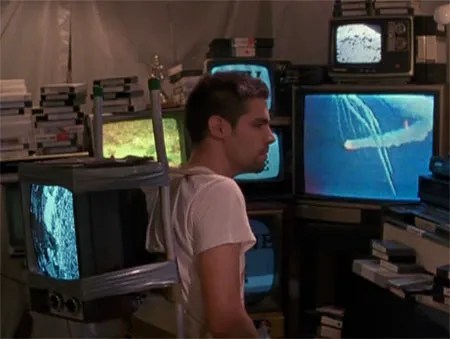
PLOT: Slacker spies on the aimless exploits of the slackers of Austin, TX; the camera follows one character for a few minutes, then veers off to chase another through a series of comical, philosophical, and absurd vignettes involving hit-and-run drivers, elderly anarchists and video fetishists.

Still from Slacker (1991)

WHY IT WON’T MAKE THE LIST: Slacker is a seminal, interesting, and at times incisive storytelling experiment, but it’s of interest to weirdophiles mainly as the spiritual prequel to Waking Life, which is virtually Slacker remade as a dream.

COMMENTS: The batty cast list—credited characters include “Dostoevsky Wannabe,” “Recluse in Bathrobe” and “Hit Up for Cigarettes”—accurately reflects the mix of mundanity and eccentricity on display in writer/director Richard Linklater’s slice-of-life tour of the coffee shops and crash-pads and on the fringes of Austin, Texas in 1991. Slacker is a character study of the subculture of bright but unambitious dropouts and unemployed postgrads bent on extending their undergrad lifestyles that exists in every college town. At the time of its release it was seen as emblematic of “Generation X”‘s alienation and withdrawal from mainstream culture, but in reality this Bohemian substrata of unmotivated aesthetes and anti-establishment hedonists has always been with us under various names (if the movie had been made in 1291 in Saint-Rémy-de-Provence it would have been entitled Goliard). For this peripatetic essay Linklater borrows the elegant but seldom used narrative device invented by Luis Buñuel for The Phantom of Liberty: two characters walk down the street discussing whether they should leave the country, then the cameraman suddenly gets bored and starts following a man who enters a coffee shop where an insane woman advises him that he should “never traumatize a woman sexually,” then decides instead to see where the guy who just entered the shop wearing a bathrobe is headed to, and so on. The result is a series of vignettes which are occasionally funny, occasionally disturbing, and often repetitive, but which capture a peculiar, laid-back, mad energy of a particular place at a particular point in time. Still, as the film’s oldest character rhapsodizes when remembering Charles Whitman, “this town has always had its share of crazies—I wouldn’t want to live anywhere else.” Memorable characters range from the UFO enthusiast who accosts passersby to explain his theory that we’ve been on the moon since the 1950s to the tomboy who’s looking to fence stolen celebrity gynecology artifacts, cheap. Linklater, who delivers the first of the film’s many discursive monologues himself in the role of “Should Have Stayed at the Bus Stop,” shows an attitude of fond disdain for a town where everyone sleeps in late and is working on an unfinished novel or playing in an unsigned band. The director may have arisen out of the Austin milieu, but if he’s a slacker, then he’s a type-A personality slacker; he’s obviously a much harder worker than the guy who earnestly muses “who’s ever written a great work about the tremendous effort required not to create?” over a cup of cappuccino.

If Slacker has one downside (besides excusably spotty acting by the amateur cast), it’s that the movie turns repetitive and arguably outstays its welcome. Somewhere between twenty and forty-five minutes in we start to get the picture; although the UFO guy and the JFK guy have totally different obsessions, ultimately they’re both just proselytizers with a passion for explaining stuff we don’t care about to us in ridiculous detail. The overall portrait Linklater manages to paint is still very impressive; Slacker may be the most passionate and invigorating movie about doing nothing ever made.

On a personal note, I was lucky enough to see Slacker in Austin, TX in 1991 in a theater in a strip mall (I lived in Dallas at the time but had a friend attending UT with a couch I could crash on). The movie, which was playing nowhere else in the country, had been held over for a second week, and the afternoon matinee showing was standing room only; everyone in the audience but me probably had a friend or two who was an extra in it. I had an aisle seat; a middle-aged woman came in late and stood next to me during the entire show, shooting me nasty looks as she shifted from foot to foot. I recall thinking it ironic that the Austinite had to stand through the whole performance simply because she had slacked off on getting to the show on time.

WHAT THE CRITICS SAY:

“…funny, surreal and weird… Linklater traces the dehumanized weirding of America — as collectively defined by David Lynch, Errol Morris, Jim Jarmusch and others. But he does it with a detached, yet sympathetic sense of irony.”–Desson Howe, The Washington Post (contemporaneous)

(This movie was nominated for review by nicolas, who suggested that all of Linklater’s films were “pretty weird and deep with one or two exceptions.” Suggest a weird movie of your own here.)