Category Archives: List Candidates

BORDERLINE WEIRD: THE BLACK CAT (1934)

The Black Cat has been promoted onto the List of the 366 Best Weird Movies ever made. Please make comments general comments about the film on the official Certified Weird entry.

Recommended

DIRECTED BY: Edgar G. Ulmer

FEATURING: , Bela Lugosi

PLOT: A young couple find themselves caught between the machinations of a doctor bent on revenge and a mad engineer in the latter’s Art Deco mansion, built on the graves of the soldiers he sold out in a World War I battle.

Still from The Black Cat (1934)
WHY IT’S ON THE BORDERLINEThe Black Cat has the cadence of a nightmare.  Its shadows haunt the mind long after the DVD clatters out of the tray. Still, as impressive as the movie’s evocation of corruption masked by civility is, it’s highly creepy but only mildly weird; it remains to be seen whether it’s eccentric excellence will overcome it’s somewhat suspect surreality and catapult it onto the List.

COMMENTS:  Today, The Black Cat looks like a cult film.  In the popular memory it’s almost never mentioned alongside the Universal horror classics Frankenstein (1931), Dracula (1932), and The Wolf Man (1941), but “those in the know” sing its praises to the uninitiated: The Black Cat is a forgotten Expressionist classic, too cool for the masses, a film that had to be resurrected from oblivion by the cinematic savants at Cahiers du Cinema who recognized its neglected genius.  Truth be told, however, The Black Cat, which teamed up terror titans Bela Lugosi and Boris Karloff for the first time, was a huge box office hit in 1934.  Despite reviews from The New York Times, Variety,and Time that ranged from dismissive to near-scathing, the film was a blockbuster, Universal’s highest-grossing release of the year.  Through modern eyes—with its daring pre-code perversity and its disjointed, dreamlike rhythms—The Black Cat looks like an ahead-of-its-time oddity we assume musty old timers would have misunderstood, but perhaps audiences in 1934 were hipper than we give them credit for.

At the time, the two rising horror stars were the main draw, and they acquit themselves admirably.  Returning to wreak revenge on the man who wronged him after spending 15 years in a WWI prisoner-of-war camp, Lugosi’s Dr. Vitus Werdegast makes an unlikely, suspect hero.  He’s a raw and damaged bundle of obsessions and phobias hidden underneath a suave, aristocratic exterior and filtered through a thick Hungarian accent.  Lugosi has his impressive moments, as when he loses his mind (and, temporarily, his grasp of the English language) in the film’s startling climax, but Karloff outshines him, turning in one of his finest performances as villainous architect Hjalmar Poelzig.  Initially glimpsed as a menacing shadow rising mechanically from his bed, when he steps into the light we see a frowning, grim faced man with a diabolically angular haircut, draped in black robes.  Karloff’s every motion is cold and calculated, detached and almost inhuman: he hangs back, animated only by the occasional spasm of evil (as when he reveals his hidden lust for the heroine by thrusting forth his hand and tightly gripping a nude figurine in the foreground while watching her kiss her husband).

Vitus and Poelzig play a cat-and-mouse game, dramatically demonstrated in an oddly conceived chess match for the soul of the heroine.  The backdrop before which they fence—Poelzig’s gleaming Bauhaus mansion, full of odd angles, deep shadows, and hidden rooms, including one with twisted crosses and jutting angular pillars before which he conducts his rites dedicated to Lucifer—lends their jousting an aura of  strangeness.  Karloff’s haircut is almost an Expressionist set of its own.  There’s no literary connection to Edgar Allan Poe’s psychological horror story “The Black Cat,” but the beautiful, flitting imagery and tone of repressed evil evokes Poe’s opiated style, and there is a literal black cat who pops up inexplicably on occasion, almost as an afterthought, to terrify the phobic Lugosi.

The Black Cat is full of arresting images: corpses preserved and encased in glass boxes, Lugosi recoiling before the giant shadow of the black cat, Karloff conducting a Black Mass.  The plot, on the other hand, is fragmented; it lurches forward without clear explanation  (the company hardly reacts when Lugosi launches a conveniently placed throwing knife at the pesky feline; the unexplained swoon of a female Satanist allows Lugosi to turn the tables on Karloff).   At one point Poelzig asks Vitus, “of what use are all these melodramatic gestures?,” a question he could well address to the movie itself.  The answer, of course, is to provide pure atmosphere: an atmosphere of psychic repression and elegant perversity, full of hints of necrophilia, sex slavery, incest, mass murder, and other European decadences.  The combination of powerful images and loose narrative connections gives the film a choppy, nightmarish feel that works even better in the memory than it does while you are watching it, and accounts for the weird feeling The Black Cat generates in susceptible viewers.

Director Edgar G. Ulmer apprenticed under F.W. Murnau and worked as an uncredited set designer for Fritz Lang on Metropolis, among other projects.  Set to be a big name helmer after the success of The Black Cat, rumor has it that Ulmer indulged in an affair with the wife of a powerful Universal producer and was exiled to the poverty row studio PRC.  There, he turned out workmanlike B-movies with titles like Girls in Chains and Isle of Forgotten Sins before creating another minor classic, the grimy and effective low-budget noir Detour (1945).

WHAT THE CRITICS SAY:

“…nutty, nightmarish melange… a crepehanger’s ball.”–Pauline Kael, The New Yorker (retrospective)

For another opinion and further background on the film, see Alfred Eaker’s Edgar G. Ulmer’s The Black Cat.

BORDERLINE WEIRD: THE NIGHTMARE BEFORE CHRISTMAS (1993)

AKA Tim Burton’s The Nightmare Before Christmas

Recommended

DIRECTED BY: Henry Selick

FEATURING: Voices of Chris Sarandon, Danny Elfman, , Ken Page

PLOT: Jack Skellington, the Pumpkin King of Halloweentown, discovers Christmas and tries to recreate it, with ghoulish results.

Still from The Nightmare Before Christmas (1993)

WHY IT’S ON THE BORDERLINE: As a children’s film, The Nightmare Before Christmas has a high hurdle to overcome. Since it’s aimed at kids, the movie is permitted to indulge in imagination and fantasy, so long as it uses a conventional story framework and takes a stab at conveying a useful moral lesson. Nightmare has a great, morbid motivating idea and is a triumph of macabre art design, but at heart it doesn’t stray very far from the childrens’ film format. If it’s eventually to be counted amongst the weird, it will be solely for its incidentals and visuals.

COMMENTS: The opening song introduces us to the ghastly denizens of Halloweentown, including the expected assortment of witches, vampires and ghosts, but also a creature with black and white striped snakes for fingers, the “clown with the tearaway face,” and a two-faced mayor with a spinning top for a head and a freakishly phallic stovepipe hat. This legion of scary weirdos are ruled over by Jack Skellington, an elegant but spindly skeleton in a pinstripe suit. A grim gray pallor hangs over the town, which features an Expressionist pumpkin patch/boneyard with slanted tombstones and a curlicue hill permanently posed before a giant yellow moon. Bored with the repetitive routine of  Halloween, Skellington seeks new vistas and finds one when he stumbles onto Christmastown, an eye-popping festival of lights and toys set among blinding white snowbanks ruled over by a jolly fat man; the town provides the perfect visual and spiritual contrast to gloomy Halloweentown. A holiday architect looking for a new challenge, Jack decides to “take over” Christmas (incidentally kidnapping Santa Claus). After futile attempts to ferret out the meaning of Christmas by dissecting teddy bears and placing crushed ornaments in boiling beakers, Skellington hatches a plan to pose as Kris Kringle and deliver toys himself, which leads to the film’s keystone sequence: a horrific Christmas Eve sleigh ride through a doomed village, where the Santa-suited skeleton leaves ghoulishly inappropriate gifts for Christmastown’s tots, including a severed head and a tannenbaum-swallowing snake. It all ends in disaster, as Jack, who began with the best of intentions, realizes that his amateur staging of Christmas was a Nightmare and that he has to set things right and reaffirm his devotion to the Satanic rites of All Hallow’s Eve. The moral seems to be, attempts to understand other cultures are doomed to failure; stick to your own kind.

The character designs and intricate, almost hidden gruesome details (like the skeletal Halloween cock that crows the dawn) are the triumph of Nightmare. With a couple of exceptions—the bubbly, Broadwayesque “What’s This?” when bemused Jack first discovers Christmastown (“There’s children throwing snowballs instead of throwing heads/They’re busy building toys and absolutely no one’s dead!”) and a deviant number sung by three mischievous trick or treaters who plan to kidnap “Sandy Claws” (“Kidnap the Sandy Claws, throw him in a box/Bury him for ninety years, then see if he talks”)—Danny Elfman’s songs are flat and unmemorable, advancing the plot but not thrilling the ear. The story is also exceedingly thin, even at its trim running time of under 80 minutes. The original concept came from a Burton parody of Clement Moore’s “Twas the Night Before Christmas;” to pad out the running time, a romantic subplot and an antagonist were added. The love interest is Sally, a stitched-together female Frankenstein forever losing her limbs.  She’s constantly scheming to escape her creator, a duck-billed mad scientist with a detachable brainpan who wants to keep her locked in his castle, and she acts as a cautionary voice for Jack, trying to warn him off his insane Yuletide scheme. There’s no spark to their relationship, though, and though their romantic ending is pretty, it’s also pretty meaningless in story terms. The villain, Oogie Boogie the Boogeyman, is another wonderful character in search of a plot function. A burlap sack stuffed with creepy crawlies, gruff Ken Page gives him a 1920s boogie-woogie singer’s voice, and he makes a hell of a hellish impression. But he’s introduced late and has no real motivation: it’s unclear why he thinks that bumping off Santa Claus will help him unseat Skellington as king of Halloweentown. He pads the film, but his main purposes are to set up an unnecessary, anticlimactic action sequence for the finale, and (more importantly) to provide Selick the opportunity to build another magical set. And Oogie’s lair is it’s own freaky, fun world: his hideout is casino themed, with living gunfighter slot machines and worms crawling through the pips of dice, and it’s bathed UV lights to give the puppets an eerie glow. Though the script could have done much more to make him a meaningful antagonist, the awesome visuals this boogeyman inspires are reason enough for him to take up space in Nightmare‘s world. The entire story takes a back seat to the cute, Gothic animation, so why should Sally and Oogie Boogie be any different?

The idea for Nightmare was originally sketched out by Tim Burton at Disney Studios, before they fired him for “wasting company resources” by making Frankenweenie. After the director found success outside the Magic Kingdom, Disney was willing to work with him again, and he served as Nightmare‘s producer and even got his name in the title. In a case of history repeating itself, the studio again found the finished work too morbid and were afraid it would frighten young children, so they released it under their Touchstone subsidiary. Despite rave reviews, Nightmare was not an immediate success, but it has found a cult audience on video. Disney has since fully re-embraced the movie, removing all traces of the old Touchstone logos and prominently slapping the Disney name back on the prints, just as if they had been 100% behind it before it became a hit.

Related: Alfred Eaker’s A Few Odd Yuletide Favs.

WHAT THE CRITICS SAY:

“[Burton] pulls adult minds down to the surreal darkness of childish imagination — where the real nightmares are. But through Burton’s eyes, these dark dreamscapes aren’t bad places at all. In fact, they’re quite wonderful.”–Desson Howe, The Washington Post (contemporaneous)

RECOMMENDED AS WEIRD: A TOWN CALLED PANIC [PANIQUE AU VILLAGE] (2009)

DIRECTED BY: Stéphane Aubier and Vincent Patar

FEATURING: Stéphane Aubier, Bruce Ellison, Vincent Patar

PLOT: The childish Cowboy and Indian decide to build their roommate Horse a brick

Still from A Town Called Panic (2009)

barbecue for his birthday, but after accidentally ordering 50 million bricks instead of just 50, they launch a spectacular and hilarious chain of events involving sea creatures, catapulted farm animals, music lessons, burning lava, mad scientist overlords, and a giant robotic penguin.
WHY IT SHOULD MAKE THE LIST: The inexplicable premise sets up a story that escalates into weirder and weirder territory as it progresses.  A lively assemblage of old-fashioned model figures rendered in clay prance about a candy-colored landscape sporting Looney Tunes-worthy voices and completely nonsensical motivations.  Their experiences get funnier as they become more surreal, with frequent disregard of the laws of physics, a range of goofy outbursts, eclectic personalities, and unpredictable changes of scenery.  As a film it’s immensely enjoyable, but completely impossible to explain.

COMMENTS: Belgian writers/directors Stéphane Aubier and Vincent Patar adapted A Town Called Panic from their television series starring bickering housemates Horse, Cowboy, and Indian, featuring a wide variety of shenanigans.  In the beginning of this movie, the trio transform a few normal life experiences (running a farm, finding a birthday gift, taking music lessons) into uncategorizable slices of a child’s playtime.  As it moves along, the small connection to reality dissipates in trips to the center of the earth, Antarctic mad science, and underwater department stores.

The animation is incredibly playful and dynamic, and the sets look like they jumped out of a Dr Seuss illustration.  The characters, modeled in clay to resemble plastic action figures, move around with jerky large movements and detailed fine ones, propelling the film forward with an insane energy.  No matter what is happening on screen, it is extremely fun to watch, as well as an impressive technical achievement.  The bursts of garage rock soundtrack perfectly suit the manic atmosphere of the visuals.

It’s immensely funny, and chock-full of surrealistic imagery and wacky surprises.  Many of the voices are high-pitched to match the rapid, anxious dialogue.  The story is crazy, but somehow it all makes sense within the parameters of this imaginary world that Patar and Aubier have created.  It fits that when a house is crushed by a mountain of bricks, it just flips upside down and hangs underwater, or that falling down a deep crevice leads to the earth’s molten core.  Once you’re into the swing of things, just sit back and allow the insanity, cartoon violence, and non sequiturs to unfold across this unplanned epic journey.

While the script is notably zany, it’s quite smart and thoughtful, with various cute details and references that create a good balance between the physical comedy and dialogue.  The characters are adorable and surprisingly relatable in their own ways, offering such delightful antics and madcap conversations that—when taken in together with the bold visuals—multiple viewings are required to fully appreciate the film’s humor and imagination.

WHAT THE CRITICS SAY:

“Made with an anarchic, anything-goes spirit, this is truly a film, not to mention a town, where you never know what’s going to happen next.” – Kenneth Turan, Los Angeles Times (contemporaneous)

NOTE: This review is also published in a slightly different form at Film Forager.

BORDERLINE WEIRD: SPIDER (2002)

366 Weird Movies may earn commissions from purchases made through product links.

DIRECTED BY: David Cronenberg

FEATURING: , Miranda Richardson, Gabriel Byrne

PLOT: A disturbed man is released from a mental institution and sent to live in a halfway house. While there, he traces back to his childhood to remember a troubled past and the tragic events that shaped his current mental instability.

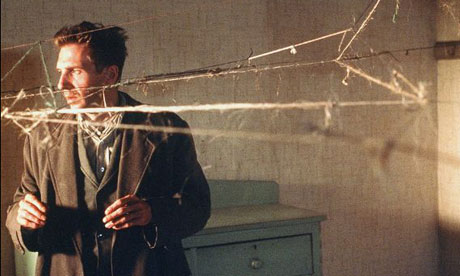
Still from Spider (2002)

WHY IT’S ON THE BORDERLINE: To compile a list of the weirdest movies ever made, one would be hard-pressed not to include Cronenberg’s entire oeuvre.  Here, the director eschews the “body horror” that encompassed much of his earlier films and focuses solely on the deterioration of the mind. While this can be just as grotesque as horrors of the flesh, the journey can get so convoluted at times that the weirdness teeters on a fulcrum. Eventually, the confusion weighs too heavy and topples the weirdness into mere befuddlement.

COMMENTS: A cinematic pet peeve of mine was surely tested with this movie. Being American, I shouldn’t have to struggle listening to an English film (i.e., UK-Great Britain). We speak the same tongue, albeit with some slight variances in words and phrases. The cockney accents in this film can get so thick at times I considered reaching for the subtitle button on the remote. To make matters worse, the film focuses on the character of Spider (Fiennes) who mumbles and spews gibberish as a means of communication.  Actually, most of his conversations are only with himself. I loathe having to toggle the volume levels up and down. I had to do this for the duration of the film. Aside from this aggravation, Spider is not a bad film; nor is it a great one.

I loved the approach taken in the opening credits. Various textiles and walls are displayed artistically with corrosion and chipped paint, each frame containing a pattern or form that is open to interpretation. It is set up to resemble Rorschach inkblot tests used in the psychiatric field (I must be going mad myself because all I see in them are cool looking demons). These opening credits are effective because they prepare the viewer for a movie that deals with an imbalanced mind. What we perceive to be truth is certainly going to be skewed from the perspective of a protagonist with warped sensibilities.

Spider enters the picture slowly, exiting a train and returning onto the streets of  London. Continue reading BORDERLINE WEIRD: SPIDER (2002)

BORDERLINE WEIRD: STINGRAY SAM (2009)

DIRECTED BY: Cory McAbee

FEATURING: Cory McAbee, Crugie, David Hyde Pierce

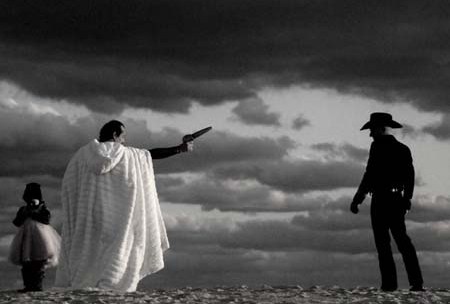
PLOT: Ex-con/lounge singer Stingray Sam grudgingly joins his former partner the Quasar Kid

Still from Stingray Sam (2009)

in a quest to save a little girl, with frequent musical breaks featuring songs by The Billy Nayer Show. David Hyde Pierce narrates intermittent segments of animated collage that explain their futuristic society.

WHY IT’S ON THE BORDERLINE: It’s a wacky, memorable space musical with western flair, crisp black and white visuals, and imaginative, nonsensical notions of the future, but all that can be found in slightly more intriguing form in McAbee’s earlier work The American Astronaut, which better serves The List by being a feature-length movie (Stingray Sam is an hour-long serial).  But it certainly contains enough of its own charm and inventiveness to stand alongside its predecessor, and it shouldn’t be wholly dismissed just yet.

COMMENTS: Conspicuously sponsored by the fictional “Liberty Chew Chewing Tobacco” and excitedly asking what our heroes will be up to next at the end of every episode, Stingray Sam is a fitting tribute to old-fashioned serials, keeping many of the western and sci-fi elements of such shows while incorporating a wealth of inspired new ideas. There are several weird inventions and convenient technologies to place it in the futuristic space setting, but the sets are wonderfully low-key and familiar. McAbee’s incredible charm seeps through the screen in everything from his performance to the silly dialogue, aided along by the excellent musical numbers and gorgeous animated collage sequences.

By the time the second episode’s explanatory animated piece details the upper class invention of gender-determining drugs, male-on-male baby-making, and a delightful portmanteau naming system, what started out as a fairly straightforward quest to rescue a maiden quickly evolves into a madcap journey through McAbee’s unpredictable imagination.  The layers of references, backstory, character, and pseudo-science wrapped up in a musical comedy-adventure are impressively nuanced.  David Hyde Pierce’s articulate and tongue-in-cheek narration (which delights particularly in the word “Durango”) offers a range of ideas, inventions, and happenings that don’t always make sense but never fail to spark interest.  The first time around some of this information goes by too quickly, as viewers are hit with so many novelties and humorous animation at once, but subsequent watches prove McAbee’s involved story and unique futuristic vision to be unavoidably successful, if preposterous.

With catchy tunes that probably sit somewhere in the rock and roll spectrum yet manage to remain without a definable genre classification, The Billy Nayer Show (who also comprise several main cast members) craft a fun soundtrack that usually leads to manic dancing and wide smiles.  Each episode contains one song, which never encroaches on the action or comedy (and often increases the latter), along with a curt opening theme that reminds us “Stingray Sam is not a hero, but he does do the things that folks don’t do that need to be done.”  They serve to make the strange story even more memorable, describing stingray babies, entertainment on Mars, and peg-legged fathers, and add an extra element of goofy joy to the work.

Looking past the wonky sci-fi premise and western trappings (complete with cowboy hats and “yes ma’ams”), the heart of Stingray Sam lies in the unbridled glee the entire project exudes. As Sam, McAbee swings his way into everyone’s hearts with his jerky dance moves, easy smile, and affable demeanor, while Crugie keeps his cool as the Quasar Kid, offers some gruffer tunes, and frequently betrays a weakness for olives.  Their intricate secret handshake is just icing on this lovable, quirky cake of a partnership.  The beleaguered faces of many supporting cast members seem somehow twisted and plasticine, suiting the off-kilter atmosphere perfectly as they help or hinder our heroes’ proceedings.  There’s not much else like Stingray Sam.

Stingray Sam is currently only available directly from director Cory McAbee at his personal site (click here to purchase).  If the film follows the marketing plan of The American Astronaut, it will eventually be released via normal distribution channels as well.

WHAT THE CRITICS SAY:

“Sounds weird? You bet your ass… Cory McAbee manages to cram enough story and song in to each episode, each more ridiculous than the other and still come out with a coherent story and structure.”–Swarez, Twitchfilm