All posts by Alex Kittle

I like ambiguous video and installation art, experimental comic books, screaming lady bands, and of course, delightfully strange and surreal films. I dig regular stuff, like pizza and The Kinks, too. I also make and sell film-inspired art: http://www.etsy.com/shop/guiltycubicle

CAPSULE: REDLINE (2009)

This review first appeared in a slightly different form at Film Forager.

DIRECTED BY: Takeshi Koike

FEATURING: Takuya Kamura, Yû Aoi,

PLOT: Set in a distant future and moving between multiple planets, this is a fairly simple tale of a major road race taking place on a militaristic planet that doesn’t want it there.  Racers “Sweet” JP, the big-haired underdog, and Sonoshee, a single-minded gearhead, are the main focus of the story.

WHY IT WON’T MAKE THE LIST: Armed with an eclectic cast of alien characters and a host of over-the-top shenanigans, Redline might come off as “weird” to someone unfamiliar with anime, but I’d say the stranger humor and visuals fit in pretty squarely with other properties of the genre.  It’s an imaginative and enormously entertaining film, just not especially Weird.

COMMENTS:  The future laid out in Redline is certainly an intriguing one, if completely ludicrous.  Hot shot reckless racer JP makes it to the titular big interstellar race, held on a militaristic planet that hasn’t consented to be the host.  He cozies up to Sonoshee, a cute green-haired lady who is one of the most serious and intimidating drivers there, and together the two attempt to navigate a strange obstacle course against alien competitors (some with inexplicable magic powers) and large-scale weaponry.  Squeezing in ESPN-like profiles of various racers—from an experienced cyborg who’s fused himself with his machine to a pair of scantily clad pop stars hailing from a magical princess planet—there’s some room for satire, too.

This movie is essentially all spectacle and adrenaline, with very little comprehensible or meaningful plot holding it together, but it’s not like the filmmakers are operating under any pretense of depth.  They’ve created a gorgeously animated, pumped-up sci-fi thriller, and that’s all that’s needed!  The characters are slick, and the vehicle designs slicker, with plenty of exaggerated personalities and colorful attachments for an engaging race line-up.  Sure, there’s a silly romantic/secret-past subplot thrown in there, but it’s never taken very seriously.  Various secondary stories are introduced, such as the military planet’s worker resistance and JP’s involvement in race-fixing, but the race itself remains the focus and it’s easy to forget that anything else is going on (the script certainly seems to by the end).  The set-up can be confusing at times due to an influx of minor characters and limited explanation of the obviously complex political and environmental structures.

The strengths of Redline lie almost completely in its visuals and fast pacing.  The dark shading and bright color schemes, the over-the-top hair styles and imaginative alien creatures, the quick-cut-editing and crazy landscapes: it’s all fantastically sweet eye-candy, set to an ecstatic musical score.  It’s violent but fun, and there’s probably political commentary thrown in there somewhere.  The script is cheesy at points, but vaguely self-aware.  It’s just a very cool movie all around, rarely letting up for a moment in its quest to assault the senses with psychedelic imagery and revving engines.

WHAT THE CRITICS SAY:

“One of the most visually spectacular toons in recent years, pic is a thumping ride for fanboys, but the script’s underdeveloped central romance and the fizzling out of intriguing plot threads will impede wider acceptance… [Plays] like a twisted combo of “Death Race 2000,” “Speed Racer” and a ’50s hot-rod movie on steroids…”–Variety (contemporaneous)

CAPSULE: MELANCHOLIA (2011)

Recommended

DIRECTED BY:

FEATURING: , Charlotte Gainsbourg, , , ,

PLOT: A young woman grapples with serious depression on her wedding day, causing rifts i nher already-tempestuous family relationships. Meanwhile, a planet known as Melancholia is making its way towards Earth.

WHY IT WON’T MAKE THE LIST: Von Trier’s rumination on the end of the world is for the most part surprisingly understated, incorporating surrealistic imagery here and there but primarily relegating itself to a realistic study of a family in crisis with a science-fiction background.

COMMENTS: Opening with breathtaking slow-motion shots of a dreamlike apocalypse set to a bombastic Wagner score, Melancholia begins with the promise of something literally earth-shattering. Its ambition and scope seem far-reaching and all-encompassing, much like Malick’s confused 2011 offering The Tree of Life. Shifting to close-quarters shaky cam as the focus moves to new bride Justine’s wedding party, Melancholia becomes an investigation of her debilitating depression and how most of her wealthy, bitter family is unsympathetic. The second half keeps the setting of an isolated mansion inn, but puts the spotlight on sister Claire, whose extreme anxiety is increased by the foreboding presence of the incoming planet.

As the promise of a visually and thematically grandiose event lingers over the film’s proceedings, von Trier endeavors to first fully establish his characters and their relationships. We spend a lot of time with these people, seeing their connections and lack thereof, slowly understanding their underlying flaws and neuroses. The looming threat of complete world destruction is barely acknowledged during the first half as the script is absorbed in Justine’s efforts to hide her disease and Claire’s concern for keeping up appearances. It’s meandering and slow-moving, but the strong lead performances from Dunst and Gainsbourg—along with a charismatic supporting turn from Sutherland—are engaging enough to keep things interesting until the apocalypse strikes.

Because we spend so much time with these characters beforehand, their plight at the end is felt all the more acutely. Seeing how these women lived—raised in wealth but suffering internally (all very Salinger-esque)—is such an intimate experience that it’s hard to not feel involved personally. The planet Melancholia itself is truly an awesome sight, eerie and intimidating, seeming to affect the actors internally and causing a few mouths to open in the audience.  Of course, the ear-shattering Wagner orchestration helps build the intensity.

Weird movie fans will surely appreciate the gorgeous surrealistic imagery peppered throughout, but at its heart Melancholia is a serious examination of mental illness and family ties in the shadow of a cataclysmic event.

G. Smalley adds: Melancholia is an intensely metaphorical movie, but it is essentially a more conventional, dramatic reworking of the theme of clinical depression vonTrier explored in the weirder, more outrageous Antichrist.  The two movies contain common themes and a similar look (I was surprised to discover that they had different cinematographers), but they are so different in their approach that I’m not sure liking one will predict how you’ll react to the other.  In fact, I suspect that many of the people now singing the praises of Melancholia were the ones complaining the loudest at Antichrist and von Trier’s descent into “torture porn.”  Melancholia is strong throughout, but I found the opening the most astounding part.  It’s a six-minute super slow motion surrealistic montage that manages to enrapture while featuring characters and events about whom we know nothing yet.  It opens with a shot of a devastated-looking Kirsten Dunst with dead birds falling in the background, and includes what may be my favorite image of the year: Dunst trudging through a forest glade in her white wedding gown, dragging behind her a train of huge vines tied to her ankles and waist.  The slow motion photography is technically amazing; sometimes you believe you’re looking at a still photograph until you see a foot lift, and at other times it seems figures in the foreground and background are moving at different rates.  It’s thrilling (to me, at least) to see a director who once advocated stripping film down to its basics (the short-lived “Dogme 95” movement) now embracing the full operatic range of cinematic tools.

WHAT THE CRITICS SAY:

“In many ways this bizarre, nihilistic meditation is a dreary, redundant, pretentious bore… On the other hand, the magnificent, ethereal visuals/special effects are haunting, particularly the opening collage which compresses the entire story.”– Susan Granger, SSG Syndicate

LIST CANDIDATE: FATHER’S DAY (2011)

This review first appeared in a slightly different form at Film Forager.  Alex Kittle’s complete coverage of the Toronto After Dark festival can be found here.

DIRECTED BY: Astron-6

FEATURING: , , , Mackenzie Murdock, Amy Groening, Lloyd Kaufman

PLOT: A crazed cannibalistic killer goes after fathers in his rape/murder spree.  One-eyed assassin/maple syrup maker Ahab, young priest Father John Sullivan, paranoid streetwalker Twink, and mystery-solving stripper Chelsea all seek revenge, teaming up for a strange and scattered mission.

WHY IT MIGHT MAKE THE LIST: An eye-patched vigilante, a topless stripper with a chainsaw, a nearsighted cannibal rapist, incest, demonic possession, trips to both heaven and hell, a non sequitur commercial for low-budget sci-fi “Star Raiders,” hallucinogenic berries: Father’s Day has a lot of weirdness to recommend it. It starts off as a fairly standard (and insanely gory) grindhouse throwback, but evolves into a bizarre and fantastic adventure that just might be weird enough for the List.

COMMENTS:  Known for their impressive output of horror and comedy shorts, Winnipeg-based collective Astron-6 combines DIY filmmaking with a sick sense of humor and unadulterated love for 80’s straight-to-video schlock.  After making a trailer for the fake exploitation flick “Father’s Day,”  offered the group $10,000 to produce a full-length feature of the concept.  At the start it seems like a standard, and completely gruesome, grindhouse throwback with grisly close-ups of penis mutilation and sickening rape/murders set alongside over-the-top character archetypes and an enthusiastic score.  As Ahab (Adam Brooks), Father John (Matthew Kennedy), and Twink (Conor Sweeney) team up in the wake of several close-to-home father murders, it begins to take a turn for the ludicrous and eventually plunges into all-out wacky fantasy, seeming to forget its initial narrative and stylistic leanings—and becoming better for it.

With real pig intestines, buckets of fake blood, and a well-laid green screen, Father’s Day maintains a dark, grungy aesthetic that works well with its 70’s appropriations while exuding DIY innovation that sets it apart from some of its peers.  Steven Kostanski’s stop-motion hell creations and an extended trip around the world for Father John are among the many segments that vary in style and tone.  There’s even a goofy commercial for a fake Star Wars rip-off thrown in about two-thirds of the way through (the feature itself is introduced as a “midnight movie” tv program).  Astron-6 seems to have hundreds of ideas and little interest in streamlining, resulting in a surprisingly dense 99 minutes as myriad references, off-kilter jokes, side-trips, and subplots arise and descend.  Luckily, most of them work, but the ones that don’t result in some unevenness, especially in the overall tone.  The noticeable shift towards the middle is somewhat jarring, but not a dealbreaker.

Father’s Day may be sick and twisted in many ways, but it manages to be most of all fun.  The Astron-6 gang looks like they’re having a blast just being silly together as the plot becomes more and more ridiculous.  The whole cast is great, injecting equal amounts of parody and imagination into their roles, and I especially enjoyed the main three male leads, who have excellent comedic chemistry.  The film’s biggest flaw is its tonal inconsistencies, but for many viewers the inclusion of so many ideas and exploitation references will likely be appreciated.  Astron-6 decided to really go all-out for this film, and by holding nothing back they will impress many and alienate those who wouldn’t get it anyway. And I have a feeling they’re fine with that.

Father’s Day official site.

WHAT THE CRITICS SAY:

“With a surreal plotline, exceptional acting, a host of hilarious one-liners, and a large, beautiful cast of many many almost naked women this is one highly recommended giggle & gorefest you really shouldn’t miss.”–Rick McGrath, Quiet Earth (festival screening)

CAPSULE: BUNRAKU (2010)

DIRECTED BY: Guy Moshe

FEATURING: , Gackt, , , Ron Perlman

PLOT: Set in a post-apocalyptic future that outlaws guns but promotes copious amounts of sword-heavy battles, Bunraku follows two mysterious lone strangers—a card-playing cowboy (Hartnett) and a pacifistic Japanese warrior (Gackt)—as they strive to take down the all-powerful crime lord (Perlman) who controls the city.

Still from Bunraku (2010)
WHY IT WON’T MAKE THE LIST: The visuals are stunning and innovative and the effects are wildly impressive, but the cookie-cutter sci-fi/western tale and clumsy script hold it back from approaching true Weirdness.

COMMENTS: Introduced by a gorgeous animated sequence involving puppetry (which is also the only time the film’s title comes into play), Bunraku takes place in a type of future many films have already established. There was a world-wide nuclear war, everything was destroyed, and human beings build the world back up to create a lawless, decrepit landscape where everyone fights all the time.  The all-knowing, presumably winking narrator is upfront about what type of story this is, making cracks about the type of mysterious loners always found in places like these.  This self-awareness pervades the script and certainly makes the film more digestible.

The set-up and story don’t make a lot of sense, with bouts of under- and over-exposition that either confuse or bore.  Hartnett’s Drifter is stiff and stern, with no emotion and no reason for the audience to care about him.  Gackt’s Yoshi is likable enough (and magnetically androgynous), but like Drifter he’s so enigmatic there’s barely any character left for the actor to embody.  They’re one-dimensional archetypes to the fullest extent of the word, but Moshe seems fully aware of this. Woody Harrelson brings some levity and charisma to The Bartender, a friendly but heartbroken working man who doesn’t take sides but finds himself pulled into Drifter and Yoshi’s war against Nicola (Perlman), the vicious and world-weary “Woodcutter.”  Demi Moore is extremely out of place as the crime lord’s resentful woman, but her role is small enough.

Luckily there is plenty to distract from the weak characterization!  Bunraku is chock-full of fascinating visuals and downright exciting fight scenes.  The lighting is over-saturated and the locations are highly stylized, with cut-paper backgrounds and a few Caligari-esque sets.  A sizable chunk of the running time is devoted to intense action sequences, with an inexhaustible amount of literal Redshirts ready to be killed by our heroes (led by Kevin McKidd as Killer #2, easily the weirdest character in the film) in elaborate group scenes.  There are fistfights, swordfights, polefights, circusfights, axefights, and one cool car chase. The effects are excellent, transitioning from comic-book style animation to CG enhancements to miniatures with a believable flow.

For all its thrilling action and memorable visuals, Bunraku suffers from an overcomplicated yet under-explained plot and an inexcusably long running time.  It could easily have lost 30 minutes and become tighter, better paced, and more enjoyable.  The writing is hit and miss, with some really sly moments that show Moshe’s self-awareness and sense of fun, and others that are over-serious and dull.  Aside from its looks, the film doesn’t do anything different but it doesn’t mean to, so it’s forgivable.  It’s just a fantastical, stupid romp with the colors of a 1950’s musical and the stylized gore of a Frank Miller comic.  What’s not appealing about that?

WHAT THE CRITICS SAY:

“Extremely cool-looking in the manner of ‘Sin City,’ but clumsily staged, slackly acted and mind-numbingly dull, Israeli director Guy Moshe’s English-language fantasy is set in a future when guns, and apparently coherent conversations, have been outlawed.”–Lou Lumenick, New York Post (contemporaneous)

CAPSULE: THE FUTURE (2011)

DIRECTED BY: Miranda July

FEATURING: Miranda July, Hamish Linklater, David Warshofsky, Isabella Acres

PLOT: A thirtysomething couple decides to adopt a sick cat in one month, during which time they quit their jobs and try to find ways to make their lives more satisfying. The cat (named Paw-Paw) narrates part of the story from her veterinary hospital cage.


WHY IT WON’T MAKE THE LIST: Populated with just enough flights of fancy to warrant “eccentric” and offering a surprisingly bleak and realistic look at two people on the brink of nervous breakdown while in a crumbling relationship, The Future just isn’t strange enough for a spot on the List.

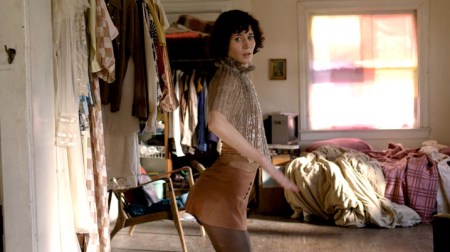
COMMENTS: Though it opens with the creepy, nasally voice-over of Paw-Paw the cat detailing its rescue by a kind couple, The Future spends most of its time with Sophie (July) and Jason (Linklater).  She is an “overqualified” dance teacher for young girls, he works from home accepting tech support calls.  When they decide to adopt a sick cat, their future spreads before them as nothing but caring for it and then reaching old age after it dies.  Sophie tries to motivate herself to make online dance videos but instead finds solace in an affair with a friendly sign-maker.  Jason becomes “open to everything,” accepting a volunteer position with an environmental group and befriending an elderly pack rat.  As Paw-Paw waits patiently, her soon-to-be owners flounder in the face of self-fulfillment with anxiety-ridden freakouts.

Known in the film world for her quirk-filled debut Me and You and Everyone We Know, writer and performance artist Miranda July is developing definite trademarks.  She once again employs experimental voice-over and somewhat stilted scripting for a portrait of white middle-class romance, but this time her characters are more realized and the emotions more focused.  As Sophie and Jason claw their way through individual bouts of near-insanity, a surprisingly touching story unfolds.  For the most part we are looking at this relationship from the outside in, seeing these characters more often apart than together.  Sophie’s uncertain relationship with sign-maker Marshall and Jason’s curious friendship with elderly chatterbox Joe offer insights unseen in their actual interactions with one another.

This is uncharacteristic for me but I actually found most of the “weirder” parts detrimental to the film overall.  The creepy cat narration and puppet paws feel irrelevant and clashing—it doesn’t move the story forward and it doesn’t increase my sympathy for the cat or the couple.  Sophie’s suddenly animated t-shirt also feels out of the blue.  The best offbeat technique is employed towards the end, when Jason literally stops time so he can sort out his feelings about Sophie’s infidelity, and ends up in a sad conversation with the moon.  It’s a neat trick and sets forth an interesting structure for that segment of the film, and serves to highlight Hamish Linklater—an actor often set in supporting roles—as a performer.

There’s a good amount of twee baggage weighing down The Future.  Some of July’s little touches of style and wry humor are fun, but many drag the focus away from the central story unnecessarily.  The writing and characterization just aren’t tight enough.  It is at times a beautiful and heartbreaking film, and even quite funny at others, but viewers need to wade through a lot of excess in order to hit upon the most effective points.

WHAT THE CRITICS SAY:

“‘The Future,’ July’s coy and precious new film, is just oddball enough to be interesting, if not good.” –Peter Rainer, Christian Science Monitor (contemporaneous)