All posts by Gregory J. Smalley (366weirdmovies)

Gregory J. Smalley founded 366 Weird Movies in 2008 and has served as editor-in-chief since that time. He is a member of the Online Film Critics Society, and his film writing has appeared online in Pop Matters and The Spool.

CAPSULE: RAMPO NOIR (2005)

DIRECTED BY: Suguru Takeuchi, Akio Jissôji, Hisayasu Satô, Atsushi Kaneko

FEATURING:

PLOT: Four experimental stories of sex and madness adapted from the works of Edogawa Rampo: a man regrets a rape, a killer strikes through mirrors, a wife cares for a husband who is a human torso, and a limo driver is obsessed with a stage actress.

Still from Rampo Noir (2006)

WHY IT WON’T MAKE THE LIST: We’ll dismiss it for uneveness, although even the best segments probably would not merit inclusion in a list of the greatest weird movies of all time.

COMMENTS: Rampo Noir is more of a series of visual and stylistic calling cards than it is a tribute to the literary talents of Edogawa Rampo (Tarō Hirai, “the Japanese Edgar Allen Poe,” who selected his pseudonym to pay tribute to the American horror/mystery writer). The narratives here are either nonexistent (“Mars’s Canal,” the impressionistic Rampo-inspired first course), slight (“Caterpillar” and “Crawling Bugs”), or founded on dated pseudoscience (“Mirrored Hell”). Of course, one would not sense what made Poe great by watching ‘s Tales of Terror; the four directors here aim at capturing Rampo’s perverse atmosphere (with greater explicitness) rather than showing accuracy to his texts. The results, as might be expected, are all over the map (sometimes within the same segment).

The first film (“Mars’s Canal”) begins with a warning advising your that your disc is not defective. Entirely silent, with deliberately glitchy video, it’s an indulgence by heretofore (and hence) unknown director Suguru Takeuchi. It’s built around one magnificent shot (filmed in Iceland), but even at six minutes long it tries the patience of the average viewer.

In contrast, Akio Jissôji’s “Mirror Hell” is a (relatively) conventional murder mystery, probably the most accessible segment of the omnibus. There is a (somewhat) rational explanation to the mystery of beautiful tea-ceremony teachers who turn up dead, although it does depend on strained early-twentieth century science fiction-style explanations (undiscovered elements with properties that mimic magic, that sort of thing). It also features a Rampo-esque theme that dreams are reality, and that what we think of as life is but a reflection in a mirror, “neither real nor unreal.” It as, as might be expected, filled with multiple mirrors in almost every shot (there’s an interesting composition of mirrors on a beach, each reflecting a different landscape, that evokes a vintage Continental Surrealist painting).

Hisayasu Satô savors the sickness inherent in “Caterpillar.” The story involves the unhealthy relationship between a resentful wife and her war hero husband, now a mute quadruple-amputee, whom she must care for. Satô takes Rampo’s original anti-war parable (which was adapted more accurately in ‘s feature length film) and focuses almost entirely on the salacious sadomasochistic aspects of the story. Like all of the entries, “Caterpillar” is visually superior, but this one lacks a meaningful reason to exist: Satô’s treatment bludgeons the original’s subtleties, and due to a lack of substance in the main tale he introduces an unnecessary character (a nosy collector  who considers the caterpillar a work of art) and shoehorns in a ridiculous appearance by Rampo detective Kogorô Akechi (Asano, reprising his role from “Mirror Hell”). “Caterpillar” may impress some with its perversity, but it doesn’t so as much with the premise it was handed as it should have.

Although this rarely happens in anthologies, in Rampo Noir the best is saved for last. In an inversion of the dynamic we saw with “Caterpillar,” Atsushi Kaneko’s “Crawling Bugs” takes a well-worn idea (the shy, unhinged man obsessed with an unobtainable iconic beauty) and uses style and psychological details to make it feel fresh. There are many odd touches here, from the actress’ bizarre pyramidal hairstyle to alternating inserts of a nebula and an amoeba. While our timid limo-driver suffers from an itchy psychosomatic condition that causes him to feel like he has bugs crawling over his skin, his obsession plays a strange sexual game involving a leech-like bug that crawls over her neck. The glowing forest glade he constructs as an altar to his lady inside of his shabby apartment is a rainbow fantasy refuge that makes us feel as disconnected from reality as he is. “Bugs” is the only segment here that feels like it could stand on its own, and singlehandedly raises the quality of the anthology from “take it or leave it” to “worth watching.”

Tadanobu Asano appears in every episode and is clearly the main domestic draw. Of the directors, only Hisayasu Satô is somewhat known in the West, for exploitative sadomasochistic pink movies like Unfaithful Wife: Shameful Torture (AKA The Bedroom) and Splatter: Naked Blood. Akio Jissôji has made numerous movies not widely seen outside of Japan, but Suguru Takeuchi and Atsushi Kaneko have done nothing of note before or since this.

WHAT THE CRITICS SAY:

“Rampo Noir’s hallucinogenic approach to narrative and visuals is nothing short of invigorating.”–Jasper Sharp, Midnight Eye (DVD)

(This movie was nominated for review by “Kat,” who said she was “amused, intrigued and sickened; sometimes simultaneously” by the experience. Suggest a weird movie of your own here.)

226. CONSPIRATORS OF PLEASURE (1996)

Spiklenci Slasti

366 Weird Movies may earn commissions from purchases made through product links.

“Conspirators is actually a film about liberation, and about gaining a freedom.”–Jan Svankmajer explaining why he considered Conspirators his most Surrealistic film up to that point

Recommended

DIRECTED BY: Jan Svankmajer

FEATURING: Petr Meissel, Gabriela Wilhelmová, Barbora Hrzánová, Anna Wetlinská, , Pavel Nový

PLOT: A man enters a newsstand and furtively buys a pornographic magazine as the owner nods conspiratorially at him. At home, he leafs through the pages but is interrupted by the postwoman, who has him sign for a letter that simply reads “on Sunday.” Over the next several days the man constructs an elaborate chicken costume; meanwhile, the postwoman, his next door neighbor, the newsstand owner, and another couple are all involved in their own strange, surreptitious projects.

Still from Conspirators of Pleasure (1996)

BACKGROUND:

  • Conspirators of Pleasure began life as a screenplay for a short written in 1970 but never filmed. That short would have told the parallel stories of the “chicken man” and his neighbor across the hall. Svankmajer resumed work on the project in 1996, thought of four more characters to include, and expanded the film to feature length.
  • In 1975 Svankmajer wrote a (satirical?) essay entitled “The Future Belongs to Masturbation Machines.”
  • Originally known for his stop-motion animated shorts, Conspirators was Svankmajer’s third feature film, and it continued a trend of having less and less animation in each successive film (there are only a few accent scenes here, which amount to about one minute of animation).
  • The end credits list Sacher-Masoch, the , Freud, , and Bohuslav Brouk (a Czech psychoanalyst who wrote up a series of case studies about masturbatory practices) as having provided “professional expertise.”
  • The , animators who paid tribute to the Czech director with the 1984 film “The Cabinet of Jan Svankmajer,” are listed in the credits as “musical collaborators” (although the soundtrack is prerecorded classical music).

INDELIBLE IMAGE: The man in a chicken suit doing a ritualistic (and sometimes literally animated) dance in front of a doll-like effigy tied to a chair.

THREE WEIRD THINGS: Stop-motion submissive; dough-snorting; carp shrimping

WHAT MAKES IT WEIRD: We follow six people engaged in complicated, intensely personal fetishistic rituals; adding to the odd, voyeuristic atmosphere, there is no dialogue, other than what’s overheard in the background on television. Each of the conspirators crosses the others’ paths, but continue to work on their own private obsessions, until all of them appear to receive their ultimate gratification. Then, Jan Svankmajer launches us into a new stratosphere of strangeness at the finale, when the chickens come home to roost (so to speak).


Short clip from Conspirators of Pleasure

COMMENTS: Case study: a man, Eastern European, balding but fit Continue reading 226. CONSPIRATORS OF PLEASURE (1996) →

LIST CANDIDATE: FANDO Y LIS (1968)

Weirdest!

DIRECTED BY: Alejandro Jodorowsky

FEATURING: Sergio Kleiner, Diana Mariscal

PLOT: Fando carts and carries his paralyzed lover Lis across a ravaged landscape searching for the legendary city Tar.

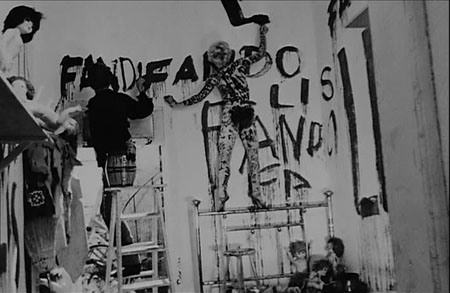
Still from Fando y Lis (1968)

WHY IT MIGHT MAKE THE LIST: If you’ve ever seen a Jodorowsky movie before, you know what to expect. Fando y Lis is a parade of fantastical, shocking imagery, including snakes that penetrate a baby doll and a man who begs for blood (he extracts a donation with a syringe and drinks it from a brandy snifter). That said, Fando & Lis is one of the least of Jodorwosky’s works, an early curiosity that is thoroughly weird, but not strongly conceived enough to make the List on the first ballot. (Plus, Jodo’s so well-represented here already we don’t feel at all bad about the possibility of leaving one movie off).

COMMENTS: Fando y Lis begins with a woman eating flowers while a siren wails. Later we will learn she is the paraplegic Lis, whose lover Fando will cart her across a bizarre post-apocalyptic landscape searching for the mystical city of Tar. Along the way they encounter a man playing a burning piano, mud zombies, a transvestite parade, and a gang of female bowlers led by a dominatrix, among other absurdities. There will also be flashbacks to both Fando and Lis’ childhoods, and unrelated fantasy sequences of the actors goofing around (posing in a graveyard, and painting their characters’ names on each other). And there’s quite a few more transgressions, both beautiful and clumsy, to be found in this rambling, overstuffed avant-garde experiment. Although Jodorowsky comes from an older bohemian tradition, at times Fando y Lis plays like something made by Mexican hippies, improvising scenes with random props in between hashish tokes.

The “spiritual journey” structure makes for an episodic film, but the ideas aren’t as stunningly realized or obsessively detailed as The Holy Mountain. Here, Jodorowsky has found, but not perfected, his unique voice: it’s as if he’s working with individual sentences, rather than complete paragraphs. It would have helped the movie feel more coherent and unified if the relationship between Fando and Lis was better done, but their dynamic is unpleasant. They unconvincingly profess eternal love for each other, but Fando is much better at conveying his irritation and annoyance at having to carry Lis everywhere, while her character is reduced to desperate, pathetic whining for most of the film.

In 1962 Jodorowsky, Fernando Arrabal and , feeling that Andre Breton and the old guard Surrealists had lost their edge and were no longer extreme enough in their embrace of absurdity, founded the Panic movement, which was mostly an experimental theater group. Fando & Lis was originally a play from this school, written by Arrabal and staged by Jodorowsky. This movie adaptation is not intended to be faithful; Jodorowsky instead described it as based on his memories of the play. When Fando y Lis premiered at the Acapulco Film Festival in 1968 it caused a riot (presumably due to its abundant nudity and mildly sacrilegious content) and was subsequently banned in Mexico. The film basically disappeared for years. Discovering Jodorowsky in the early 90s, when his films were only available in bootleg VHS versions, I was unaware that he had made a movie before El Topo; Fando wasn’t even a filmography entry. It wasn’t until 2003 that a DVD of this early work suddenly popped up.

WHAT THE CRITICS SAY:

“… pothead vaudeville all the way… A tumultuous cause celebre at festivals, it paved the way for the director’s rise from small-time poseur to big-time poseur with El Topo a few years later.”–Fernando F. Croce, Cinepassion

(This movie was nominated for review by “Zelenc” who called it a “must see film.” Suggest a weird movie of your own here.)

CAPSULE: LOVE ME IF YOU DARE (2003)

Recommended

DIRECTED BY: Yann Samuell

FEATURING:  Guillaume Canet, , Thibault Verhaeghe, Joséphine Lebas-Joly

PLOT: A boy and girl carry on their childhood contest of dares into adulthood, when the game escalates into life-wrecking catastrophes.

Still from Love Me If You Dare (2003)

WHY IT WON’T MAKE THE LIST: It’s not weird enough to make the List, although it is offbeat enough to earn a mild recommendation—especially as non-treacly alt-Valentine’s Day viewing.

COMMENTS: When Love Me If You Dare came out in 2003, most critics pegged it as a flawed and unpleasant attempt to cash in on Le Fabuleux Destin d’Amélie Poulain‘s international success. With distance, Love Me If You Dare doesn’t seem derivative so much as part of an ongoing tradition of whimsical French romantic fantasies. Writer/director Yann Samuell’s twist on the formula is to cut the sweetness, not with the usual melancholy bitter, but with sharper flavors of black comedy that many found too pungent. While is indeed the main stylistic touchstone here—both the French and American distributors were clearly hoping Marion Cotillard would melt international hearts the way had two years earlier—Dare both recalls and anticipates other Gallic romances, while forging its own path. The mix of brightly colored childhood nostalgia and salty adult sensibilities is indebted to , the unsung père of modern French whimsy. Some fantasy sequences play out on cutified versions of Georges Méliès sets—as  when young Julien goes sailing through a sky of cardboard cutout clouds, or the children find themselves as Adam and Eve with a prop apple serving as their lapsiarian music box—while anticipating the crafty handmade worlds of .

The Amélie comparisons were more of a marketing ploy than an accurate aesthetic description, but many reviewers took them to heart. Samuell’s movie got hit from both sides, simultaneously criticized for being too derivative of the hit fantasy, and for failing to warm hearts the way the previous film had. Critics who hated the film because the two main characters were too cruel failed to give credence to the underlying metaphor—that passion often involves an undercurrent of childish competition—but there is psychological merit in the notion. The increasing stakes of the dares—which move from mere humiliations (like wearing your underwear outside your clothes) to acute psychological cruelty to actual physical peril—take the movie into War of the Roses territory. They provide danger and give us a reason to keep watching, rather than the limp “will they or won’t they?” formalities of typical romantic comedies. Yet, for all the sadism inherent in their bantering, there is no doubt Julien and Sophie share a real bond, a hybrid of all-consuming love and hate that is, in a way, admirable for its purity and fidelity. They may not be a likable couple, but they are strangely believable one. Samuell’s script and direction are very impressive for a debut, and the acting by the four principals (young Julien and Sophie are portrayed by cute and expressive couple of kids) is above standard. Marion Cotillard may have been no Audrey Tautou when it came to launching a million crushes, but she ultimately proved the more versatile actress.

One negative note, though: sad to say, you will be sick to death of “La Vie en Rose” before the final credits roll.

WHAT THE CRITICS SAY:

“The dreamlike amber washes and comic visual asides stress the otherness of the pair’s reality, but seem to offer a limp excuse for their deluded exemption from empathy.”–Gianni Truzzi, Seattle Post-Intelligencer (contemporaneous)

[This movie was nominated for review by “tsross13,” who confessed “I realize this movie might not be weird enough (but the greatness of it, in my humble opinion, cancels that factor out)….” Suggest a weird movie of your own here.]

224. JAPANESE SUMMER: DOUBLE SUICIDE (1967)

Muri shinjû: Nihon no natsu

“I think that our only route to freedom and our only route to pleasure can come after we have first recognized that freedom and pleasure are not possible in this world.”–Nagisa Ôshima

Recommended

DIRECTED BY:

FEATURING: Keiko Sakurai, Kei Satô, Masakazu Tamura, Taiji Tonoyama

PLOT: An oversexed eighteen-year old girl wanders a city looking for a man to sleep with her—any man. She takes up with a strange, reserved older army deserter, but fails to convince him to service her, as he has a death wish and is only interested meeting someone who will kill him. The two are abducted and taken to a compound where outlaws are being recruited to fight in a secret underground war; meanwhile, television reports tell of a foreign sniper killing civilians on the streets, driving all of Japan to hide in their homes.

Still from Japanese Summer: Double Suicide (1967)

BACKGROUND:

  • Disappointed by the timidity of the Japanese studio system and the political controversy surrounding his 1960 movie Night and Fog in Japan, Nagisa Ôshima formed his own production company in 1965. Japanese Summer: Double Suicide was one of the baker’s dozen of self-produced films he directed between 1965 and 1972, and the first one to indulge in wall-to-wall surrealism.
  • Stars Keiko Sakurai and Kei Satô also appeared in Nagisa Ôshima’s next film, Death by Hanging, which was Sakurai’s only other acting credit.
  • Ôshima would go on to cult success in the West with his sexually explicit provocation In the Realm of the Senses (1976), and with Merry Christmas, Mr. Lawrence (1983) starring .
  • This feature should not be confused with Masahiro Shinoda‘s 1969 arthouse hit Double Suicide, a fourth-wall breaking adaptation of an 18th century Japanese play about doomed lovers. Although entirely unrelated, Shinoda‘s film is worth seeing in its own right.

INDELIBLE IMAGE: In what just might be a bit of symbolic foreshadowing, the two main characters lie down on top chalk outlines around which, moments ago, reverent monks had been circling and chanting. (Curiously, the outlines are sketched on what should be a busy four-lane highway, yet there is no traffic).

THREE WEIRD THINGS: Virgin nympho; deserted highways; “a Japanese Dallas”

WHAT MAKES IT WEIRD:  Starring a nympho who can’t get laid and a suicidal man who can’t get killed, Ôshima’s surrealistic Sixties satire carves out a unique space somewhere between a ian joke and an extended zen koan.


Original trailer for Japanese Summer: Double Suicide

COMMENTS: When our on-the-make nymphomaniac meets the Continue reading 224. JAPANESE SUMMER: DOUBLE SUICIDE (1967) →