Tag Archives: Vampire

B’TWIXT NOW AND SUNRISE: THE AUTHENTIC CUT (2011/2022)

DIRECTED BY:

FEATURING: , , , Ben Chaplin, Joanne Whalley, Alden Ehrenreich, David Paymer, Don Novello, Anthony Fusco,

PLOT: A struggling writer’s book tour lands him in a mysterious small town, where the sheriff invites him to help investigate a serial killer and guides him through a dreamworld of ghosts, vampires, and murderers.
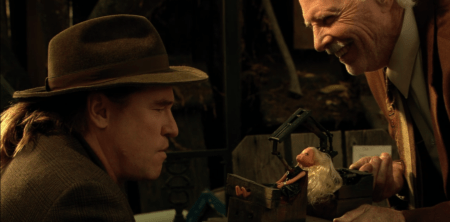
Still from B'Twixt Now and Sunrise (2011/2022)

COMMENTS: In 2011, Francis Ford Coppola released a movie called Twixt, a vampire/ghost story starring Val Kilmer as a low-rent horror writer, Elle Fanning as a pixie-esque dead girl, and Bruce Dern as the town sheriff/aspiring writer. Not many people remember it, which makes Coppola’s decision to re-release it, calling it B’Twixt Now and Sunrise: The Authentic Cut (2022), slightly baffling. Only slightly so, though, given both how much the man likes director’s cuts and the special significance this film has to him.

Its first time out, Twixt was roundly panned. The writing (by Coppola) is unfortunate, the look of the dreamworld—where Hall Baltimore (Val Kilmer) is guided through the story of a mass child murder by Edgar Allan Poe (Ben Chaplin)—is overly crisp, background characters are either wooden or overwrought, and so on. There are odd choices throughout, and the overall effect is that Twixt is a bad movie—a very entertaining bad movie.

For The Authentic Cut, Coppola removed eight minutes of runtime (four of them from the ending, which was already abrupt) and didn’t add any new footage. While the changes are understandable, such as patching scenes together, creating a twist ending, removing a homophobic joke, etc., the movie isn’t much better for them, and this is tragic.

B’Twixt is a movie close to Coppola’s heart. This is because of a subplot wherein Baltimore’s daughter has been killed in a boating accident, and he comes to accept culpability. Coppola’s 22-year-old son was also killed in a boating accident, in the same way as shown in the film. So of course he would want this semi-confessional movie to be its best and not an embarrassment. But all that works in Twixt/B’Twixt is the stuff makes it funny and cheesy and bad, like Bruce Dern’s screwball sheriff. His over-the-top energy would be par for the course in an out-and-out comedy, but because this is not one, the question of whether certain things are intentionally funny is that much more fascinating.

There are cool moments, especially in the dreamworld when everything is black and gray and red, sometimes looking like an expressionist version of  Sin City (which was released 6 years earlier). These scenes are dominated by the leader of the evil, possibly vampiric goth kids, who has the gothiest makeup ever and reads Baudelaire in French. His name is Flamingo, and he broods under the full moon. Again, genius bleeds into the ridiculous, leaving us both chuckling and wondering about intentionality.

Coppola’s original vision for this film included performing it live, taking advantage of the digital nature of editing, and having the score performed along with a fluid cut—a groundbreaking undertaking,  which occurred only once, at Comic-Con. One can easily assume from this intention that Twixt was never meant to be the final version.

For people interested in (one of) the auteur’s vision(s), B’Twixt is here for you now. But if you want a low budget horror-comedy that is both intentionally and unintentionally funny, Twixt is a hidden gem.

WHAT THE CRITICS SAY:

“The shot on digital low-budget indie film was inspired by dreams Coppola had and, well, that’s what it feels like. Although this trimmed down version is more focused and less clunky than the original (especially with Hall’s character arc), it still feels like a mish mash of ideas more than a fleshed out story… plays like a poor man’s ‘Twin Peaks.'”–DVD corner (Blu-ray)


APOCRYPHA CANDIDATE: BLOOD FOR DRACULA (1974)

AKA Andy Warhol’s Blood for Dracula

366 Weird Movies may earn commissions from purchases made through product links.

DIRECTED BY: Paul Morrissey

FEATURING: Joe Dallesandro, Udo Kier, Maxime McKendry

PLOT: Count Dracula is dying for want of a virgin’s blood, and so sallies forth to Italy in an attempt to take advantage of its selection of religious-minded young women.

Still from Blood for Dracula (1974)

WHY IT MIGHT JOIN THE APOCRYPHA: A treatise on class struggle and it’s a softcore Eurotrash vampire gore movie? Thank you kindly, Misters Morrissey and Warhol.

COMMENTS: Among many questions raised by Blood for Dracula are: what is to be done with the idle aristocracy now that it has served its purpose? Did it serve a purpose in the first place? What is a mid-’70s New York City tough guy doing as a handyman on a decayed Italian estate? And, what year is this movie set in, anyway? Paul Morrissey has a vision, I am certain, and it was put to screen in soothing verdigris, soft yellows, and spurts of crimson. The variegated colors emphasize the manifold oddities unspooling over the delicious palette, with performances one might politely describe as “eccentric” bringing to life the director’s singular vision of the vampire myth.

The opening shot unveils the chromatic motif as the camera lingers on Count Dracula (Udo Kier), forlornly applying makeup. His vampirehood is revealed in the mirror in front of him—a mirror devoid of reflection. This ailing man is in need of virgin blood to continue on, and so his manic servant has hatched a plan of questionable merit. Dracula wishes to die, it seems, but is convinced instead to shuffle into a car and trundle off to the Italian countryside. There, he hopes to find a virgin’s blood to rejuvenate him—e’er he dies, forever.

Udo Kier’s performance as the sickly Count is a standout among a number of unlikely choices. His two long stretches of vomiting impure blood, as well as his line delivery (which I suspect stem partly from an imperfect grip on the language), lay the groundwork for Nicolas Cage‘s own nuanced performance in Vampire’s Kiss. The patriarch of the Italian estate is a jolly old soul with a love for gambling matched only by his love for language (“Dracula? Drah-cule-ah. I like it!”). The lone servant on the grounds, Mario, is perhaps the only card-carrying member of the Communist party for miles around—at least I presume he’s card-carrying; what dialogue he has that doesn’t concern the overthrow of the aristos is typically, and unsettlingly, rape-y. And if you like sister-with-sister action, you’re in luck: this “art-house” rollick has got you covered.

Yes, yes: this is a sexploitation feature alternating titillation with shlock violence (by the end, I was reminded of the infamous Black Knight), and I have no right to expect haut cinéma. But the little touches, heavy-handed though some were, are evidence that Morrissey is a dab hand at capturing compelling visuals. And even in his moments of regurgitative bombast, there is a dancer’s alacrity to Kier’s performance, showing there is a grim, lively past to this melancholy invalid. Maxime McKendry (in her sole film appearance) exudes a beautiful subtlety as an obviously English noblewoman filtered through an incongruous Italian accent. Come to this film with no demands other than for angst and spectacle, and you will not leave disappointed. If you come demanding logic and internal consistency, then you should perhaps hone your title-reading skills.

WHAT THE CRITICS SAY:

“It’s a strange film—sometimes a beautiful one—but it’s also the textbook definition of ‘not for everyone.'”–Ken Hanke, Mountain XPress

CAPSULE: DAUGHTERS OF DARKNESS (1971)

366 Weird Movies may earn commissions from purchases made through product links.

DIRECTED BY: Harry Kümel

FEATURING: Delphine Seyrig, John Karlen, Danielle Ouimet, Andrea Rau

PLOT: After marrying on a whim in Switzerland, Stefan and Valerie find themselves in a grand hotel where the mysterious Countess Báthory and her companion Ilona are the only other guests.

COMMENTS: It’s just as well that Olstend’s “Grand Hotel Thermes” is nearly empty during the off season—its cavernous hallways, regal stairways, and spacious suites can barely contain the thick layers of Eurotrash that pile up the moment Stefan, Valerie, the Countess, and her “secretary” come in from the rain. This gang of sex-dripping ’70s stereotypes jostle with one another for the title of Maximus Libidinosus. Is it the new bride, Valerie, often topless and presenting an innocence that belies her eagerness? Is it creep-hunk Stefan, who nearly loses it when recounting the sadistic methods of a medieval Hungarian noblewoman? Is it deer-in-headlights Ilona, when she lingers in the nude outside of Valerie’s window the first night she meets her?

No, no, and no. This is Countess Elisabeth Báthory’s party, despite the fact she doesn’t appear until the second act. Aged somewhere between twenty-five and one-hundred or more, this long-lived, ever-beautiful femme out-fatales all the wavy-haired blonde bomb-shells that came before her. With cryptic mannerisms and more-cryptic asides, Delphine Seyrig owns the screen whenever she graces it, for better or worse. The jalopy of a plot putters along with just enough horsepower to sustain its goings on, which themselves have just enough obligatory allusions to a story that it could be argued to have one. But Daughters of Darkness is allegory, and a very lesbian kind of allegory. The “V” of seduction (with the Countess at the hub) may just as well conjure the word “vaginal”… or, if one is so inclined, “vampyre.” This is a gloriously shameless exploration of sapphic love, layered thick with electronic musical cues, heightened acting, colored lighting, and, whenever the filmmakers remember it, arcane overtones.

It’s a good midnight movie, with an atmosphere you could hang a heavy jacket on. But it is a product of its time, and its budget. Amidst the array of sensuality, sex, and sadism, there is one item that stands out, and which remained, perhaps woefully, underexplored. A key plot point—and impending film spoiler—involves Stefan’s reticence in telling his mother that he has married a young woman in Switzerland. The excuse for this trepidation is that his family is very aristocratic, and his mother would be damned before recognizing such an off-the-cuff flight of matrimonial whimsy. However, we finally meet Stefan’s mother at the film’s halfway point, and find him to be not quite what we might expect. A middle-aged man, in a woman’s lounging dress, decorated in make-up, reclining on a hammock in the middle of a conservatory. He describes Stefan’s wedding gambit not so much as inappropriate as “unrealistic”. Who is this? What are he and Stefan? And how about that butler kneeling for a much-appreciated pat on the head upon delivering Mother the telephone? No matter. Within moments, we’re back to the gauzy layers of obvious questions weaving gracefully around this new and unexpected one. Class, discuss.

Blue Underground released a remastered special edition Blu-ray of Daughters of Darkness in 2022 with three separate commentary tracks and numerous special features.

WHAT THE CRITICS SAY:

“Strange and beautiful, it’s a perfect cocktail of the weird, the horrible, and the oh-so-sexy. “–Cait Kennedy, But Why Tho? (2020 festival rerelease)

CAPSULE: TEN MINUTES TO MIDNIGHT (2020)

366 Weird Movies may earn commissions from purchases made through product links.

DIRECTED BY: Erik Bloomquist

FEATURING: Caroline Williams, Adam Weppler, Nicole Kang, William Youmans, Nicholas Tucci

PLOT: DJ Amy Marlowe is bitten by a flying animal on the way to her final broadcast, and things get a little bloody.

COMMENTS: Does Ten Minutes to Midnight embody low-budget horror? Let’s go down the list. Closed environment? Check: radio station, nary an outside scene. Undercurrent of macabre humor? Check: the night manager is a skeezy, New Wave-vintage coke-snorter, while the oddball security guard spouts good cheer with a sociopath’s menace. Pile of corpses? Check: the ladies room becomes shin-deep in victims. Brief run-time? Check: 72 minutes zip right along. Throwback lead? Super check: Caroline “Stretch” Williams owns her role as DJ Amy Marlowe. But sophomore director Erik Bloomquist throws in peripherals left, right, and center. With all that weight on the sides, the center does not hold.

From the start, Ten Minutes veers into ambiguation. The establishing shot, something I always note, shows an upside-down clock positioned at—you guessed it—11:50. (The outdoor light levels and an urgent broadcast about “tonight’s” rain storm answer the “AM or PM?” question; warning: you will get very comfortable with this clock setting.) Amy’s adventure begins offscreen and the dual bite-mark she receives on her to work introduces one possible explanation for the strangeness that ensues.

As far as cast goes, aside from the over-caffeinated security guard Ernie (Nicholas Tucci, deceased) and the station’s past-his-prime manager, there’s young-guy-with-lip-piercings radio technician Aaron who might be nursing a crush for the mature blonde DJ. And oh yeah, incongruous UC Berkeley grad Sienna (Nicole Kang) is there to act as some generational counterpoint to Amy.

You cannot hope to adequately convey much with a runtime under an hour-and-a-quarter, but that doesn’t stop our boy Bloomquist from trying. Ten Minutes explores transition—Amy is menopausal and retiring, Sienna is starting a new job, Aaron just broke up with another redhead, and callers’ lives are at a crossroads. It explores aging, death, purgatory, the modern work environment. It wants to be a vampire movie, a psychological study, a meditation on mortality, and a horror comedy… Imagine you’re at an all-you-can-eat buffet that is rigged to explode unless you consume all the offerings, from the bad pizza to the passable fresh-carved roast beef, in 72 minutes; Bloomquist seems to have endured an artistic form of this hypothetical. As a rule, I don’t mind a movie leaving me with more questions than answers, and I don’t necessarily shy away from incoherence. But while Ten Minutes to Midnight left me overstuffed with bloody imagery and thematic twists, it left me hungry for something more substantial.

WHAT THE CRITICS SAY:

“In the span of just 70 minutes [Bloomquist] manages to cover an awful lot of ground, creating a surrealist tone early on that he never lets up until the closing credits roll…  a B-grade feature wrapped up in a 1980’s mindset that gloriously marches to its own bizarre beat.”–Peter Gray, This Is Film (contemporaneous)