
Two sisters sleep under a mosquito net to keep out the vampires that come at night.
Tag Archives: Vampire
CAPSULE: DAUGHTERS OF DARKNESS (1971)
366 Weird Movies may earn commissions from purchases made through product links.
DIRECTED BY: Harry Kümel
FEATURING: Delphine Seyrig, John Karlen, Danielle Ouimet, Andrea Rau
PLOT: After marrying on a whim in Switzerland, Stefan and Valerie find themselves in a grand hotel where the mysterious Countess Báthory and her companion Ilona are the only other guests.

COMMENTS: It’s just as well that Olstend’s “Grand Hotel Thermes” is nearly empty during the off season—its cavernous hallways, regal stairways, and spacious suites can barely contain the thick layers of Eurotrash that pile up the moment Stefan, Valerie, the Countess, and her “secretary” come in from the rain. This gang of sex-dripping ’70s stereotypes jostle with one another for the title of Maximus Libidinosus. Is it the new bride, Valerie, often topless and presenting an innocence that belies her eagerness? Is it creep-hunk Stefan, who nearly loses it when recounting the sadistic methods of a medieval Hungarian noblewoman? Is it deer-in-headlights Ilona, when she lingers in the nude outside of Valerie’s window the first night she meets her?
No, no, and no. This is Countess Elisabeth Báthory’s party, despite the fact she doesn’t appear until the second act. Aged somewhere between twenty-five and one-hundred or more, this long-lived, ever-beautiful femme out-fatales all the wavy-haired blonde bomb-shells that came before her. With cryptic mannerisms and more-cryptic asides, Delphine Seyrig owns the screen whenever she graces it, for better or worse. The jalopy of a plot putters along with just enough horsepower to sustain its goings on, which themselves have just enough obligatory allusions to a story that it could be argued to have one. But Daughters of Darkness is allegory, and a very lesbian kind of allegory. The “V” of seduction (with the Countess at the hub) may just as well conjure the word “vaginal”… or, if one is so inclined, “vampyre.” This is a gloriously shameless exploration of sapphic love, layered thick with electronic musical cues, heightened acting, colored lighting, and, whenever the filmmakers remember it, arcane overtones.
It’s a good midnight movie, with an atmosphere you could hang a heavy jacket on. But it is a product of its time, and its budget. Amidst the array of sensuality, sex, and sadism, there is one item that stands out, and which remained, perhaps woefully, underexplored. A key plot point—and impending film spoiler—involves Stefan’s reticence in telling his mother that he has married a young woman in Switzerland. The excuse for this trepidation is that his family is very aristocratic, and his mother would be damned before recognizing such an off-the-cuff flight of matrimonial whimsy. However, we finally meet Stefan’s mother at the film’s halfway point, and find him to be not quite what we might expect. A middle-aged man, in a woman’s lounging dress, decorated in make-up, reclining on a hammock in the middle of a conservatory. He describes Stefan’s wedding gambit not so much as inappropriate as “unrealistic”. Who is this? What are he and Stefan? And how about that butler kneeling for a much-appreciated pat on the head upon delivering Mother the telephone? No matter. Within moments, we’re back to the gauzy layers of obvious questions weaving gracefully around this new and unexpected one. Class, discuss.
Blue Underground released a remastered special edition Blu-ray of Daughters of Darkness in 2022 with three separate commentary tracks and numerous special features.
WHAT THE CRITICS SAY:
CAPSULE: TEN MINUTES TO MIDNIGHT (2020)
366 Weird Movies may earn commissions from purchases made through product links.
DIRECTED BY: Erik Bloomquist
FEATURING: Caroline Williams, Adam Weppler, Nicole Kang, William Youmans, Nicholas Tucci
PLOT: DJ Amy Marlowe is bitten by a flying animal on the way to her final broadcast, and things get a little bloody.

COMMENTS: Does Ten Minutes to Midnight embody low-budget horror? Let’s go down the list. Closed environment? Check: radio station, nary an outside scene. Undercurrent of macabre humor? Check: the night manager is a skeezy, New Wave-vintage coke-snorter, while the oddball security guard spouts good cheer with a sociopath’s menace. Pile of corpses? Check: the ladies room becomes shin-deep in victims. Brief run-time? Check: 72 minutes zip right along. Throwback lead? Super check: Caroline “Stretch” Williams owns her role as DJ Amy Marlowe. But sophomore director Erik Bloomquist throws in peripherals left, right, and center. With all that weight on the sides, the center does not hold.
From the start, Ten Minutes veers into ambiguation. The establishing shot, something I always note, shows an upside-down clock positioned at—you guessed it—11:50. (The outdoor light levels and an urgent broadcast about “tonight’s” rain storm answer the “AM or PM?” question; warning: you will get very comfortable with this clock setting.) Amy’s adventure begins offscreen and the dual bite-mark she receives on her to work introduces one possible explanation for the strangeness that ensues.
As far as cast goes, aside from the over-caffeinated security guard Ernie (Nicholas Tucci, deceased) and the station’s past-his-prime manager, there’s young-guy-with-lip-piercings radio technician Aaron who might be nursing a crush for the mature blonde DJ. And oh yeah, incongruous UC Berkeley grad Sienna (Nicole Kang) is there to act as some generational counterpoint to Amy.
You cannot hope to adequately convey much with a runtime under an hour-and-a-quarter, but that doesn’t stop our boy Bloomquist from trying. Ten Minutes explores transition—Amy is menopausal and retiring, Sienna is starting a new job, Aaron just broke up with another redhead, and callers’ lives are at a crossroads. It explores aging, death, purgatory, the modern work environment. It wants to be a vampire movie, a psychological study, a meditation on mortality, and a horror comedy… Imagine you’re at an all-you-can-eat buffet that is rigged to explode unless you consume all the offerings, from the bad pizza to the passable fresh-carved roast beef, in 72 minutes; Bloomquist seems to have endured an artistic form of this hypothetical. As a rule, I don’t mind a movie leaving me with more questions than answers, and I don’t necessarily shy away from incoherence. But while Ten Minutes to Midnight left me overstuffed with bloody imagery and thematic twists, it left me hungry for something more substantial.
WHAT THE CRITICS SAY:
CAPSULE: THE HUNGER (1983)
366 Weird Movies may earn commissions from purchases made through product links.
DIRECTED BY: Tony Scott
FEATURING: Catherine Deneuve, Susan Sarandon, David Bowie
PLOT: When her lover of many centuries begins rapidly aging, vampiress Miriam Blaylock seduces a gerontologist to revive him.
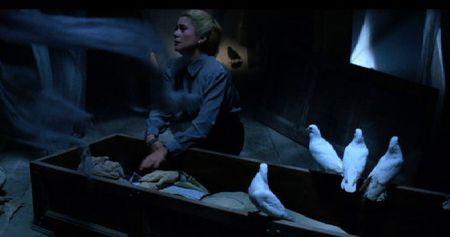
COMMENTS: Catherine Deneuve. Susan Sarandon. Ann Magnuson. David Bowie. When your movie features some of the most attractive people around, it can’t help but look beautiful. Tony Scott’s directorial debut is a beautifully shot Eurotrash-style drama whose only parallel to his smash-hit sophomore effort is, perhaps, that it has some flying things: in The Hunger, there is what I dubbed “the Dove Room”, teeming with white birds; in Top Gun, there are some flying machines (and a character named after a bird). There the similarities just about stop—but not entirely. Though Scott’s oeuvre would lean heavily toward action-thriller after he was harvested by Don Simpson and Jerry Bruckheimer, a romantic sappiness pulsates through his first two films.
The advertising featuring David Bowie is a bit misleading, seeing as his character dies (well, mostly) by the halfway mark. This is really the story of Miriam Blaylock (Catherine Deneuve, gloriously vague in a European kind of way), a vampire who originated at least as far back as ancient Egyptian times. Her man-squeeze John (Bowie, young and sexy, until he very quickly isn’t) seems to have lost the knack for eternal youth—a fate suffered by Miriam’s innumerable lovers beforehand. However, their final hedonistic days of early ’80s New York City party-fun-time do slow down enough to allow them to make the acquaintance of Doctor Sarah Roberts (Susan Sarandon, doing a wonderful job as the smoky-sexy scientist), whose research may relate to the sudden trouble suffered by hapless John.
The Hunger starts in a nightclub, with the camera focused on a goth singer and his band performing behind a caged stage. Intercut with his exorbitantly vampiric lyricising are shots of Miriam and John picking up some gothed-out groupies and draining them dry. The pastiche of club life excess, luxury car excess, and sanguino-sexual excess nicely sets the mood, and acts as an early filter for the audience. If this is not what you want to be watching for the next eighty minutes, then The Hunger is not the movie for you. What follows is a semi-tragic romance, rapid aging in a doctor’s office, and some softcore lesbian sex (if you’re into that sort of thing). Ultimately, Scott’s movie reveals that perhaps the greatest hunger is a hunger for companionship…
This is all very flip, but it’s hard not to be that way when discussing something as cheesy and stylishly overwrought as The Hunger, whose stylized nonsense and hyper-vampire-sexuality predates Interview with a Vampire by about a decade. (On film, anyway: apparently that bit of fluff-core had been in development since the early ’80s.) The only truly impressive element to be found is the make-up work on David Bowie; by the time you see John Blaylock morph from 30-something Bowie into just-about-decomposing Bowie, you’ll understand why Dick Smith’s credited with “make-up Illusions.” Otherwise, this film merely demands you grab some of the butteriest popcorn and reddest wine you can find and marvel at its wet dreaminess.
WHAT THE CRITICS SAY:
FANTASIA FILM FESTIVAL 2020 CAPSULE: CLIMATE OF THE HUNTER (2019)
366 Weird Movies may earn commissions from purchases made through product links.
Screening online for Canadians at 2020’s online Fantasia Film Festival
DIRECTED BY: Mickey Reece
FEATURING: Ginger Gilmartin, Mary Buss, Ben Hall
PLOT: Two sisters in their autumn years await the arrival of a childhood friend for whom they each have romantic ambitions.

COMMENTS: There is an elegance to the “Academy ratio” that has by and large been abandoned since the mass television market adopted “widescreen” (in particular, 16:9) as the standard ratio. The classic 4:3 ratio, found in older films and prevalent through much of television’s history, allows for an intimacy that is lost in typical widescreen extravaganzas. The extra frame space can be useful for many genres—from art-house films, with their precision framing and staging, to action films, with their need for as much visual noise as possible—but melodramas benefit greatly from the Academy ratio’s truncatedness: the focus is put right on to the characters as they interact.
This intimacy is among the many throwback elements found in Mickey Reece’s Climate of the Hunter. Another is stylized dialogue, as exemplified by the nebulous love interest, Wes (played with supreme suavité by Ben Hall). A writer by a profession, and a vampire by rumor, Wes’ fluorishes and bons mots might come across as stilted, but never quite sound unreal. This brings me to the third trick up Reece’s sleeve: he makes Climate feel like a high-end soap opera that’s been cranked up–but just a little bit. It never feels like parody, but walks ever so precariously along that knife-edge.
Climate of the Hunter is little more than a stylish oddity, but I felt compelled to bring it to your attention because it not only bumps up just below the “Recommended” mark, but also the “Apocrypha Candidate” mark. The love triangle between Wes and the two sisters plays like David Lynch riffing on Guy Maddin, with each of their styles grounding the others’ particular excesses. The film’s few defects (an unpleasantly tone-jarring “mini-montage” when the crazier sister gears up for a vampire-hunting encounter is almost a body-blow to the movie) are forgivable given the otherwise flawless atmosphere of high melodrama and playful art-house. Such presentational precision, harnessed for such an unclear story, makes Climate of the Hunter worth a look for anyone who realizes that a vampire’s life must be a deft mixture of the ornate and the dishonest.
WHAT THE CRITICS SAY: