
Guest review by Alfred Eaker
Tod Browning’s Dracula is often compared to Murnau’s unauthorized Nosferatu. It is an unfair comparison:the two are very different films, which merely happen to share the same literary inspiration. (Neither are mere adaptations. The only film to fairly compare to Murnau’s would be Herzog’s remake with Kinski and, indeed, it compares very favorably). The vampire of Murnau and Schreck is an accursed, repulsive animal, the carrier of a dreaded plague and the beast fights fiercely to sustain its life, like a rodent in its death throes. The Dracula of Browning and Lugosi is an outsider, a mesmerizing and intensely austere intruder, who comes to nourish on the aristocratic London Society, who he, paradoxically, yearns to to join (fittingly, for a genuine outsider, it is to no avail of course; he makes rather pronounced overtures and goes to extraordinary lengths to fulfill his ambition there).
Dwight Frye’s pre-bitten Renfield is nearly as strange an outcast as he is after his transformation, albeit in a far 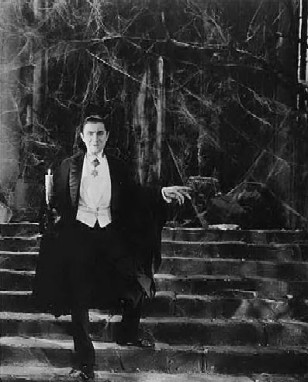 different light. Renfield is a bizarre, urban effeminate in an old meat, potatoes and superstition land. The villagers are outcasts too, but among them, Renfield is the doomed jester, misguidedly blinded by his foolhardy feeling of superiority over them and stubbornly oblivious to the peasants’ warnings.
The introduction to the inhabitants of Castle Dracula is among the most discussed in the annuls of Universal Horror and, to many viewers, it is also most perplexing. This is quintessential Browning. The static silence is punctuated with genuine dread, surreal humor, and the unnerving whimpers of a opossum. Karl Freund’s camera pans over a decidedly unreal set. The vampire brides slowly emerge as a bee scampers out of its little coffin. An opossum seems to be ducking for cover in its dilapidated coffin and its cries are the only living sounds we hear as we are introduced to Lugosi’s Count staring directly at the camera.
Renfield’s journey to Castle Dracula perfectly captures the sensory view of a crepuscular world. Indeed, no other Universal horror film would convey it as vividly and attempts to do so in later films proved pale imitations.
Renfield’s arrival to the castle, and state of confusion, is juxtaposed against the awkward but pertinacious emergence of Dracula. Lugosi’s emergence seems to partake of a genuine struggle and this echoes the delivery of his greeting which follows. This emergence sharply contrasts with the startling and confused appearance of armadillos scurrying in the ruins below, which also heightens Renfield’s confused state.
Critics have unfavorably compared this scene to Melford’s much more fluid shot of Villar’s Count appearance atop the stairwell in Dracula (The Spanish Version). Continue reading TOD BROWNING’S ‘DRACULA’ (1931): CHALLENGING THE REVISIONISTS

