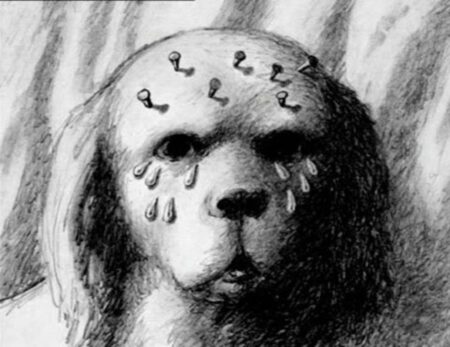
Enriqueta and Ramoneta run a business out of their house selling something too taboo to be available in any grocery store.
Alberto Vázquez has been featured here before when we highlighted his short Birdboy. I had the pleasure of seeing “Unicorn Blood” when it was featured at Slamdance last year. With the impression it left, there was no doubt it would be shared on this site as soon as it was available. If you don’t speak Spanish, be sure to turn on the subtitles by pressing the “cc” button.
Content Warning: This short contains nudity and graphic violence against unicorns.
Las Brujas de Zugarramurdi

DIRECTED BY: Alex de la Iglesia
FEATURING: Hugo Silva, Carolina Bang, Mario Casas, Jaime Ordóñez, Carmen Maura, Terele Pávez, Gabriel Delgado
PLOT: Small-time crooks bump into a coven of witches while on the run.

WHY IT MIGHT MAKE THE LIST: Like most of Alex de la Iglesia‘s spiffy, nutty B-movie efforts, Witching comes close to making the List at first glance. Its spell is mad and it makes for near perfect Halloween (or post-Halloween) entertainment—but does de la Iglesia have a better weird candidate out there lurking in his canon?
COMMENTS: About midway through Witching and Bitching, as the three main protagonists are tied up at a feast while their hostess paces on the ceiling talking on her cellphone, one of them speculates that they must have been drugged by witches’ ointment and are experiencing a mass hallucination. From their standpoint it’s a credible theory, but in the world of the movie, the scene is terribly real, and it’s about to get worse. But let’s go back to the beginning. After a Macbeth-ish “bubble bubble” prologue, Witching begins in earnest when Jesus, a green toy soldier, and some trademarked cartoon characters (you’ll never think of a certain sponge the same way again) rob a sad-sack pawn shop of its fortune in hocked wedding rings. Following a hail of bullets and a car chase, we learn that the shotgun-toting Jesus has brought his elementary school-aged son along on the heist. Fleeing in a hijacked taxi towards the French border, the two escaped gunmen recruit the driver to their cause by sharing sob stories about women problems.
Unfortunately, the gang’s escape route takes them through the Basque town of Zugarramurdi, a historical center of witchcraft, and things take a supernatural turn. Before we know it there are women walking on the ceiling; along the way we also get grabby toilets, a pair of transvestite witches, and hot punk sorceress Carolina Bang in black undies humping a broomstick while dousing herself with fresh-squeezed toad blood. With the protags tailed by an angry ex and a pair of squabbling detectives, it all ends up in an apocalyptic eldritch ceremony with a globby giant demon-Goddess whose appearance actually elicited a “wow” from this reviewer.
There’s plenty of comedy, too, much of it revolving around child custody and sexual politics. In fact, the grossout gags mixed with a pseudo-misogynist, women-are-inherently-evil subtext at times suggests Antichrist by way of Evil Dead II, although the men here are no prize either and the warring genders are reconciled by the film’s happy ending. Despite the battle-of-the-sexes thematic subtext, Witching is overwhelmingly a plot-and-gag based affair with hardly a whiff of seriousness. It’s a rambunctious ride that seldom lets up for a breather; it just keeps pressing the petal to the floor, injecting more crazy fuel into its insanity engine. Witching is the movie From Dusk Till Dawn wanted to be: wall-to-wall frenzy, without the smug egos.
Whoever approved the English-language title, however, should be burned at the stake.
WHAT THE CRITICS SAY:
Vicky must follow instructions over the phone in order to perform an exorcism on her father.
When pictures surface of people having their facial features stolen, a woman seeks the help of a detective to track down the mysterious force behind it.
Angry villagers gather to rid their small settlement of a man carrying cholera.
CONTENT WARNING: This short contains violence.
It has been said the greatest tragedy of silent film is that its era was too brief. It seems Hollywood belatedly agreed with this assessment when they named The Artist (2011, dir. Michael Hazanavicius) only the second silent film to win a Best Picture Oscar (the first was 1927’s Wings, directed by William A. Wellman). The Artist had a somewhat conventionally plotted narrative, clearly patterned after Star is Born (1937, also directed by Wellman), which was perhaps apt, as it borrows silence to portray a silent film. However, its charm and an infectious love of the era won it numerous accolades. Following close on The Artist‘s heels came Blancanieves (2012 dir. Pablo Berger), which did not get nearly the recognition The Artist did, but is the better film. Blancanieves almost feels as indebted to Guy Maddin as it does to the silent era, which may have kept it from attaining the populist status afforded The Artist.
Fifty-year-old NYU film grad Pablo Berger chose a familiar story: the Brothers Grimm’s “Snow White and the Seven Dwarfs.” This adaptation came on the heels of Hollywood’s pedestrian Snow White And The Huntsman (which predictably made a gazillion dollars) but represents a much darker, idiosyncratic telling of the tale. Berger grasps an important aesthetic of silent film: its sense of otherworldliness. Berger clearly relishes a hallucinatory texture akin to silent artists such as Tod Browning or Erich Von Stroheim. He transplants the story, brimming with humor and tragically latent left-field sexuality, into and around the arena of Spanish bullfights.
The famous toreador Antonio Villalta (Daniel Gimenez Cacho) dispenses of a quintet of bulls, only to be gored by the sixth (the bulls were actually killed, which sparked boycotts by animal rights advocates). Villalta’s pregnant wife Carmen de Triana (Inma Cuesta) witnesses his maiming, which renders him a quadriplegic. This sends Carmen into premature labor, which proves fatal after delivering her namesake. Villalta’s anesthesiologist, Encarna (Maribel Verdú) sees opportunity and maneuvers to marry the tragedy-stricken celebrity, which puts his infant daughter under the care of her grandmother.
As young Carmen grows, she is never allowed to visit her father. After her grandmother’s death, Carmen is transferred to her father’s estate and sadistic stepmother Encarna. Chopping off Carmen’s hair, butchering her pet rooster, and separating a daughter from her imprisoned, suffering invalid father are the tenets of this quintessentially evil fairy tale mommie dearest.
Reconciliation between father and daughter is managed, albeit briefly, but long enough to tap Carmen’s genetic talents. After her father’s death, Carmen barely escapes being a victim of filicide, and hauntingly evokes Mary Pickford as she merges into the grown daughter (played by Macarena Garcia) of both natural parents. Ecarna’s henchman one-ups her Disney counterpart by trying to rape Carmen before plunging the knife, which gets him gored by the feisty daughter of Villalta. Left for dead, Carmen is adopted by seven dwarf matadors.
A career in the ring follows, and, naturally, Carmen and the Los Enanitos Toreros develop a special bond. Blancanieves is equal parts pure joy and delirious darkness (with one of its most perverse scenes being staffers having their photographs taken with a celebrity corpse—shades of a finale to come). Such idiosyncrasy probably does not afford a happily-ever-after option. After learning that her believed-to-be-dead stepdaughter is the new matador taking Spain by storm, Encarna murders her henchman for having failed in his job, and proceeds to the arena with poisoned apple in hand. Blancanieves concludes on a perverse shocker, worthy of Luis Buñuel.
Like many silent film artists, Berger approaches the seedier elements with good aesthetic taste; the difference being that past artists were required to take such an approach due to period censorship, while Berger chooses to be indirect—and, consequently, gives the film a surprisingly modern vibe.