Tag Archives: Recommended

CAPSULE: ROBOT CARNIVAL (1987)

Robotto kânibaru

366 Weird Movies may earn commissions from purchases made through product links.

Recommended

DIRECTED BY: , Atsuko Fukushima, Kôji Morimoto, Hiroyuki Kitazume, Manabu Ôhashi, Hidetoshi Ômori, Yasuomi Umetsu, Hiroyuki Kitakubo, Takashi Nakamura

FEATURING: N/A

PLOT: Robot-themed animated shorts are assembled under the banner of a traveling “Robot Carnival.”

COMMENTS:

What do you call a robot made out of all kinds of things?

A Smörgåsborg!

It’s a dark day when the “Robot Carnival” comes to town. In a windswept desert, a young boy finds the torn remains of a poster. Who can say what the year is? All that is on display is a little village peopled by survivors: survivors who immediately suss the danger of the coming attraction. They flee to their homes, nail jagged bits of wood across doors and windows, and wait out the menace. The menace is in the form a gargantuan machine chuffing its way to the center of town; chuffing and crushing, leveling half the homes before the true fireworks begin. Yes, the Robot Carnival is here: featuring a full band, with rocket trombones; bomb-dropping ballerina-droids; and a fireworks display that will leave you flattened.

This dark whimsicality is Robot Carnival‘s opening salvo. Among the collection’s attractions is the nebulous “Clouds” segment (dir. Manabu Ôhashi), the most non-traditional of the spectacles. A series of old-photograph sections come to life, as a robot boy travels ever leftwards with meditative, and possibly mythic, imagery playing in the background. “Presence” (dir. Yasuomi Umetsu) is the longest of the bunch, and starts off with a gang of hooligans severing the head of a passing toff to use as a football; rest assured, the decapitated automaton minces no words about his displeasure at being kicked around by these young jackanapes. The tone shifts to tell the story of a steampunk toy maker who crafts a robotic companion, and who then makes an immediately regrettable decision which haunts him the rest of his days.

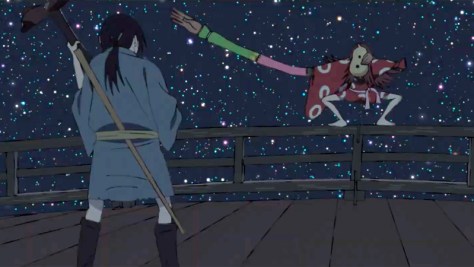
The crème-de-la-crème (or whatever a robot-preferred dessert substance may be) is “Nightmare” (dir. Takashi Nakamura), a beautifully eerie fantasia with a cartoonishly comic undercurrent. A strange ‘bot astride a hovering mono-cycle travels the night, zapping power transformers, vehicles—anything electrical—to summon therefrom smiling prowlers. (The sight of dozens of jaggedly lithe metal gremlins springing from an earth-mover will happily haunt my memory for years to come.) This eldritch summoner, whose manner and appearance suggest the fabled Pied Piper, is interrupted by a drunk, who espies the massing mechanical monsters and tries to hie to safety on his scooter—only to zip headlong into the massive puppet-master-bot for a sequence worthy of “Merry Melodies.”

As with any mixture, the quality varies from section to section. However, considering these anime shorts were produced by the director/animator team behind Akira, there is much comfort—and much robot—to be taken in the fact that they are one talented team among many involved in this cavalcade of clankinous and creepy contraptions . Across the seven short films, flanked by Katsuhiro Ôtomo and Atsuko Fukushima’s paired intro and outro, Robot Carnival clatters along at an occasionally uneven, but never dull, shambling of hisses, humor, gears, and grandeur.

WHAT THE CRITICS SAY:

“If you’re a core anime fan, these shorts may be a little too alien and unfamiliar, but if you have a soft spot for creative animation then there’s plenty to love here… The animation is exemplary, the art styles wildly original and the stories support the madness.” -Niels Matthijs, Onderhond

CAPSULE: INSPECTOR IKE (2020)

366 Weird Movies may earn commissions from purchases made through product links.

Recommended

DIRECTED BY: Graham Mason

FEATURING: Ikechukwu Ufomadu, Matt Barats, Grace Rex, Jessica Damouni, Ana Fabrega, Anthony Oberbeck, John Early

PLOT: Inspector Ike investigates a murder at an avant-garde theater group.

Strill from Inspector Ike (2020)

COMMENTS: Inspector Ike is a parody of a very specific subgenre— 1970’s mystery-themed “movies of the week,” a la “Columbo”—from the nearly extinct Zucker/Abrahams/Zucker-Mel Brooks school of tomfoolery. Presented as a faux episode of a ongoing movie-of-the-week series, complete with animated intro with a magnifying-glass carrying, trenchcoated sleuth, the movie drops us into a world where Inspector Ike already exists, catching new crooks week after week with his signature finishing move: hiding handcuffs near some incriminating piece of physical evidence, then toasting the perp with a wink and a glass of champagne.

This “episode” (“Audition for Death”) follows an struggling actor who kills his mentor so he can take the lead in his troupe’s production of the one-man musical “Mannie.” In “Columbo” fashion, we see the murder first, and suspense comes from watching Ike try to put the pieces together, while the killer tries to cover his tracks. The theater world setting allows the film to poke some gentle fun at the off-off-Broadway scene (the mythical “Avant-Garde Alley,” where you find mimes and kabuki actors smoking on stoops in-between rehearsals); that milieu, after all, is not all that different than the world of New York’s underground comedy scene from which Ike‘s cast was drawn. Like a true TV villain, murderer Matt Barats hams the hell out of his part, all sideways glances and sly grins before the heat turns on, then big-eyed and twitchy, like a hack in the Scottish play seeing an imaginary drop of blood on his corduroy sleeve. By contrast, Ufomadu’s Ike is totally deadpan; suave and quietly competent whether he’s fixing a tilted picture with his shadow or cooking a pot of chili in a nervous suspect’s apartment. A wide range of always humorous supporting actors occupy the spaces between these two combatants, most notably scene-stealing Deputies Hawthorne and Dinardo, who can never seem to stay on topic during their consultations with Ike.

Inspector Ike gets the fond camp tone exactly right—possibly because there’s not a lot of well-worn tropes to overparody in this extremely specific subgenre, which allows the script freedom to simply wander in the direction of whatever joke it finds most amusing at the moment. Despite the minuscule budget, Ike seems like a relic of the era, based mainly on accurate 70s wardrobes (Harry’s mustard turtleneck, Ike’s powder-blue suit with wide striped tie) and appropriate touches like commercial fadeouts. The film was shot on the streets of Brooklyn, carefully avoiding anachronisms. Casting such a project with local stand-ups rather than full-time thespians was a wise choice; low-budget comedies often fail because the actors lack comic timing and instincts, which is never an issue here. I’ll confess that I rarely found any of the gags laugh-out-loud funny, but that wasn’t a problem, because the likeable cast carries the movie along on a pleasant current of low-key absurdity that never becomes either boring or upsetting.

So it’s fun, but is it a weird movie? Well, mildly so, in at least in its general conception. In his director’s commentary, Mason says that he was trying to create something that “nobody asked for,” an artifact that would leave the audience wondering “why does this even exist?” but glad that it does. He succeeds in this goal admirably, and I’d love to see more stuff from the Mason/Ufomadu team that I never asked for.

It’s a shame that Inspector Ike did not land a streaming deal so that more people could see it, but the Blu-ray package is well worth the purchase for comedy fans. It features a commentary track by director/co-writer Mason, and a booklet with more Graham commentary, an “Inspector Ike” episode guide, and a word search puzzle. Along with the memorable trailer, two comic Ufomadu/Mason short collaborations round out the package: “Words with Ike” (a “word of the day” TV parody) and “The Photos of Ana” (with “Detective Hawthorne” Ana Fabrega). Both shorts have the same underplayed, off-kilter comic sensibilities as Inspector Ike. The package even includes an official Inspector Ike recipe card, which you can use to jot down ingredients and directions for Ike’s detailed chili recipe when prompted.

WHAT THE CRITICS SAY:

“As pop culture deep cuts go in 2022, ‘Inspector Ike’ certainly has the weirdest inspiration in recent memory… Ufomadu is terrific in the part, and the rest of the cast commits to the weirdness of the effort. Not every joke lands, or is even attempted, but there are spirited, dryly hilarious performances to enjoy throughout the endeavor.”–Brian Orndorf, Blu-ray.com (Blu-ray)

CHANNEL 366: THE SANDMAN (2022)

366 Weird Movies may earn commissions from purchases made through product links.

Recommended*

DIRECTED BY: Mike Barker, Jamie Childs, Mairzee Almas, Andrés Baiz, Coralie Fargeat, Louise Hooper,

FEATURING: Tom Sturridge, Boyd Holbrook, Vivienne Acheampong, Vanesu Samunyai, , voice of

PLOT: Captured by a human magician, the entity Dream escapes after a century and sets about reclaiming his tools to rebuild his realm.

Still from The Sandman (2022)
The Sandman. Tom Sturridge as Dream in The Sandman. Cr. Courtesy of Netflix © 2021

COMMENTS: This Sandman is no “candy-colored clown.” Dream is more of a contemplative type, deathly pale, darkly haired, and pursed-lipped. But then, when we meet him, he has considerable reason to be. Roderick Burgess, dark sorcerer extraordinaire, has captured the ruler of the dream lands, and, with his son taking over the guardianship upon the wizard’s passing, kept him incarcerated for a century. So begins Netflix’s chronicle of “The Sandman,” an effects-filled, symbol-heavy, and, yes, dreamy vision of ‘s much beloved comic book series.

Dream is one of seven godlike entities collectively known as “the Endless,” and his realm (“the Dreaming”) is laid out in full splendor as we travel through it while he softly narrates the introduction. Tom Sturridge’s performance as Dream is well up to the task (even accounting for his excessive habit of pursing his lips). The first episode chronicles his capture, hinting at the world’s characters as we observe the Dream trapped in a glass-and-steel orb nestled within a summoning circle. There is a sad twist from the get-go, for we learn that it was not this particular Endless that Burgess was after—he intended to capture Death, to bargain with her to return his dead son.

Kirby Howell-Baptiste, as the friendliest Death this side of the divide, and Gwendoline Christie, as a prim-and-proper-and-not-ever-to-be-crossed Lucifer, shine in their roles. Dream’s early encounter with Lucifer in Hell hints of some nastiness to come (in season two, presumably). You see, having escaped his cage, Dream is weakened not only by the long-separation from his realm, but also from the loss of his regalia: a bag of sand which allows him to travel the dream world (as well as summon it); a helm, which allows him to travel freely through the waking world; and most importantly, a ruby amulet which allows him to craft dreams—and destroy them.

The fifth episode is the best. I give nothing away by telling you that Dream does collect his accessories, and it is in the pursuit of the final element—the ruby—that “The Sandman” experiences its strangest turn. Set almost entirely within a diner, the episode explores one man’s dream of a better world: a world in which lies cannot exist. The antagonist, and the man with this dream, is one John Dee (David Thewliss, providing the best performance of the series), the civilly unhinged son of the woman who stole Dream’s gear from Burgess all Continue reading CHANNEL 366: THE SANDMAN (2022) →

APOCRYPHA CANDIDATE: INCREDIBLE BUT TRUE (2022)

366 Weird Movies may earn commissions from purchases made through product links.

Incroyable mais vrai

Recommended

DIRECTED BY: Quentin Dupieux

FEATURING: , , Benoît Magimel,

PLOT: Unlike his wife, Alain isn’t impressed by the dazzling feature hidden away in the basement of their new home, and his boss Gérard can’t believe that neither of them are impressed by his new penis.

WHY IT SHOULD MAKE THE LIST: Dupieux takes on two absurd premises and runs with both in tandem, and in so doing explores some lofty themes by way of a time-travel plot device and a “steerable” iPenis.

COMMENTS: Please believe me when I say there was a legitimate reason why I began earnestly checking my watch two-thirds into this (*gasp*), and for hoofing it out of the auditorium before the end credits had finished (double-*gasp*). Incredible But True filled me with such enthusiasm that I felt it imperative to return to my hotel room as quickly as possible to write this review. So, here I am. I made good time—and that is a perfect segue.

Dupieux’s latest film is predominately about time, and its passing. About aging, and aging’s ramifications. Alain (Alain Chabat, in full-on mellow) is an insurance functionary, and he and his wife purchase a new home featuring an odd basement amenity that, as the realtor explains after much breathless “You won’t be believe this…”, defies the laws of space and time. The upshot of it is a slooooow path to youth. This prospect leaves Alain amused, but fairly indifferent; his wife Marie becomes obsessed. Before the domestic feature takes over her life, the two have dinner with Alain’s boss Gérard, and his girlfriend Jeanne. These dinner guests explain, after much delay in the reveal, that Gérard got an upgrade.

The deadpan comedy trundles along to a plucky score, with the surrounding absurdity perfectly bouncing off Alain Chabat’s unflappable demeanor. His character is older, and content with it; has his limitations, and is at peace with those. Marie becomes obsessed with youth, Gérard is obsessed with being perceived as masculine—exemplified most obviously by his implant, but also by his penchant for fast cars and firing ranges, where a nasty recoil incident triggers his first run-in with technological fallibility. In many ways, Alain is more like Jeanne, an avidly sexual being who lives for the now and neither makes nor demands apologies from others living their lives.

Having set this plot in motion, Dupieux lets it roll nicely until…

Until…

Until… it just kind of ends. I like to think that I understand, as much as one might hope to, what Dupieux is about. I love that no idea is too crazy, and that someone out there is making comedies that are clever and outlandish. But too often, his movies just seem to stop. He’s got the middles nailed, and is good enough setting his various gears in motion (maybe he’d do well to talk with Steven Penny), but though I don’t necessarily demand a punchline, or, Heaven forbid, a nicely wrapped-up narrative complete with expository ribbon, Rubber, Keep an Eye Out, and now Incredible But True all feel like they cop-out on the finale. That said, I can still full-throatedly recommend this movie—as could the hundreds of fellow viewers who laughed along with me through the feature. Indeed, watching a Dupieux film in a theater full of avid enthusiasts was almost as surreal as the film itself.

WHAT THE CRITICS SAY:

“Throughout the film’s lean 74 minutes, Dupieux coaxes four strong core performances, while the jaunty bounce of Jon Santo’s synth-led score mirrors the film’s cheerful weirdness.” -Lou Thomas, Sight & Sound (festival screening)

APOCRYPHA CANDIDATE: INU-OH (2021)

366 Weird Movies may earn commissions from purchases made through product links.

犬王

Recommended

DIRECTED BY: Masaaki Yuasa

FEATURING: Voices of Avu-chan,

PLOT: A blind itinerant priest crosses paths with “the King of Dogs”, a vivacious and deformed creature with a talent for dancing; through the priest’s music and the dancer’s storytelling, they attempt to lay the lost souls of the Heike clan to rest.

WHY IT SHOULD MAKE THE LIST: I have come to the conclusion that perhaps everything in Masaaki Yuasa’s œuvre should get canonized, particularly as we now have the elbow room to do so. (Night is Short, Walk on Girl was shortchanged due to numeric constraints.) Inu-oh brings an unlikely legend to bombastic life, fusing rock opera, ballet, pyrotechnics, spirits, curses, gender self-discovery, physical transformation; it’s a 21st-century story about a 14th-century performance troupe unearthing the secrets of an 12th-century war.

COMMENTS: It tickles me that Inu-Oh is Masaaki going “commercial.” This stems to a great extent, of course, from the fact that here in the United States, film norms are sickeningly normal: we are reigning kings of the lowest white bread denominator (so much so that it was controversial when Disney took a belated and modest stand against overtly bigoted legislation in its home state). Among the many themes explored in Inu-Oh, gender identity is near the fore, along with the nuances of parental acceptance of someone’s true self.

But let me stop that vein of thought for the moment. This is film for, and about, entertainment. It’s about musical revolution, and the delineation of the esteemed Noh tradition, which harkens back to the middle of last millennium. Inu-Oh follows Noh’s traditional story arc, lacing it with modern rock sensibilities. (Well, maybe not “modern” rock, but certainly strains of Buddy Holly through Jimmie Hendrix and Freddie Mercury.) The titular character is a born performer, despite—or because of—the fact he is a born monstrosity: an unnamed son of a proto-Noh performer, a boy of ambiguous shape, deformed face, and a long, strong arm. He embraces his outcast status, at one point referring to himself as “the Horrible Gourd” in honor of his misshapen mask. But as the son of a dance troupe leader, it comes as no surprise that Inu-Oh was born to jump and jive.

Tomona, the biwa priest, has a comparatively subtler trajectory. The son of a salvage diver, he is blinded at a young age when he and his father retrieved cursed regalia. Masaaki’s visual treatment of this unseeing musician is a treat, as total darkness gains rough outline of form with each sound Tomona hears. Being unable to see, the priest-musician (a biwa is never without his four-string shamisen and bachi) does not fear Inu-Oh, and is so able to help the mutant through his journey. Tomona’s personal journey is also about transformation as he evolves into an increasingly feminine entity, adopting the name Tomaori by the film’s end. The morphing of their name allows them to grow into their true form, but plays havoc with the spirit world, and with their ancestors—as one’s given, or accepted, name is what allows Tomona/Tomaori’s father to maintain contact from the afterlife.

While the first half of Inu-Oh is “merely” steeped in music, song, and dance, the second half is one long string of hand-clapping, foot-stomping musical numbers showcasing the monumental talents Tomona and Inu-Oh share as natural performers. They give the forgotten fate of the Heike spirits full-throated treatment, with Inu-Oh performing transgressively non-traditional storytelling through song and dance, while Tomona positively shreds it on their shamisen. Contemporary shogunate politics play a role in the story as well, as does the concurrent, tragic tale of Inu-Oh’s fame-obsessed father. Masaaki Yuasa never settles for half measures, and every theme—friendship, salvation, transformation, politics, and music—ties together in an animated vortex of vivacity and sonic rollercoaster of rocking melody.

WHAT THE CRITICS SAY:

“This anachronistic rock musical promises a return to the playful, literary surrealism of ‘The Tatami Galaxy’ (2010) and its 2017 spin-off, ‘Night Is Short, Walk On Girl,’ but comes up short… There are individual sequences that reach the psychedelic heights of Yuasa’s best work. But too often, this tale of the liberating power of art is about as mind-expanding as an early-afternoon set at Fuji Rock Festival.”–James Hadfield, Japan Times (contemporaneous)