Tag Archives: Recommended

CAPSULE: WATCHMEN (2009)

Recommended

DIRECTED BY: Zach Snyder

FEATURING:, Jackie Earle Haley, Jeffery Dean Morgan

PLOT: As the film opens in an alternate past in 1985, Richard Nixon has been re-elected to a fifth presidential term as the Cold War rages on, costumed superheroes are integrated into the national security defense framework, the nuclear Doomsday Clock has ticked forward to five minutes to midnight, and ex-Watchman “the Comedian” has just been thrown through the window of his Manhattan high rise.

watchmen

WHY IT WON’T MAKE THE LIST:  Not weird enough.  Watchmen is about as weird as big-budget major studio releases will ever be allowed to get, which weirdness explains why Watchmen was released as a Spring rather than a Summer blockbuster.  All the oddness, however, resides in the scenario.  Once the rules of this alternate universe are laid out—superheroes are real, they have tawdry affairs and abuse their power in bursts of sociopathic violence—Watchmen goes about its business with strict action-movie realism.

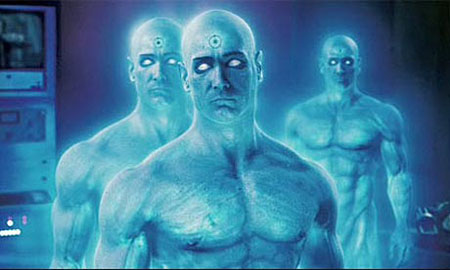
COMMENTS: The brilliant montage over the opening credits is a distillation of “all-too-human” vignettes in which we see four decades of masked avengers interact on a fictionalized American history stage, to the strains of Bob Dylan’s “The Times They Are a Changin’.” A costumed moth-man is dragged off to an insane asylum, and a glowing blue man in a three piece suit shakes hands with a grateful JFK, and Andy Warhol paints pop portraits of caped crusaders. The opening captures what is good about Watchmen: the setting is so original that the film relocates you into its own peculiar universe, which is what escapist entertainment is supposed to do.  And this one has just enough of a veneer of philosophical and political depth (“who watches the Watchmen?”) to give adults an intellectual justification to sit back and enjoy a comic book on film.  The flawed superheroes are briefly sketched, but their slightly twisted archetypes capture our interest.  The noirish Rorschach has an inflexible vigilante code of justice and ever-shifting inkblot mask; atomic superman Dr. Manhattan deploys his colossal blue CGI penis as unashamedly as he does his godlike power to create special effects, all the while suffering existential detachment as his contemplation of quantum realities alienates him from human ones. The script weights the amount of time devoted to each of the intertwining stories and backstories well, supplying a rich context without becoming confusing.  The film’s nihilism ultimately appears as little more than a tonal choice, much like a decision to film in black and white instead of Technicolor. The setting is absorbing enough to make most overlook the films more than occasional gaffes, from the excessively visceral, bone-cracking and blood-spurting violence meant to deglamorize the heroes to a laughably glamorous moonlight lovemaking scene in a hovering owlcraft.

From the standpoint of someone who hasn’t read the beloved comic book graphic novel from which the movie was adapted, it’s amusing to observe Internet kvetching over the movie’s supposedly superhuman power to drain the source work of it’s magic.  Even reviews by professional critics often devolve into column-length comparisons of the literate merits of the original to the relatively pedestrian film version.   But, coming to the film not expecting it to have the intellectual depth and characterization of a novel, I found the movie Watchmen to be an excellent advertisement for the source material.

WHAT THE CRITICS SAY:

“‘Watchmen’ is… going to be the ultimate tough sell: there will be those who view the film as a bewildering mishmash of underexplored themes, thinly sketched characters and noisy, excessive violence… And yet, there’s something admirable about the entire enterprise: its ungainly size, its unrelenting weirdness, its willful, challenging intensity.”–Tom Huddleston, Time Out London (contemporaneous)

17. TIDELAND (2005)

“[Producer] Jeremy [Thomas] knew [raising money to make Tideland] would be difficult, particularly because the film is very, very weird.”–Terry Gilliam

Recommended

DIRECTED BY: Terry Gilliam

FEATURING: Jodelle Ferland, Brendan Fletcher,

PLOT: Jeliza-Rose is a nine year old girl with an active imagination who is being raised by a pair of junkies. When her father spirits her away to a lonely, dilapidated farmhouse, then takes an extended “vacation” on heroin, Jeliza-Rose is left to her own devices. She retreats into an intricate fantasy world where her four doll’s heads are her closest companions, but reality is scarcely less bizarre than her imagination: her neighbors are a witch-like one-eyed woman with an unhealthy interest in taxidermy and a childlike mentally retarded man who also lives in his own fantasy world.

tideland


BACKGROUND:

  • Tideland was adapted from a critically praised novel by Mitch Cullin; ironically, this faithful movie adaptation was critically panned.
  • Gilliam made Tideland while on a six month hiatus from directing the big-budget commercial fantasy, The Brothers Grimm (2005).
  • Tideland was a commercial disaster, earning less than $100,000 in its initial domestic run.
  • According to Gilliam, the French distributor did not want to screen this film at Cannes because there is a scene involving farting, which the French find objectionable.

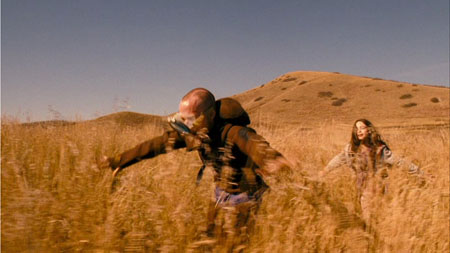
INDELIBLE IMAGE:  Many will remember Jeliza-Rose’s doll’s heads, who make memorably fantastic appearances in an underwater house and flying about inside a man’s ribcage.  But the more indelible image, because it’s repeated so many times, is the view of the broken down farmhouse in front of amber waves of grain.  The look was inspired by the Andrew Wyeth paining “Christina’s World,” and, though unacknowleged, also from the 1990 film The Reflecting Skin (which had an almost identical look as well as an eerily similarly child protagonist). Gilliam often emphasizes the tall gold grass towering over tiny Jeliza-Rose’s head, as if it were surf and she was living in an undersea world.  This ubiquitous aquatic imagery helps to explain the title “Tideland“.

WHAT MAKES IT WEIRD:  Gilliam has described the movie as a cross between “Alice in Wonderland” and Psycho, which sounds weird enough on its own terms. He pushes the envelope of weirdness even further with his trademark visual flair for phantasmagorical set pieces, for example, with a gloriously imaginative sequences of Jeliza-Rose falling down a rabbit hole full of tumbling syringes. But even if the audience wasn’t planted firmly inside the skull of the 9-year-old heroine, peering out onto this grotesque world through her child’s eyes, the scenario would have been weird, as the world of Tideland is peopled by grossly exaggerated lowlifes who live out their lives on the lonely fringes of plausibility.


Original trailer for Tideland

COMMENTS: Tideland is a misunderstood film, which is not automatically the same thing Continue reading 17. TIDELAND (2005)

13. KUNG FU HUSTLE (2004)

AKA Kung Fu, Kung Fu-sion

“It’s good to go over the line.  It’ll be boring if it doesn’t.  Following reality is not refreshing for me.”–Yuen Woo-ping, fight choreographer for Kung Fu Hustle

Recommended

DIRECTED BY: Stephen Chow

FEATURING: Stephen Chow, Qui Yuen, Wah Yuen, Siu-Lung Leung

PLOT: The Axe Gang, hatchet-wielding hooligans garbed in black-tie evening wear, terrorizes Shanghai in the 1930s. Only the poorest areas avoid falling under their thumb—neighborhoods like Pig Sty Alley, a tenement building where every other resident seems to have one-in-a-million kung fu powers.  When an incompetent ersatz gangster tries to extort protection money from the residents of Pig Sty Alley, he accidentally sets in motion a series of events that brings the Axe Gang into conflict with the poor fighters, with explosive results.
Still from Kung Fu Hustle (2004)

BACKGROUND:

  • Director Stephen Chow worked his way up from the trenches of the Hong Kong film industry, starting in television (including a stint as a children’s TV host). He became one of Hong Kong’s most popular comedians, specializing in a verbal style of comedy called “mo lie tau” (roughly, “nonsense”), which relies heavily on puns, wordplay, incongruities and non sequiturs. He began directing in 1994.
  • Chow’s previous film, Shaolin Soccer (2001), was supposed to be his breakthrough film in the West, but distribution was botched by Miramax and the picture became only a small cult hit on DVD.
  • Chow coaxed many older actors from the kung fu’s heyday out of retirement to star in major roles in Kung Fu Hustle. Qui Yuen (who played the part of “Landlady”) was one of the few female martial arts stars of the 1970s and had a small non-speaking role in the Bond film The Man with the Golden Gun. Wah Yuen (“Landlord”) has over one hundred acting credits, mostly from the late 1970s and early 1980s, and was at one time Bruce Lee’s stunt double. Siu-lung Leung (“The Beast”) was at one time considered third only to Bruce Lee and Jackie Chan as a martial arts star, and had been retired from the film business since 1988.
  • Kung Fu Hustle was the most profitable feature in Hong Kong cinema history. In its US theatrical run it opened as the #5 movie in the country and became the highest grossing foreign language film of 2005.

INDELIBLE IMAGE: There are so many memorable images in Kung Fu Hustle that it’s impossible to determine a consensus favorite.  The vision of two harpist assassins who strum their instruments to summon swords and warriors is a strong candidate, because their poetic menace draws a strong contrast to the lighter and less serious tone of the rest of the film.  Other contenders include the Axe Gang’s Broadway dance number, the Landlady’s whirling Road Runner legs, and a beatific Buddha in the clouds.

WHAT MAKES IT WEIRD: Kung Fu Hustle begins with a brutal and atypically realistic gangland slaughter on the neon-washed streets of Shanghai, and to celebrate gaining control of the city, the Axe Gang breaks into a carefully choreographed Busby Berkeley style fox trot, waving their tomahawks in the air. From this moment, the viewer realizes that they are in the hands of a maestro for whom reality is almost infinitely malleable, and who’s willing to switch cinematic styles at the drop of a hatchet to produce the effect he needs. Chow’s direction drives the movie through numerous stylistic incarnations, from absurd visual comedy through a ballet of breathtakingly beautiful and unreal violence, while quoting everything from Wong Kar Wai to The Shining and The Untouchables to Warner Brothers’ “Looney Tunes,” yet never loses its grip on the story or alienates the viewer with its madcap diversions.

U.S. release trailer for Kung Fu Hustle

COMMENTS:Kung Fu Hustle is likely to be the most commercially successful, mainstream Continue reading 13. KUNG FU HUSTLE (2004)

CAPSULE: CORALINE (2009)

366 Weird Movies may earn commissions from purchases made through product links.

Recommended

DIRECTED BY: Henry Selick

FEATURING: Dakota Fanning (voice), Teri Hatcher (voice)

PLOT:  A petulant little girl finds a parallel universe behind a hidden door in an old house, a world where her parents are more attentive, her neighbors more fascinating, and the entire universe seems set up to pamper and delight her; she can stay there forever, but of course there’s a catch.

Still from Coraline (2009)

WHY IT WON’T MAKE THE LIST:  I attended a screening with a ten-year old and asked him if he thought the movie was “weird.”  His answer: “Nah, not unless you think every fantasy movie is weird.”  Smart lad.

COMMENTSCoraline is a welcome dark fantasy for children, although its themes of evil Doppelgänger moms, frightening buttons, and implied eye-gouging are too scary for very little ones.  Since it’s from Hanry Selick, the director of the borderline weird Nightmare Before Christmas, we suspect going in that the art direction and stop-motion animation will be the real stars.   Selick does not disappoint, shuffling the viewer through three distinct visual styles: the dingy earth tones of real life, a brightly colored, eye-popping fantasy world, and a sinister, disintegrating universe with an insect trapped in a spiderweb theme.  The storyline, and the unexpected scares once the movie shifts from childhood fantasy to childhood horror in the third act, make Coraline more than just eye candy for the kiddies.

Presented in theaters in 3-D, but the novelty doesn’t add anything significant to experience: I would have been just as happy to watch the same moving pictures tell the same story on an unabashedly flat screen.  Though there’s nothing really weird to be found here, Coraline, in the best children’s’ movie tradition, is worth a trip even for adult fans of fantasy and pure escapism.

WHAT THE CRITICS SAY:

“Coraline discovers a Wonderland filled with surreal characters and dark implications that make a kid grow up quick… those who tough it out with this twisted, trippy adventure in impure imagination will only be the better for it.”–Peter Travers, Rolling Stone

11. JACOB’S LADDER (1990)

“Something weird is going on here.  What is it about us?  Even in ‘Nam it was always weird.  Are we all crazy or something?” –line in original screenplay to Jacob’s Ladder

Recommended

DIRECTED BY: Adrian Lyne

FEATURING: , Elizabeth Peña, Danny Aiello

PLOT:  Jacob Singer (nicknamed “Professor” by his army buddies due to his glasses and Ph.D.) is wounded in Vietnam after a harrowing, disorienting battle.  While he is on duty in Vietnam, his young son dies; years later, he works in New York City as a postman and has a sexy new girlfriend, Jezzie.  Jacob begins suffering flashbacks of the day he was wounded, along with hallucinations in which everyday people take on demonic forms—catching brief glimpses of tails, horns, and howling faces with blank features—and eventually discovers that the other members of his unit are experiencing similar symptoms.

jacobs_ladder

BACKGROUND:

  • The script for Jacob’s Ladder shuffled between Hollywood desks for years, impressing executives but not being viewed as a marketable project. The script was cited by American Film Magazine as one of the best unproduced screenplays.
  • Before he asked to direct Jacob’s Ladder, British director Adrian Lyne was best known for sexy, edgy, and profitable projects such as Flashdance (1983), 9 1/2 Weeks (1986) and Fatal Attraction (1987).
  • Screenwriter Bruce Joel Rubin (who later wrote Ghost [1990] and other commercial properties) says that his script was partly influenced by The Tibetan Book of the Dead.
  • Adrian Lyne states that some of the hellish visual cues in the film, including the whirring and vibrating head effect, were inspired by the woks of grotesque painter Francis Bacon.
  • Lyne deleted scenes and changed the ending after test audiences found the film to be too intense.

INDELIBLE IMAGE:  A blurred, whirring human head which shakes uncontrollably from side to side at tremendous speed, seen several times throughout the film.  The effect looks mechanical, as if the head were an unbalanced ball attached to an out-of-control hydraulic neck.  It was achieved by filming an actor casually shaking his head from side to side at four frames per second, which produced a terrifying effect when played back at the standard twenty-four frames per second.  The technique has been imitated in movies, video games, music videos, and even a porno flick since, but has never since been used to such fearsome effect.

WHAT MAKES IT WEIRD:  Like many psychological thrillers, Jacob’s Ladder strives to keep the audience disoriented and off-balance, wondering what is real and what is false. The movie achieves this effect wonderfully, but what gives it it’s cachet as a weird movie are two intense hallucination sequences: one at an horrifically orgiastic party intermittently lit by a strobe light, and one where the protagonist lies helpless on a hospital gurney as he’s wheeled down an increasingly bizarre and alarming hospital corridor. Both scenes are difficult to forget, equal parts creepy surrealism and visceral body-horror.

Original Trailer for Jacob’s Ladder

COMMENTS: I can’t watch Jacob’s Ladder without comparing it to Alan Parker’s Angel Heart.   The similarities are obvious: both were psychological thrillers with supernatural Continue reading 11. JACOB’S LADDER (1990)