Tag Archives: Recommended

CAPSULE: WRISTCUTTERS: A LOVE STORY (2006)

366 Weird Movies may earn commissions from purchases made through product links.

Recommended

DIRECTED BY: Goran Dukic

FEATURING: Patrick Fugit, Shannyn Sossamon, Shea Whigham, Tom Waits

PLOT:  In a special afterlife reserved for suicides, three lost souls hit the road: Zia is searching for his earthly lover, Mikal is convinced she’s here by mistake and is looking for the People in Charge, and Eugene is along for the ride because he has nothing better to do.

wristcutters_a_love_story

WHY IT WON’T MAKE THE LIST:  Despite the sunglasses-snatching black hole that’s taken up permanent residence under the passenger seat in Eugene’s old beater, Wristcutters never really crosses the shaky border into the land of the weird. A few magical realist touches decorate this otherwise conventional, indie-flavored road movie/love triangle that’s best described as “quirky.” (If you know of a review that doesn’t use the word “quirky” to describe this movie, please contact the proper authorities; the writer needs to have his or her critical credentials yanked).

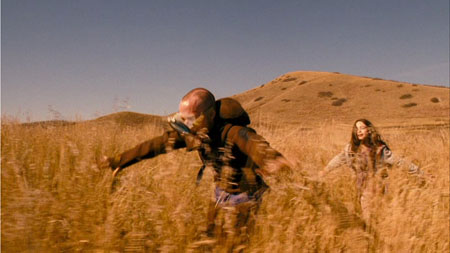
COMMENTS:  Adapted from a story by Etgar Keret, Wristcutters is a romantic comedy disguised as a black comedy, a conventional movie disguised as a bizarre movie, and a shamelessly hopeful movie disguised as a bleak movie. None of those disguises are particularly hard to penetrate. “Who could think of a better punishment, really? Everything’s the same here, it’s just a little worse,” newly deceased wristcutter Zia realizes soon after he gets a pizza delivery job in the afterlife. In Wristcutters, new suicides wake to discover a Great Beyond that’s not so great: in fact, it’s set in the middle of the Mojave desert where everything is so run down and recycled, even the automobiles are held together mostly by duct tape. Furthermore, in the most dreadful dissimilarity to the living world, its denizens find themselves unable to smile, a restriction that makes the sympathetic performances of the young principals all the more impressive. Still, the movie always has a hopeful sense that the main characters can find a way out of their existential predicament, and it doesn’t disappoint those hoping for a happy ending (though some may consider it a cop-out). Although Wristcutters sometimes reeks of missed opportunities to explore deeper themes and blacker comedy in a more mystical landscape, it’s also apparent that director/scripter Dukic has hit exactly the lightly offbeat tone he was aiming for, and he has the good sense to wrap the story up quickly after his world runs out of new Purgatorial quirks to offer. A couple of tunes by Tom Waits (who also offers up a memorable turn as ramshackle but wizardly guiding spirit Kneller) and Gogol Bordello bump up the cool quotient considerably.

After this successful debut, Croatian director Dukic is poised between worlds: he could use this feature as springboard to do something even more conventional, or push his offbeat impulses to their logically weird conclusion. We’ll keep an eye on him.

WHAT THE CRITICS SAY:

“What makes it work is that the performers, trapped in a weird movie about a weird place, underplay their astonishment.”–A.O. Scott, New York Times (contemporaneous)

(This movie was nominated for review by reader “Natalia.” Suggest a weird movie of your own here.)

Wristcutters
  • Region 1 (U.S. and Canada only)
  • Multiple Formats, AC-3, Closed-captioned, Color, Dolby, NTSC, Widescreen
  • 88 minutes
  • NR
  • English

19. THE REFLECTING SKIN (1990)

“You been exploding frogs again?”–Ruth Dove

Recommended

DIRECTED BY: Philip Ridley

FEATURING:  Jeremy Cooper, , Lindsay Duncan

PLOT:  Over-imaginative young Seth, growing up in post-World War II rural USA, comes to believe that his widowed neighbor is actually a vampire.  After his father dies in unexpected fashion, the older brother he adores returns from his military tour of the Pacific.  When the brother falls in love with the vampire widow, Seth tries to find a away to save him.

Still from The Reflecting Skin (1991)

BACKGROUND:

  • This was Philip Ridley’s first directorial effort, after breaking into the movie business by writing the script for The Krays. He is also an author of children’s books.
  • A top-billed, pre-fame Viggo Mortensen had just come off playing the role of the cannibal “Tex” in Leatherface: Texas Chainsaw Massacre III.
  • The production company for the film (Bialystock & Bloom Limited) is jokingly named after Zero Mostel and Gene Hackman’s characters in The Producers.
  • This film, with its hyper-imaginative child protagonist roaming among golden fields of wheat, was an obvious inspiration for Terry Gilliam‘s 2005 film Tideland, which has a slightly different atmosphere but can be seen as a companion piece.

INDELIBLE IMAGE:  Seth cradling and asking advice from the petrified baby (which he believes to be an angel) that he found hidden in an egg-like box in a hayloft chapel.

WHAT MAKES IT WEIRD:  Nothing that happens in The Reflecting Skin is literally impossible.  Much of the film’s bizarre effect comes from the characters, especially the weird widow Dolphin who is obsessed with decay and destruction and whose husband hanged himself after a week of marriage. Other characters who form the background of young Seth Dove’s weird world are his perpetually on the verge of tears, creatively abusive mother; a father who reeks of gasoline and hides a secret past; a drunken neighbor obsessed with his own sinful thoughts who dresses like a Puritan; the world’s unluckiest town sheriff, who has lost three body parts to animal attacks and who wears a slice of a colander for an eyepatch; and a hot-rod hearse full of juvenile delinquents that haunts the back roads of this Midwestern farm community.  Altogether, it’s a such an odd concoction of unlikely ingredients, told in a straightforward dramatic manner, that might earn the label “improbable realism” (as well as “Midwestern Gothic”).

Original trailer for The Reflecting Skin

COMMENTS: On it’s release in 1990-1991, The Reflecting Skin was frequently compared to Continue reading 19. THE REFLECTING SKIN (1990) →

SHORT: GREEN PORNO – FLY (2008)

Recommended(episode & 1st season series)

DIRECTED BY: Isabella Rossellini & Jody Shapiro

FEATURING: Isabella Rossellini

PLOT: A fly bides its time explaining to us how it escapes being swatted by humans, lands upside down on the ceiling, and spits into its food to dissolve it, until it sees a female and rushes to mate.

Complete short film, Green Porno: Fly.  (Requires Adobe flash player).

WHAT MAKES IT WEIRD:  The reproductive processes of insects are strange and sometimes gruesome, but Rossellini describes them in deadpan fashion with a sly and detached wit that accentuates their alien-ness even further.

COMMENTS:  The first “Green Porno” series of eight short films ran as bumpers on the Sundance Channel in 2008.  Each approximately two minute film describes the morphology and exotic mating habits of a different bug—spiders, flies, earthworms, snails, bees, praying mantises, dragonflies, and fireflies.  Rossellini wrote, performed and co-directed the entire series.  Fly is one of the better episodes, although they are all similar in quality.  Although the films ostensibly have a documentary bent, the elegant, often childishly simple sets, costumes and art direction reveal that the series is inspired as much (if not more) by the theater as the classroom.  Rossellini’s performances can be subtly hilarious: note the big smile she flashes while copulating, and the abruptly disconcerting way she ends this episode with the image of her severed head accompanied by her proud fatherly proclamation, “Our babies grow up in cadavers.  They are called—maggots!”   She also seems to recognize that seeing a former sex symbol turned grandmotherly matron of the arts gleefully humping a model fly is going to look a little weird, and takes to the task with relish.  Although the films are meticulously clinical and entomological, depictions of insect beheadings, penetrations and S&M rituals among snails can be unnerving.

The entire series can be viewed on The Sundance Channel website.  A second season, covering sea creatures like the barnacle, starfish and limpet is airing currently on the channel and can also be viewed at the website.

WHAT THE CRITICS SAY:

“…defying all existing categories previously known to any species Rossellini has embarked on an affectionate, raw when not surreal, often tongue in cheek and intermittently lusty exploration of creature erotic appetites.”–Prairie Miller, Newsblaze

CAPSULE: WATCHMEN (2009)

Recommended

DIRECTED BY: Zach Snyder

FEATURING:, Jackie Earle Haley, Jeffery Dean Morgan

PLOT: As the film opens in an alternate past in 1985, Richard Nixon has been re-elected to a fifth presidential term as the Cold War rages on, costumed superheroes are integrated into the national security defense framework, the nuclear Doomsday Clock has ticked forward to five minutes to midnight, and ex-Watchman “the Comedian” has just been thrown through the window of his Manhattan high rise.

watchmen

WHY IT WON’T MAKE THE LIST:  Not weird enough.  Watchmen is about as weird as big-budget major studio releases will ever be allowed to get, which weirdness explains why Watchmen was released as a Spring rather than a Summer blockbuster.  All the oddness, however, resides in the scenario.  Once the rules of this alternate universe are laid out—superheroes are real, they have tawdry affairs and abuse their power in bursts of sociopathic violence—Watchmen goes about its business with strict action-movie realism.

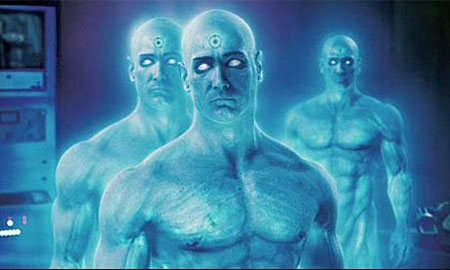
COMMENTS: The brilliant montage over the opening credits is a distillation of “all-too-human” vignettes in which we see four decades of masked avengers interact on a fictionalized American history stage, to the strains of Bob Dylan’s “The Times They Are a Changin’.” A costumed moth-man is dragged off to an insane asylum, and a glowing blue man in a three piece suit shakes hands with a grateful JFK, and Andy Warhol paints pop portraits of caped crusaders. The opening captures what is good about Watchmen: the setting is so original that the film relocates you into its own peculiar universe, which is what escapist entertainment is supposed to do.  And this one has just enough of a veneer of philosophical and political depth (“who watches the Watchmen?”) to give adults an intellectual justification to sit back and enjoy a comic book on film.  The flawed superheroes are briefly sketched, but their slightly twisted archetypes capture our interest.  The noirish Rorschach has an inflexible vigilante code of justice and ever-shifting inkblot mask; atomic superman Dr. Manhattan deploys his colossal blue CGI penis as unashamedly as he does his godlike power to create special effects, all the while suffering existential detachment as his contemplation of quantum realities alienates him from human ones. The script weights the amount of time devoted to each of the intertwining stories and backstories well, supplying a rich context without becoming confusing.  The film’s nihilism ultimately appears as little more than a tonal choice, much like a decision to film in black and white instead of Technicolor. The setting is absorbing enough to make most overlook the films more than occasional gaffes, from the excessively visceral, bone-cracking and blood-spurting violence meant to deglamorize the heroes to a laughably glamorous moonlight lovemaking scene in a hovering owlcraft.

From the standpoint of someone who hasn’t read the beloved comic book graphic novel from which the movie was adapted, it’s amusing to observe Internet kvetching over the movie’s supposedly superhuman power to drain the source work of it’s magic.  Even reviews by professional critics often devolve into column-length comparisons of the literate merits of the original to the relatively pedestrian film version.   But, coming to the film not expecting it to have the intellectual depth and characterization of a novel, I found the movie Watchmen to be an excellent advertisement for the source material.

WHAT THE CRITICS SAY:

“‘Watchmen’ is… going to be the ultimate tough sell: there will be those who view the film as a bewildering mishmash of underexplored themes, thinly sketched characters and noisy, excessive violence… And yet, there’s something admirable about the entire enterprise: its ungainly size, its unrelenting weirdness, its willful, challenging intensity.”–Tom Huddleston, Time Out London (contemporaneous)

17. TIDELAND (2005)

“[Producer] Jeremy [Thomas] knew [raising money to make Tideland] would be difficult, particularly because the film is very, very weird.”–Terry Gilliam

Recommended

DIRECTED BY: Terry Gilliam

FEATURING: Jodelle Ferland, Brendan Fletcher,

PLOT: Jeliza-Rose is a nine year old girl with an active imagination who is being raised by a pair of junkies. When her father spirits her away to a lonely, dilapidated farmhouse, then takes an extended “vacation” on heroin, Jeliza-Rose is left to her own devices. She retreats into an intricate fantasy world where her four doll’s heads are her closest companions, but reality is scarcely less bizarre than her imagination: her neighbors are a witch-like one-eyed woman with an unhealthy interest in taxidermy and a childlike mentally retarded man who also lives in his own fantasy world.

tideland


BACKGROUND:

  • Tideland was adapted from a critically praised novel by Mitch Cullin; ironically, this faithful movie adaptation was critically panned.
  • Gilliam made Tideland while on a six month hiatus from directing the big-budget commercial fantasy, The Brothers Grimm (2005).
  • Tideland was a commercial disaster, earning less than $100,000 in its initial domestic run.
  • According to Gilliam, the French distributor did not want to screen this film at Cannes because there is a scene involving farting, which the French find objectionable.

INDELIBLE IMAGE:  Many will remember Jeliza-Rose’s doll’s heads, who make memorably fantastic appearances in an underwater house and flying about inside a man’s ribcage.  But the more indelible image, because it’s repeated so many times, is the view of the broken down farmhouse in front of amber waves of grain.  The look was inspired by the Andrew Wyeth paining “Christina’s World,” and, though unacknowleged, also from the 1990 film The Reflecting Skin (which had an almost identical look as well as an eerily similarly child protagonist). Gilliam often emphasizes the tall gold grass towering over tiny Jeliza-Rose’s head, as if it were surf and she was living in an undersea world.  This ubiquitous aquatic imagery helps to explain the title “Tideland“.

WHAT MAKES IT WEIRD:  Gilliam has described the movie as a cross between “Alice in Wonderland” and Psycho, which sounds weird enough on its own terms. He pushes the envelope of weirdness even further with his trademark visual flair for phantasmagorical set pieces, for example, with a gloriously imaginative sequences of Jeliza-Rose falling down a rabbit hole full of tumbling syringes. But even if the audience wasn’t planted firmly inside the skull of the 9-year-old heroine, peering out onto this grotesque world through her child’s eyes, the scenario would have been weird, as the world of Tideland is peopled by grossly exaggerated lowlifes who live out their lives on the lonely fringes of plausibility.


Original trailer for Tideland

COMMENTS: Tideland is a misunderstood film, which is not automatically the same thing Continue reading 17. TIDELAND (2005) →