Tag Archives: Philosophical

42. JOHNNY GOT HIS GUN (1971)

“How can you tell what is a dream and what’s real when you can’t even tell when you’re awake and when you’re asleep?”–line from Joe’s internal monologue in Johnny Got His Gun

DIRECTED BY: Dalton Trumbo

FEATURING: Timothy Bottoms, Jason Robards, Donald Sutherland

PLOT:  Joe is an ordinary young man with a sweetheart back home who goes to Europe to fight World War I and is blown apart by an enemy shell. The accident leaves him limbless, deaf, and blind; the doctors assume he is brain dead, but keep him alive in hopes of learning how to cure similar brain injuries in the future. Left alone in a hospital bed with only his own thoughts for company for years on end, Joe drifts in and out of memories and dreams, while during his lucid moments he struggles to find a way to communicate with the outside world.

Sill from Johnny Got His Gun (1971)

BACKGROUND:

  • Dalton Trumbo wrote the novel “Johnny Got His Gun” in 1938; it won that year’s National Book Award for “Most Original Novel.”
  • Trumbo became a sought after screenwriter in Hollywood in the 1930s and 1940s. He joined the American Communist Party, and in 1947 he was brought before the House Un-American Activities Committee (the “McCarthy hearings”). Along with 9 others (the “Hollywood 10”), Trumbo was held in contempt of Congress for refusing to testify on the grounds that he believed the First Amendment protected his right to political association. Trumbo served several months in prison and was later blacklisted by Hollywood. While the blacklist was in effect he wrote the script for The Brave One; the screenplay won an Academy Award, but no one showed up to the Oscars to claim it. The person credited for the screenplay was actually a producer’s nephew.
  • Luis Buñuel, whom Trumbo had met while in a self-imposed exile in Mexico, was originally set to direct the adaptation of the novel. The two men went so far as to collaborate on a screenplay. When the deal fell through, Trumbo decided to direct the film himself. The image of Christ driving the locomotive was one typically Buñuelian touch that made it into the final product.
  • Johnny Got His Gun tied for the Jury Prize (second place) at Cannes.
  • The movie inspired the popular Metallica song “One,” and footage from the film features heavily in music video (included on the DVD).
  • There is also a 2008 version of Johnny Got His Gun available on DVD, which is actually a film version of the stage play.

INDELIBLE IMAGE: Jesus Christ howling out the window of a locomotive engine as he drives doomed doughboys to the front.

WHAT MAKES IT WEIRD: The bizarre flashbacks and fantasies Joe endures for years on end as he lies in a nightmarish paralysis. His dreamlike reveries—including conversations with Jesus and imagining himself as a freakshow exhibit in a carnival traveling though a barren desert—are never gratuitously weird, but always relate tightly to his psychology and to the antiwar theme.


DVD trailer for Johnny Got His Gun (1971)

COMMENTS:  It’s difficult to imagine a more nightmarish scenario—to be paralyzed in a Continue reading 42. JOHNNY GOT HIS GUN (1971)

34. STALKER (1979)

366 Weird Movies may earn commissions from purchases made through product links.

“My dear, our world is hopelessly boring.  Therefore, there can be no telepathy, or apparitions, or flying saucers, nothing like that.  The world is ruled by cast-iron laws, and it’s insufferably boring.  Alas, those laws are never violated.  They don’t know how to be violated…. To live in the Middle Ages was interesting.  Every home had its house-spirit, and every church had its God.”–Writer, Stalker

Must See

DIRECTED BY:

FEATURING: Aleksandr Kaidanovsky, , Nikolai Grinko, Alisa Freindlich

PLOT:  A mysterious phenomenon known as the Zone arises in a small, unnamed country.  The military sent soldiers in and the troops never returned; they cordon off the Zone with barbed wire and armed guards, but rumors persist within the populace that inside the Zone is a room that will grant the innermost wish of anyone who enters it.  A Stalker, a man capable of evading both the police and the traps formed by the Zone itself, leads a writer and a scientist into the Zone in search of the mystical room.

Still from Stalker (1979)

BACKGROUND:

  • For information on director Tarkovsky, see the background section of the entry for Nostalghia.
  • Stalker is very loosely based on a science fiction novel with a title translating to “Roadside Picnic” written by two brothers, Boris and Arkady Strugatsky.
  • After shooting the outdoor scenes for over a year on an experimental film stock, the entire footage was lost when the film laboratory improperly developed the negatives.  All the scenes had to be re-shot using a different Director of Photography.  Tarkovsky and Georgy Rerberg, the first cinematographer, had feuded on the set, and Rerberg deserted the project after the disaster with the negatives.
  • Tarkovsky, his wife and assistant director Larisa, and another crew member all died of lung cancer.  Vladimir Sharun, who worked in the sound department, believed that the deaths were related to toxic waste the crew breathed in while filming downstream from a chemical plant.  He reported that the river was filled with a floating white foam that also floated through the air and gave several crew members allergic reactions.  A shot of the floating foam, which looks like snow falling in spring or summer, can be seen in the film.
  • The Chernobyl nuclear disaster happened seven years after the film was released.  The quarantined area around the disaster site is sometimes referred to by locals as “The Zone,” and guides who illegally and unwisely take tourists there as “Stalkers.”
  • A popular Russian video game named “S.T.A.L.K.E.R.: Shadow of Chernobyl” involves the player penetrating a “Zone” and evokes a similar visual sense as the movie.

INDELIBLE IMAGE:  Like most of Tarkovsky’s works, Stalker is a movie full of awe-inspiring visual poetry and splendor, making it hard to pick a single sequence.  One key scene that stands out is Stalker’s dream.  The film stock changes from color to sepia—but a very warm brown, almost golden—as the camera pans over a crystal clear stream.  A female voice whispers an apocalyptic verse and the mystical electronic flute theme plays as the camera roams over various objects lying under the water: abstract rock formations, tiles, springs, gears, a mirror clearly reflecting upside down trees, a gun, an Orthodox icon, a fishbowl with goldfish swimming in it.

WHAT MAKES IT WEIRD: Stalker is an ambiguous, but despairing, existential parable containing narrative non-sequiturs wrapped inside of strange and gorgeous visuals.


Scene from Stalker

COMMENTS: It’s not fair to the potential viewer unfamiliar with Tarkovsky to start a Continue reading 34. STALKER (1979)

30. A CLOCKWORK ORANGE (1971)

“The story functions, of course, on several levels, political, sociological, philosophical and, what’s most important, on a dreamlike psychological-symbolic level.”–Stanley Kubrick

Must See

DIRECTED BY:

FEATURING: Malcolm McDowell, Patrick Magee

PLOT:  Alex is the leader of a small gang of violent, thrill-seeking youths in England sometime in the indefinite near future.  After a home invasion goes bad, his “droogs” betray him and his victim dies, and he is sent to prison.  The government selects him to undergo experimental Pavlovian conditioning that makes him violently ill when he becomes aggressive, then releases him onto the streets as a “reformed” criminal, only to find he is helpless to defend himself when he encounters his vengeful former victims.

Still from A Clockwork Orange (1971)

BACKGROUND:

  • A Clockwork Orange is an adaptation of the critically acclaimed 1962 novel by Anthony Burgess.  Burgess was ultimately unhappy with this treatment of his novel, because in his intended ending for the story, Alex voluntarily reformed.  This final chapter of redemption had been excluded from American prints of the novel—the version Kubrick worked worked from—at the request of the American publisher.  Kubrick’s version ends with evil triumphant.  Although Kubrick had not read the final chapter of the novel before beginning the film, he later stated in interviews that he would not have included the happy ending anyway because he thought it rang false.
  • The title—which is not explained in the movie, only glimpsed briefly as a line of text on a typewritten page—comes from an expression Burgess overheard in a bar, “as queer as a clockwork orange.”
  • Burgess created the elaborate fictional jargon Alex uses by mixing elements of Russian and Slavic languages with Cockney slang.  Much of his original dialogue found its way into the movie.
  • A Clockwork Orange was Stanley Kubrick’s next project after his previous weird masterpiece, 2001: A Space Odyssey (1968).  It was also young star Malcolm McDowell’s first feature role after starring in a 1968 weird film, Lindsay Anderson’s If…
  • A Clockwork Orange was the first movie to use Dolby sound.
  • The movie was released in the United States with an “X” rating, and was later cut slightly and re-released in 1973 with an “R” rating.
  • The film was blamed for several copycat crimes in Britain and Europe, notably, a gang rape in which the rapists sang “Singin’ in the Rain” during the assualt.  Kubrick, an American who lived in the United Kingdom, was also reportedly stalked by some deranged fans of the film.  For these reasons, Kubrick withdrew A Clockwork Orange from distribution in Britain, both from live screenings and on video.  The self-imposed ban lasted until Kubrick’s death.

INDELIBLE IMAGEA Clockwork Orange filled with as many iconic images as any film of the last fifty years.  Scenes like the one where Alex and his costumed droogs walk cockily through a deserted city in slow motion have consciously or unconsciously been copied many times (compare the similar slo-mo shot of the uniformed gangsters emerging from their breakfast meeting in Quentin Tarantino’s Reservoir Dogs).  Probably the most instantly recognizable image is the opening closeup of Alex’s sneering face, wearing a huge false eyelash one one eye only.  I selected another memorable Malcolm McDowell closeup, the one of Alex as he’s undergoing the Ludovico technique, with wires and transistors attached to his head and metal clamps forcibly holding his eyes open so he cannot look away from the violent images on the screen, because it works as a perfect ironic metaphor for a film we cannot tear our eyes away from.

WHAT MAKES IT WEIRD:  Although the plot is simple, and realistic in its own speculative way, Kubrick’s A Clockwork Orange is so hyper-stylized with its bizarre poetic language, sets, costumes, music, broadly exaggerated performances, and the improbable karmic symmetry of the plot that it seems to take place in a dream world or a subconscious realm.  The action, which takes the form of an ambiguous moral fable, occurs in an urban landscape that’s familiar, but fabulously twisted just beyond our expectations.


Original trailer for A Clockwork Orange

COMMENTSA Clockwork Orange did not have to be weird.  The story could have been Continue reading 30. A CLOCKWORK ORANGE (1971)

27. SYNECDOCHE, NEW YORK (2008)

“I think the movie is fun. It has a lot of serious emotional stuff in it, but it’s funny in a weird way. You don’t have to worry, ‘What does the burning house mean?’ Who cares. It’s a burning house that someone lives in-—it’s funny.”–Director/writer Charlie Kaufman

RecommendedWeirdest!

DIRECTED BY:

FEATURING: Philip Seymour Hoffman, Samantha Morton, Catherine Keener

PLOT: Caden is a community theater director in Schenectady, New York, whose marriage and health are crumbling.  When things seem their lowest—his wife abandons him, and he believes that he’s dying—he inexplicably receives a MacArthur Genius grant.  He uses the money to create a meticulous recreation of New York City inside a warehouse, filled with actors playing characters from his own life, including one playing Caden the director himself.

Still from Synecdoche, New York

BACKGROUND:

  • Synecdoche is the directorial debut of Charlie Kaufman, who has been the screenwriter behind most of Hollywood’s big-budget weird films in the past decade.  His scripting credits include Being John Malkovich (1999), Adaptation (2002), and Eternal Sunshine of the Spotless Mind (2004).
  • Kaufman began the script for Synecdoche as a horror film to be directed by frequent collaborator Spike Jonze.  Over two years the script evolved into its current tragicomedy form, and, as Jonze was busy with other projects, it was agreed that Kaufman would direct, with Jonze co-producing.
  • Synecdoche, New York won the 2008 Independent Spirit Award for best first feature.

INDELIBLE IMAGESynecdoche is a movie that weirds us out more through the concepts and dramatic situations than through the visuals, but there is a lovely image of a tattooed rose that physically sheds a real dead petal as its owner expires.

WHAT MAKES IT WEIRD:  Charlie Kaufman.  More to the point, Charlie Kaufman unleashed; unlike Being John Malkovich or Adaptation, where weird and puzzling events are given a rational (if obscure) answer by the end, the weirdness of Synecdoche deliberately frustrates all attempts at a logical solution.  Hazel’s house, which burns and smokes for decades without being consumed, is shamelessly absurd.  The movie is an exploration of dream logic, a life journey that fractures time, space and coherence, where individual events do not add up piece by piece on a plot level, but resolve themselves on an emotional level.


Original trailer for Synecdoche, New York

COMMENTS: “There is a secret something at play under the surface, growing like an Continue reading 27. SYNECDOCHE, NEW YORK (2008)

15. STEPPENWOLF (1974)

“…it seems to me that of all my books Steppenwolf is the one that was more often and more violently misunderstood than any other, and frequently it is actually the affirmative and enthusiastic readers, rather than those who rejected the book, who have reacted to it oddly…”–Hermann Hesse in the 1961 prologue to Steppenwolf

DIRECTED BY:  Fred Haines

FEATURING: Max von Sydow, Dominique Sanda, Alfred Baillou

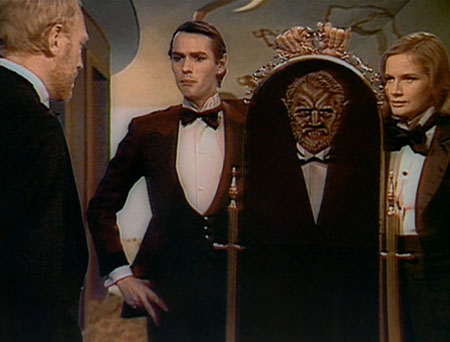
PLOT:  Harry Haller is a world-weary writer and intellectual in the Weimar Republic who is considering committing suicide soon.  One night he meets Hermine, a beautiful young woman, who shows unusual interest in him and makes him pledge obedience to her as she initiates him into the pleasures of the flesh, including jazz, drugs, and sex.  Eventually Hermine leads Harry to the Magic Theater, where a delirious dream about some aspect of his personality lurks behind every door—including, perhaps, his homicidal side.

Still from Steppenwolf (1974)

BACKGROUND:

  • The movie was adapted from Nobel laureate Hermann Hesse’s classic 1927 novel Steppenwolf, which had been rediscovered and adopted by the 1960s counterculture because of its perceived revolutionary vision and apparent endorsement of free love and psychedelic drugs.
  • Michelangelo Antonioni (Blowup) was offered the chance to direct but turned it down because he thought the book was unfilmable.
  • This was the only film directed by Fred Haines.  He had previously been co-nominated for an Oscar for Best Adapted Screenplay for Ulysses (1967).
  • Co-producer and LSD-enthusiast Melvin Abner Fishman declared the Steppenwolf would be “the first Jungian film.”
  • The Czech artist Jaroslav Bradac created the wonderful animated sequence, “The Tractate on the Steppenwolf”; the artist Mati Klarwein (who was also responsible for classic album covers for Miles Davis and Santana) created the fascinating paintings that line the corridors of the Magic Theater.

INDELIBLE IMAGE:  For a movie that is so deliberately visionary, there’s not one single image that sticks out far above the others.  The most obvious choices are the images which show Harry simultaneously as a wolf and a man, a concept that is often chosen in numerous variations for covers of paperback editions of the novel.

WHAT MAKES IT WEIRD:  The heavy symbolism and feverish imagery of Hesse’s masterpiece, written while Freud and Jung’s theories of the unconscious mind were still novel and revolutionary, present some weird scenarios (such as Harry entering into dream debates with the ghosts of Goethe and Mozart). When this material is adapted through a 1974 lens, an era when cinematographers hadn’t yet come down from the LSD-inspired visual experimentalism of the late 1960s, it becomes even weirder. From the Magic Theater sequence on, Steppenwolf is truly trippy stuff.

Original trailer for Steppenwolf (1974)

COMMENTS: There’s a difficulty in reviewing movie adaptations of novels, in that the Continue reading 15. STEPPENWOLF (1974)