Tag Archives: Japanese

CHANNEL 366: WONDER EGG PRIORITY (2021)

366 Weird Movies may earn commissions from purchases made through product links.

DIRECTED BY: Shin Wakabayashi, Yūta Yamazaki, Yūki Yonemori, Yūichirō Komuro, Shinichirō Ushijima, Yūsuke Yamamoto, Maiko Kobayashi, Eita Higashikubo, Mitsuru Hagi

FEATURING: Voices of Kanata Aikawa, Tomori Kusunoki,  Shuka Saitō, Hinaki Yano, Yūya Uchida,  Hiroki Takahashi; Mikaela Krantz,  Dawn M. Bennett, Anairis Quiñones, Michelle Rojas, Brendan Blaber, Ian Sinclair (English dub)

PLOT: Four teenage girls buy eggs from mannequins in hopes of bringing suicides back to life.

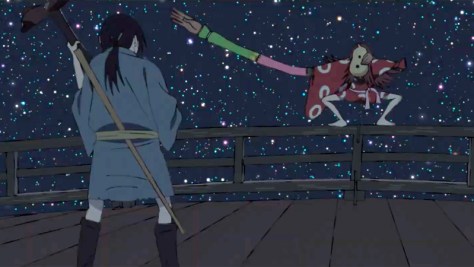
Still from Wonder egg priority (2021)

COMMENTS: Episode 1 (“The Domain of Children”) is a promising start. We meet Ai Ohto, a hikikomori heroine with heterochromia, already inside of a dream. Following a brief orientation in Ai’s waking reality (a hermit existence with only her mother and a visiting teacher to relieve the self-imposed loneliness), we go into the following night’s dream, which brings schoolgirls with blurred faces, a talking toilet paper roll, grinning eyeless balls called “see-no-evils” (who will be recurring adversaries), a flashback inside the dream, a crying statue, and a resurrected firefly who offers Ai an egg that contains, he claims, the thing she really wants—a friend. It ends with the firefly revealed to be, in reality, a crash-test-dummy mannequin in a tuxedo who hangs out, along with a more casual mannequin wearing his baseball cap backwards, in a garden where the two sell teenage girls Wonder Eggs out of a vending machine. Each egg leads into a dream where the buyer must save a former female suicide from a metaphorical monster; succeed in enough of these missions, it’s hinted, and Ai will get her dead friend back.

Thrown into this scenario, the introduction is charmingly disorienting, although enough clues are supplied that, by episode 2, the outlines of the plot are comprehensible (aside from the overriding issue of how and why this oddly conceived suicide egg economy exists in the first place.) The series then falls into a “monster of the week” groove; in the second episode, Ai fights a demonic coach to save a gymnast worked into suicide, and in each of the next four installments a new Wonder Egg devotee comes on board, until we have a girl gang of four dream warriors. Each of the characters has a distinctive design and a nice character hook: Neiru is an pretty but emotionally-stunted girl genius, Rika is a peppy and mischievous former junior idol, and Momoe is an androgynous outcast. The missions the girls go on allow the creators to address an array of topics of interest to the target audience: bullying, unrealistic expectations, self-acceptance, molestation, gender identification, obsessive fandom, and, most prominently, suicide. In between battles, the girls bond, and a couple of subplots—Ai’s teacher and his relationships to much of the female cast, hints of Neiru’s backstory—start developing. A few new elements are also added, Continue reading CHANNEL 366: WONDER EGG PRIORITY (2021) →

APOCRYPHA CANDIDATE: INU-OH (2021)

366 Weird Movies may earn commissions from purchases made through product links.

犬王

Recommended

DIRECTED BY: Masaaki Yuasa

FEATURING: Voices of Avu-chan,

PLOT: A blind itinerant priest crosses paths with “the King of Dogs”, a vivacious and deformed creature with a talent for dancing; through the priest’s music and the dancer’s storytelling, they attempt to lay the lost souls of the Heike clan to rest.

WHY IT SHOULD MAKE THE LIST: I have come to the conclusion that perhaps everything in Masaaki Yuasa’s œuvre should get canonized, particularly as we now have the elbow room to do so. (Night is Short, Walk on Girl was shortchanged due to numeric constraints.) Inu-oh brings an unlikely legend to bombastic life, fusing rock opera, ballet, pyrotechnics, spirits, curses, gender self-discovery, physical transformation; it’s a 21st-century story about a 14th-century performance troupe unearthing the secrets of an 12th-century war.

COMMENTS: It tickles me that Inu-Oh is Masaaki going “commercial.” This stems to a great extent, of course, from the fact that here in the United States, film norms are sickeningly normal: we are reigning kings of the lowest white bread denominator (so much so that it was controversial when Disney took a belated and modest stand against overtly bigoted legislation in its home state). Among the many themes explored in Inu-Oh, gender identity is near the fore, along with the nuances of parental acceptance of someone’s true self.

But let me stop that vein of thought for the moment. This is film for, and about, entertainment. It’s about musical revolution, and the delineation of the esteemed Noh tradition, which harkens back to the middle of last millennium. Inu-Oh follows Noh’s traditional story arc, lacing it with modern rock sensibilities. (Well, maybe not “modern” rock, but certainly strains of Buddy Holly through Jimmie Hendrix and Freddie Mercury.) The titular character is a born performer, despite—or because of—the fact he is a born monstrosity: an unnamed son of a proto-Noh performer, a boy of ambiguous shape, deformed face, and a long, strong arm. He embraces his outcast status, at one point referring to himself as “the Horrible Gourd” in honor of his misshapen mask. But as the son of a dance troupe leader, it comes as no surprise that Inu-Oh was born to jump and jive.

Tomona, the biwa priest, has a comparatively subtler trajectory. The son of a salvage diver, he is blinded at a young age when he and his father retrieved cursed regalia. Masaaki’s visual treatment of this unseeing musician is a treat, as total darkness gains rough outline of form with each sound Tomona hears. Being unable to see, the priest-musician (a biwa is never without his four-string shamisen and bachi) does not fear Inu-Oh, and is so able to help the mutant through his journey. Tomona’s personal journey is also about transformation as he evolves into an increasingly feminine entity, adopting the name Tomaori by the film’s end. The morphing of their name allows them to grow into their true form, but plays havoc with the spirit world, and with their ancestors—as one’s given, or accepted, name is what allows Tomona/Tomaori’s father to maintain contact from the afterlife.

While the first half of Inu-Oh is “merely” steeped in music, song, and dance, the second half is one long string of hand-clapping, foot-stomping musical numbers showcasing the monumental talents Tomona and Inu-Oh share as natural performers. They give the forgotten fate of the Heike spirits full-throated treatment, with Inu-Oh performing transgressively non-traditional storytelling through song and dance, while Tomona positively shreds it on their shamisen. Contemporary shogunate politics play a role in the story as well, as does the concurrent, tragic tale of Inu-Oh’s fame-obsessed father. Masaaki Yuasa never settles for half measures, and every theme—friendship, salvation, transformation, politics, and music—ties together in an animated vortex of vivacity and sonic rollercoaster of rocking melody.

WHAT THE CRITICS SAY:

“This anachronistic rock musical promises a return to the playful, literary surrealism of ‘The Tatami Galaxy’ (2010) and its 2017 spin-off, ‘Night Is Short, Walk On Girl,’ but comes up short… There are individual sequences that reach the psychedelic heights of Yuasa’s best work. But too often, this tale of the liberating power of art is about as mind-expanding as an early-afternoon set at Fuji Rock Festival.”–James Hadfield, Japan Times (contemporaneous)

26*. THE WARPED FOREST (2011)

Asatte no Mori

366 Weird Movies may earn commissions from purchases made through product links.

Recommended

“…an ‘idiot’ or a ‘comedy’ The Thing….”–director  describing his stylistic aspirations for The Warped Forest

DIRECTED BY: Shunichiro Miki

FEATURING: , , Yoji Tanaka,

PLOT: Nine people are vacationing at a Japanese hot springs resort; some of them have disappeared for three days and reappeared without explanation. In an alternate universe, these nine pursue an existence in a village inside magical forest of sexualized fruit, miniature people, and brothels stocked with nipple-sucking creatures. The alter-egos supplicate before a monolith in the forest, seeking for a way to warp their dreams and find a happier existence.

Still from The Warped Forest (2011)

BACKGROUND:

  •  Funky Forest: The First Contact (2005) was a surreal anthology film from three directors ( , Aniki, and ) with no real plot, although it was themed around the idea of alien contact. This spiritual sequel was made by , whose monstrous, -on-laughing-gas creature designs were arguably the most memorable part of the original.
  • Although Miki has a segment in another anthology film and some TV episodes to his credit, this is his sole solo feature. He mostly directs commercials; he saved the money he made over the years and spent his entire life savings to fund this film himself.
  • The Warped Forest only had a short festival run and was never released to cinemas in Japan or elsewhere. In 2022 it was released as the co-feature in the Funky Forest Blu-ray set.

INDELIBLE IMAGE: Cute-as-a-button Fumi Nikaidô holding an ornately carved rifle, which charges up with an advancing series of lights and a crescendo of whirs when she grasps it and, when fully operational, flips the compartment in the barrel to reveal… a tiny wiener, which emits a thin stream of white fluid.

TWO WEIRD THINGS: Hypertech jizz gun; genital fruit

WHAT MAKES IT WEIRD: Shunichiro Miki melds the weirdly organic and the comically absurd into a singular pocket of dreamspace, presenting a completely personal and unduplicatable vision that is simultaneously shocking, angularly erotic, and heartwarming.


Original trailer for The Warped Forest (2011)

COMMENTS: In 2011, Shunichiro Miki released a short trailer for Continue reading 26*. THE WARPED FOREST (2011) →

CAPSULE: ADAM BY EVE: A LIVE IN ANIMATION (2022)

366 Weird Movies may earn commissions from purchases made through product links.

DIRECTED BY: Nobutaka Yoda, Hibiki Yoshizaki, Yuichiro Saeki

FEATURING: Hanon, Ano, Eve

PLOT: A story about a friendship between two schoolgirls, Taki and Aki, and their shared dream of a one-eyed monster serves as a framing device for a series of songs by the Japanese pop singer Eve.

Still from Adam by Eve: A Live In Animation (2022)

COMMENTS: It begins with two schoolgirls discussing dreams in a diner. (Where would take that premise?) Taki relates a dream of a one-eyed monster, then leaves to get the girls a refill on their tea. Suddenly, Aki realizes she’s had the exact same dream.(Later, she will overhear people on a public bus describing an identical nocturnal vision.) Aki looks up and the diner is deserted; Taki is gone. Aki’s voiceover tells us she never heard from Taki again. A peppy guitar riff begins playing, Aki pines for Taki, and eventually a music video commandeers the screen.

And so it will go: little bits of story alternating with longer stretches of music by Eve. Eve is a camera-shy presence, commonly shot from behind so that we see only his shaggy blond mane, or seen in silhouette, or with his face hidden deep inside a shadowy hood, or with a bullhorn posed before his face as he shouts a particularly enthusiastic verse. The creativity required to constantly find new ways to shroud his identity is impressive. Musically, I suppose he’s competent; his tongue is fluid and precise as he drops cascades of syllables, with every song delivered in the same uptempo style, half-rapped, half-sung. Eve’s voice is pleasant but nothing special, although as a 53-year old American male who favors avant-garde jazz, I’m about as far away from his target demographic of teenage Japanese girls as possible. Despite the bubblegum sound, Eve’s lyrics tend towards the melancholic—not to mention the vague. (“It hurts, this restless center of a flower.”)

Those who aren’t fans in particular of Eve’s music will be tuning in for the animation, which doesn’t disappoint. First, a flock of animated white doves fly before the hooded singer. Then, brief inserts of anime characters pop in, happily hopping along to the beat. With each new song these characters and abstract whirligigs share more of the screen with the singer, overlaid on live concert footage, taking up more and more of the stage, swirling in patterns that obscure Eve almost entirely. The eye symbol, in various forms (e.g. briefly blinking into and out of existence on a skyscraper), begins to dominate the imagery, until we finally arrive at the film’s 6-minute all-animated centerpiece. A city of schoolgirls and schoolboys, equipped with happy-faced masks that flop in front of their real faces, share a city with tall, identical cyclopes: conformist youth flanked by fascist elders. But, using combat skills they learned from first person shooters, the kids revolt and slaughter their monster overlords, in a carnival of carnage recalling Evangelion 3.0 + 1.0 scored to a techno beat. More music videos in the accustomed style wind down the action, and as a bonus, a second full-length animated short plays over the closing credits.

The title suggests the story of Adam and Eve, but aside from a few stray apples seen lying about, you won’t find much in that line of inquiry. Clearly, it’s Eve’s poppy music and the psychedelic anime routines that are the draw here. But the thin narrative does at least suggest themes of teen love, teen alienation, teen sexuality, and teen suicide, with a sly queer slant. Good stuff for the young, but even us crusty Gen-Xers could screen a lot worse entertainment in an hour.

Adam by Eve: A Live in Animation currently streams exclusively on Netflix.

WHAT THE CRITICS SAY:

“… simply looking at its fluid, fascinating collision of dreams with reality, it’s a satisfyingly bold adult animation project, one interested less in clear narrative, and more in visual expression for its own sake.”–Kambole Campbell, Polygon (contemporaneous)