Tag Archives: Italian

CAPSULE: PERFUME OF THE LADY IN BLACK (1974)

DIRECTED BY: Francesco Barilli

FEATURING: Mimsy Farmer, Maurizio Bonuglia, Mario Scaccia, Jo Jenkins, Daniela Barnes, Orazio Orlando

PLOT: A wealthy, workaholic bachelorette chemist begins seeing visions of a lady in black, and a young blond girl; is she going mad or being tricked (or both)?

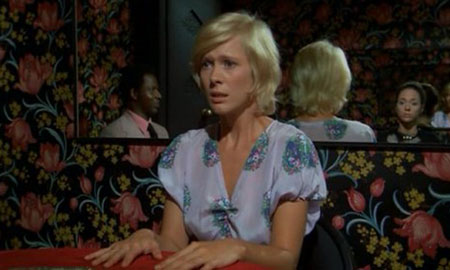
Still from The Perfume of the Lady in Black (1974)

WHY IT WON’T MAKE THE LIST: With its hysterical hallucinations and hints of witchcraft, plus a grisly surprise ending, a case could be made for certifying this quality offbeat occult giallo; but ultimately, it falls into the category of “you gotta draw the line somewhere.”

COMMENTS: In his interview comments accompanying the Raro Video release, writer/director Francesco Barilli acknowledges The Perfume of the Lady in Black’s debt to , but you’d probably sniff the lingering scent of Repulsion early on even without that admission (not to mention a whiff of Rosemary’s Baby, too). Perfume is part of a line of 60s and 70s horrors playing on the anxieties of young single working women. Thanks to sexual liberation, a class of working women living on their own without a live-in male protector was a relatively new phenomenon, and for all the necessary freedom, the fact is that it can be scary to be a woman in a man’s world. Lone females have more to fear than solo males: they fear all the same things men do, plus, they have to fear men. Silvia is competent enough to manage a chemistry lab, but she can’t trust her surroundings, her neighbors, strangers who stare at her on the street, or her even own senses in the dead of night. Whenever she’s alone, she’s endangered, and returns to sanity only when her boyfriend rushes to her side.

Perfume takes place in that lush giallo world, an existence full of tennis dates, elegant silk robes, and apartment courtyard’s with Roman fountains. The art direction is sumptuous, and at times a little outrageous, such as the jungle mural that hovers above Silvia’s friend’s bedpost. Surely such bourgeois elegance can only be there to cover up the stench of decadence. Mimsy Farmer, while not star material, is a treat in this role, constantly frightened and almost reluctantly sexy. The plot seems to be being made up as it goes along. It turns out that there are really two storylines, one of which involves oblique divulged secrets from Silvia’s childhood. The dual plots are mashed together, which produces extra confusion, but less satisfaction, since there’s not a single resolution, and nothing in particular to tie them together. Highlights include a ghostly little girl, “Alice in Wonderland” references, and a séance with a blind psychic (which may be the most giallo scenario ever). The ending is a genuine shock surprise, leaving a strong enough impression to make you forget the somewhat tedious early moments.

Raro Video upgraded Perfume to Blu-ray in 2016. The disc includes an interview with writer/director Barilli (which might be cut down from a longer one included on the DVD release) and a bonus short film, the 23-minute “The Knight Errant,” a shot-on-video variation on Death Takes a Holiday with a couple of surreal surprises that’s well worth a watch.

WHAT THE CRITICS SAY:

The Perfume of the Lady in Black piles on the weird, somewhat to its detriment.”–Jamie S. Rich, DVD Talk (2011 DVD)

1962 EXLPOITATION TRIPLE FEATURE: MONDO CANE, EEGAH, AND WILD GUITAR

“All the scenes you will see in this film are true and are taken only from life. If often they are shocking, it is only because there are many shocking things in this world.”

Thus, Mondo Cane not only introduced America to the mondo name and genre, it also was the first shockumentary to play in cinemas internationally, unsettling both critics and audiences who had never seen anything like it. It became a grandfather to countless pseudo-sequels and imitations, including the infamous Faces of Death, and for that reason alone Mondo Cane is of historical importance to bizarre cinema aficionados. Although dated and outdone by its successors, Mondo Cane retains its power to provoke—and that is the sole purpose of this film, which further renders it an original in every way.

Still from Mondo Cane (1962)Although Mondo Cane has been accused of having a xenophobic perspective, its hard to make that point when the filmmakers (Paolo Cavara, , and ) consistently contrast primitive and western customs through condescending narration. It’s really a series of mostly unrelated film clips. Food is the theme most explored: from Asians eating dog, to rattle snake entrails in the marketplace, to pigs beaten to death in New Guinea, to civilized diners devouring ants in a posh restaurant.

A scene of a sea turtle slowly dying on a radioactive beach is beautifully harrowing and juxtaposed against the extended, revolting spectacle of a bull goring a man to death. While recommending the film to anyone with suicidal tendencies probably would not be a good idea, Mondo Cane is not without some humor, seen in its pet cemetery vignette, and in the contrast of savage native women being fattened to become the bride of a chieftain with Western women rolling their fat away on the floor. Very well-shot and surprisingly endowed with a sterling score (by Nino Oliviero and Riz Ortolani), Mondo Cane is cinema at its most bi-polar and nihilistic. How nihilistic is it? It’s the only film I know of that will inspire the viewer to pity a man-eating shark.

Eegah often makes top ten worst movies of all time lists for a very good reason: it is one of the most wretched movies imaginable. This is another sadomasochistic endurance test from the Arch Hall Sr./ team, which justifiably landed a showing on . That exposure has made Eegah Hall’s most famous film, such as it is. This low budget effort was clearly trying to ride the teen monster fad that began with I Was a Teenage Werewolf (1957) and, impossible as it may seem, Eegah was actually something of a hit for its producers.

Hall Jr mantles his typical pouty, coiffed protagonist teen persona as Continue reading 1962 EXLPOITATION TRIPLE FEATURE: MONDO CANE, EEGAH, AND WILD GUITAR

248. DJANGO KILL! (IF YOU LIVE, SHOOT!) (1967)

Se sei Vivo Spara; AKA Oro Hondo

“That [If You Live, Shoot!] should be part of the small group of films that become a part of film history, embedded in the viewer’s imagination, obviously pleases me greatly… But I have to quickly add that it is a cult phenomenon for a few young likable nutcases. Every generation has a few of those.”–Giulio Questi

Recommended

DIRECTED BY:

FEATURING: Tomas Milian, Roberto Camardiel, Francisco Sanz, Piero Lulli, Ray Lovelock

PLOT: Two wandering Indians find a half-dead Stranger climbing out of a makeshift desert grave. They also find a bag of gold on his body, which they melt down and fashion into bullets for him. They then take him to the nearest town, which the Indians call “the Unhappy Place,” where the Stranger goes after the man who betrayed him, stole his share of the gold, and left him for dead.

Django Kill (If You Live, Shoot!) (1967) still

BACKGROUND:

  • Franco Arcalli served as editor and collaborated on the screenplay. Arcalli later became a big name in the Italian film industry, going on to collaborate with (on Zabriske Point), Bernardo Bertolucci (on The Conformist and Last Tango in Paris) while also collaborating on screenplays for Last Tango and Sergio Leone’s Once Upon a Time in America, among others. As his fame grew, he continued to work on Questi’s movies, as well.
  • Questi drew on his experiences as a paramilitary resistance fighter during WWII for the action sequences.
  • Italian audiences complained to censors about gruesome scenes where a man’s torso is torn apart to get at the golden bullets inside and another where a man is scalped. These scenes were immediately re-edited—in different countries, between twenty and thirty minutes of violence were cut out. Since they weren’t included in prints sent to the U.S., these scenes were never dubbed into English; therefore, when watching the restored version on Blu-ray, these scenes suddenly appear subtitled when the rest of movie is dubbed.
  • Originally titled If You Live, Shoot!, distributors later added Django Kill to the title (against Questi’s wishes) in a shameless attempt to cash in on the popularity of ‘s Django series. Thomas Millian does not play Django, and If You Live, Shoot! has nothing to do with the series.
  • Repo Man director is one of this film’s champions; he provided a 1997 introduction for a BBC series called “Forbidden Films,” where he he called it “the creepiest film I’d ever seen.”

INDELIBLE IMAGE: Based on sheer grisly shock value, it’s the scene where the villagers rip into Oaks’s still-breathing body trying to dig out the golden bullets inside it. Due to skillful editing, you don’t actually see as much blood and torn flesh as you imagine you do, but that’s part of what makes the scene so masterful—you and the filmmakers collaborate on building it in your mind’s eye.

THREE WEIRD THINGS: Golden bullets; gay cowpokes of the Old West; alcoholic oracle parrot

WHAT MAKES IT WEIRD: With its ambiguously dead antihero who shoots golden bullets fights Mr. Sorrow and his gang of gay fascist cowboys, Django Kill‘s subversive, surreal subtext befuddled 1967 viewers expecting warmed-up Spaghetti Western leftovers. It still has the power to perturb the unsuspecting today. Go into it looking for weirdness, and you’ll be amply rewarded.


British DVD release trailer for Django Kill

COMMENTS: Halfway down the dusty road that leads from A Fistful Continue reading 248. DJANGO KILL! (IF YOU LIVE, SHOOT!) (1967)

CAPSULE: SALO, THE 120 DAYS OF SODOM (1975)

Beware

DIRECTED BY:

FEATURING: Paolo Bonacelli, Giorgio Cataldi, Umberto P. Quintavalle, Aldo Valletti

PLOT: Four Italian fascists kidnap dozens of young boys and girls and imprison them in an isolated villa to sexually torture them in bizarre rituals of sadism.

Still from Salo: the 120 Days of Sodom

WHY IT WON’T MAKE THE LIST: There are a lot of words that can be used to describe Salo: disturbing, intense, perverse, depressing, extreme. “Weird” is pretty far down the list. (I did not find any critics who used the word “weird” in discussing Salo). So many of our readers have nominated it for review that I am forced to confess that it may be found lurking somewhere in the outermost penumbra of the weird—but if you want to see a truly weird treatment of the same source material, look at how ended L’Age d’Or with a Surrealist reference to the same novel adapted in Salo. ((Henri Xhonneux and also make far stranger references to the book in their twisted De Sade biopic, Marquis.)) Casting Jesus Christ as Duc de Blangis is less obscene but far more provocative than anything Pasolini could depict in his literal rendition of the book.

COMMENTS: “Although these crimes against humanity are historically accurate, the characters depicted are composites… and the events portrayed, have been condensed into one locality for dramatic purposes… We dedicate this film with the hope that these heinous crimes will never occur again.”

Salo, The 120 Days of Sodom may seem stranger to someone who comes to the movie with no foreknowledge of the source material, the Marquis De Sade’s “120 Days of Sodom,” than it does to someone who knows the backstory. De Sade, of course, is the 18th century writer whose name inspired the now commonplace words “sadism” and “sadist.” He was an aristocrat devoted to literature, philosophy, and pornography (not in that order), and he produced some genuinely accomplished works. His most powerful books, such as “Philosophy in the Bedroom” and “Justine: the Misfortunes of Virtue,” mix shocking depictions of sexual cruelty with virile intellectual monologues wherein the characters philosophically justify their depravity and smash moralist objections.

“The 120 Days of Sodom” was not one of those books. It was De Sade’s first major work, written while was imprisoned in the Bastille (for a string of crimes including the beating of a prostitute and consensual homosexual sodomy). “Sodom” is an obsessive catalog of perversions, with almost none of the philosophical speeches that would add meaning and value to De Sade’s later work, ((“The 120 Days of Sodom”  was unfinished and the ending only sketched, so it is conceivable De Sade would eventually have inserted philosophical reflections later.)) arranged according to a mathematical progression: 30 days of orgies in each set of four escalating perversions, moving from “simple” passions (such as urine drinking) to “murderous” ones. The novel was probably intended for De Sade’s own sexual gratification. The result is the Continue reading CAPSULE: SALO, THE 120 DAYS OF SODOM (1975)

LIST CANDIDATE: GET MEAN (1976)

DIRECTED BY: Ferdinando Baldi

FEATURING: Tony Anthony, , Lloyd Battista

PLOT: An abandoned town, a gypsy family, a very Spanish princess: enter, the Stranger. Offered $50,000 to ferry the displaced sovereign back home, before she can be reinstated there’s a question of reclaiming an ancient treasure. Alas, standing in the way of our Hero is a sadistic fop, a hot-tempered Mongol chieftain, and a Shakespeare-quoting hunchback.

Still from Get Mean (1976)

WHY IT MIGHT MAKE THE LIST: By setting the bulk of his Spaghetti Western somewhere along the coast of Spain, Ferdinando Baldi’s Get Mean elicits an initial reaction of “oh realllly…,” then cranks things up to all the way to bizarre with its visionary combination of temporally and geographically misplaced clashing adversaries. Tony Anthony adds to this movie’s peculiar brand of “magic” with his gristly voice and an unceasingly sardonic grin in lieu of a stoic Clint Eastwood imitation. Toss in no fewer than three main villains, chin-stroking xenophobia, and a string of food motifs, and you’ve got yourself a Western.

COMMENTS: This breezy little movie starts off with weirdness hanging off its sleeve. A man (Tony Anthony) is being dragged through a desolate countryside past a mysterious reflective orb nestled among bedraggled plants. Pulled into an empty town, he stumbles into one of the buildings. Inside, of course, is a family of gypsies. The eldest woman of the group says, ominously, “We have been expecting you.” The Stranger accepts their task of bringing a Spanish princess back to her home country. After a quick brawl with some local toughs, one dressed in Mongol garb, the Stranger heads off on a burning-map travel montage. Starting from somewhere in the Great Lakes region and heading across the sea, within minutes we find the escort and his ward on the beaches of Spain, staring down two hostile armies.

By this time, things have not gone well for the stranger. Nor have things gone well for those who prefer a little historical accuracy, even in their Spaghetti Westerns. The rival bands are Moors, who in this world seem to be soldiers of the Spanish monarchy, and a clutch of barbarians, which explains the outfit of the baddie in the opening fight. I’m not certain how many Central Asian warriors are named Diego, but Get Mean taught me there’s at least one. Aiding the Mongol antagonist are a refined, bordering-on-maniacal hunchback (Lloyd Battista) and one of those caricatured homosexuals only found in ’70s movies. These three are keen on the power that can only be unlocked through the discovery of the ancient “Treasure of Rodrigo” (!).

Quips, beatings, explosions, and large firearms are scattered throughout the movie. These are to be expected in a low budget Western. Less expected is the Stranger’s trial in a quasi-Land of the Dead. Conniving with the hunchback, the Stranger infiltrates an ancient mosque that has teamed up with Christian clergy. He squares off against the psychic attacks of unhappy undead in a chapel, travels through some chintzy-looking caves, and dispatches perhaps the least effective treasure guardian ever encountered in cinema. Enough? Heavens no — an explosion renders him black(face)ened for a stretch, during which he matches wits with a wild bull in the middle of nowhere. Get Mean‘s writer and director have cheerily decided to throw believability to the wind in pursuit of a movie that looks like what might’ve happened had ever tried his hand at the Western genre.

Tony Anthony’s performance is reminiscent of something by Clint Eastwood’s illegitimate half-brother. We know he’s either in for travel or trouble whenever a very jaunty, very Spaghetti tune gears up—perhaps the only note of consistency to be found in the movie. The combined elements of this Western set over 4,000 miles East of the Mississippi were enough to make me wonder what the heck would happen next. Sadly, Get Mean was ignored upon release and didn’t find a cult following in the intervening four decades. Thankfully, that did not stop the good people at Blue Underground from resurrecting it. Perhaps over the next forty years Get Mean might find the fringe adoration that eluded it.

WHAT THE CRITICS SAY:

“One of the strangest and most obscure spaghetti westerns ever to come out of Italy…”–TV Guide