Tag Archives: Horror

BORIS KARLOFF’S THRILLER (1960-1962): EPISODE GUIDE AND REVIEWS, PART TWO

Part I of “Boris Karloff’s Thriller” episode guide is here.

“The Poisoner,” (directed by Herschel Daugherty and written by  Robert Hardy Andrews) is loosely based on the real-life case of suspected serial poisoner Thomas Griffiths Wainwright. Here he is given the name of Thomas Edward Griffith and played by eternally underrated actor Murray Matheson. As artist, author and dandy, Griffith, used to the fine life, lies his way into marriage with rich socialite Frances Abercrombie (Sarah Marshall), only to discover she has also lied about her wealth. Worse, she moves her family in. Fortunately, Griffith is an expert poisoner. A score from Jerry Goldsmith again accentuates the suspense. It’s fairly well shot for television and includes that favorite noir murder method—pushing a wheelchair-bound victim down a spiraling stairwell. As the Abercrombies are an across the board ingratiating lot, it’s hard not to be manipulated into sympathizing with Griffith, but his mistreatment of a poor innocent kitty reveals him to be the cad he is.

“Man in the Cage” (directed by Gerald Mayer, written by Stuart Jerome and Maxwell Shane) stars Philip Carey as engineer Darrel Hudson, going to Tangier in search for his missing brother Noel (Guy Stockwell). The exotic location and co-star Diana Millay are wasted in a hopelessly dull episode.

“Choose a Victim” (directed by Richard Carlson, better known as the beefcake protagonist of Creature From The Black Lagoon, and written by George Bellak) is another crime noir. This one features prolific television actors Susan Oliver (many will remember her as the heroine in the two-part “Star Trek” episode “The Cage”) and Larry Blyden (from both “Alfred Hitchcock Presents” and “The Twilight Zone”). Tragically, both actors died young: Oliver from lung cancer, Blyden from a traffic accident. Blyden plays beach bum/golddigger Ralph, who stumbles onto the sad but beautiful Edith when he sneaks into her room to rob her. Rather than turning him in, Edith is sexually attracted to daring larcenist Ralphie and demands his “attention.” The episode takes a Postman Always Rings Twice turn when Edith manipulates Ralphie in a plot to kill her wealthy uncle. Naturally, that’s not only the bit of manipulation going on, and the episode revels in playing its mind games, even if it’s not a standout thriller.

Still from "Hay-fork and Bill-hook"“Hay-Fork and Bill-Hook” (directed by Herschel Daugherty and written by Allan Caillou) is an uneven episode with a plot that might call to mind elements from Anthony Shaffer’s later (and vastly superior) The Wicker Man (1973). Atmosphere and a sense of dread (aided again by Goldsmith, in top form) make up for a degree of awkward writing about a coven of witches in the Druid ruins of the rural Dark Falls, in Wales. The honeymoon of Scotland Yard inspector Continue reading BORIS KARLOFF’S THRILLER (1960-1962): EPISODE GUIDE AND REVIEWS, PART TWO →

252. POSSESSION (1981)

AKA The Night the Screaming Stops

Recommended

“…Viktor Shklovsky wrote about how the job of the artist was to come up with a device that made the familiar seem strange. The ‘strangeness’ sets our brain a challenge, and the process of dealing with it is engaging – not just on an intellectual level, but an emotional one too… In Possession, Żuławski made a marital breakdown ‘strange’ by showing ‘the horror’ – this was not Scenes from a Marriage – it was something else.”–Daniel Bird

“Nothing wants to bite anymore – they want to lick.”– Andrzej Zulawski, from the Possession commentary track.

DIRECTED BY:

FEATURING: , , Heinz Bennent, Margit Carstensen, Carl Duering, Shaun Lawton

PLOT: Mark, an agent for some unspecified agency, returns home to his wife, Anna, and son in Berlin only to find that Anna has taken a lover. She splits her time between her home and her lover; however, Mark still wants her, causing extensive conflict between them. He uncovers a previous affair with a man named Heinrich, but she also left him for another—and finding the identity of her current lover leads to mayhem and a rising body count.

Still from Possession (1981)

BACKGROUND:

  • Andrzej Zulawski conceived Possession in the wake of several events—the collapse of his marriage to actress Małgorzata Braunek after being allowed to return to Poland from exile after the international success of 1975’s The Most Important Thing Is To Love, and the subsequent production and shutdown of On The Silver Globe and his second exile from Poland.
  • Zulawski originally pitched the film to Paramount Studio head Charlie Bluhdorn, calling it “a movie about a woman who f**ks an octopus.” They passed.
  • The film played at Cannes and Isabelle Adjani won “Best Actress,” sharing the award for her roles in both Possession and Merchant/Ivory’s Quartet.
  • The final film was chopped up by distributors. The U.S. release was notorious for being a total misrepresentation of the movie: the distributor removed about 40 minutes, reshuffled scenes, and added optical effects to play up and sell it as a horror movie. The Australian version made similar cuts. It wasn’t until 2000 that the original version was available to be seen in the U.S.
  • Possession was briefly released in the UK, but on videotape it was later banned as a “video nasty,” a classification intended for extreme horror films with no artistic merit.

INDELIBLE IMAGE: In a film with many memorable images, mainly close-ups of the characters in various stages of mania, the one that sticks is of Adjani’s Anna being serviced by something coiled around her… and writhing.

THREE WEIRD THINGS: Pink socks; subway miscarriage; Anna’s lover

WHAT MAKES IT WEIRD: It starts out as a domestic drama turned up to 11, which then goes up to 15. The intensity is compelling, especially when most other relationship films at the time went for quiet decorum. Possession throws all that right out the window. And then at the midway point, it drops the bottom out of expectations with the introduction of the Creature.


Possession international release trailer

COMMENTS: There seems to be no major disagreement about Possession joining a list of “weird” anything. The fur begins to fly in the Continue reading 252. POSSESSION (1981) →

CAPSULE: PERFUME OF THE LADY IN BLACK (1974)

DIRECTED BY: Francesco Barilli

FEATURING: Mimsy Farmer, Maurizio Bonuglia, Mario Scaccia, Jo Jenkins, Daniela Barnes, Orazio Orlando

PLOT: A wealthy, workaholic bachelorette chemist begins seeing visions of a lady in black, and a young blond girl; is she going mad or being tricked (or both)?

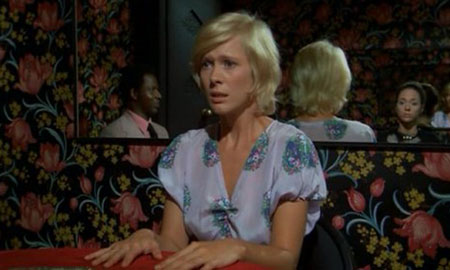
Still from The Perfume of the Lady in Black (1974)

WHY IT WON’T MAKE THE LIST: With its hysterical hallucinations and hints of witchcraft, plus a grisly surprise ending, a case could be made for certifying this quality offbeat occult giallo; but ultimately, it falls into the category of “you gotta draw the line somewhere.”

COMMENTS: In his interview comments accompanying the Raro Video release, writer/director Francesco Barilli acknowledges The Perfume of the Lady in Black’s debt to , but you’d probably sniff the lingering scent of Repulsion early on even without that admission (not to mention a whiff of Rosemary’s Baby, too). Perfume is part of a line of 60s and 70s horrors playing on the anxieties of young single working women. Thanks to sexual liberation, a class of working women living on their own without a live-in male protector was a relatively new phenomenon, and for all the necessary freedom, the fact is that it can be scary to be a woman in a man’s world. Lone females have more to fear than solo males: they fear all the same things men do, plus, they have to fear men. Silvia is competent enough to manage a chemistry lab, but she can’t trust her surroundings, her neighbors, strangers who stare at her on the street, or her even own senses in the dead of night. Whenever she’s alone, she’s endangered, and returns to sanity only when her boyfriend rushes to her side.

Perfume takes place in that lush giallo world, an existence full of tennis dates, elegant silk robes, and apartment courtyard’s with Roman fountains. The art direction is sumptuous, and at times a little outrageous, such as the jungle mural that hovers above Silvia’s friend’s bedpost. Surely such bourgeois elegance can only be there to cover up the stench of decadence. Mimsy Farmer, while not star material, is a treat in this role, constantly frightened and almost reluctantly sexy. The plot seems to be being made up as it goes along. It turns out that there are really two storylines, one of which involves oblique divulged secrets from Silvia’s childhood. The dual plots are mashed together, which produces extra confusion, but less satisfaction, since there’s not a single resolution, and nothing in particular to tie them together. Highlights include a ghostly little girl, “Alice in Wonderland” references, and a séance with a blind psychic (which may be the most giallo scenario ever). The ending is a genuine shock surprise, leaving a strong enough impression to make you forget the somewhat tedious early moments.

Raro Video upgraded Perfume to Blu-ray in 2016. The disc includes an interview with writer/director Barilli (which might be cut down from a longer one included on the DVD release) and a bonus short film, the 23-minute “The Knight Errant,” a shot-on-video variation on Death Takes a Holiday with a couple of surreal surprises that’s well worth a watch.

WHAT THE CRITICS SAY:

“The Perfume of the Lady in Black piles on the weird, somewhat to its detriment.”–Jamie S. Rich, DVD Talk (2011 DVD)

BORIS KARLOFF’S THRILLER (1960-1962): EPISODE GUIDE AND REVIEWS, PART ONE

The reputation of ‘s “Thriller,” which ran from 1960-1962, is such that it was one of the most highly anticipated DVDs until its 2010 release. Despite its somewhat hefty price tag, it became a best seller (and was followed by a ‘greatest hits’  top ten release in 2012). Author Steven King’s proclaiming it the “best horror series of all time” (in his 1981 book, ‘Danse Macabre’) certainly enhanced its eminence. Of course, a statement that absolute is going to be argued, and it was (with naysayers pointing to the earliest crime oriented episodes as evidence against King’s boast ). Naturally, like all series, “Thriller” is uneven. Still, the positives outweigh the negatives enough to justify its cult status.

Karloff hosted each episode, and acted in a few. This was his second horror anthology series. His first,  the ten episode “The Veil,” from 1958, never actually aired; after its DVD release in 2001 , was dubbed by some critics as “the best television series never seen.” A later DVD release, under the title of “Tales of the Unexplained from the Veil,” featured two additional “lost” episodes. “The Veil” has also been referred to as a precursor to “Thriller,” although it’s not quite as good and the flavor is different. Hopefully, we’ll get around to reviewing the earlier series by next Halloween.

“Thriller” premiered on September 13th, 1960 with the episode “The Twisted Image” (directed by Arthur Hiller), which starred Leslie Nielsen and Natalie Trundy. “Her possessive eyes… Alan Patterson was aware of her eyes at the newsstand, at the lunch counter, in the elevator. He was aware of them for almost a month and they were to lead him into guilt, and terror, and murder as sure as my name is Boris Karloff. ”

Title from Boris Karloff's Thriller: The Twisted ImageAs we watch, Karloff informs us that this a tale of watching and being watched, assuring that a shattering effect lies within the “Twisted Image.” Nielsen, as Patterson, a married, successful business man, is watched by four psychotic eyes belonging to Lily (Trundy) and Merle (George Gizzard). Lily lusts after him and, at least on the surface, Merle is insanely jealous. Although director Hiller denied it, as it was written (by James P. Cavanagh adapting William O’ Farrell’s novel) and played by Grizzard, there is sexual longing in Merle’s voyeurism as well. Still, we’re not entirely convinced he deserves all the attention, as the very young Nielsen has none of his later charisma. Grizzard walks away with the episode playing a scheming, destructive looney tune coworker. Competent, but unimaginative with no surprises, this debut waddles its way to a lackluster finale.

“Child’s Play” (also directed by Hiller and written by Robert Dozier): Continue reading BORIS KARLOFF’S THRILLER (1960-1962): EPISODE GUIDE AND REVIEWS, PART ONE →

250. THE CREMATOR (1969)

Spalovac Mrtvol

366 Weird Movies may earn commissions from purchases made through product links.

“The Lord arranged it very well when he told people: ‘Remember, dust thou art and to dust thou returnest.’ A crematorium, dear friends, is clearly a God-pleasing object, because it helps God to speed up the transformation of people into dust.”–Kopfrkingl, The Cremator

Recommended

DIRECTED BY:

FEATURING: , Ilja Prachar, Milos Vognic, Jana Stehnová, Jirí Lír

PLOT: Kopfrkingl is a crematorium operator in Czechoslovakia in the late 1930s who holds odd opinions about the liberating nature of death, based largely on his self-study of the Tibetan Book of the Dead. Because he has German blood, an old army buddy recruits him into the Czech branch of the Nazi party. His beloved wife’s half-Jewish parentage, however, soon becomes an issue that threatens his advancement both in the party, and in his chosen profession.

Still from The Cremator (1969)

BACKGROUND:

  • The movie is based on a novel by Ladislav Fuks, a Czech who had been a forced laborer (arbeitseinsatz) during the Nazi occupation. Fuks collaborated with director Juraj Herz on the screenplay.
  • Although he was their contemporary, Herz did not consider himself part of the In school he studied puppetry (in the same class as ) rather than film, and had few friends in the New Wave clique. (One exception was director , who plays the small role of Dvorák in The Cremator). He did sneak in to film screenings at FAMU (the national film school that incubated the New Wave movement) and filmed a segment for the 1966 anthology Pearls of the Deep, which was rejected because of its length (30 minutes).
  • The Cremator began filming during the Prague Spring, but was interrupted by the Soviet invasion in 1968, which made completing it a challenge. The film was released and screened but removed from circulation soon after.
  • Czechoslovakia submitted The Cremator to the Oscars as Best Foreign Film, but the Academy did not grant it an official nomination.
  • The Cremator won best film, actor (Rudolf Hrusínský) and cinematography (Stanislav Milota) at the Sitges Film Festival, but not until 1972, three years after its initial release.

INDELIBLE IMAGE: Most likely it’s frequently tuxedoed cremator-in-chief Rudolf Hrusínský’s round face, the subject of so many closeups, that will stick with you the most. We chose to highlight the moment when he is invited into the rear tent at the freaskshow to gaze at the embalmed two-headed specimens and faces ravaged by syphilis, in which he shows a strange fascination.

THREE WEIRD THINGS: Buddhist Nazism; the throne in Lhasa; girl in black

WHAT MAKES IT WEIRD: A WWII drama soaked in an atmosphere of Gothic psychological horror, The Cremator seems like a screenplay might have written if he’d lived to see the Holocaust. Distorted lenses and madcap montages track the cremator’s bent descent from eccentric mortician to megalomaniacal tool of ultimate evil.


Second Run DVD trailer for The Cremator

COMMENTS: The IMDB categorizes The Cremator as, among other Continue reading 250. THE CREMATOR (1969) →