Tag Archives: Horror

RECOMMENDED AS WEIRD: DEADGIRL (2008)

366 Weird Movies may earn commissions from purchases made through product links.

DIRECTED  BY: Marcel Sarmiento and Gadi Harel

FEATURING: Jenny Spain, Shiloh Fernandez,

PLOT: Two high school delinquents find an undead young woman and use her as a sex slave.
Still from Deadgirl (2008)

WHY IT SHOULD MAKE THE LIST: Deadgirl is weird by virtue of its highly unconventional subject matter, which is treated in as matter-of-factly as a conventional drama. It’s also better than you might think;  Deadgirl is one of the best necrophilia-themed movies I’ve seen.

COMMENTS: When I read any description of a horror movie that includes the words, “teenager” or “students,” it stops me in my tracks, and I groan in disappointment. However, it was conducive to the plot of this horror yarn that the two antagonistic protagonists be just that.

The pair are working class high school misfits. (I must note that they are little more working class than the jocks and cheerleaders at most high schools, who stridently compensate for their ordinariness by engaging in meaningless make-work activities and ardently conform in order to raise their perceived social status.) The two boys in this film are misfits only in the sense that they aren’t on the football team. Like all teenage boys (and girls, let’s be honest) they are also dying of horniness.

Rickie (Fernandez) predictably covets a cheerleader possessing no redeemable qualities, who is saving herself to be date raped by the captain of the football team some drunken Homecoming night. One afternoon, his friend J.T. (Segan) convinces him to skip class to drink beer in an abandoned insane asylum. Where else?

Once there, they discover an inexplicably re-animated, shapely young dead girl (Spain) Continue reading RECOMMENDED AS WEIRD: DEADGIRL (2008)

CAPSULE: WHITE ZOMBIE (1932)

Recommended

DIRECTED BY: Victor Halperin

FEATURING: Bela Lugosi

PLOT: A Haitian plantation owner seeks the help of local witch doctor and zombie mogul ‘Murder’ Legendre (Bela Lugosi) to bewitch another man’s bride.

Still from White Zombie (1932)

WHY IT WON’T MAKE THE LISTWhite Zombie can send quite the uncanny chill down your spine and is well worth a look for those seeking to soak up some classic Gothic atmosphere, but its weird elements are too submerged for it to make the List.

COMMENTS: Although talkies had been around for five years when White Zombie came out, the film is suffused with the sensibility of a silent movie, with the machinations of mustachioed villains causing damsels in flapper bobs to daintily faint.  The players still use the exaggerated facial expressions and physical gestures of actors used to conveying emotions by pantomime, and when they do speak, they over-inflect, as if concerned with projecting their words into the last rows of a theater.  This mannered, operatic style, where the characters magnify their fear, grief, malice and wonder in an recognizable but unnatural way, plays right into Bela Lugosi’s larger-than-life persona.  The Hungarian, here again the soul of suave degeneracy, dominates the proceedings in what may be the second best performance of his career.  In an era where we’ve become used to completely naturalistic performances and sets, White Zombie‘s primitive aesthetic seems romantic and, yes, a little weird; when this stately style is wedded to such a stark good versus evil storyline, the results can be magical, if you allow yourself to fall under its spell.  Even the grain in the picture, the hiss in the soundtrack, and the jumps where a few frames of film are missing add to the dreamlike effect. (Watching White Zombie, it’s easy to see how Guy Maddin became intoxicated with this era of film).  The narrative holds few surprises, there are dry patches, and the action climax isn’t exactly a thrill ride.  But White Zombie features many wonderfully disquieting moments that worm their way under your skin and make you squirm in your seat, including the Haitian funeral set to ancient African tribal chants and the damned souls powering the creaking mill wheel at Legendre’s sugar cane factory.

This was the first film to bring the Haitian idea of the zombie—a soulless, re-animated corpse brought to life by a combination of drugs and witchcraft—to the cinema.  Lugosi, just a year off Dracula, was a hot horror commodity but a notoriously bad businessman: he only received $800 for the role of Legendre. 

White Zombie is in the public domain and therefore can be found in many different DVD packages. The best picture comes from the restored Roan Group print (now released by Alpha Video). Although the source material used is not pristine, the best value is Mill Creek’s Horror Classics 50 Movie Pack Collection (also containing Carnival of Souls and several other worthwhile titles, along with some stunning losers like Creature from the Haunted Sea). White Zombie is also in the public domain and can be legally viewed or downloaded for free at the Internet Archive.

WHAT THE CRITICS SAY:

“Contemporary critics  found White Zombie childish, old-fashioned, and melodramatic.  They might have allowed that it was also a Gothic fairy tale filled with traditional symbols, dreamlike imagery, echoes of Romanticism, and (probably unintentional) psychosexual imagery.”–Carlos Clarens, An Illustrated History of Horror and Science-Fiction Films

SATURDAY SHORT: NACHTMAHR GEISTERGANG

This week’s short, Nachtmahr: Geistergang, (Nightmare: Ghost Trail) was written by another fan of ours, Kacper Radecki.   This is visually and aurally one of the stranger shorts I’ve come across.  Each scene is quite unique. There’s a creature (which took an entire week to make the costume for) dancing in the forest, a series of ruins, a pipe scene, and a bug trying to escape a jar. All of which, along with the whispers and screams in the background, make it true to it’s title; a nightmare.

Kacper is a self-taught photographer and director who plans to study film in the United States in 2010. Our best wishes go out to him in furthering his passion for film.

For a look at Kacper’s photography visit this link.

CAPSULE: DRACULA (1992)

AKA Bram Stoker’s Dracula

Recommended

DIRECTED BY:

FEATURING: Gary Oldman, Winona Ryder, Anthony Hopkins, , Tom Waits

PLOT:  Vlad Dracula, a defender of Christendom against invading Muslims, curses God and becomes undead when his beloved bride throws herself from the castle walls due to false reports of his death sent by Turkish spies; centuries later, he plots to seduce his love’s reincarnation in Victorian London.

Still from Dracula (1992)

WHY IT WON’T MAKE THE LIST: Coppola’s take on the Dracula myth is dreamy, glossy, and visually experimental for a blockbuster, but too mainstream to be truly weird.

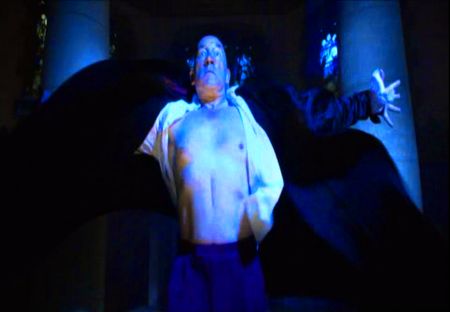
COMMENTS:  Coppola had a chance to make one of the classic Dracula films; in the end, he made not a classic, but he did make the most visually advanced and beautiful vampire movie of our times.  The early reels are taken up with crisp visual experiments, such as when the Transylvanian countryside outside Johnathan Harker’s carriage turns blood red while Dracula’s eyes appear superimposed in the sky.  Another trick Coppola employs—making the Count’s shadow move independently of its host, displaying his hostile intent while its host blathers on about business matters—has become iconic.  The best sequence the director invents is Harker’s encounter with Dracula’s three beautiful undead brides, a scene that moves effortlessly from dreamy eroticism to outright surreal horror when the temptresses reveal their true nature (one of the bloodsucking succubi was played by soon-to-be-famous, ethereal beauty Monica Belluci).  The scene of an enticing vampiress scuttling on the masonry like a startled spider is pleasantly jolting, and the entire picture in fact swings back and forth between the sexual and the diabolical with a natural ease.  Coppola displays great discipline in the film, making the film stylish, sexy and horrifying in audience-pleasing measures.  The various camera tricks, the shadow plays, the grandiose sets and costumes, the boldly unreal colors, the switches between film stock, never draw too much attention to themselves, but always work in service of creating an operatic hyperreality, a world that’s strange and exaggerated, but cinematically familiar.

What prevents the movie from being a classic is the uneven ensemble acting.  The good Continue reading CAPSULE: DRACULA (1992)

CAPSULE: ARMY OF DARKNESS (1992)

Recommended

DIRECTED BYSam Raimi

FEATURING:  Bruce Campbell

PLOT:  Following the events of Evil Dead II, Ash finds himself flung backwards in time into a medieval land, where his failure to retrieve the Book of the Dead enables evil forces to muster a massive army of stop-motion animated skeletons.

Army of Darkness

WHY IT WON’T MAKE THE LISTEvil Dead II struggled mightily to obtain its weird credentials, and just barely qualified for its weird badge thanks to the “cabin fever” sequence in the middle portion of the film.  In the third entry of the “Evil Dead” trilogy, director Sam Raimi distills what he thinks is the popular essence of Evil Dead II, emerging with a concentrated dose mixing ghoulish comedy with a stiff shot of badass working class hero Ash.  Weirdness was discarded as a waste product, although traces remain.

COMMENTS:  The beginning of Army of Darkness rewrites the tale of how Ash came to be recognized as the “Chosen One” at the end of Evil Dead II, but consistent storytelling (along with respect for the laws of physics) has never been a high priority in this series.   Since the  midpoint of the second film, Raimi’s Evil Dead emphasis for the trilogy has been comedy, and Army of Darkness is tongue-in-cheek from start to finish.  As an action/comedy/fantasy/horror hybrid, Army of Darkness pulls in too many directions to hang together as a story, much less integrate itself with the rest of the series, but the manic energy is a lot of fun, and the film does work on a scene-by-scene basis.  The flick dips into the Three Stooges tribute well even more than Evil Dead II did; in one funny scene, every orifice on Ash’s face is invaded by skeletal fingers from still buried corpses, despite his best defensive maneuvers (our hero never learned from Curly’s mistakes—don’t introduce your tongue as a new target by sticking it out in triumph after successfully blocking the dual finger eye poke).  Gags aside, the comic momentum overwhelming comes from Bruce Campbell’s Ash, who has transformed from a much abused punching-bag for macabre forces into an arrogant, wisecracking hero.  Campbell adopts just the right campy, parodic tone when reprising hit action catchphrases like “Groovy” or fresh favorites like “Just me, baby.”   Ash’s overweening, usually unjustified bravado is the comic binding that keeps the scattershot script from blowing away in the wind.  For fans of weirdness, the best bits are the hallucinatory scenes after Ash takes refuge from a shakycam assault inside a windmill: for unexplained reasons, he ends up by menaced by a gang of tiny Ashes in a “Gulliver’s Travels” parody, then sprouts an Evil Ash from his shoulder.  These scenes take place at approximately the same stage in the movie as the “cabin fever” sequences did in Evil Dead II, and may have been intended as one of the many, many nods to the previous film.  Another high point is the army of stop motion animated skeletons (a tribute to Ray Harryhausen).  Each member of the bony horde is brilliantly individualized and detailed; particularly striking is the martial band, beating drums made from skulls and playing flutes fashioned from arm bones.   Overall, Army of Darkness is a worthy, if commodified and popularized, sequel, and a solid roller coaster for fans of fantastic film who aren’t hung up on logic.

Army of Darkness was the transitional film for Raimi between campy experimental films like Crimewave and Evil Dead II and purely commercial fare such as the Spider-Man series.  The large scale battle and professional action scenes in Army seem almost like audition reels for making a Major Motion Picture.

WHAT THE CRITICS SAY:

“…a goofy, hyperventilated send-up of horror films and medieval warfare, so action-packed it sometimes seems less like a movie than like a cardiovascular workout for its stars.”–Roger Ebert, Chicago Sun-Times (contemporaneous)