Tag Archives: Puzzle

IT CAME FROM THE READER-SUGGESTED QUEUE: THE MIDNIGHT AFTER (2014)

Na yeh ling san, ngoh choh seung liu Wong Gok hoi mong Dai Bou dik hung Van

366 Weird Movies may earn commissions from purchases made through product links.

DIRECTED BY:

FEATURING: Wong You-nam, Janice Man, Simon Yam, Kara Hui

PLOT: A bus from Mong kok to Tai Po arrives at its destination to find a neighborhood rendered empty by some unknown catastrophe, and the passengers are left to unravel the mystery of what happened, and what might happen to them.

COMMENTS: If a credit alone could catapult a film onto the Apocrypha, then “Based on the Novel by Pizza” would be a strong contender, even more so when you learn that this particular novel debuted in serialized form on an internet forum. Alas, this is not the first wonderfully weird credit we’ve come across around here, so I guess we’ll have to rely on Pizza’s ideas to judge whether this movie merits inclusion. Indeed, there are some offbeat notions at the heart of The Midnight After, but they are all in service to a greater mystery that is only inconsistently the story’s main focus.

Chan smartly kicks things off in the hyperkinetic atmosphere of modern Hong Kong, with a lively sequence in which the various personalities find their way onto the van. The city is energized, with joyful revelers, anxious workers, and quarreling lovers all populating the opening sequence in a way that gives the city its own character while establishing a contrast with the abandoned landscape we will soon enter. That contrast also gives us our first glimpse into the kaleidoscope of tonal shifts that Chan will employ throughout the course of the film. We’ll soon be treated to wistful romance, snarky comedy, surreal music videos, gritty justice, and disturbing horror. The Midnight After gets your attention, but once it has it, it quickly changes the game.

As we are introduced to the individual backstories of the passengers—the married couple who loves English football, the low-level gangster who has alienated his family, the junkie who never seems to realize what is going on—it starts to feel like the story would be better served as a TV series. One series in particular, in fact: “Lost,” the turn-of-the-millennium puzzle-box American series that thrived on unveiling mysteries with the promise of answers somewhere down the line. Like that show, Midnight assembles an unusually diverse collection of characters whose personal motivations and conflicting interactions make up the story’s drama. Also like “Lost,” new mysteries and complications keep getting thrown into the mix, including a cadre of hazmat-suited Japanese soldiers, a round of vigilante justice against a sex criminal, and a coded signal that seems to be transmitting the lyrics to “Space Oddity.” Unlike the series, The Midnight After attempts to deliver all of this in roughly two hours, as opposed to the six years afforded to the passengers of Oceanic Flight 815. The compressed time frame is acutely felt, with more stories than Chan could possibly hope to resolve. Supposedly an unrealized sequel would have brought some closure, but wrapping things up seems to be far from anyone’s goal.  

Cultural elements are necessarily lost on an outsider like myself. For those in the know, The Midnight After is a metaphor for the impending handover of control of Hong Kong to the Chinese government, with the stranger-in-a-familiar-land vibe of the bus passengers’ predicament mirroring that of Hong Kong residents who find themselves absorbed into an entirely new political and cultural environment. You’ll also find references to Sino-Japanese relations, the uneasy alliance between capitalism and faith, the ongoing threat of aerial pandemic, and multiple genre parodies. Ultimately, it’s that stew of ideas that becomes the weirdest thing about the film. The basic mystery – “Where’d everybody go?” – is pretty straightforward. It’s the sheer mass of the additional ornamentation that throws you off.

All that The Midnight After could have been is captured in its final image, a beautiful tracking shot in which the camera pulls through the bus and shows the faces of people who are trying to take in the scope of all that they have lost. It’s a potent vision, but also one that highlights the open-ended nature of the tale. They don’t know where they’re headed, and neither do we. It’s an unusual approach to storytelling, but also a deeply unsatisfying one.

WHAT THE CRITICS SAY:

Blithely unconcerned with subtlety, coherence or the Chinese market, the film sizzles with untranslatable colloquial wisecracks, trenchant social satire, and an ensemble cast of character actors and young up-and-comers at their freaky best. A mercurial ride that is decidedly outside the mainstream, it should nonetheless delight genre aficionados and bonafide fans of Hong Kong cinema… Dream sequences and spooky visions further add to the surreal atmosphere…”-– Maggie Lee, Variety (festival screening)

(This movie was nominated for review by Dean. Suggest a weird movie of your own here.) 

CAPSULE: LINOLEUM (2022)

366 Weird Movies may earn commissions from purchases made through product links.

Linoleum is currently available for VOD rental.

DIRECTED BY: Colin West

FEATURING: Jim Gaffigan, , Gabriel Rush, Rhea Seehorn, Roger Hendricks Simon

PLOT: When a rocket crashes in his backyard, failed children’s TV-show host Cameron decides to rebuild it; meanwhile, a lot of strange, inexplicable things are happening in his suburban town.

Still from Linoleum (2022)

COMMENTS: Linoleum has a lot going on in it, and for a while you may get the sense that it has bitten off more than it will be able to chew. The core story follows Cameron, who once wanted to be an astronaut but has settled for a career as an astronomer-cum-children’s show host, and whose long-running Bill Nye-esque science program has just been shifted to the midnight time slot. It also spends a lot of time following his daughter Nora, who’s a fashionably lesbian outcast until the new boy in town makes her question her sexual identity. There’s also Cameron’s wife Erin, who’s debating her own career choices and her choice of mate, and Cameron’s father, who’s in memory care with dementia. And there’s the new arrival in town, Cameron’s doppelgänger, who crashes onto the scene in a red convertible in miraculous fashion. A lot of weird, reality-defying events happen in this suburban town in an unspecified VHS-era time period, much of it precipitated by the rocket capsule that crashes in Cameron’s back yard. I’d be remiss if I didn’t point out Linoleum‘s numerous, deliberate Donnie Darko nods, from the FAA-baffling aeronautic MacGuffin to the mysterious old woman hanging around on the periphery to a climax occurring at a Halloween party. So, yeah, there’s a lot going on; to the script’s credit, it’s all eventually explained by the (guessable, but not obvious) ending twist.

Colin West’s third feature film sports capable direction, helped along by a solid cast of indie movie vets. But most of the film’s publicity and buzz rightly centers around stand-up Gaffigan’s unexpected thesping. Although he doesn’t quite sink his wholesome reputation—Cameron is likable, if a bit of a wimp—he does stretch in his secondary role as Kent Armstrong, who brings a different and darker energy. Kent is cocky, and he treats his son with a military dad’s disciplinary philosophy. He’s both a better (younger, more competent) and a worse (less empathetic) version of Cameron. Gaffigan differentiates the two parts nicely, making a strong case he should be considered for more dramatic roles.

There’s a lot to praise in Linoleum, and yet, for me, it doesn’t entirely launch—and I’m not really sure why. The plot mechanics work; the twist satisfyingly ties things together (presuming you prefer things tied up in tidy packages). But the scattered critical reception it received, ranging from raves to confusion, suggest it failed to land universally. Cameron looks at the tangled mess of wires and unknown components he’s gathered from the capsule wreckage and wonders how he’s going to assemble them into a functional rocket. An early trial of the boosters starts with nothing, followed by a gradual growing power-up, followed by disappointment. So even though the assemblage works, it doesn’t work exactly as intended. This is not quite the proper metaphor for my experience of watching Linoleum, but it comes close. On the plus side, Linoleum has a gentle, Gaffiganesque charm and a resolution that tugs on susceptible heartstrings. So although it falls short of a general recommendation, if you are looking for the unusual combination of a puzzle movie with a tearjerking element, I’ll understand if you value this film highly.

No idea why it’s called Linoleum.

WHAT THE CRITICS SAY:

“…The overload of strange occurrences and oddball coincidences gets unwieldy pretty quickly… Linoleum teases these weird glitches for most of its running time before clumsily explaining them away in a rush of exposition in the final act.”–Josh Bell, CBR

CAPSULE: ULTRASOUND (2021)

366 Weird Movies may earn commissions from purchases made through product links.

Utrasound is currently available for VOD rental.

Recommended

DIRECTED BY: Rob Schroeder

FEATURING: Vincent Kartheiser, Chelsea Lopez, Bob Stephenson, , Tunde Adebimpe

PLOT: After a car accident, a man spends a night at a couple’s remote house and—at the husband’s insistence—sleeps with his much younger wife, which leads to an increasingly strange series of events.

Still from Ultrasound (2021)

COMMENTS: Glenn blows out a tire in the rain returning from a remote wedding and takes shelter at the home of a strange couple. After an awkward evening between Glenn, heavyset “depressive” host Art, and his young wife, Cyndi, the scene suddenly switches to a new character, a woman swimming laps in a pool. She sometimes appears pregnant, and sometimes not.

“I don’t see the link between the two things,” says Glenn, much later, from a wheelchair. “It will all make sense as we go along, I promise” assures the therapist who’s guiding him through a roleplay exercise as a form of physical therapy.

Juggling multiple plots and subplots, the script basically keeps the promise suggested by the above line of dialogue. Characters will sometimes appear to change into other characters or locations into other locations, and their lives will take major turns without explicit explanations. Two pregnancies, which may or may not be pregnancies, supply part of the impetus for the title Ultrasound. Besides Art, Glenn, Cyndi, and the mysterious swimming woman, there’s a major conspiracy afoot, and a couple of other subplots running around, making for a movie that demands close attention if you want to figure it all out (a careful second viewing will, of course, make the timelines clearer, and allow you to catch otherwise obscure clues).

The acting is good, with veteran character actor Bob Stephenson a standout as the unassuming but subtly persuasive Art. (“Art has gotten so weird lately,” says one character, and another corrects her: “more emphasis on so weird.”) The score and sound design effectively increase the tension in moments when things seem “off” even though there is not much action onscreen. Although the sets and visuals aren’t lavish, first-time director Schroeder frames some clever compositions: in one shot, a countertop lines up with a refrigerator and a cabinet to create an imaginary line down the middle of the frame—a sort of in-camera split screen effect implying a world divided into different realities.

Still, it’s the script that’s the standout here. Ultrasound‘s profound paranoia resonates in our gaslit world of deepfakes, fake news, and fake claims of fake news. But it’s possible to puzzle our way through the illusions: the screenplay answers nearly all our questions, and what it leaves ambiguous is easily filled in by the savvy viewer. A satisfying outing for fans of reality-bending films who demand answers to the mysteries and aren’t afraid to do a little mental lifting to get them.

WHAT THE CRITICS SAY:

“Weird, disorientating, and complex, Ultrasound compels the viewer into a fugue state into which this darkly dangerous science-fiction can unfold and wrap around then. Some truly uncomfortable ideas around the ability to control others are told through an overtly science-fiction lens, but the potential truth within the film is what makes it a harrowing watch.”–Kat Hughes, The Hollywood News (festival screening)

CAPSULE: “DIRK GENTLY’S HOLISTIC DETECTIVE AGENCY, SEASON 2” (2017)

Recommended

DIRECTED BY: Douglas Mackinnon (episodes 1 & 2), (ep. 3 & 4), Richard Laxton (ep. 5 & 6), Wayne Yip (ep. 7 & 8), Alrick Riley (ep. 9 & 10)

FEATURING: , , , Amanda Walsh, , , , , John Hannah, Alan Tudyk

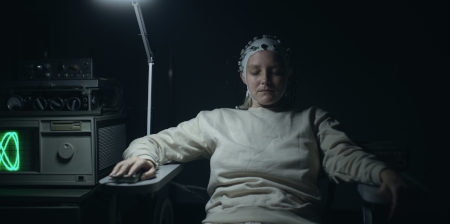
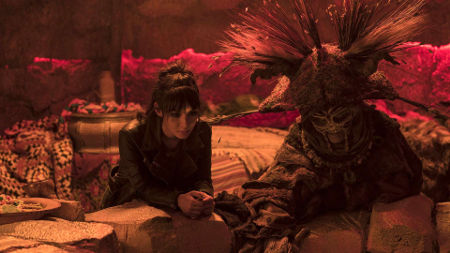
PLOT: After the events of Season 1, Todd and Farrah are on the run and Dirk is a prisoner in a secret military facility; a new mystery begins when a visitor from the magical land of Wendimoor reveals that Dirk is prophesied to save their world from an evil Mage.

dirk_gently's_holistic_detective_agency_season_2

WHY IT WON’T MAKE THE LIST: TV series, not movie. But it’s a series you may want to take note of: otherwise, we wouldn’t be reporting on it, would we? “Dirk Gently”’s mix of absurd humor, bewildering but addictively complex plotting, and fanboy-friendly sci-fantasy tropes was just intriguing enough that that BBC America took a chance on it as potential cult item, but also so weird and difficult that it was cancelled after only two seasons.

COMMENTS: “Have you noticed an acceleration of strangeness in your life?”

The following synopsis may not make much sense to a lot of you. This includes veterans of “Dirk Gently Season 1” as well as newcomers to the series. The one advantage Season 1 viewers have over total neophytes is that they understand “Gently”’s method—throw about a dozen subplots and random events at the viewer in episode 1, then spend the rest of the season slowly connecting the dots, with every little detail merging in a “holistic” (and fantastic) fashion. So, I’ll just lay it out: season 2 introduces a gay pink-haired hero with a scissor sword. A train in the sky. A fishing boat run aground in a field in Montana. A friendly, sort of slow sheriff and his hard-partying deputy. A beleaguered middle-aged woman with a limp, a crummy son, a crummy husband, and a crummy job at the quarry where her crummy boss is making shady deals. A dashing gangster in a snappy white suit with a black tattooed hand and a fabulous mustache. A magic wand. A car stuck in a tree. (The literal Purple People Eater won’t show up until episode 4).

It does all connect, naturally. This high-fantasy based plot is perhaps not as satisfying as Season 1’s time-travel yarn, but on the other hand the show devotes more time to building up its underlying infrastructure, dropping hints about Project Blackwing and introducing new “anomalous individuals” like Dirk and the Rowdy 3. (They’re all sort of a team of metaphysical X-Men gone renegade.) Rather than dominating the plot with his clueless exuberance, Samuel Barnett’s Gently is sidelined a bit this season, moping through most of the story in an existential crisis. He and Elijah Wood’s Todd Brotzman invert their Season 1 dynamic, with Todd now eager to solve the case for his own reasons, dragging the reluctant detective along with him. Other characters pursue their own arcs. Farrah shows more vulnerability, and there are hints of burgeoning romance between her and Todd. Todd’s sister Amanda develops magical powers, making her character more relevant—although this development feels a little forced. Ken is set up for a heel turn. And holistic assassin Bart (Fiona Dourif) remains the most fascinating entity. Her fans will be thrilled with her opportunities to prove she is the ultimate badass killing machine, and she gets by far the best lines: “I think that sometimes when you’re killing people they don’t like it, and it makes them unhappy, and scared, and also dead, which they don’t like, I don’t think…” If that monologue doesn’t intrigue you, then “Dirk Gently” isn’t the show for you.

Unfortunately, the series has been canceled, and we’ll never get to see where creator was ultimately headed with all of this. The most bittersweet part of what turned out to be the series finale is that the last shot sets Bart up for a dramatically increased role in the unmade Season 3.

WHAT THE CRITICS SAY:

“…a show where weird things happen in literally every frame…”–Hahn Nguyen, IndieWire (season premier)

344. TWELVE MONKEYS (1995)

AKA 12 Monkeys

Must See

“I think we should try to avoid defining things precisely. Too many films are packaging the world too neatly for us, and I don’t think the world should be packaged neatly. But hidden things and unknowns… The more you can encourage that on the screen, the better for the mental state of the world.” –Terry Gilliam, “FilmScouts” interview

DIRECTED BY:

FEATURING: , Madeleine Stowe,

PLOT: The future is a grim world where most of humanity has been wiped out by a virus and the rest live underground. James Cole, a prisoner in this future, is recruited to travel back in time on a mission to discover the source of this virus and help his present time develop an antidote. Thanks to unforeseen mishaps and the shaky technology of time travel, his mission goes off track.

Still from Twelve Monkeys (1995)

BACKGROUND:

  • This feature was inspired by La Jetee, ‘s 1962 experimental science fiction short film done almost entirely with black and white still photographs and narration. Terry Gilliam knew the structure of the film, but did not view it before making Twelve Monkeys (obviously, screenwriters David and Janet Peoples were intimately familiar with the earlier film). The core story of James Cole witnessing an execution while stuck in a time loop is the main element surviving from La Jetee. The virus, Brad Pitt’s character, and Madeline Stowe’s role are all the scriptwriters’ invention, as well as an updating and cultural shift to an American setting.
  • One scene that does survive from La Jetee is a character tracing the timeline of their existence on a cross-cut tree stump. Gilliam makes a double-homage by showing the scene from Vertigo during a convenient film marathon showing at the theater where Willis and Stowe hide out.
  • Gilliam cites a trip to the dentists’ office, with its multiple layers of protection for everything to keep it sterile, as inspiration for the protective gear—including the “body condom”—Bruce Willis wears in his trips to the world’s surface.
  • Brad Pitt had never played an unhinged lunatic before Twelve Monkeys; Gilliam was excited at the prospect of casting him against type. Later, Pitt would become known for his manic portrayals in films such as 1999’s Fight Club.
  • On-set rumor has it that Gilliam got Pitt to be a more convincing crazy person by confiscating his cigarettes during filming; Pitt was acting while experiencing nicotine fits.
  • There are TV screens present at some point or another in nearly every scene of the film; Gilliam’s intended to show us as dehumanized by media. Gilliam firmly asserts his place in the cyberpunk genre with the quote: “I’ve always had a problem with the belief that technology was going to solve all of our problems.” Twelve Monkeys continues this theme from 1985’s Brazil.
  • Twelve Monkeys received two Oscar nominations: Pitt for Best Supporting Actor and Julie Weiss for Costume Deign. It won neither.
  • The SyFy Channel original series 12 Monkeys is a spinoff of this movie.

INDELIBLE IMAGE: Insert the obligatory lament that there are so many indelible scenes that it’s hard to pick one. We’ll go with the giant “video ball,” a metal sphere festooned with lenses and video screens, which is always hovering in front of James Cole as the scientists interrogate him in between time hops. It’s a signature of the film’s “complex style over function” motif and the most sure moment where you can walk into the film cold and still say “Aha, this must be a Terry Gilliam movie!”

THREE WEIRD THINGS:  “Mentally divergent” Cassandra Complex; tooth surgery;  giraffes galloping down the freeway

WHAT MAKES IT WEIRD: Besides Terry Gilliam’s trademark rococco visuals, off-the-wall plotting, and larger-than-life characters, Twelve Monkeys has something else that sets it apart from other time travel movies: it is completely without plot holes, and even without paradoxes except that of the stable time loop which gives us the story. Upon first viewing, the story seems to be chaos. Repeat viewings are necessary to assemble a clear story out of the puzzle pieces, every single one of which fits perfectly down to the tiniest details. It’s such a flawless whole when fully mapped that constructing it was a cerebral feat on the order of Fields-medal mathematics.

Original trailer for Twelve Monkeys

COMMENTS: Warning: this review contains spoilers.

Make no mistake: Twelve Monkeys is a very clear, coherent narrative. You just need a wall of pushpin charts, a ball of yarn to connect all Continue reading 344. TWELVE MONKEYS (1995)