Tag Archives: Drama

94. PINK FLOYD THE WALL (1982)

“It was like nothing anyone had ever seen before—a weird fusion of live action, story-telling and of the surreal.”–Pink Floyd the Wall Director Alan Parker on the movie’s Cannes premiere

Recommended

DIRECTED BY: Alan Parker

FEATURING: Bob Geldof, Kevin McKeon, Jenny Wright,

PLOT: The movie begins with a man sitting motionless in a chair in a hotel room.  A series of scrambled flashbacks, fantasies and impressions tell the story of Pink, who grew up fatherless but became a successful, if unhappy, rock star prone to tantrums and bouts of severe depression.  Eventually, Pink’s manager and a crowd of roadies and doctors break down the hotel room door and give him a shot which revives him; his body rots, he peels it away to reveal himself as a fascist dictator who goes onstage to perform.
Still from Pink Floyd: the Wall

BACKGROUND:

  • “The Wall” began life as a 1979 concept album by Pink Floyd.  The double LP and the single “Another Brick in the Wall, Part II” both reached #1 on Billboard’s U.S. charts.  “The Wall” remains one of the 50 top selling albums of all time to this day.
  • Most of the incidents in The Wall stem from Roger Waters’ personal history; a few, however, are taken from the life of former Pink Floyd lead singer Syd Barrett, a psychedelic drug abuser whose erratic behavior caused him to be kicked out of the band and to eventually become a recluse.
  • Almost all of the songs from the original album appear in the movie, sometimes in slightly altered forms.
  • With Alan Parker as producer, The Wall movie was originally intended to be a concert film with animated sequences and a few specially shot live action scenes.  When the concert footage was found to be unusable, the project was reimagined as a (semi-) narrative film with Parker as director.
  • Pink Floyd singer/bassist and Wall librettist Roger Waters originally wanted to play the lead, but after a poor screen test fellow musician Bob Geldof was cast instead.  Ironically, Geldof, lead singer for the Irish punk band The Boomtown Rats, was reportedly not a Floyd fan.
  • Parker and Waters clashed on the set, with the director almost quitting several times.
  • Designer/animator Gerald Scarfe was a caricaturist and political cartoonist before he began collaborating with Pink Floyd.
  • The cheering extras at the fascist concert were actual white supremacists.
  • Director Parker called The Wall “the most expensive student film ever made.”

INDELIBLE IMAGE:  Picking a single image to represent The Wall is a tough assignment.  Among the live-action sequences, the vision of British schoolchildren in faceless blob masks marching into a meat-grinder is fairly unforgettable.  It would be criminal, though, to elevate any mere photograph over Gerald Scarfe’s animations; even picking among them is a tough call.  Though short, these bizarre and horrific images blaze across the screen in such a haunting way that their impact makes up for the brevity. We’re going to select the scene of the goosestepping fascist hammers as the most unforgettable (partly because the hammer imagery that recurs throughout the movie reaches a startling peak with this scene, and partly because Sacrfe’s crossed hammer symbol proved so iconic that it was adopted by actual fascist groups).  If you chose the genitalia-shaped flowers who entwine, mate, and then grow teeth and viciously rip into each other before the female swallows the male whole, however, we couldn’t argue against it.

WHAT MAKES IT WEIRD:  Pink Floyd: the Wall is a collaboration between three separate


Original trailer for Pink Floyd The Wall

creative talents.  In 1979 Roger Waters performed a public self-psychoanalysis by writing a bombastic, self-indulgent rock opera, full of catchy melodies and sardonic lyrics.  When it came time to adapt the album into a movie, he enlisted political cartoonist Gerald Scarfe to provide animated segments, which ultimately included a surrealistic version of the bombing of London during World War II, a judge who is literally an ass, and some of the scariest cartoon vaginas ever drawn.  Bringing it all together was director Alan Parker (Midnight Express), who devised fantastic over-the-top live action visuals to complement the music and found a way to weave the competing thematic strands (autobiography, social commentary, and spur-of-the-moment surrealistic flights of fancy) into something comprehensible, while nonetheless keeping it defiantly weird.  Trying to meld these three separate creative egos on a project whose source material was already grandiose and scattershot could easily have produced an incoherent, pretentious mess.  Remarkably, the result instead is a semi-coherent, pretentious near-masterpiece.

COMMENTS: Watching, or listening, to Pink Floyd: The Wall is one miserable experience. All Continue reading 94. PINK FLOYD THE WALL (1982) →
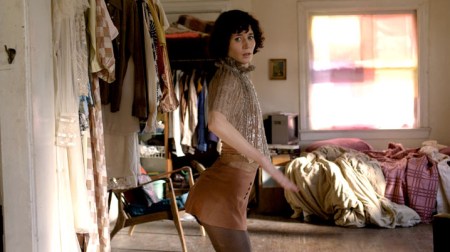
CAPSULE: THE FUTURE (2011)

DIRECTED BY: Miranda July

FEATURING: Miranda July, Hamish Linklater, David Warshofsky, Isabella Acres

PLOT: A thirtysomething couple decides to adopt a sick cat in one month, during which time they quit their jobs and try to find ways to make their lives more satisfying. The cat (named Paw-Paw) narrates part of the story from her veterinary hospital cage.


WHY IT WON’T MAKE THE LIST: Populated with just enough flights of fancy to warrant “eccentric” and offering a surprisingly bleak and realistic look at two people on the brink of nervous breakdown while in a crumbling relationship, The Future just isn’t strange enough for a spot on the List.

COMMENTS: Though it opens with the creepy, nasally voice-over of Paw-Paw the cat detailing its rescue by a kind couple, The Future spends most of its time with Sophie (July) and Jason (Linklater).  She is an “overqualified” dance teacher for young girls, he works from home accepting tech support calls.  When they decide to adopt a sick cat, their future spreads before them as nothing but caring for it and then reaching old age after it dies.  Sophie tries to motivate herself to make online dance videos but instead finds solace in an affair with a friendly sign-maker.  Jason becomes “open to everything,” accepting a volunteer position with an environmental group and befriending an elderly pack rat.  As Paw-Paw waits patiently, her soon-to-be owners flounder in the face of self-fulfillment with anxiety-ridden freakouts.

Known in the film world for her quirk-filled debut Me and You and Everyone We Know, writer and performance artist Miranda July is developing definite trademarks.  She once again employs experimental voice-over and somewhat stilted scripting for a portrait of white middle-class romance, but this time her characters are more realized and the emotions more focused.  As Sophie and Jason claw their way through individual bouts of near-insanity, a surprisingly touching story unfolds.  For the most part we are looking at this relationship from the outside in, seeing these characters more often apart than together.  Sophie’s uncertain relationship with sign-maker Marshall and Jason’s curious friendship with elderly chatterbox Joe offer insights unseen in their actual interactions with one another.

This is uncharacteristic for me but I actually found most of the “weirder” parts detrimental to the film overall.  The creepy cat narration and puppet paws feel irrelevant and clashing—it doesn’t move the story forward and it doesn’t increase my sympathy for the cat or the couple.  Sophie’s suddenly animated t-shirt also feels out of the blue.  The best offbeat technique is employed towards the end, when Jason literally stops time so he can sort out his feelings about Sophie’s infidelity, and ends up in a sad conversation with the moon.  It’s a neat trick and sets forth an interesting structure for that segment of the film, and serves to highlight Hamish Linklater—an actor often set in supporting roles—as a performer.

There’s a good amount of twee baggage weighing down The Future.  Some of July’s little touches of style and wry humor are fun, but many drag the focus away from the central story unnecessarily.  The writing and characterization just aren’t tight enough.  It is at times a beautiful and heartbreaking film, and even quite funny at others, but viewers need to wade through a lot of excess in order to hit upon the most effective points.

WHAT THE CRITICS SAY:

“‘The Future,’ July’s coy and precious new film, is just oddball enough to be interesting, if not good.” –Peter Rainer, Christian Science Monitor (contemporaneous)

LIST CANDIDATE: DEAD RINGERS (1988)

NOTE: By popular demand, Dead Ringers has been promoted onto the List of the 366 Best Weird Movies ever made! Please read the official Certified Weird entry. Comments are closed on this post; this initial review is left here for archival purposes.

Recommended

DIRECTED BY: David Cronenberg

FEATURING: Jeremy Irons, Genevieve Bujold

PLOT: A woman disturbs the delicate psychic balance between twin gynecologists.

Still from Dead Ringers (1988)

WHY IT MIGHT MAKE THE LIST: When the plot synopsis contains the words “twin gynecologists,” you know you’ll be traveling into territory off the beaten path.  When it’s David Cronenberg directing a story about twin gynecologists, you can expect something even further out there.  While Dead Ringers is a drama, it’s a drama for horror movie fans, and it’s offbeat and unnerving enough that it might in indeed rise to the level of “weird.”

COMMENTS:  Twins can be mildly eerie.  Male gynecologists are slightly creepy.  Put twins and gynecologists together, though, and the ick factor increases exponentially; especially when the twin gynecologists’ dating practices are, to say the least, highly unethical.  As shy Beverly and suave Elliot, the Mantle twins, Jeremy Irons gives a fascinating and multifaceted performance.  By utilizing differing mannerisms and energy levels (Bev is jittery where Elliot is detached), Irons makes it so the viewer can immediately differentiate which twin is which about 80% of the time.  That 20% uncertainty about who you are looking at on the screen adds an extra uneasy edge to a picture that’s already morally queasy.  Bev and Elliot, you see, share their women—who are also their patients—and the ladies may be bedding Bev while believing they’re receiving Elliot.  When Beverly, the more sensitive of the pair, becomes enamored with a French-Canadian actress/patient, he decides he wants to keep her for himself and pursue a normal male/female relationship.  But these psychic Siamese twins have become accustomed to share every experience, professional and erotic, since childhood, and asserting his independence proves traumatic for Beverly.  He slides into drug abuse and professional disgrace, and drags codependent Elliot down into the sewer with him.  Cronenberg keeps the explicitly weird elements to a minimum.  There’s a dream sequence, but perhaps the film’s oddest feature is the fact that, rather than using the traditional reassuring white scrubs, the twins perversely outfit their surgical staff in uniforms of blood red—the color of alarm.  Though it’s played straight (for a Cronenberg film), there’s a murky psychological undertone to the incidents that makes Ringers unsettling even beyond its unsavory subject matter.  Cronenberg directs crisply, with sharp cinematography on elegant sets that ironically underscore the seediness of the proceedings.  Stiff Brit Irons lends a touch of class and even manages to make the unsavory twins sympathetic as they spiral to a professional and personal nadir of barbiturate withdrawal psychosis.  Irons performance nabbed Best Actor awards from the New York and Chicago film critics associations and a runner-up prize from the LA film critics, but the project was too strange to be endorsed by the Academy Awards, which procrastinated until the following year to recognize the actor for his role as accused murderer Claus von Bulow in Reversal of Fortune (Irons credits Dead Ringers for an “assist” in nabbing him that statuette).  Despite the paucity of plaudits, this may be the greatest portrayal of twins by a single actor in movie history, making this unusual and extremely dark film worth a look even for conventional cinephiles.

As strange and implausible as Dead Ringers scenario might seem, it’s actually loosely based on a real-life case.

WHAT THE CRITICS SAY:

“Who, then, will be drawn to this spectacle? Anyone with a taste for the macabre wit, the weird poignancy and the shifting notions of identity that lend ‘Dead Ringers’ such fascination.”–Janet Maslin, The New York Times (contemporaneous)

(This movie was nominated for review by “Mighty Utar.” Suggest a weird movie of your own here.)

VICTOR SJOSTROM’S HE WHO GETS SLAPPED (1924) STARRING LON CHANEY

He Who Gets Slapped (1924) is part of the 2011 Warner Archive Lon Chaney collection, and in this film Chaney gives one of his most natural, assured performances—in no small part due to director ,  who also directed Chaney, with Norma Shearer, in the following year’s Tower Of  Lies (unfortunately, yet another lost film).  Victor Sjostrom is something of an icon.  He was a favorite director of stars Greta Garbo and Lillian Gish, and his masterpiece, The Phantom Carriage (1921), was a considerable influence on .  After the coming of sound Sjostrom retired from directing to return to his first love of acting, but he still served as mentor to the young Bergman; Bergman repaid the favor by casting Sjostrom in the extraordinarily beautiful role of Dr. Isak Borg  for Wild Strawberries (1957, possibly Bergman’s greatest film).

After seeing the films Sjostrom had made in Sweden, Producer Irving Thalberg  recruited Sjostrom to Hollywood.  He Who Gets Slapped was the first film the director made at MGM, and it proved to be a lucrative endeavor for all concerned.  Sjostrom was one of the few directors respected by both Louis B. Mayer and Thalberg.  He Who Gets Slapped is based off the 1914 play by Leonid Andreyev.  The resulting film looks, thinks and acts far more European than anything Hollywood studios had produced at that time.

It is a tale of degradation, humiliation, pathos, and sacrifice.  Thankfully, it is a film in which we do not find ourselves rooting for the Donald Trumps or Paris Hiltons of the world.  Chaney is the destitute but prolific scientist Paul Beaumont, so dedicated in his work that he, inevitably, is rendered the oblivious fool.  Beaumont’s filthy rich patron is the Baron de Regnard (Marc McDermott).  Regnard has been helping himself to Beaumont’s selfish wife Maria (Ruth King) and additionally plans to steal the fruit of Beaumont’s scientific labors.

Still from He Who Gets Slapped (1924)The world of Paul Beaumont comes crashing down when Regnard presents Beaumont’s work, as his own, to the Academy.  Beaumont tries, in vain, to convince the Academy of the theft, but they take the side of the affluent Regnard as opposed to the unknown, poverty stricken Beaumont.  Beaumont is belittled  by his patron’s betrayal, by the mocking laughter of the academy, by the discovery of his wife’s infidelity, and, finally, by Regnard’s humiliating slap to his face.  It is a slap which Beaumont now obsessively echoes in repetition every night.  On the Continue reading VICTOR SJOSTROM’S HE WHO GETS SLAPPED (1924) STARRING LON CHANEY →

CAPSULE: THE TREE OF LIFE (2011)

The Tree of Life has been promoted to the List of the 366 Best Weird Movies.  This initial review is left here for archival purposes.  Please visit the film’s official Certified Weird entry for further discussion of the film.

Must See

DIRECTED BY: Terrence Malick

FEATURING: Brad Pitt, Hunter McCracken, Jessica Chastain, Sean Penn

PLOT: A man recalls his childhood in suburban Waco, Texas, and his difficult relationship with

Still from The Tree of Life (2011)

his father; in the process he also seems to unlock some primal memories of the creation of the universe and the evolution of life.

WHY IT WON’T MAKE THE LIST:  Any movie that tells the story of a suburban Texas boy’s troubled relationship with his father—but uses a dramatic encounter between dinosaurs to illustrate its main point—is at least making a nod towards the bizarre.  But, although there are many strange images and ideas in the stream-of-cosmic-consciousness Tree of Life, surrealism is only used as an occasional accent here; overall, the mood is more accurately described as “poetic” rather than “weird.”

COMMENTS: A boy’s tempestuous relationship with Brad the Father is used as a metaphor for nothing less than the turmoil between man and his Maker in Terrence Malick’s moon shot of a movie.  Told mostly as a series of hazy, almost dreamlike domestic memories, the story frequently drifts from reality to fantasy: at times, the boy imagines his mother as Snow White encased in a glass coffin in the forest, or sees a mysterious tall man looming over him in an arched attic.  In one memorable shot, a child in a flooded, womb-like bedroom swims out the window as a teddy bear floats in the amniotic brine.  But what people remember and talk about most are the amazing sequences of the laying of the foundation of the earth—the formation of nebulae, the birth of stars, molten lava boiling, merging into visions of the dance of cellular mitosis as the Tree of Life begins to form.  This leads to those famous graceful dinos who enact a unlikely primal drama, before a meteor wipes them out and we jump forward to our protagonist’s birth.  The cosmic creation sequences seem to come ex nihilo, and, despite the frequent comparisons to the far-out visuals of 2001: A Space Odyssey, they’re more like watching the “Best of Nova” on fast forward.  As is the rest of the narrative, the scenes of life’s gestation and birth are accompanied by the heavenly choral and symphonic sacred music of Bach, Taverner, Smetana, Mahler, and a host of others; history’s most glorious music written by man to express his wonder at creation.  It is impossible not to be awed by the splendor of the universe Malick lays out before us, and it’s impossible not to be intrigued by his brashness in recreating the cosmos for our benefit.  The middle section of the film, which details young Jack’s inability to comprehend gruff and demanding dad Brad’s harsh plan to toughen him up to face life’s challenges, will prove tough going for many due to the slow pace and lack of narrative flow, but it fits the movie’s meditative themes perfectly and gives the mind a chance to turn over the metaphor Malick molds.  The film’s finale, which may be its weakest (or at least its most divisive) feature, moves from the cosmic to the supercosmic as Sean Penn, the resentful little boy now turned into a doubtful and accusatory adult, walks through a door frame hanging in desert space onto a beach of souls.  You may not agree with Tree of Life‘s ultimate religious message, but you have to admire the sincerity and passionate intensity with which Malick delivers it.  He leaves nothing on the table.  Considering the pandering, preachy crud that passes as “inspirational” cinema these days, it’s a miracle to see a thoughtful spiritual movie that gives doubt its due and isn’t self-servingly made to elicit “hallelujahs!” from the pious choir (though they will likely praise it, too).  Based on the screening I attended, I can say that the reports of audible exhaling when the credits roll and the buzz of excited conversation outside theaters afterwards are not exaggerated.  Like it or not, or agree with the message or not, Tree of Life is a challenging and audacious work of cinema, and you’ll be better for having encountered it.

Beginning with the Charles Starkweather-inspired Badlands in 1973, the perfectionistic and reclusive Terrence Malick has only completed five feature films.  All of them are paced with unfashionable slowness, feature gorgeous natural cinematography, and wrestle with weighty themes (the Harvard-educated director was a Rhodes scholar who briefly taught philosophy at MIT before turning to film).  Now 63 years old, Malick has another project currently in the works, but The Tree of Life has the feeling of a cinematic summation and a swan song.

WHAT THE CRITICS SAY:

“…a beautiful, messy film: at times lyrical, intimate, and uplifting; at others, vast, inscrutable, and maddening.”–Christopher Orr, The Atlantic (contemporaneous)

NOTE: We loved The Tree of Life but didn’t really think it was strange enough to qualify as a “weird” movie (by our elevated standards).  366 readers disagreed, and in the 2nd Reader’s Choice poll they selected The Tree of Life to be placed on the List of Candidates for the 366 Best Weird Movies of All Time.  So it is done.