Tag Archives: Documentary

THE POISONOUS IMAGE IN WISCONSIN DEATH TRIP (1999)

A note about the following essay, from the author.

Wisconsin Death Trip is a 1999 film directed by James Marsh, an oddball, morbid documentary inspired by a 1973 nonfiction book of the same title. The film is structured as a chain of anecdotes and vignettes about life in small-town Wisconsin in the late 1800’s. This was a period of depression and hardship, and the psychological toll it took on the populace is apparent: most of the anecdotes are about murder, suicide, and madness, provided with a total lack of context that makes them seem uncanny and inexplicable. The visuals are a combination of period black-and-white photographs and stylized reenactments, and all the accompanying narration is drawn from actual newspaper reports of the time.

The film is a dreamy, dissociative experience, the ramblings of a ghost walking through a funhouse of bad mojo. If you haven’t seen it, I recommend going in fresh, and then reading this essay afterward. As an analysis of the structure and subtexts of the film, this essay is intended to augment and heighten that pure experience, rather than preview it or assess it. It’s a beautiful, stark, unapologetically eccentric documentary, definitely worth a couple hours of your time. If it intrigues you as much as it did me, come on back, and hopefully you’ll get something out of the critical observations to follow.

The Poisonous Image in Wisconsin Death Trip (1999)

Still from Wisconsin Death Trip (1999)From the photographs and newspaper reports, the last decade of the 19th century was a tough time in rural Wisconsin. In the sick sunlight of a national and regional depression and a hard winter, a garden of small disasters sprung up, blossoming with incidents of suicide, murder, and delusion; this was where you could see the fragility of civil society and stoic reason, the hard ground of rationality cracking over the pressure of the uncanny. Wisconsin Death Trip–a 1999 Continue reading THE POISONOUS IMAGE IN WISCONSIN DEATH TRIP (1999)

CAPSULE: MAN WITH THE MOVIE CAMERA (1929)

Chelovek s kino-apparatom; AKA Living Russia, or the Man With the Movie Camera

Recommended

DIRECTED BY: Dziga Vertov

FEATURING: Mikhail Kaufman (cameraman)

PLOT: A plotless record of twenty four hours of life in the Soviet Union of 1929, exhibited

Still from Man with a Movie Camera (1929)

through series of experimental camera tricks.

WHY IT WON’T MAKE THE LIST: Man with the Movie Camera is a visually inventive, historically important and formally deep movie that reveals more secrets with each viewing; but, the only quality in it that might be called “weird” are the surreal camera tricks it occasionally employs. It’s a movie that demands space on the shelf of anyone seriously interested in editing techniques or film theory, but as far as weirdness goes, it’s purely supplemental viewing.

COMMENTS: Reviews of Man with a Movie Camera often spend as much, if not more, time discussing the history and philosophy of the production and its influence on future films than they do describing what’s actually in the movie. That’s because the challenge the movie sets for itself—to create a “truly international absolute language of cinema based on its total separation from the language of theater and literature”—is more fascinating than the film’s subject matter (the daily lives of Soviet citizens in 1929). On a technical level, Movie Camera is a catalog of editing techniques and camera tricks, many of which were pioneered in this film but are commonplace or obsolete now. Be on the lookout for double exposures, tricks of perspective, slowing down or speeding up the camera speed, freeze-frames, reversed footage, split screens, and even crude stop-motion animation. One of the most interesting techniques is the amphetaminic editing of Movie Camera‘s climax, which moves almost too fast for the eye or mind to follow (a technique Guy Maddin would fall in love with and use to ultra-weird effect in the Constructivist/Surrealist hybrid The Heart of the World). Structurally, the film flows along as a series of counterpoints, alternating between two sets of scenes to create ironic contrasts (cross-cutting a funeral procession and the birth of a baby), metaphors (scenes of soot-covered workers Continue reading CAPSULE: MAN WITH THE MOVIE CAMERA (1929)

111. SANS SOLEIL (1983)

AKA Sunless

“It is tempting, and not unjustified, to speculate that one reason for Marker’s growing visibility and popularity is that, as a culture, we have now finally caught up with works that once seemed like dispatches from another planet…”–Catherine Lupton, “Chris Marker: Memory’s Apostle” (2007 Criterion Collection essay)

Must See

DIRECTED BY:

FEATURING: Alexandra Stewart (narrator, English language version)

PLOT: Essentially plotless, Sans Soleil is structured as a series of letters sent from around the world by a fictional director addressed to the anonymous female narrator. The footage shown ranges from the banal to the incredible, and each image sparks a meditation from the letter writer. Among other sights, we view Japanese praying at a shrine to dead cats, the imaginary nightmares of sleeping subway riders, and the bloody slaughter of a giraffe by poachers.

Still from Sans Soleil (1983)

BACKGROUND:

  • Sandor Krasna, the cameraman whose letters the unnamed narrator is supposedly reading, is fictional, an alter-ego of reclusive director Chris Maker. The name “Chris Marker” is itself a pseudonym for Christian François Bouche-Villeneuve.
  • Marker has said he was born in Mongolia, a claim some film historians dispute. He was a philosophy student before joining the French resistance during the Nazi occupation. After the war he became a journalist, then a documentary filmmaker.
  • Sans Soleil was Marker’s first personal film after years spent making a series of Marxist political documentaries.
  • The title comes from a song cycle by Modest Mussorgsky; some of the melodies are recreated in nearly unrecognizable electronic versions arranged by Isao Tomita.
  • In one section of the film “Sandor Krasna” has traveled to San Francisco to visit locations from Alfred Hitchcock’s Vertigo. Remembering the scene where Madeline points to the tree stump, the narrator says “he remembered another film in which this passage was quoted…” The other film, of course, is Marker’s own La Jetée.

INDELIBLE IMAGE: For many, Sans Soleil‘s unforgettable scene is the slice in time when a striking-looking young woman in Cape Verde, who knows the camera is pointed at her but demurely refuses to acknowledge it, briefly makes eye contact; Marker highlights the moment, remarking about “the real glance, straightforward, that lasted a twenty-fourth of a second, the length of a film frame.” (It’s an inversion of a famous bit from Marker’s La Jetée, where every shot is technically the length of a film frame except for a single glance at the camera). As unexpectedly powerful as this brief moment of eye contact is, it’s unfortunately not so weird. So, for our indelible image we instead turn to the video transformation of the ceramic cat idol into an abstract orange and blue blob, a moment where Marker brings two of the film’s diverse interests into a temporary harmony, illustrating how he weaves his seemingly random obsessions into a coherent tapestry.

WHAT MAKES IT WEIRD: Sans Soleil begins with an image of three Icelandic girls and


Clip from Sans Soleil

voiceover narration admitting that the photographer can find no other image to link it to, followed by a brief shot of American warplanes on an aircraft carrier, followed by scenes Japanese commuters napping on a ferry. This ADD documentary changes topics every minute or two, with each brief sequence accompanied by a spoken observation that could be read as profound, poetic, pretentious, or even all three at once. Sans Soleil visits cat shrines, the slaughter of a giraffe, and a monkey porn museum in its wanderings. If that’s not weird enough for you, the film takes time out of its busy schedule to recreate the imaginary nightmares of passengers dozing on a Tokyo subway. All of the scenes are accompanied by freaky synthetic electronic sounds percolating up through a video mix that’s often altered with then-avant-garde video transformation techniques. With their feet nailed to reality, documentaries have to strain hard to escape the bonds of gravity and sail to the heights of weirdness, but Sans Soleil is one experiment in nonfiction that manages to soar effortlessly.

COMMENTS: Essentially, Sans Soleil is an arthouse version of Mondo Cane. (For the record, I Continue reading 111. SANS SOLEIL (1983)

CAPSULE: THE HELLSTROM CHRONICLE (1971)

Must See

DIRECTED BY: Ed Spiegel (Hellstrom sequences), Walon Green (producer and principal photography), David L. Wolper (executive producer)

FEATURING: Lawrence Pressman

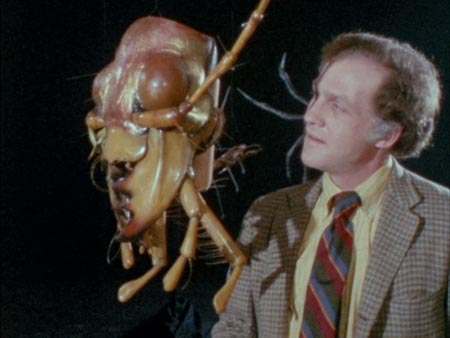
PLOT: The fictional Dr. Nils Hellstrom explains the evolutionary advantages of insects and

Still from The Hellstrom Chronicle (1971)

concludes they are biologically superior to humans, leading him to predict dire consequences for the future of our species.

WHY IT WON’T MAKE THE LIST: Documentaries don’t come much weirder than this, but even the orgies of insectoid sex and violence and Dr. Hellstrom’s flaky mad scientist rants about the inherent superiority of spiders, termites and centipedes can’t raise this to the level of the truly bizarre. Despite the fact that it doesn’t have the goods to rank among the weirdest movies of all times, however, it’s still a beautiful abnormality that’s well worth your attention.

COMMENTS: The Hellstrom Chronicle contains a lot of curiosities, but the heart of the movie are the amazing images captured through (then miraculous) micro-photography: a caterpillar developing from a fertilized cell to a larva in the space of a minute, a shot of beetles locked in a death struggle that widens and pans to show a human couple cuddling on the lawn, individual brightly-colored butterfly scales glowing in the sunlight like Lite Brites. As that last image suggests, there is a psychedelic character to much of this parade of fantastical bug-tography, one that the filmmakers play up as they segue from those super-closeups of wings to shaky cam scenes of fields of butterflies flying through a forest, as Lalo Schifrin’s electronic free-jazz symphony soars ecstatically. From sequences like this we realize why this documentary was so popular on college campuses in the 1970s; you can almost see the clouds of pot smoke rising up in front of the five-foot tall black beetles with their jutting horns silhouetted against the sunrise, and hear the low murmurs of “far out, man.”

With its dissonant sitars, electric pianos dithering over waves of cymbals, and waveform synthesizers wavering in the background, Schrifin’s remarkable score evokes not only midnight trips but also conventional sci-fi giant insect cues, which is appropriate because much of the Continue reading CAPSULE: THE HELLSTROM CHRONICLE (1971)

CAPSULE: BLANK CITY (2010)

DIRECTED BY: Celine Danhier

FEATURING: Amos Poe, Jim Jarmusch, Steve Buscemi, Lydia Lunch, Nick Zedd, Richard Kern, ,

PLOT: This documentary examines the “No Wave” and “Cinema of Transgression” film

Still from Blank City (2010)

movements and their connections to performance art and punk rock in New York City circa 1977-1985.

WHY IT WON’T MAKE THE LIST: It’s purely a supplemental feature for your weird movie education, giving background information on a significant underground DIY film movement.

COMMENTS: “It felt like our lives were movies,” says Debbie Harry early on in Blank City. “It was very cinematic.” Perhaps this explains Celine Danhier’s choice, which earned her criticism in some quarters, to place the focus more on the filmmakers than the films in this documentary. Based on the No Wave film clips which illustrate the story, this was the correct angle to take on the material. Most of the “greatest hits” Super-8 highlights consist of grungy hipsters smoking cigarettes in grainy black and white, or walking around dirty East Village streets in washed-out, home-movie color. By contrast, the Bohemian lifestyle the filmmakers fondly recall—sharing $50 apartments in burnt out tenements with cockroaches, shooting on the street on the spur of the moment whenever they could assemble a crew, sneaking into locations to film without permission or permits, and heading off to CBGB’s after a hard day of scraping together footage to drink and dance the night away while a pre-fame Blondie or Television played on stage—is a lot more interesting. The No Wave scene flourished during New York City’s downbeat phase, when the burg was deep in debt, full of abandoned buildings, and riddled by crime and heroin abuse (basically, the New York of Midnight Cowboy and Taxi Driver). The city in the late Seventies was nasty and dangerous, but for nouveau-beatnik types it offered cheap rent, cheaper Super-8 film stock, and the company of like-minded free spirits. Although it grew out of the ashes of the previous New York avant-garde exemplified by and Jack (Flaming Creatures) Smith, movement godfather Amos Poe explains that this wave rebelled against the Continue reading CAPSULE: BLANK CITY (2010)