Tag Archives: Coming of Age

136. VALERIE AND HER WEEK OF WONDERS (1970)

Valerie a Týden Divu

“…one of those haunting, dream-like films that once seen is difficult to forget.”–Tanya Krzywinska

Recommended

DIRECTED BY:

FEATURING: Jaroslava Schallerova, Petr Kopriva, Helena Anyzova, Jiri Prymek, 

PLOT: Young Valerie lives in a farmhouse on the edge of a small town with her Granny. She flirts with “Eagle,” a boy about her age who is either a neighbor or her brother, and they both fear a pale-faced bogeyman they call “the Weasel.” On the day she becomes a woman (symbolized by blood drops appearing on a daisy), Valerie’s life suddenly becomes a strange dream involving family betrayals, lusty priests, constantly shifting identities, and a vampire infestation.

Still from Valerie and Her Week of Wonders (1970)

BACKGROUND:

  • Valerie and Her Week of Wonders is an adaptation of the novel of the same name by Vítězslav Nezval, which was written in 1935 but not published until 1945. Nezval was a co-founder of the Czech Surrealist group (one of the first Surrealist groups organized outside of France).
  • This is considered one of the last works in what was known as the , although that term more commonly refers to Czech movies made or released just before or during the Prague spring of 1968. In contrast to most of the New Wave canon, Valerie was released after the Soviet invasion of Czechoslovakia and the installation of a hardline government who redoubled censorship efforts. Despite the fact that it’s a Surrealist work, equally offensive to the official aesthetic of Socialist Realism as a banned New Wave movie like 1967’s Daisies, Valerie appears to have evoked little objection from the censors. This may be because the film’s heavily anticlerical tone meshed with the Communist Party’s official stance on the Church.
  • A Philadelphia “freak folk” supergroup dubbed “The Valerie Project” wrote an alternate soundtrack to the film, and toured across the U.S. from 2006-2008 performing the score while the film screened as a silent movie.

INDELIBLE IMAGE: Drops of blood on white daisy petals.

WHAT MAKES IT WEIRD: Valerie and Her Week of Wonders is often, and accurately, described as a Freudian version of Alice in Wonderland, with the confusion of new hormones surging through the young heroine’s body coloring her encounters with a dark and fearful tinge: Valerie faces vampires and rapist priests instead of Alice’s White Rabbits and Cheshire Cats. The plot makes no literal sense, because characters keep changing into different characters, the way they might in a dream; but overall Valerie’s welter of wonders hangs together as a mosaic of a girl’s anxieties about impending adulthood and the enticing but scary world of sex.

Clip from Peter Hames Criterion Collection commentary Valerie and Her Week of Wonders

COMMENTS: Valerie and Her Week of Wonders opens with images of pretty young Valerie drinking from a waterspout, petting a dove, sniffing Continue reading 136. VALERIE AND HER WEEK OF WONDERS (1970) →

RECOMMENDED AS WEIRD: PALINDROMES (2004)

DIRECTED BY: Todd Solondz

FEATURING: , Richard Masur, , Sharon Wilkins

PLOT: A teenager falls in with a group of anti-abortionists in her quest to become pregnant.

Still from Palindromes (2004)

WHY IT SHOULD MAKE THE LIST: As if the plot isn’t off-beat enough, Palindromes‘s teenage porotagonist is played by a variety of actors of different ages, sizes, races, and even genders.

COMMENTS: The standout feature of Palindromes is the unorthodox casting of a series of different actresses (and one actor) in the role of Aviva Victor. The variety of thespians allows Solondz to express the evolution of Aviva’s self-image, physically reflecting changes in her emotional state during the movie. When we first meet Aviva, she is played by a young African-American girl who wears her emotions on her sleeves and in her facial expressions. She is the only child to middle class parents (Barkin and Masur) living in an anonymous suburb in the Northeast United States. Horrified at the probable suicide of her cousin Dawn and alienated by the material nature of her mother’s love, Aviva becomes obsessed with the idea of having lots of babies to ensure she has someone to love her. Then, as a Caucasian brunette in her early teens, she has an ill-advised encounter with the son of a family friend, and gets pregnant. As a reedy, red-haired, slightly older girl, she strenuously resists but eventually accedes to getting an abortion. As a more confident and more attractive brunette, she runs away with the help of a truck driver, with whom she has sex in the hopes of once again getting pregnant. Abandoned by the truck driver, she wanders through wilderness in the shape of a teenage boy and then is discovered—now as a large, older African–American woman—by the driven and very Christian Mama Sunshine, who runs an orphanage for children with medical infirmities. Here Aviva is least like herself: in a completely alien environment, she has to lie about her name and her past to fit in, and her self-doubt and anxiety are apparent in her magnified size, awkward movement, and change in race. The plot unfolds from there involving more pedophilia, a quest to assassinate the doctor who aborted her fetus, and a shootout in room 11 of a seedy motel, with Aviva switching from shape to shape, becoming more assertive and mature. At the point where she feels most grown-up, she returns to her family as a world-weary, bedraggled 20-something waif (Jennifer Jason Leigh). She holds her own in an existential debate with her older cousin, Mark, and easily wins arguments with her parents. But, as the title of the movie suggests, things come around: Aviva meets up with the boy who got her pregnant to begin with, reverts mentally through the chain of actors who have portrayed her, until she is once again the vulnerable, out-of-place, emotionally needy little black girl. As seductive as the message is that everything eventually returns to its beginning state, palindrome-like, some things in the film are irreversible: death, certain operations, and murder among them. In the end, it’s these things that will eventually shape the person Aviva will eventually become, but she’s not yet become them yet.

WHAT THE CRITICS SAY:

“What makes this strange story even stranger is Aviva is played by eight different performers… Solondz constructs a deadpan sheltering bubble around his film, thereby defusing most of the issues he raises. It’s all one Warholian shrug. Still, ‘Palindromes’ is unlike anything you’ve seen at the movies.”–Bob Longino, Atlanta Journal-Constitution (contemporaneous)

CAPSULE: LABYRINTH (1986)

Recommended

DIRECTED BY:

FEATURING: ,

PLOT: A dreamy teenage girl must rescue her kidnapped baby brother by journeying to the Goblin City at the center of a bizarre labyrinth.

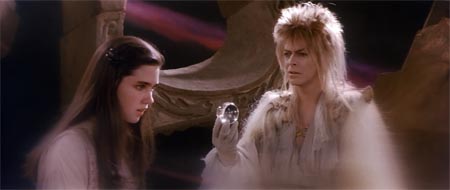
Still from Labyrinth (1986)
WHY IT WON’T MAKE THE LIST: Despite the MC Escher-inspired set-design, the unexpected sexual tension between teenaged Connelly and fruitily-dressed goblin king Bowie, and a devout cult following, Labryinth is ultimately just too close to a mainstream Muppet fantasy to place on a List of the 366 Weirdest movies. We’ve passed over slightly stranger movies in this genre—the visually similar Henson-directed The Dark Crystal and the thematically similar Henson-produced MirrorMask—and, although I think Labyrinth is a better film than either of those, it’s difficult to justify certifying this one when its companion films don’t even get to sniff the List.

COMMENTS: In The Wizard of Oz, Judy Garland’s breasts were famously flattened out with tape so the 16-year old could play a pre-pubescent girl. Labyrinth takes a different strategy: 14-old Jennifer Connelly plays exactly her age, portraying a hormonally testy girl-woman caught at the stage where her attention starts to shift from stuffed animals to the well-stuffed pants of strutting rock stars. That shot of rising estrogen distinguishes Labyrinth from other Oz/Alice in Wonderland fairy tale variations, giving it a subtext that goes over the heads of the tots in the audience but leaves adults with additional nuggets to ponder (and no, that’s not another reference to Bowie’s stretch pants).

There’s an impressive amount of imagination on display here, starting with Henson’s puppets, who reveal an almost limitless variety (each individual goblin looks like a representative of its own species) and a nearly human expressiveness (to be honest, the puppets out-act both Connelly and Bowie). The girl’s three companions—the cowardly dwarf Hoggle, the bestial Ludo, and Sir Didymus, the comic relief knight/terrier—are all worthy additions to Henson’s Muppet menagerie, and there is a zoo full of eccentric Wonderland-esque supporting creatures, including walking playing cards, Continue reading CAPSULE: LABYRINTH (1986) →

LIST CANDIDATE: PRIVATE PARTS (1972)

366 Weird Movies may earn commissions from purchases made through product links.

Recommended

DIRECTED BY:

FEATURING: Ayn Ruymen, Lucille Benson, John Ventantonio

PLOT: A sexually curious teenage runaway negotiates the deviant scumbags in her crazy aunt’s creaky boarding house.

Still from Private Parts (1972)
WHY IT MIGHT MAKE THE LIST:  It might make the List thanks to the atmosphere of sleazy psychosexual depravity that’s slathered on thicker than the blue eye shadow teenage Cheryl cakes on to try to make herself look like a woman.

COMMENTS: Private Parts is a haunted house movie, except that the ghosts bedeviling the heroine are the bizarre, boozy boarders at her aunt’s decrepit hotel, and she’s not nearly as wary of them as she needs to be. This is a movie full of creaking floorboards, turning doorknobs, and unseen men peeping through knotholes in a dusty old hotel. Adding to the atmosphere is a wonderfully overwrought Bernard Hermann-inspired soundtrack that’s with us so constantly that it actually creates tension when it disappears for a moment to allow the characters to speak. Not that what this collection of skid-row oddballs has to say would be particularly reassuring. We have the Reverend, who at one point suggests he should slip out of his clerical vestments into something more comfortable; the spooky old hag who calls young Cheryl “Alice” after a resident who disappeared a long time ago under suspicious circumstances; and there’s the hotelier herself, Aunt Martha, who loves funerals, hates painted women and believes “the body is a prison.” There’s also George, the silent young photographer with the darkroom in the basement and the creepy stare that focuses on pubescent Cheryl whenever she’s in the room. Each of these weirdos has deeper secrets in their closets, which Cheryl will uncover when she starts snooping around their rooms against her Aunt’s orders (hint to future runaways: you should never trust a guy who owns a customized carrying case for his personal syringe). Obviously, this is no place for a naïf like Cheryl, but she’s not oblivious to the degeneracy—she’s actively drawn to it. Curious about sex but totally inexperienced, she enjoys the feel of a grown man’s eyes on her developing body, without understanding the difference between healthy lust and sick perversion. All she knows is, after receiving presents of erotica and spiderweb lingerie from a secret admirer, boys her own age suddenly seem boring. Although the movie sports a body count, the tension comes from hoping Cheryl will somehow escape what seems to be her inevitable seduction and corruption. If IMDB is to be believed, Ayn Ruymen was 25 years old when she played the part, but you may have a hard time believing the actress is a day over 16. Not only does she have an adolescent build, she plays the part with a wonderful mix of innocent naughtiness; she mischievously snoops and pranks the boarders, but still sleeps with a teddy bear and isn’t half as sophisticated as she thinks.  The bits with a bizarre, customizable “blow up” doll are unforgettably creepy. After playing as straight psychohorror through most of the running time, Private Parts takes a strange detour into black comedy territory for the conclusion with the arrival of a couple of ludicrously blasé cops, and throws out a couple of scarcely believable twists at the very end as the weird capper. All told, Private Parts a deliciously depraved debut from oddball Paul Bartel.

Private Parts is a should-be cult movie that’s still searching for its cult forty years after release. For some reason, MGM picked the movie up for distribution, then apparently balked at the pseudo-pedophiliac subject matter and buried the movie. The flick has been consistently overlooked since; those who caught it in its brief theatrical run or stumbled upon its unheralded VHS or DVD releases remember it, but word of mouth has never made it a hit, despite its midnight movie feel and pleasing perversity. Ironically, director Paul Bartel received more exposure making films like Death Race 2000 for (Roger’s brother Gene was producer on Private Parts) than he with this Hollywood debut.

WHAT THE CRITICS SAY:

“…for pure excess and surreal humor, it’s something of a minor pop art masterpiece; a careful blending of the eccentric and the sleazy, very much akin to other midnight revival mainstays like Beyond the Valley of the Dolls and the ’70s films of John Waters, with a wickedly unique take on repressed desire and secret shame.”–Paul Corupe, DVD Verdict (DVD)

(This movie was nominated for review by “Gerby” who called it “a strange one!” Suggest a weird movie of your own here.)