Tag Archives: Comedy

272. CITY OF WOMEN (1980)

La città delle donne

Recommended

“It’s the viewpoint of a man who has always looked at woman as a total mystery.… Through the ages, from the beginning of time, I’m certain man has covered woman’s face with masks. They are, however, his masks, not hers.”–Federico Fellini defending City of Women

DIRECTED BY:

FEATURING: , , Ettore Manni, Bernice Stegers, Donatella Damiani

PLOT: Waking on a train across from a seductive woman, Snàporaz pursues her into the carriage’s wash-room. Abruptly, the train stops and the woman de-embarks, heading across a field with Snàporaz in close pursuit. During his long journey he explores an hotel teeming with Feminists, hitches a ride with a crew of drugged-out teenage motorists, and meets a doctor whose “manly” villa contravenes local law.
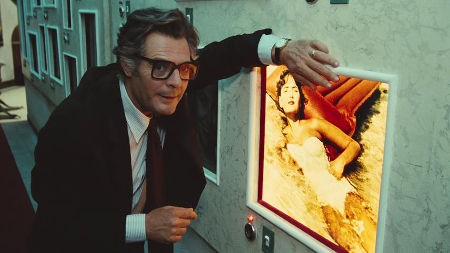
Still from City of Women (1980)

BACKGROUND:

  • A massive re-work of the story was required when the second male lead (Ettore Manni, who played “Dr. Katzone”) died from a fatal, self-inflicted gunshot wound to the groin.
  • Before returning to his reliable proxy Marcello Mastroianni, Fellini offered the role to Dustin Hoffman. Hoffman declined, as he was concerned about the post-dubbing process being detrimental to his performance.
  • Though it received largely positive reviews on its general release, it fared poorly at Cannes. , in Rome at the time working on Nostalghia, dismissed City of Women in his diary, saying “…it’s true, his film is worthless.”
  • Production designer Dante Ferretti was kept on his toes while making of the film, as Fellini would constantly request that new, elaborate sets be whipped up in a small amount of time. Farretti invariably obliged the director’s requests, and his success allowed him sole billing as “Production Designer,” a title usually nabbed by Fellini himself in the movie’s credits.

INDELIBLE IMAGE: After the brief introduction of the train ride turning into a romp across a field, virtually everything that follows in Fellini’s City of Women starts globbing on to the memory. From a long list of choices (addled Feminists fomenting in an hotel, drugged-out [?] minors driving the middle-aged protagonist to a haunting techno-pop tune, and an aged Lothario blowing out 10,000 candles among them), perhaps the best choice is the joy-filled sequence in the museum of women at Katzone’s villa. Snàporaz darts back and forth with an innocently lecherous glee as he flicks on the photographs’ illumination and hears a snippet from that woman’s sexual history. The visual and sonic overload goes up to eleven when Snàporaz’s ex-wife appears at the end of the corridor and turns on all of the displays. Women, women everywhere—in sound and vision.

THREE WEIRD THINGS: The hall of sexual conquests; memory lane slide; ideal woman escape balloon

WHAT MAKES IT WEIRD: Traipsing along for two and one-half hours, City of Women somehow combines the sugary charm of a light-weight musical with the non-stop adventure of an epic film. Beginning with a tone bordering on the mundane (the tediousness of travel), Fellini quickly pushes things from believable, to somewhat believable (the feminist convention), then onwards and upwards to a literal and metaphorical peak of disbelief as our hero escapes an arena full of spectators by clinging to a hot-air balloon. Between the jostling in the train car and the flight into the unknown, it would be faster to answer the question, what isn’t weird about it?


Original Italian trailer for City of Women

COMMENTS: Obsession can be a dangerous thing, but it can also be Continue reading 272. CITY OF WOMEN (1980) →

SATURDAY SHORT: BLACK HOLES (2017)

Dave, an aging astronaut teams up with a sentient cantaloupe on the first ever Mars mission.

This concept piece is currently being made into a full-length television series, and the team has turned to crowd funding to help cover the costs. If you’d like to help the cause, please visit their Kickstarter page.

Content Warning: This short contains some cartoon nudity.

269. NOTHING BUT TROUBLE (1991)

“An adequate song score album for a movie that utterly failed to live up to its weird potential.”–Steven McDonald, reviewing the soundtrack to Nothing but Trouble

DIRECTED BY:

FEATURING: Chevy Chase, Dan Aykroyd, John Candy,

PLOT: Four carefree travelers go for a drive in New Jersey. They get pulled over in a small backwater town for running a stop sign and have to be escorted to the local judge. They are then imprisoned in a haunted-house like mansion that shares premises with a junkyard.

Still from Nothing But Trouble (1991)

BACKGROUND:

  • Dan Aykroyd’s background probably destined him to make at least one weird movie. Both of his parents were Spiritists, and he’s had a fascination with the occult since childhood that inspired him to create Ghostbusters, among other hits.
  • This is Aykroyd’s sole directing credit (he also wrote). Canadian-born Aykroyd was once pulled over for a speeding ticket while on his motorcycle in the States, and had to be escorted to a courthouse in a small town. Legend has it that this movie was inspired by that event.
  • The movie had a budget of $40 million and only pulled in $8.5 million. Critics panned it, including Roger Ebert, who declined to review it in written form. It also got nominated for the Razzies for Worst Picture, Worst Actress, Worst Supporting Actress (John Candy in drag), Worst Director, and Worst Screenplay, though it “won” only for Worst Supporting Actor (Akroyd).
  • Digital Underground worked their cameo in this movie into a music video for their 1991 single “Same Song,” which entered MTV rotation. It still shows up periodically on cable music stations.
  • After the movie flopped, Akroyd wrote an apology letter to the cast taking full credit for the film’s failure.
  • Pete Trbovich‘s Staff Pick for a Certified Weird movie.

INDELIBLE IMAGE: In a movie with no shortage of contenders, the scenes everybody leaves raving about are the ones with the Mr. Bonestripper ride. This is a backyard roller-coaster in which victims are given a final ride before being dumped into a leering cartoon maw with mechanical teeth which grind the victims down to shiny, polished bones, which are then ejected out the back towards a bullseye target painted on a metal fence. It even has its own theme song, courtesy of the band Damn Yankees. Are we having fun yet?

THREE WEIRD THINGS: Model train dining; subliminal penis nose; mutant junkyard fatties

WHAT MAKES IT WEIRD: Nothing but Trouble invents its own genre, hereby known as Industrial Gothic, which plays on the horrors of Americana. These extend to labyrinthine freeway exits, small town hicks, Rust Belt ghost towns, corrupt law enforcement, class struggles between disenfranchised Main Street and out-of-touch Wall Street, welded-together death machines, compulsive hoarding, and a lack of mental health care. Take a Canadian-born comedian who’s had a scary run in with American law enforcement and let him make a Kafkaesque pitch-black comedy that will be the first (and so far only) Industrial Gothic movie, and this is exactly what you get.


Original trailer for Nothing but Trouble

COMMENTS: To be a fan of weird movies, your expectations must Continue reading 269. NOTHING BUT TROUBLE (1991) →

READER RECOMMENDATION: ESCORIANDOLI (1996)

AKA Trash – T.R.A.

Reader recommendation by “Tracian”

DIRECTED BY: Antonio Rezza

FEATURING: Antonio Rezza, Valeria Golino, Claudia Gerini, Isabella Ferrari, Valentina Cervi

PLOT: Five connected stories where the protagonist is always played by Rezza. An affair during a funeral is spiced up by the occasional comments of the deceased; the two lovers of a woman suddenly exchange their ages; a terminally bored girl is forced to join a totalitarian rehab clinic; a poet consumes his life searching for forgiveness for having stepped on a man’s toe; and a professional event-crasher loses control of his own body and is forced to cut it to pieces until only the head remains.

Still from Escoriandoli (1996)

WHY IT SHOULD MAKE THE LIST: Because it is a rare example of an arthouse film that is not pretentious but actually fun, highly committed to weirdness and yet serious in its (admittedly well-hidden) message.

COMMENTS: While you have to understand Italian to fully appreciate the lyrical, offbeat and hilarious dialogues, everyone will be amazed by the physical and vocal contortions of the protagonist(s). Pretty much everything in Escoriandoli (the title itself is a pun that roughly means “confetti-like joy in excoriating them”) is odd: an example may be how all the actors on a bus react to its movements—although the vehicle is explicitly shown as being still—but almost no scene can be considered “normal”.

WHAT THE CRITICS SAY:

“Italian surreal comedy consisting of a series of satirical vignettes… Fun at times, but the acting is way too silly.”–Zev Toledano, The Worldwide Celluloid Massacre

266. 200 MOTELS (1971)

Frank Zappa’s 200 Motels

“I never set out to be weird. It was always other people who called me weird.”–Frank Zappa, Baltimore Sun, October 12, 1986
Weirdest!

DIRECTED BY: Tony Palmer, Frank Zappa

FEATURING: , , , , , Jimmy Carl Black, Frank Zappa

PLOT: A collection of absurd sketches about life on the road as a rock band, 200 Motels offers very little in the way of plot. Running bits include Ringo Starr playing a large dwarf enlisted to portray Zappa, Theodore Bikel as a Mephistophelean figure trying to get the band to sign documents in blood, and Keith Moon as a groupie dressed as a nun; amidst the chaos, the band members constantly try to either get laid, get high, or scheme to form spin-off bands. In between, Zappa and the band perform musical numbers like “Lonesome Cowboy Burt,” and Zappa conducts an orchestra playing his avant-garde classical compositions.

Still from 200 Motels (1971)

BACKGROUND:

  • Frank Zappa thought up the idea for the film while on tour with the Mothers of Invention. He wrote much of the music in 200 Motels from motel rooms while on tour.
  • The opening credits explain the split in the directorial duties, with Tony Palmer credited for “visuals” and Zappa for directing the “characterizations.”
  • Mark Volman and Howard Kaylan (“Flo and Eddie”) formerly comprised the Turtles, who had a smash hit with “Happy Together.” They joined Zappa’s band, the Mothers of Invention, as featured vocalists in 1970, and stayed in the Mothers until 1972—just long enough to have featured roles in 200 Motels.
  • Ringo Starr’s chauffeur played the band’s bass player: according to one anecdote, he was cast after the two bass players quit the band and a frustrated Zappa vowed to hire the next person who walked through the door.
  • 200 Motels was one of the earliest films shot on video and transferred to film. Shooting on video allowed Tony Palmer to create visual effects that would have been too expensive to shoot on film.
  • In his review of the soundtrack album, Palmer called 200 Motels “one of the worst films in the entire history of cinema, a criticism which I can confidently assert because I was in part responsible for its direction.“
  • In 1988 Zappa made a documentary about the film called The True Story of Frank Zappa’s 200 Motels. That rarity is long out of print on VHS and has never had an authorized DVD or Blu-ray release.

INDELIBLE IMAGE: Tony Palmer overlaid trippy experimental video effects—the visual correlative of Frank Zappa’s oddball music—over almost every minute of the running time, making this a particularly difficult movie to choose a single image for. These tricks accumulate to build up a hazy impression of whirling psychedelia. Since we have to pick one image, however, we’ll go with our first view of Centerville, the small town enveloped in a wavering pattern of lysergic zebra stripes, which represents the hazy, melted-together vision of every two-bit town the band soldiers through.

THREE WEIRD THINGS: Hot Nun; towel smoking; penis oratorio

WHAT MAKES IT WEIRD: If anything sets 200 Motels apart from the other psychedelic cinematic noodlings of the hippie era, it’s Frank Zappa’s extraordinarily weird music—a unique mix of jazz-inflected blues/rock, avant-garde 12-tone classical music, and junior high school sex jokes. Mix concert footage (both of the Mothers of Invention and the orchestra Zappa retained for the shoot) with experimental videos, underground cartoons, oddball rock star cameos, and no plot whatsoever and you have a movie worthy of the production company’s name: “Bizarre Productions.” Zappa is a latter-day saint of pop-surrealism, and although he’ll always be best known for his music, this is the canonical record of his twisted sensibility on film.


Original trailer for 200 Motels

COMMENTS: The original tagline did not read “Ringo Starr IS Larry Continue reading 266. 200 MOTELS (1971) →