Tag Archives: Comedy

CAPSULE: SLACKER (1991)

Recommended

DIRECTED BY:

FEATURING: The citizens of Austin, Texas

PLOT: Slacker spies on the aimless exploits of the slackers of Austin, TX; the camera follows one character for a few minutes, then veers off to chase another through a series of comical, philosophical, and absurd vignettes involving hit-and-run drivers, elderly anarchists and video fetishists.
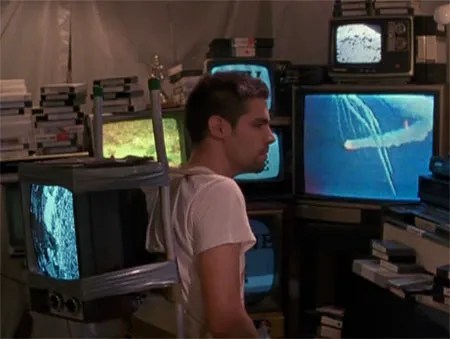
Still from Slacker (1991)

WHY IT WON’T MAKE THE LIST: Slacker is a seminal, interesting, and at times incisive storytelling experiment, but it’s of interest to weirdophiles mainly as the spiritual prequel to Waking Life, which is virtually Slacker remade as a dream.

COMMENTS: The batty cast list—credited characters include “Dostoevsky Wannabe,” “Recluse in Bathrobe” and “Hit Up for Cigarettes”—accurately reflects the mix of mundanity and eccentricity on display in writer/director Richard Linklater’s slice-of-life tour of the coffee shops and crash-pads and on the fringes of Austin, Texas in 1991. Slacker is a character study of the subculture of bright but unambitious dropouts and unemployed postgrads bent on extending their undergrad lifestyles that exists in every college town. At the time of its release it was seen as emblematic of “Generation X”‘s alienation and withdrawal from mainstream culture, but in reality this Bohemian substrata of unmotivated aesthetes and anti-establishment hedonists has always been with us under various names (if the movie had been made in 1291 in Saint-Rémy-de-Provence it would have been entitled Goliard). For this peripatetic essay Linklater borrows the elegant but seldom used narrative device invented by Luis Buñuel for The Phantom of Liberty: two characters walk down the street discussing whether they should leave the country, then the cameraman suddenly gets bored and starts following a man who enters a coffee shop where an insane woman advises him that he should “never traumatize a woman sexually,” then decides instead to see where the guy who just entered the shop wearing a bathrobe is headed to, and so on. The result is a series of vignettes which are occasionally funny, occasionally disturbing, and often repetitive, but which capture a peculiar, laid-back, mad energy of a particular place at a particular point in time. Still, as the film’s oldest character rhapsodizes when remembering Charles Whitman, “this town has always had its share of crazies—I wouldn’t want to live anywhere else.” Memorable characters range from the UFO enthusiast who accosts passersby to explain his theory that we’ve been on the moon since the 1950s to the tomboy who’s looking to fence stolen celebrity gynecology artifacts, cheap. Linklater, who delivers the first of the film’s many discursive monologues himself in the role of “Should Have Stayed at the Bus Stop,” shows an attitude of fond disdain for a town where everyone sleeps in late and is working on an unfinished novel or playing in an unsigned band. The director may have arisen out of the Austin milieu, but if he’s a slacker, then he’s a type-A personality slacker; he’s obviously a much harder worker than the guy who earnestly muses “who’s ever written a great work about the tremendous effort required not to create?” over a cup of cappuccino.

If Slacker has one downside (besides excusably spotty acting by the amateur cast), it’s that the movie turns repetitive and arguably outstays its welcome. Somewhere between twenty and forty-five minutes in we start to get the picture; although the UFO guy and the JFK guy have totally different obsessions, ultimately they’re both just proselytizers with a passion for explaining stuff we don’t care about to us in ridiculous detail. The overall portrait Linklater manages to paint is still very impressive; Slacker may be the most passionate and invigorating movie about doing nothing ever made.

On a personal note, I was lucky enough to see Slacker in Austin, TX in 1991 in a theater in a strip mall (I lived in Dallas at the time but had a friend attending UT with a couch I could crash on). The movie, which was playing nowhere else in the country, had been held over for a second week, and the afternoon matinee showing was standing room only; everyone in the audience but me probably had a friend or two who was an extra in it. I had an aisle seat; a middle-aged woman came in late and stood next to me during the entire show, shooting me nasty looks as she shifted from foot to foot. I recall thinking it ironic that the Austinite had to stand through the whole performance simply because she had slacked off on getting to the show on time.

WHAT THE CRITICS SAY:

“…funny, surreal and weird… Linklater traces the dehumanized weirding of America — as collectively defined by David Lynch, Errol Morris, Jim Jarmusch and others. But he does it with a detached, yet sympathetic sense of irony.”–Desson Howe, The Washington Post (contemporaneous)

(This movie was nominated for review by nicolas, who suggested that all of Linklater’s films were “pretty weird and deep with one or two exceptions.” Suggest a weird movie of your own here.)

THE CHASER (1928)

The Chaser (1928) was ‘s second directorial feature for First National studios. His third and final feature, Heart Trouble (1928) is considered lost. The few who did see Heart Trouble claimed that it could have restored Langdon to prominence. However, by then First National had written their star off, canceled his contract and punished his risk-taking by yanking Heart Trouble. In most likelihood the studio destroyed all the copies.

In his review of Chuck Harter and Michael Hayde’s book “Little Elf: A Celebration of Harry Langdon,” Leonard Maltin writes: “Harter and Hayde are so pro-Langdon that they feel it necessary to disparage  [who directed Langdon’s first film] at every opportunity… the authors take heavy-handed swipes at Capra at every opportunity, ignoring the fact that Langdon’s features did take a nosedive after the collaborators parted company. I remember sitting with an audience stunned into silence as we watched Three’s a Crowd and The Chaser when Raymond Rohauer first presented them theatrically in 1971. They are painfully unfunny. There were other factors that worked against these late-silent features aside from Capra’s departure, but Langdon was not destined to succeed as his own producer, as this book explores in detail.”

Maltin, in his turn, takes the tried and true route of putting Capra on a pedestal, while failing to grasp the nature of Langdon’s art as Langdon envisioned it. Neither of Langdon’s surviving features attempt to be typical period comedies. While Capra’s status as a consummate commercial filmmaker is well deserved, his numerous comments regarding European film, experimentalism, and film as an art form are embarrassingly sophomoric.  Capra’s bourgeoisie elitism is so pronounced as to render useless his comments regarding Langdon’s aesthetic choices.

Still from The Chaser (1928)The European avant-garde and the Surrealists predictably had a better grasp on what Langdon was trying to accomplish.  A revealing example might be found in Wheeler Dixon’s “The Films of Jean-Luc Godard.” Dixon writes that for the script of his film, Prenom: Carmen (1983) Godard cited Beethoven’s notebooks, Rodin’s sculptures and Harry Langdon as inspirations.

In his New Yorker review of The Chaser, Richard Brody writes: “as a director, Langdon was far more radical and original than Capra ever was, which accounts for the audience’s rejection of his films. Three’s a Crowd, from 1927, is a grimly Sisyphean comedy of a lonely man in quest of a family, and its slapstick brilliance is smeared with a mire of poverty that few dramas could rival. In The Chaser, Langdon’s directorial originality fuses remarkably with his unique performance style: he gives himself long, static, and obsessional closeups of a sort that wouldn’t be seen again until the rise of the overtly modernist cinema of the nineteen-sixties. It’s time to remember Langdon as a director, too.”

As with Three’s a Crowd, Arthur Ripley provided the story for The Chaser. The movie opens with wife (Gladys McConnel) berating Husband (Langdon) on the telephone. Husband claims to be at the lodge, but it is past 8:30! Wife’s Mother (Helen Hayward)  joins her daughter in castigating Husband. Langdon’s camera lingers on Wife and Mother’s chastising for such an extended time, that it becomes progressively surreal, like a dissonant string duet. Langdon cuts to Husband, on his end, doing nothing for an elongated span of time. Eventually, Husband lethargically emerges from his lifelessness, but until then, the scene could almost pass for a still photograph. Actually, as we soon learn, Husband is engaging in voyeurism at a hedonistic party. Husband does not join in the activities himself. His lack of reaction on the telephone, coupled with his failure to join the party, strongly suggest an impotent character, an idea which will be reinforced later.

Wife and Mother go to court. Judge (Charles Thurston) denies a divorce and instead sentences Husband to 30 days of gender reassessment. Simply put, Judge forces Husband to be Wife for a month, while Wife gets to be husband. The inserts of newspaper headlines, announcing Judge’s sentence on Husband are intentionally childlike, as if culled from a dream.

From hère, The Chaser becomes postmodern.

Now parading around the house in a skirt, Husband (now Wife) sends Wife (now Husband) off to work.

A bill collector arrives, seeking a year-long overdue payment for a baby carriage. Wife calls Husband to ask. Absolutely not. We will not be needing it. The impotent Langdon is forced to return the familial dream.

After the amorous bill collector is sent a packing, the iceman cometh. After the iceman sneaks a kiss, Langdon decides on suicide. A long extended sequence on various methods of attempted self-destruction follows. When all else fails, go play golf with a buddy from the party.

Shorn of  his skirt and adorned in his swashbuckling lodge outfit, Langdon reclaims his manhood with a near lethal kiss planted on a couple of bathing beauties at the golf course. This, of course, sends him back to Wife fully revived.

A sequence involving Husband mistaken for a ghost will later influence Stan Laurel.

A small slice of Langdon’s late 1920 audience had stayed with him. However, the site of the star in drag, mistakenly believing he has laid an egg and attempting suicide, rendered them aghast. The Chaser sent Langdon’s dwindling audience packing.

Posthumously, Langdon had his defenders . The critic James Agee was among them. In his Life magazine essay, Agee wrote: “Langdon had one queerly toned, unique little reed, but out of it he could get incredible melodies. Whatever else the others might be doing, they all used more or less elaborate physical comedy; Langdon showed how little of that one might use and still be a great silent-screen comedian. Twitches of his faces were signals of tiny discomforts too slowly registered by a tinier brain; quick, squirty little smiles showed his almost prehuman pleasures, his incurably premature trustfulness. He was a virtuoso of hesitations and of delicately indecisive motions. He was as remarkable a master as Chaplin of subtle emotional and mental process and operated much more at leisure.”

CAPSULE: A LIAR’S AUTOBIOGRAPHY – THE UNTRUE STORY OF MONTY PYTHON’S GRAHAM CHAPMAN (2012)

DIRECTED BY: Bill Jones, Jeff Simpson, Ben Timlett

FEATURING: Graham Chapman, , Terry Gilliam, Michael Palin,

PLOT: Fourteen different animation studios bring chapters of Monty Python alumnus Graham Chapman’s farcical written autobiography to life, with narration provided by Chapman himself (recorded before he snuffed it in 1989 at 48 years of age).

Still from A Liar's Autiobiography (2012)

WHY IT WON’T MAKE THE LIST: It’s weird enough, but the appeal is too limited—it’s mainly Monty Python memorial fanservice.

COMMENTS: It begins (after thirty seconds of abuse) with Graham Chapman, or rather with a photograph of Chapman’s head digitally pasted onto a cutout of Chapman’s body, forgetting a line while onstage performing a live sketch. As the audience and his cutout co-stars grow restless at the awkward silence, the roof opens and helpful aliens beam the suffering actor up into a psychedelic Saturday morning kid’s show version of a spacecraft. It appears that the foregoing was all a hallucination, however, and after spewing a beautiful chunk of rainbow vomit into a gas mask as he’s being wheeled into surgery, Chapman begins reflecting on his childhood. He focuses on a (perhaps unreliable) early memory of being taken for a stroll through the wartime streets of a British city, calmly smoking his pipe as mom pushes his pram over the severed limbs littering the street. And that’s just the first ten minutes of this odd opus. At its best, A Liar’s Autobiography skips along from one insane sketch to another with the absurdist impatience of a good episode of “Monty Python’s Flying Circus.” Unfortunately, the script is rarely at its best, and things frequently bog down with scenes like Chapman’s memories of arguments over getting haddock or halibut during a childhood vacation; incidents that neither enlighten us about the enigmatic comic’s artistry nor, more importantly, make us laugh very hard. Chapman adds silly little jokes to his life story—such as the notion that his parents were disappointed when he was born because they were hoping for a “heterosexual black Jew with several amusing birth defects” because they “needed the problems.” This autobiography, however, probably could have used more substantial and ongoing lies, like a recurring supervillain nemesis, because a gripping life story does not emerge here: the movie plays more as a series of digressive comic essays loosely organized around Chapman’s personal chronology. The genesis and operations of Monty Python are largely passed over, though fans will catch some throwaway lines and references, and clips of some classic sketches are incorporated. None of the rest of the troupe are more than minor characters in the story. The two themes Chapman keeps returning to are his homosexuality (bisexuality, if he’d had a few drinks) and his alcoholism. From what appears onscreen, Chapman never struggled with his homosexual urges, but became a “raging poof” quite enthusiastically. Nor were his friends particularly shocked—though he does make Marty Feldman faint from giggling at his coming out party—so there’s no element of conflict to the movie’s sexual subtext. Alcohol proves a more fruitful antagonist, and scenes of hazy hotel room escapades with random groupies and a squiggly Edvard Munch-ian delirium tremens sequence add darker textures. What keeps Autobiography watchable even during its driest patches are, firstly, the constantly shifting animation styles, which range from a dingy variant on Pixar-style 3D to a blocky children’s storybook style to an experimental bits with partially translucent figures. The other thing that keeps you watching despite the lack of any compelling storyline are the completely off-the-wall bits that may pop up at any moment. A man walks out of a bomber cockpit and finds two lesbians making love in the cargo bay; Cameron Diaz voices Sigmund Freud as he analyzes the previous segment; Chapman rides in a roller coaster shaped like a penis past bizarre clumps of suspended breasts. Though not the funniest by a long stretch, Autobiography may be the most surreal project any Python was ever associated with, which is saying something in itself. Overall, this is an uneven piece, but regular readers of this site will surely find something to admire in it. Python fans will obviously want to check it out, although they also stand to be the most disappointed in its lack of probing insights into its central character.

The movie’s official site is worth a click; by answering an interminable series of silly screening questions designed to identify your level of (im)maturity, you can gradually unlock content from the film.

WHAT THE CRITICS SAY:

“…an engaging trip: miscellaneous, wittily surreal, with a sadness to lend it a structuring heartbeat.”–Nigel Andrews, Financial Times (contemporaneous)

LOST AND FOUND: THE HARRY LANGDON COLLECTION

This article was originally published in a slightly different form at Raging Bull Movie Reviews.

 said he “only felt threatened by .” Samuel Becket wanted Langdon to act in his experimental film, but had to use Buster Keaton after Langdon’s early death. James Agee, Kevin Brownlow, Walter Kerr, Robert Youngson, Harold Lloyd and Mack Sennett were among those who sang high praises for Langdon’s art.

Langdon’s characterization expressed the most pronounced silence of the era’s clowns. This is why, despite his fans’ claims (seen on the documentary included on “Lost and Found: The Harry Langdon Collection”), sound proved completely disastrous for him. Langdon’s persona was only suited to the abstract plane that silent cinema offered.

It is easy to see why he appealed so readily to the Surrealists. His persona is dreamlike, subconscious, otherworldly. Langdon’s man-child seems an elfin id. Silence and make-up were existential turpentine for Langdon, removing him, layer-by-layer, from the world as we know it.

Of course, for many, turpentine is unbearable, and Langdon haters will pull out their hair, waiting for him to do something. Even his blink was lethargic. , Langdon’s one-time director and permanent detractor once bitched, “It takes him an hour to get started.” Langdon was the master of anti-reaction and he did more with less than anyone, Keaton included. That’s the magic of the Langdon persona. With the barest minimum, he was able to etch a c

haracterization so vivid, it is second only to Chaplin in identifiability. Langdon’s unique personality accelerated his stardom.

The cause of Langdon’s equally quick fall, after a mere three years, is debated. Certainly, that same personality, combined with his admirable risk-taking, ego, and poor business skills, was partially responsible. But, after he left Sennett for the fascistic First National, both studios released a plethora of his films; the result was an onslaught of Langdon product in 1927, and his considerable fan base went into massive overdose.

Still from All Night Long (1924)
“All Night Long” (1924)

This stands in direct contrast to Capra’s self-serving claim that he alone fashioned Langdon’s screen persona. Capra further claimed that the actor had no true understanding of his own persona and when Langdon ventured into edgier territory, over Capra’s populist-minded objections, the star simply imploded. With sound inevitably around the corner, combined with Langdon’s advanced age in comparison to younger rivals, his desire for rapid experimentation is understandable. The risks he took produced an artistic triumph, but a commercial disaster.

Steve Martin tried something similar with a brief series of films that pushed his own boundaries. When the payoff proved commercially lackluster, Martin predictably receded back into the safety of the mainstream. Langdon received no chance for reprieve with First National.

He alone was blamed for the disappointing box office results of Three’s a Crowd (1927) and The Chaser (1928). His third self-directed feature for the studio, Heart Trouble (1928), was never released and reportedly was destroyed. By most accounts, it would have proven to be his commercial rebound effort. Lamentably, the film seems to be forever lost.

Harry Langdon was and remains an idiosyncratic, enigmatic, minimalist “anti-clown.” For many a novice, he appears a sort of inexplicably surreal Continue reading LOST AND FOUND: THE HARRY LANGDON COLLECTION →