
DIRECTED BY: Darren Lynn Bousman
FEATURING: Terrance Zdunich, Sean Patrick Flanery, Briana Evigan, Jessica Lowndes, Dayton Callie
PLOT: A suicide, a jewel thief, and a thug’s girlfriend die and find themselves at an afterlife circus run by the Devil; he reads the stories of their sins retold as fables, which they re-enact to musical accompaniment supplied by carnies.

WHY IT WON’T MAKE THE LIST: The Devil’s Carnival is a lot like director Darren Lynn Bousman’s previous horror musical effort, Repo: The Genetic Opera, only on a smaller scale. If that one didn’t make it onto the List, then logically this one shouldn’t, either.
COMMENTS: Hell is eternal musical theater! I knew it! The Devil’s Carnival looks like refugees from a Fellini circus took over unused sets from Moulin Rouge. Hell’s color scheme is candy apple red and hot dog mustard yellow, and all the demons have mime-white faces with black and red designs equally inspired by medieval harlequins and KISS. The plot to this musical is delightfully warped, in more ways than one. It involves suicide, thievery, and women in masochistic relationships, but it also benefits from a wild narrative that veers between reality, fantasy, and song and dance numbers at a whim. Fittingly, none of the denizens of the carnival seem the slightest bit surprised by any of it; the three hellbound souls receiving their poetic punishments wonder why they’re suddenly at a state fair designed by David Lynch for all of five seconds before they start accepting the dream at face value. I always like it when a movie script takes on too much and mixes its metaphors. Carnival starts off as Dante by way of Cirque du Soleil, then, one-third of the way in, after each of the three stories is already in progress, the Devil starts reading a book of Aesop’s fables which illustrate the sins (adding to the confusion, the last section, “The Devil’s Due,” doesn’t even refer to Aesop—the quote’s from from Shakespeare and the plot’s from nowhere in particular). Along with the three fables, we also get a backstage peek at the Devil’s lieutenant casting the night’s morality plays and a subplot about the Lucifer-God rivalry, all shoehorned in around a dozen songs in a movie that’s only an hour long. The script’s a mess, but I don’t mean that as a criticism: the overabundance of ideas and references in The Devil’s Carnival gives the entire enterprise a loose and crazy feeling that’s appropriate and appealing. The costume and set design is superlative, and the demonic hoofers—the Hobo Clown, the Painted Doll, and plastic-haired greaser Scorpion—are all a morbid hoot. Where The Devil’s Carnival loses me is with the songs. They are impressively staged and consistently performed in a Weimar-era German cabaret style. The Hobo Clown, ragged hat extended for alms, croons a demented doggerel silhouetted by footlights while a topless woman is whipped in the background (like all of Carnival, this is a surprisingly PG-13 rendition of some very dark material). But the melodies, while appropriately carnivalesque, aren’t memorable, and the libretto can’t match the ambition of the mise-en-scene. There’s too much repetition, and more than once the lyrics fall back on the cheap trick of incorporating children’s nursery rhymes to cop a little irony. Songs like “Kiss the Girls,” with a man menaced by a gang of sexy clowns in Bozo’s of Hollywood lingerie, look great, but make little sense. The lip-syncing is also frequently off, providing another distraction. Ivan L. Moody, a veteran of several minor metal bands with a surprisingly melodious baritone, gives the best performance; but the best conceived number is “Prick,” a love badly sung by a painted waif to a bullfrog that makes clever use of the double meaning in the title. Still, there is nothing here that you’d want to put on your I-Pod (Repo cultists, many of whom bought this soundtrack on the release date without having heard a note, may naturally disagree). Divorced from their presentations, the songs are all competent but forgettable, and, like its predecessor Genetic Opera, it’s that lack of memorable tunes that keeps The Devil’s Carnival from making the leap to the next artistic level. If Bousman could just borrow the talents of Tim Rice and Andrew Lloyd Webber, or even Richard O’Brien, for just a week sometime, he might make something really magical. The film is part of a planned series, and ends on a bit of a cliffhanger. Carnival may not have blown me away, but the best compliment I can give it as that it has me looking forward to the next installment—and, it makes me consider looking backward to reassess Repo.
While Bousman continues to make horror movies like Mother’s Day within the Hollywood system, The Devil’s Carnival cements his credibility as a cult filmmaker and suggests he’s dedicated to the more interesting, less-marketable horror-musical concept. The mid-range production values, cable TV-friendly naughtiness, cliffhanger ending and hour-long length of Carnival make it look like a pilot for an HBO series, although there’s no evidence it was ever intended for the small screen. The marketing of the film, which was self-financed by Bousman and partner Terrance Zdunich (who wrote the script and plays the Devil), is innovative: a VOD/Netflix streaming release, supplemented by a collector’s edition DVD/Blu-ray (limited to 6660 copies) and a “carnival road tour.” Hopefully this nontraditional distribution strategy will work and allow the pair to retain their artistic independence by selling directly to the fans.
WHAT THE CRITICS SAY:
 The world of Paul Beaumont comes crashing down when Regnard presents Beaumont’s work, as his own, to the Academy. Beaumont tries, in vain, to convince the Academy of the theft, but they take the side of the affluent Regnard as opposed to the unknown, poverty stricken Beaumont. Beaumont is belittled by his patron’s betrayal, by the mocking laughter of the academy, by the discovery of his wife’s infidelity, and, finally, by Regnard’s humiliating slap to his face. It is a slap which Beaumont now obsessively echoes in repetition every night. On the
  Alex de la Iglesia bolsters his already fine cult film résumé (Acción Mutante, The Day of the Beast) with this b-movie styled action/melodrama that’s also an allegory for the Spanish Civil War. The movie’s best sequence is the prologue, where the Republican army conscripts a circus troupe into emergency action (“a clown with a machete—you’ll scare the s**t out of them”!) Flash forward to 1973, when the embittered son of one of the Shanghaied carnies embarks upon a career as a “Sad Clown,” but is immediately smitten by a beautiful trapeze artist. Unfortunately for him, the acrobat Natalia is the personal property of the “Happy Clown,” a psychotic, drunken woman-beater who just happens to be great with kids. The two mountebanks’ working relationship quickly turns sour as they take turns beating the greasepaint off each other in a brutal rivalry that eventually leaves both of them mutilated and insane. Which mad harlequin will Natalia choose? The Spanish Civil War angle is simplistic and neither adds nor subtracts from the narrative, which starts as a tawdry carnival melodrama and morphs into an action movie with a high-flying, clown-mauling showdown atop a giant cross. A few Sad Clown dream sequences–he keeps seeing his dead father and archival footage of Spanish pop singer Raphael singing a vintage ballad in clownface—add nominal weirdness, but these touches aren’t pervasive enough to raise the film above the level of aggressively offbeat. Still, there are those who are going to want to check out any film where an insane jester uses lye, an iron, and some clerical vestments to improvise his own clown costume, then steals a cache of automatic weapons and walks the streets of Madrid armed to the teeth with homicidal gleam in his eye. One final note: my movie-going companion was disappointed in the lack of variety in the clown-on-clown violence; he had been hoping to see a wide variety of Bozos brutalizing each other in an all-out melee. So be forewarned—if you consider two killer clowns too few, this Circus is not for you.
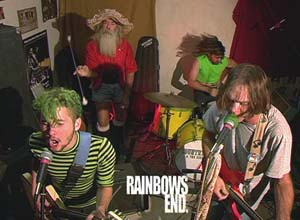 If The Last Circus is edgy, Rainbows End occupies the opposite end of the offbeat spectrum—it’s whimsical. Ostensibly a documentary about six east Texas eccentrics on a road trip to California to pursue a motley assortment of dreams, it’s also one of the funniest movies yours truly has had the privilege of checking out in 2011. It’s the characters who drive the bus in this episodic feature—and in this case that bus needs a push start, leaks radiator fluid, and at times is literally held together with duct tape.
