Tag Archives: Children’s Film

CAPSULE: THE WIZARD OF OZ (1939)

Must See

DIRECTED BY: Victor Fleming (credited), King Vidor, Mervyn LeRoy (uncredited)

FEATURING: Judy Garland, , Frank Morgan, Bert Lahr, Ray Bolger, Jack Haley

PLOT:  A cyclone carries a Kansas girl (and her little dog, too) to a magical land over the rainbow.

Still from The Wizard of Oz (1939)

WHY IT WON’T MAKE THE LIST: In creating a list of the 366 best weird movies of all time, The Wizard of Oz presents a huge challenge.  After all, this Technicolor extravaganza contains such trippy imagery as a bizarre cyclone that hurls snatches of a young girl’s fears past her spinning window; a land of doll-like little people threatened by a witch; talking apple trees; a giant floating green head appearing and disappearing before a curtain of flame; knife-nosed, green-faced Cossack guards; and of course, flying monkeys—never underestimate the weirdness of flying monkeys.  These should be the building blocks of a stunningly psychedelic pic, but if this magical movie only seems fantastic, never weird, it’s because the entire adventure feels so safe.  The musical numbers, the comedy, and the deliciously stagey sets serve to remind all but the very youngest children that we’re in an artificial, sheltered environment, and that no harm can ever come to Dorothy.  We’re invited to sit back and soak in the spectacle, not to experience it directly.

COMMENTS: Most reviews of The Wizard of Oz could be distilled down to two words: “me too.”  Are you a viewer who loves the movie?  Me, too.  You admire the immaculate casting and performances?  The unforgettable music?  The clever nonsense wordplay of Continue reading CAPSULE: THE WIZARD OF OZ (1939)

37. TIME BANDITS (1981)

“…Gilliam fearlessly brings the logic of children’s literature to the screen.  Plunging headfirst into history, myth, legend, and fairy tale, Gilliam sends his characters—a boy and six good-natured if rather larcenous little persons (i.e. seven dwarves)—careening through time-twisting interactions with Napoleon, Robin Hood, and Agamemnon (played, respectively, by Ian Holm, John Cleese, and Sean Connery).  The landscape is populated by the giants, ogres, and sinister crones of legend and fairy tale, all in the service of Gilliam’s weird, ecstatic vision.”–Bruce Eder, “Time Bandits” (Criterion Collection essay)

Recommended

DIRECTED BY: Terry Gilliam

FEATURING: Craig Warnock, David Rappaport, , , Michael Palin, Shelley Duvall, Sean Connery, , Katherine Helmond,

PLOT:  11-year old Kevin is largely ignored by his parents, who are more interested in news about the latest microwave ovens than in encouraging their son’s interest in Greek mythology.  One night, a gang of six dwarfs bursts into his bedroom while fleeing a giant floating head, and Kevin is swept up among them and through an inter-dimensional portal in their scramble to escape.  He finds that the diminutive and incompetent gang is tripping through time robbing historical figures using a map showing holes in the space-time continuum of the universe that they stole from the Supreme Being; things get complicated when Evil devises a plan to lure the bandits into the Time of Legends in order to steal the map for himself.

Still from Time Bandits (1981)

BACKGROUND:

  • Time Bandits is the first movie in what is known as Gilliam’s “Trilogy of Imagination” or “Trilogy of Dreams.”  It deals with the imagination in childhood; the second movie, the bleak Brazil (1985), with adulthood; and the third, Baron Munchausen (1989) with old age.  Gilliam did not intend from the beginning to make three films with similar themes; he only noticed the connection between the three films later, after fans and critics pointed it out.
  • Gilliam began the script in an attempt to make something marketable and family-friendly, since he could not find anyone interested in financing his innovative script for Brazil.  The success of the idiosyncratic Time Bandits allowed Gilliam to proceed making imaginative, genre-defying films.
  • The film was co-written by Gilliam with his old Monty Python’s Flying Circus mate Micheal Palin, who is responsible for the snappy dialogue.
  • Ex-Beatle George Harrison helped finance the film, served as executive producer, and is credited with “songs and additional material” for the movie.  Only one Harrison composition is featured, “Dream Away,” which plays over the closing credits.
  • Gilliam shot the entire movie from a low angle to give an impression of a child’s-eye view of the world.
  • Sean Connery was not originally intended to appear in the final scene, but was meant to appear in the final showdown with Evil.  The actor’s schedule did not allow him to appear when the battle was being shot, but Connery suggested that he could play a role in the final scene.  His second, quite memorable, role consists of two shots, filmed in an afternoon.
  • A low budget release, Gilliam’s film cost about $5 million to make but grossed over $42 million.

INDELIBLE IMAGE: The avenging floating head of God appearing out of a cloud of smoke.

WHAT MAKES IT WEIRD:  As an utterly original blend of history, comedy and theology wrapped in Monty Pyhton-eque verbal sparring and presented as a children’s fable, Time Bandits starts with a weird enough design.  As the film continues and the bandits journey from history into myth, the proceedings get more mysterious and existential, until the flick winds up on a shatteringly surreal climax that is bleak enough to supply the most well-adjusted of kiddies with years of nightmares.  As the tagline says, it’s “All the dreams you’ve ever had—and not just the good ones.”


Original theatrical trailer for Time Bandits

COMMENTS: Sandwiched between the Biblical parody of Life of Brian (1979) and the Continue reading 37. TIME BANDITS (1981)

CAPSULE: PONYO [Gake no ue no Ponyo] (2008)

Recommended

DIRECTED BY

FEATURING (AMERICAN DUBBED VERSION): Noah Cyrus, Frankie Jonas, Tina Fey, Liam Neeson, Betty White

PLOT: In this Japanese variation on Hans Christian Andersen’s “The Little Mermaid,” a goldfish with a human face escapes from the undersea lair built by her wizard father and decides she wants to become human when she washes ashore and is adopted as a pet by a little boy.

Still from Ponyo (Gake no ue no Ponyo) (2008)

WHY IT WON’T MAKE THE LISTPonyo is an imaginative and beautifully drawn fairy tale for children that frequently sacrifices mature logic for emotional effect or visual spectacle, but it’s a bit too safe and cutesy, and more fantastic and childlike than bizarre.  Because it is told from a child’s-eye view and not simplified for adults, some grown-ups may find it weird.

COMMENTS: Ponyo begins with a descent into an ocean teeming with fish, squid and crustaceans; the picture’s frame becomes an impossibly dense and multi-layered aquarium of submarine life. When the headstrong goldfish Ponyo wanders away from this underwater Eden, her journey on the back of a jellyfish runs aground when she encounters an equally thick stratum of human detritus and garbage, stirred into a whirlpool by the propellers of passing ships, and ends up washed ashore lodged in a bottle for 5 year-old Sōsuke to find.

There’s a not so subtle ecological message at play here, but Miyazaki never gets preachy. The main focus of the film is in drawing wondrous moving images that delight a child’s imagination (and look pretty good to adults, too, even if they can’t resonate in quite the same way). The most mesmerizing of these is newly half-human Ponyo’s gallop atop tsunami waves which turn into fish and melt back into surf as she chases after Sōsuke. Visions of a luminescent sea goddess and a city of ships drawn to the horizon by an encroaching moon also ensnare the fancy. The animation is deliberately primitive, almost childlike, in style, appropriately looking like a children’s book come to life. Unfortunately, the story and tone are childlike as well, resulting in a film that entrances kids but lacks a crossover magic for adults. Grown-ups in the film accept the magic matter-of-factly, as if they were just big kids with driver’s licenses, showing no amazement when a pet turns into a little girl, or when they discover two pre-schoolers piloting their own boat unattended after a flood. Precociously cute, infatuated with her discovery of the human world, and squealing “I love ham!,” the one-note goldfish herself is a character only a mother or fellow toddler could love. With Ponyo, Miyazaki has crafted a film that will hypnotize girls aged four to seven. There’s not much of a story to engage their parents, but they can amuse themselves watching the parade of pretty pastel-colored pictures for ninety minutes, and in trying to recall what it was like when the line between reality and make-believe was as thin as the skin of a bubble.

I confess that I haven’t seen any Miyazaki films previously (everyone has some gaps in their film education). The revered animator’s most celebrated works like Spirited Away (2001) are supposed to be so fantastic as to be virtually surreal.  With the visual imagination evident in Ponyo, it’s easy to see how, working with material oriented less towards the kindergarten set, another work of his might merit a spot on the list of the 366 best weird movies ever made.

WHAT THE CRITICS SAY:

“The story sounds weird, and it is weird: Like many of Miyazaki’s previous films, Ponyo is written from a child’s perspective and with a child’s sense of logic… pure fairy-tale surrealism.”–Rene Rodriguez, Miami Herald (contemporaneous)

CAPSULE: CORALINE (2009)

366 Weird Movies may earn commissions from purchases made through product links.

Recommended

DIRECTED BY: Henry Selick

FEATURING: Dakota Fanning (voice), Teri Hatcher (voice)

PLOT:  A petulant little girl finds a parallel universe behind a hidden door in an old house, a world where her parents are more attentive, her neighbors more fascinating, and the entire universe seems set up to pamper and delight her; she can stay there forever, but of course there’s a catch.

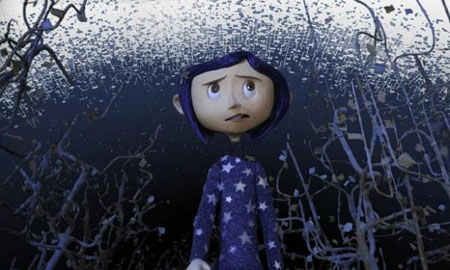
Still from Coraline (2009)

WHY IT WON’T MAKE THE LIST:  I attended a screening with a ten-year old and asked him if he thought the movie was “weird.”  His answer: “Nah, not unless you think every fantasy movie is weird.”  Smart lad.

COMMENTSCoraline is a welcome dark fantasy for children, although its themes of evil Doppelgänger moms, frightening buttons, and implied eye-gouging are too scary for very little ones.  Since it’s from Hanry Selick, the director of the borderline weird Nightmare Before Christmas, we suspect going in that the art direction and stop-motion animation will be the real stars.   Selick does not disappoint, shuffling the viewer through three distinct visual styles: the dingy earth tones of real life, a brightly colored, eye-popping fantasy world, and a sinister, disintegrating universe with an insect trapped in a spiderweb theme.  The storyline, and the unexpected scares once the movie shifts from childhood fantasy to childhood horror in the third act, make Coraline more than just eye candy for the kiddies.

Presented in theaters in 3-D, but the novelty doesn’t add anything significant to experience: I would have been just as happy to watch the same moving pictures tell the same story on an unabashedly flat screen.  Though there’s nothing really weird to be found here, Coraline, in the best children’s’ movie tradition, is worth a trip even for adult fans of fantasy and pure escapism.

WHAT THE CRITICS SAY:

“Coraline discovers a Wonderland filled with surreal characters and dark implications that make a kid grow up quick… those who tough it out with this twisted, trippy adventure in impure imagination will only be the better for it.”–Peter Travers, Rolling Stone

9. HELP! HELP! THE GLOBOLINKS [HILFE! HILFE! DIE GLOBOLINKS] (1969)

“Headmasters never sing!” –line sung by the headmaster in Help!  Help!  The Globolinks

DIRECTED BY:  Joachim Hess, from a production of composer/librettist Giancarlo Menotti

FEATURING:  The Hamburg State Opera

PLOT:  In this children’s opera, the world has been invaded by bizarre alien creatures named Globolinks, who are allergic to music.  A bus full of children returning to boarding school breaks down in the middle of a lonely forest, and the students are surrounded by the alien creatures. Meanwhile, back at the school, the headmaster is infected by one of the aliens, meaning that he will soon turn into a Globolink himself.

globolinks

BACKGROUND:

  • Gian Carlo Menotti, the author of Help! Help! The Globolinks, was a well respected, Pulitzer Prize winning composer.  His most popular work is the Christmas opera Amahl and the Night Visitors, which was commissioned specifically to launch the “Hallmark Hall of Fame” television series, and which was shown annually in the United States on television during the Christmas season from 1951-1966.
  • Help!  Help!  The Globolinks, by contrast, was a flop and is rarely performed.  It is usually only mentioned in complete biographies of Menotti.
  • Menotti was a pioneer in adapting opera for telecast, and the film version of Help!  Help!  The Globolinks was originally shown on German television in 1968.

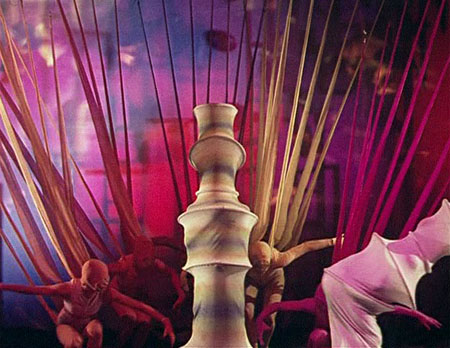
INDELIBLE IMAGE:  No doubt, it’s the Globolinks themselves (pictured above), who come in two varieties: one that looks like a wriggling rook from a chess set, and one that looks like an avant-garde ballerina dressed in a full-body dayglo bungee-jumping suit.

WHAT MAKES IT WEIRD:  A children’s opera about music-loathing aliens is already, presumptively, pretty weird.  But when the opera is made in 1968, at the height of the psychedelic sixties, and utilizes all the camera tricks, distorted electronic noises, and bizarre set designs Summer of Love filmmakers developed in an attempt to mimic the disorienting effects of LSD, there’s no more need for the presumption: we’re definitely caught in a very weird nook of film.

Scene from Help! Help! The Globolinks

COMMENTSHelp! Help! The Globolinks is one of the most obscure Continue reading 9. HELP! HELP! THE GLOBOLINKS [HILFE! HILFE! DIE GLOBOLINKS] (1969)