Tag Archives: Black Comedy

233. DEATH BY HANGING (1968)

Koshikei

“You mustn’t think our film is just labored theorizing. The officials’ attempts to convince R that he is R are amusing and bizarre. I think it’s a spot-on depiction of all us Japanese in all our amusing bizarreness.”–Nagisa Ôshima

Recommended

DIRECTED BY:

FEATURING: Yung-Do Yun, Fumio Watanabe, , Akiko Koyama

PLOT: After the failed execution of a Japanese-Korean double murderer, various state functionaries are at a loss as how to proceed when the criminal’s body refuses to die. Going to increasingly outlandish lengths to remind the convict of why he is there and condemned, the prison’s officials inadvertently explore the nature of crime, nationality, and culpability. Eventually a young woman is introduced to the group, and the captors decide to get drunk.
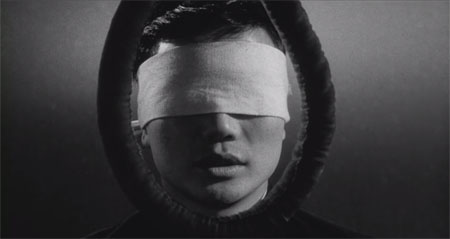
Still from Death by Hanging (1968)

BACKGROUND:

  • The criminal in Death By Hanging is based on Ri Chin’u, who also murdered two Japanese school girls. In addition to his crimes, Ri Chin’u gained a degree of fame for his extensive writings while in prison.
  • Much of the dialogue between R and his “sister” is taken from actual correspondences between Ri Chin’u and a Korean journalist.
  • Death by Hanging came during Ôshima‘s most experimental period, made back-to-back with the Certified Weird satire Japanese Summer: Double Suicide. Like most of Ôshima‘s mid-to-late 1960s work, Hanging was initially ignored in America, not even screening for the first time until 1974 and not officially reaching home video until 2016.

INDELIBLE IMAGE: The movie is stuffed to the gills with claustrophobic shots of slapstick fused with philosophy, none more so than the penultimate scene: an unlikely combination of prison officials getting hammered around a “table” while the convict “R” and his (probably imaginary) sister consider the nature of guilt. The drinkers take turns discussing how they came to this kind of work while R, reclining with the young woman beneath a Japanese flag, comes to the conclusion that though he committed his crimes, he is not responsible for them.

THREE WEIRD THINGS: Stubborn corpse; rape re-enactment; hallucination participation

WHAT MAKES IT WEIRD: Death By Hanging starts with a very traditional documentary approach, including narration reeling off statistics and some expository shots of a nondescript execution facility in a prison compound. Quickly, however, the aura of formality disintegrates as the hapless officials endeavor in vain to make sense of the film’s central conceit: a young convict refusing to die. Their efforts to restore his memory and edge him toward accountability grow desperate and extreme until a point is reached where everyone involved in the process begins to believe in the unreal.


Original trailer for Death by Hanging

COMMENTS: While most leftist directors merely point a shotgun at Continue reading 233. DEATH BY HANGING (1968) →

230. THE BED SITTING ROOM (1969)

Recommended

“Nobody ever got the point about what it was about. What we were trying to say through all this laughter and fun, was that if they dropped the bomb on a major civilisation, the moment the cloud had dispersed and sufficient people had died, the survivors would set up all over again and have Barclays Bank, Barclay cards, garages, hates, cinemas and all…just go right back to square one. I think man has no option but to continue his own stupidity.”–Spike Milligan

DIRECTED BY:

FEATURING: Rita Tushingham, Michael Hordern, , Richard Warwick, , , , , Dudley Moore,

PLOT: After a nuclear bomb is dropped on Britain, about twenty survivors prowl the wreckage, including 17-months pregnant Penelope and her parents and lover, who live on a still-functioning subway car. Aboveground, Lord Fortnum seeks the opinion of a doctor, who confirms his suspicions that nuclear mutation will soon turn him into a bed sitting room. When the chocolates taken from vending machines run out, the family makes its way to the surface, where Penelope finds herself engaged to the doctor, the mother turns into a wardrobe, and the entire family moves into Lord Fortnum.

Still from The Bed Sitting Room (1969)

BACKGROUND:

  • The Bed Sitting Room began its life as a one-act play, written by comedian Spike Milligan and John Antrobus in 1962, the year of the Cuban Missile Crisis.
  • Promoters acknowledged the film’s limited commercial prospects by issuing a poster with the tagline “we’ve got a BOMB* on our hands” and the footnote (“*BOMB – a motion picture so brilliantly funny it goes over most people’s heads”).
  • The film bombed so hard, in fact, that director Richard Lester could not find work for four years afterwards, and when he returned to movies he toned down the absurdism of his early films and worked in a mainstream idiom, returning with the action-comedy The Three Musketeers (1973) and going on to direct blockbusters like Superman II (1980).

INDELIBLE IMAGE: The BBC, tidy tuxedo on top his top half, sackcloth on the bottom, squatting in an empty television frame on a blasted salt flat to deliver exposition.

THREE WEIRD THINGS: BBC post-bomb broadcasts; dad’s a parrot and mom’s a wardrobe; a doctor living inside his patient

WHAT MAKES IT WEIRD: Twenty very British survivors of the apocalypse go about their business amidst the rubble, despite mutations that gradually change them into furniture or bargain housing. This absurd anxiety nightmare about the Bomb could only have come out of the Swinging Sixties; it’s one of the weirder relics of an era when filmmakers felt it was their patriotic duty to laugh in the face of the imminent apocalypse.


“Trailers from Hell” annotated original trailer for The Bed Sitting Room

COMMENTS: The original play “The Bed Sitting Room” was written Continue reading 230. THE BED SITTING ROOM (1969) →

READER RECOMMENDATION: MOTIVATIONAL GROWTH (2013)

Reader Recommendation by Bryan Pike

DIRECTED BY: Don Thacker

FEATURING: Adrian DiGiovanni, , Danielle Doetsch, Pete Giovagnoli, Ken Brown

PLOT: Ian Folivor, a depressed and reclusive 30-something, finds himself taking advice from a fungal growth in his bathroom after a failed suicide attempt.

Still from Motivational Growth (2014)

INDELIBLE IMAGE: The film’s lead impossibly suspended horizontally while sucking greedily from a wall-mounted fungal teat, followed closely by the animatronic mold itself.

WHY IT SHOULD MAKE THE LIST: That the protagonist communicates with a talking fungus is strange enough to warrant potential inclusion, but for a movie limited to the confines of an apartment this film takes on a truly epic and bizarre scope, with spore-induced hallucinations involving infomercials and B-grade science fiction TV shows, demonic TV repairmen, a bathroom murder and dismemberment, a sweet romantic sub-plot and by the film’s close, genuine questions as to what of the preceding 104 mins was real or imagined.

COMMENTS: “The Mold knows, Jack, The Mold knows…”

Normally when considering the first feature of an independent film director one makes allowances for certain technical shortcomings: out of focus shots, poor film stock, a bump in a dolly shot or two, things obvious to the seasoned film viewer but which are ignored in good faith and focus given to the storytelling or performances. There is no such necessity in this film, there are no such flaws to note. In terms of technical craft alone this is easily the most impressive debut I’ve seen from any feature director; the rich and developed performances and storytelling are equally impressive.

The aforementioned fungal teat sequence, the circuitous, overhead crane shots of Ian on his filthy couch, and even a quasi-bullet time shot of the lead falling in the bathroom; are all ambitious, complex shots which are executed effortlessly. The grimy, festering detritus of Ian’s depression made manifest in the scattered garbage filling his apartment is an impressive feat of art direction.

I’d classify it as an absurdist, theatrical, sitcom take on Enter the Void, at least in the sense of a post-death hallucinatory journey (or is it?). It features a shut-in who attempts suicide and is then given a new lease on life by an enormous fungus growing in his bathroom. “The Mold”, an animatronic puppet voiced by Jeffrey Combs, guides our protagonist back to a clean, regular life—if sucking from wall-mounted fungal teats, altercations with demonic TV repairmen, and dream sequences involving infomercials can be considered “regular”.

The puppet for “The Mold” is a refreshing break from the digital in our overly-CGI’ed times, reminiscent of the impressive practical effects from 80’s films like The Thing or The Howling. Jeffrey Comb’s assured, mellifluous voice is the perfect contrast to the wired, intense performance of Adrian Giovanni. The 8-bit music, while fitting the period (early 90’s) and the aesthetic of Thacker’s Imagos production company, is occasionally jarring compared to the action on screen. Although varied and amusing, the TV infomercials playing on Ian’s unit, “Kent” are perhaps the weakest aspect of the film; this satire of vapid and bombastic TV programming has been done better elsewhere, notably Fight Club, or, let’s be honest, the better moments of SNL. To Thacker’s credit it would be difficult at this stage to bring something fresh and inventive to such satire, given the sheer glut of both modern television programs and subsequent parodies.

Ian also merges with these TV programs in some kind of day dream or hallucination, with television’s Kent accusing Ian of betrayal, saying that he “looked after him” long before (the Mold?) did. In the overall context of the film it remains unclear whether Kent is a separate character and rival to the Mold for Ian’s allegiance. Is Kent—who often uses the same language as The Mold—merely an extension of it? The ambiguity employed is merely distracting, rather than serving as an engaging mystery within the film.

The only other complaint one could make of the film are that the level of technical innovation and impressive camera feats drop off towards the end (though this is more a reflection of the story taking prominence over on-screen auteur flourishes at that stage), and that the ambiguous ending leaves one feeling dissatisfied. At various points during the film it is hinted that Ian is dead (or at the very least that “someone” has died) and that our film experience is a hallucinatory afterlife trip inside Ian’s head. But this is arguably the least satisfying outcome or final premise for the film. Isn’t the buildup towards Ian’s “improvement” and the possibilities this direction takes us in (i.e. what are the Mold’s designs for Ian within the larger world outside the apartment?) more intriguing than “oh, Ian’s dead and this is him working things out in the afterlife as his corpse is consumed by mold”? I may have simply been hoping for a different film based on the initial premise than what transpired.

Ultimately, despite these minor misgivings, the film remains an impressive and vastly entertaining debut feature that rewards subsequent viewings for more details as to the nature of what we’ve witnessed.

WHAT THE CRITICS SAY:

“…you can categorize Motivational Growth under “The Weird,” and I mean that as a true compliment.”–Matt Donato, We Got This Covered (contmeporaneous)

WOODY ALLEN’S CRIMES AND MISDEMEANORS (1989) AND MATCH POINT (2005)

In 1935, Peter Lorre (in one of his few great roles) seared the screen as Raskolnikov in Crime and Punishment (Josef von Sternberg directed, unevenly). is too original to give us a direct adaptation of his literary hero, but he certainly utilizes a   Dostoyevsky diving board  for his own Crimes and Misdemeanors (1989), just as he did (in parody) in Love and Death (1975).

Judah Rosenthal () is a phenomenally successful Manhattan ophthalmologist having an extramarital  affair with flight attendant Dolores (). It’s his first affair, and it turns out to be brief and tragic. Judah consults with both his blind rabbi best friend Ben (Sam Waterston) and his mafioso brother Jack (Jerry Orbach). Both give contrasting advice, as expected. As he did in 1986’s Hannah and Her Sisters, Allen utilizes a large ensemble cast here, interweaving character narratives. Allen himself plays Cliff Stern; a serious low-budget documentarian who, through family connections, has been commissioned to make a promotional film about smug television producer Lester (Alan Alda).

Still from Crimes and Misdemeanors (1989)Landau earned an Academy Award nomination for his role. He had been nominated for the previous year’s Tucker: A Man and His Dreams and would be nominated again (and finally win) in 1995 for playing in ‘s Ed Wood. Landau shines in his nail-biting, pacing-the-floor moments, but it’s Alda as the vulgar, bouncing-off-the-walls, dumbed-down producer who steals the film.

Both Lester and Cliff are competing for Halley (Mia Farrow). Will she choose the romantic outsider artist, or status through money? As Ed Wood () tells Georgie Wiess (Mike Stall) in Ed Wood, “Georgie, this is drama.” Actually, here it’s bleak comedy, and the film peaks with this love triangle.

Crimes And Misdemeanors repeats familiar Allen themes. As in The Purple Rose of Cairo (1985) there is love unrewarded. As in Dostoyevsky, there is murder unpunished. Despite those familiar themes, Crimes and Misdemeanors excels in lucid, innovative storytelling. There is symbolism aplenty (the blind rabbi, the ophthalmologist’s father warning him that God can see everything). It is the type of film that literary minded students are prone to dissect, but Crimes’ self-assured humor is what wins us over.

In Match Point (2005), Theodore Dreiser’s “An American Tragedy” serves as Allen’s literary reference (in addition to Dostoyevsky). Some critics found it a weaker sibling to Crimes and Misdemeanors, but also noted it was Allen’s best film in a decade. Putting aside sophomoric better than or weaker than gauges, Match Point again finds Woody in superior narrative form. He has listed it as being his best work, undoubtedly aided considerably by Remi Adefarasin’s icy, noirish lens work. At 124 minutes, it is also his longest film to date.  Refreshingly, Allen is forthright about influences when Chris (Jonathan Rhys Meyers) is depicted reading “Crime And Punishment.”

Still from Match Point (2005)The object of Chris’ obsession is Nola (), and the two lead actors give sizzling performances. Myers’ mechanically cold blue eyes contrast with Johansson’s earthy anxiousness (Allen worked with her again in 2006’s Scoop and 2008’s Vicky Cristina Barcelona). Like the antagonist/protagonist in Dreiser’s epic work, Chris comes from poverty. He is on a tennis tour when meets affluent pro Tom (Matthew Goode). Tom’s girlfriend is the wannabe actress Nola. At the opera, Tom plays cupid, introducing Chris to his single sister Chloe (Emily Mortimer). The seeds of marrying right are planted. However, after Tom dumps Nola (she doesn’t live up to familial expectations), Chris throws the proverbial monkey wrench into his own machinery when he begins a torrid affair and impregnates Nola.

Allen takes a smarter route than George Stevens did in A Place In The Sun (1951), his update of “An American Tragedy.” In the earlier film, Stevens cast as an unattractive, pathetically nagging girlfriend to Montgomery Clift. When Clift contemplates murdering Winters to further his romance with the wealthy Elizabeth Taylor (in one of her most sensuous roles), we can only feel relief. Although none of the characters in Match Point rise above being reprehensible, Johansson, at her most complex, inspires more sympathy than Winters did. As in the source material, there is a pointed condemnation of unfettered capitalism, but Allen also makes a comment about existence without meaning: “I’d rather be lucky than good.” By removing himself from the film’s ensemble cast, Allen’s commitment to the unfolding narrative is complete. Upon its release, many critics cast it as Allen’s most atypical film. There is a degree of truth in that, but Allen also manages to make avarice and homicide pay, when we almost expect a Dickens-like Scrooge to heed the ghost’ warning. In Allen’s world, the response is quite different.

CAPSULE: BUZZARD (2014)

DIRECTED BY: Joel Potrykus

FEATURING: Joshua Burge, Joel Potrykus

PLOT: After his latest con goes bad, a slacker and small-time scam artist goes on the run, taking along his homemade Freddy Kruger glove.

Still from Buzzard (2014)

WHY IT WON’T MAKE THE LIST: It’s not that weird, although it is an outside-the-box indie with a unique slacking-class take on American society.

COMMENTS: “You’re just trying to cheat the system?” asks an exasperated bank clerk when Marty Jackitansky takes advantage of a loophole to get a bonus for opening a new checking account. “Absolutely,” he responds. “For fifty dollars?,” the clerk continues, incredulously. “Absolutely!” replies Buzzard, with pride. (Although Marty is never explicitly referred to by that avian moniker in the film, the name is perfect for this scavenger). Marty’s completely clueless, utterly unmerited self-esteem is hilarious, and tragic; it seems the smaller the stakes of the scam, the more jazzed he gets. You might conclude Marty’s self-worth is wrapped up in his ability to get by on his wits, but isn’t really self-conscious enough for such vanities. It’s just that Buzzard has little interest in anything beyond video games, junk food, splatter flicks, metal, and the minor adrenaline rush he gets from seeing a two-figure check made out in his name. Lying simply comes as second nature to him. Gaunt and rumpled, with a slouchy swagger, Joshua Burge plays the character as a young man perfectly confident in his own indifference to his social status. Director Potrykus plays cubicle-mate Derek, the Beavis to Burge’s Butthead. He’s a corporate drone whose equally blind to his own beta-male status; he has the temerity to call his basement apartment “the Party Zone” and has such meager social prospects that he longs for approval from big brother figure Buzzard.

The style might be described as “minimalist punk,” with long takes (the already-notorious five-minute spaghetti eating scene) punctuated by bursts of senseless vandalism scored to death metal riffs. The DIY aesthetic is authentic, and the film is as unpretentious and brash as Buzzard himself. Buzzard mixes a bemused, clear-eyed disdain for its title character with a gentle touch of affection for his adolescent antics. Marty scorns the system, but he doesn’t actually oppose it; he just is disinterested in playing the game, and so tries to skate by under the authorities’ radar. Buzzard understands the psychology and sociology of pathologically shortcut-obsessed losers; it also sympathizes with his plight, without endorsing his behavior. Watching Buzzard, we feel some measure of compassion for this blatant con dude, even while he’s staring us in the face with disdain and thinking up ways to rip us off. That’s some scam to pull.

This is the third in an unofficial “animal” trilogy by Potrykus, all starring Burge. The first was the werewolf (!) short “Coyote,” followed by the 2012 feature Ape (about a pyromaniac comic). Buzzard is the best-received and distributed of the three. Both Potrykus and Burge are talents to keep an eye on.

WHAT THE CRITICS SAY:

“The dark, weird and hilarious ‘Buzzard’ is definitely a great slacker movie.”–Brad Keefe, Columbus Alive (contemporaneous)