Tag Archives: 1982

94. PINK FLOYD THE WALL (1982)

“It was like nothing anyone had ever seen before—a weird fusion of live action, story-telling and of the surreal.”–Pink Floyd the Wall Director Alan Parker on the movie’s Cannes premiere

Recommended

DIRECTED BY: Alan Parker

FEATURING: Bob Geldof, Kevin McKeon, Jenny Wright,

PLOT: The movie begins with a man sitting motionless in a chair in a hotel room.  A series of scrambled flashbacks, fantasies and impressions tell the story of Pink, who grew up fatherless but became a successful, if unhappy, rock star prone to tantrums and bouts of severe depression.  Eventually, Pink’s manager and a crowd of roadies and doctors break down the hotel room door and give him a shot which revives him; his body rots, he peels it away to reveal himself as a fascist dictator who goes onstage to perform.
Still from Pink Floyd: the Wall

BACKGROUND:

  • “The Wall” began life as a 1979 concept album by Pink Floyd.  The double LP and the single “Another Brick in the Wall, Part II” both reached #1 on Billboard’s U.S. charts.  “The Wall” remains one of the 50 top selling albums of all time to this day.
  • Most of the incidents in The Wall stem from Roger Waters’ personal history; a few, however, are taken from the life of former Pink Floyd lead singer Syd Barrett, a psychedelic drug abuser whose erratic behavior caused him to be kicked out of the band and to eventually become a recluse.
  • Almost all of the songs from the original album appear in the movie, sometimes in slightly altered forms.
  • With Alan Parker as producer, The Wall movie was originally intended to be a concert film with animated sequences and a few specially shot live action scenes.  When the concert footage was found to be unusable, the project was reimagined as a (semi-) narrative film with Parker as director.
  • Pink Floyd singer/bassist and Wall librettist Roger Waters originally wanted to play the lead, but after a poor screen test fellow musician Bob Geldof was cast instead.  Ironically, Geldof, lead singer for the Irish punk band The Boomtown Rats, was reportedly not a Floyd fan.
  • Parker and Waters clashed on the set, with the director almost quitting several times.
  • Designer/animator Gerald Scarfe was a caricaturist and political cartoonist before he began collaborating with Pink Floyd.
  • The cheering extras at the fascist concert were actual white supremacists.
  • Director Parker called The Wall “the most expensive student film ever made.”

INDELIBLE IMAGE:  Picking a single image to represent The Wall is a tough assignment.  Among the live-action sequences, the vision of British schoolchildren in faceless blob masks marching into a meat-grinder is fairly unforgettable.  It would be criminal, though, to elevate any mere photograph over Gerald Scarfe’s animations; even picking among them is a tough call.  Though short, these bizarre and horrific images blaze across the screen in such a haunting way that their impact makes up for the brevity. We’re going to select the scene of the goosestepping fascist hammers as the most unforgettable (partly because the hammer imagery that recurs throughout the movie reaches a startling peak with this scene, and partly because Sacrfe’s crossed hammer symbol proved so iconic that it was adopted by actual fascist groups).  If you chose the genitalia-shaped flowers who entwine, mate, and then grow teeth and viciously rip into each other before the female swallows the male whole, however, we couldn’t argue against it.

WHAT MAKES IT WEIRDPink Floyd: the Wall is a collaboration between three separate


Original trailer for Pink Floyd The Wall

creative talents.  In 1979 Roger Waters performed a public self-psychoanalysis by writing a bombastic, self-indulgent rock opera, full of catchy melodies and sardonic lyrics.  When it came time to adapt the album into a movie, he enlisted political cartoonist Gerald Scarfe to provide animated segments, which ultimately included a surrealistic version of the bombing of London during World War II, a judge who is literally an ass, and some of the scariest cartoon vaginas ever drawn.  Bringing it all together was director Alan Parker (Midnight Express), who devised fantastic over-the-top live action visuals to complement the music and found a way to weave the competing thematic strands (autobiography, social commentary, and spur-of-the-moment surrealistic flights of fancy) into something comprehensible, while nonetheless keeping it defiantly weird.  Trying to meld these three separate creative egos on a project whose source material was already grandiose and scattershot could easily have produced an incoherent, pretentious mess.  Remarkably, the result instead is a semi-coherent, pretentious near-masterpiece.

COMMENTS: Watching, or listening, to Pink Floyd: The Wall is one miserable experience. All Continue reading 94. PINK FLOYD THE WALL (1982)

CAPSULE: THE DARK CRYSTAL (1982)

DIRECTED BY: , Frank Oz

FEATURING: , Frank Oz (puppeteering); Stephen Garlick, Lisa Maxwell, Billie Whitelaw (voice acting)

PLOT: A meek Gelfling sets out on a journey to fulfill the prophecy that he will heal the Dark

Still from The Dark Crystal (1982)

Crystal.

WHY IT WON’T MAKE THE LIST:  With its advanced puppetry and dazzling color, The Dark Crystal is a visually spectacular movie.  The standard-issue quest story, however, is nothing unusual; just recycled Tolkien, watered down for kids.

COMMENTSThe Dark Crystal may be the most elaborate puppet show ever staged.  There are no human actors in the film, and the sets—from the spiny castle rising from a bleak landscape to the twisted interior corridors of the Skeksis’ lair to the forests of walking plants—are all fairy tale artifice, storybook illustrations adapted into three-dimensional scenery.  A menagerie of imaginatively designed creatures parade in front of these beautifully textured backdrops.  Most impressive are the evil Skeksis, hunched bipeds who simultaneously resemble reptiles, dinosaurs and birds of prey.  They are opposed by the gentle Mystics, four armed, droning sloths with kind wizardly faces, and Gelflings, the “human” characters, who look like an experiment in breeding J.R.R. Tolkien’s elves with chimpanzees from The Planet of the Apes.  The meticulously molded puppets–each turkey-faced Skeksis’ beak is individually gnarled—have expressive eyes, and their jaws move when they speak.  The rest of the puppet faces, however, are immobile; so despite the minute detailing, the mix of animatronics with static features makes the creatures overall appearance unreal and somewhat uncanny—maybe even “weird.”  (The fact that the puppets move at about three-quarters the speed of a human actor, while seriously hampering the action sequences, also adds to the movie’s artificial reality).  The simplistic, muted emotions conveyed by the creatures’ features aren’t terribly jarring, however, because their puppet shells are inhabited by one-dimensional characters.  Lack of character depth isn’t a problem for the villainous Continue reading CAPSULE: THE DARK CRYSTAL (1982)

LIST CANDIDATE: PINK FLOYD:THE WALL (1982)

Pink Floyd the Wall has been promoted to “Certified Weird” status.  Comments have been closed; please post all new comments on the official entry.

Recommended

DIRECTED BY: Alan Parker

FEATURING: Bob Geldof, Bob Hoskins, Jenny Wright

PLOT: A rock singer, “Pink,” isolates himself in a hotel room and reflects upon his life while

Still from Pink Floyd: the Wall

slipping further into drug addiction and madness. The film has little in the way of dialogue and is heavy on visual interpretations of Roger Waters lyrics for the 1979 double album of the same name.  The metaphorical “wall” is constructed around the rock singer’s life separating him from the outside world and alone with his tortured thoughts and memories.

WHY IT MIGHT MAKE THE LIST: Possibly for one reason only: the fantastic and bizarre animation sequences rendered by British political caricaturist Gerald Scarfe.  Although the sequences are relatively short, the horrific images blaze across the screen in such a haunting way that the impact makes up for the brevity.

COMMENTS: Watching, or listening, to Pink Floyd: The Wall is one miserable experience. All the key elements of a depressing film are on display: madness, alienation, the atrocities of war, mind-numbing drug addiction, infidelity, fascism…well, you get my drift.  This is not an upbeat or fun movie by any stretch of the imagination.  Yet, the film is constructed in such a skillful manner by director Alan Parker that it is hard not to justify its reputation as a work of art.

Upon the opening scene we see the protagonist rock star “Pink” (Bob Geldof) in his hotel room staring blankly at the television screen with a long burned out cigarette perched between his fingers.  Pink is in this position and state of mind for many of his scenes.  It is open to interpretation, but perhaps all of the scenes of the film are what is playing out in his unraveling mind.  The images correlate to the lyrics of each song, and we start off things by learning of Pink’s father’s death in World War II.  His bunker was blown to bits by an air raid bombardment.  Pink never knew his father and it is clear that this had a major impact in his childhood, as evidenced by a scene where he is playing in a park as a young child and desperately tries clinging on to a hand of an unsuspecting and unwilling male father figure.  As Pink grows up and goes to school he’s subjected to the harsh British educational Continue reading LIST CANDIDATE: PINK FLOYD:THE WALL (1982)

SHORT: VINCENT (1982)

Recommended

DIRECTED BY: Tim Burton

FEATURING: Vincent Price

PLOT: A seven year old boy wishes he could be just like the Vincent Price he sees in old movies.

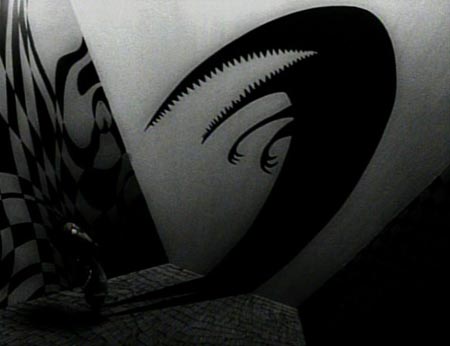
Still from Vincent (1982)

WHAT MAKES IT WEIRD:  It’s not quite weird; more mildly macabre.  But it sure is cool.

COMMENTSVincent is a 5 minute poem, narrated by the mellifluous Vincent Price, about a morbid boy (also named Vincent) obsessed with emulating the horror icon’s tormented screen persona.  It’s told in a singsong, storybook cadence and given a superlative reading by Price (who was so flattered by the tribute that he proclaimed it a greater honor than a star on Hollywood Boulevard).  There are some specific references to Price’s work for the actor’s fans, though the short prefers to evoke their general atmosphere than to cite specific movies. Young Vincent’s daydreams involve dipping his aunt in wax, turning his dog into a zombie, and slowly being driven mad by his guilt over his unspeakable crimes.  A representative stanza: “Such horrible news he could not survive/For his beautiful wife had been buried alive!/He dug out her grave to make sure she was dead/Unaware that her grave was his mother’s flower bed.”  Vincent is visually impressive, deliberately shot in luminous black and white and drawing on the gloomy Gothic style of the old Universal horror movies with a powerful dose of German Expressionism.  (Burton denied being directly influenced by The Cabinet of Dr. Caligari, but he’s the only one who doesn’t notice the similarity to the silent psychological horror classic in the geometrically warped sets).  The look and childishly ghastly tone bring to mind a lighter version of the macabre black and white lithographs of Edward Gorey (who once created a primer where each letter illustrates the death of a tot).  Burton’s visual sensibility is already fully formed here, and the elements of his classic style—his comic, cathartic synthesis of fresh childhood innocence and the must of the grave—are already in evidence.  In fact, there may be no better example in the director’s entire body of work of than this crisp five minute exhibition of his talent for mixing the chuckle with the shudder.

Disney has traditionally made Vincent and Burton’s other pre-fame short Frankenweenie as extras on all their editions of The Nightmare Before Christmas.  The film is also included on the anthology Cinema 16: American Short Films (buy) alongside  Maya Deren‘s “Meshes of the Afternoon” and works by Andy Warhol, Todd Solondz and Gus Van Sant, among others.

WHAT THE CRITICS SAY:

“…a pastiche of styles lifted from the writings of Dr. Seuss and Edgar Allen Poe, and a range of movies from B-horror films, German expressionist works and the films of Vincent Price.”–Michael Frierson, Animation World Magazine (DVD)

[(This movie was nominated for review by reader “Maxwell Stewart.” Suggest a weird movie of your own here.)]

RECOMMENDED AS WEIRD: LIQUID SKY (1982)

DIRECTED BY: Slava Tsukerman

FEATURING: Anne Carlisle, Paula E. Sheppard, Susan Doukas, Otto von Wernherr, Bob Brady

PLOT: Tiny aliens land their flying saucer on the roof of a New York City penthouse and begin sucking the brains out of sex-addicted New Wave beatniks.

Still from Liquid Sky (1982)

WHY IT SHOULD MAKE THE LIST: Tsukerman’s filming style is free-form and unconventional. Liquid Sky‘s visual footprint is every bit as avant-garde as its story about drug addicted extraterrestrials is bizarre.

COMMENTS: Aliens come to Earth in search of a heroin rush. It seems the little green, er, ah, terrestrially challenged ones don’t have the requisite opposing thumbs needed for handling a set of works, so they enjoy their smack the next best way: by telekinetically extracting the gray-matter of heroin addicts whose brains are flooded with opiates. Wonderful though it may be, heroin turns out to be only a gateway drug for the saucer-jockeys. While some human poppy-heads may find death to be the ultimate narcotic, the aliens soon discover that the endorphin rush in a juicy human brain during orgasm is the ultimate high, and they reset their priorities accordingly.

Now the gnarly little starmen seek out fornicators and harvest their orgasms for the best buzz. Still guided by the scent of smack, the space-meisters dock their star-buggy on the roof of a penthouse shared by a drug dealer and her lesbian fashion model lover. Their apartment contains a large amount of heroin, but better yet, is the locus of a lot of degenerate sex.

When the two gal pals aren’t waxing philosophic during their performance art exhibitions and dance routines at a local New Wave club, they are attracting a steady stream of addicted customers, androgynous jet trash, and depraved sex fiends back to their pad. The astral hop heads make the most of the situation and suck hapless guests dry when they sexually relieve themselves. Of course this kills each guest, but no matter. A few dead bodies are an almost normalizing factor at these two girls’ crazy, drug-addled, day-glo, non-stop New Wave penthouse party.

A Berlin scientist who has been studying the aliens makes the scene and tries to rescue the girls before the little neuron nibblers absorb their whacked-out noggins as well. The situation becomes a bit sticky when he discovers that the fashion model has plans of her own for the moonmen junkies.

Liquid Sky is a terribly dated, low budget film that is imaginatively colorful and oh so avant-garde. While it looks pretty campy now, 1980’s hipsters affirm that at the time of its release, Liquid Sky was considered to be the coolest thing by New Wave standards since “smart drinks” and those wraparound mirrored “spectrums” Devo used to wear.

WHAT THE CRITICS SAY:

“…one of the weirdest films you’ll ever see… The film redefines weirdness and randomness as it jumps back and forth between seemingly unimportant scenes in clubs where our characters, like deer stuck in headlights, dance away and fight off the advances of others.”–Ed Gonzalez, Apollo Movie Guide (DVD)