TALES THAT WITNESS MADNESS (1973) & FROM A WHISPER TO A SCREAM (1987)

‘ Tales That Witness Madness, made for World Film Services in 1973, is clearly patterned after the Amicus horror anthologies. Of course, what better way to emulate the competition than to acquire the man who directed nearly half of the Amicus franchise, along with several of that studio’s top draw actors?

The setup is simple and familiar enough: is the resident psychiatrist of an asylum, giving friend Jack Hawkins (in his final film) a tour of the grounds. Along the way, he tells the stories of four inmates.

In “Mr. Tiger,” Russell Lewis’ imaginary feline pet beast takes a sour view of his master’s verbally abusive parents. Just how imaginary the tiger is questioned after some clawing on the door and blood splattering on Oedipal walls.

A time traveling bicycle is at the malevolent heart of “Penny Farthing.” It stars Peter McEnery as an antique shop owner and Suzy Kendall as his wife. Soon, they discover the bike is literally antique and … we’re so sorry, Uncle Albert.

Still from "Mel" from Tales That Witness Madness (1973)“Mel” stretches credibility when Michael Jayston is more interested in an oddly shaped tree than he is in oversexed wife Joan Collins in something pink from Frederick’s of Hollywood. It’s the most remembered segment for a reason—it’s a camp hoot, with Collins channeling her inner jealous diva. The tree tries to upstage the human competition, which is not an easy task against Joan in a flimsy nightie, wielding an axe.

Rita Hayworth was originally cast in the final segment, “Luau,” but bowed out, citing health reasons. replaces her and gives a pallid performance as another jealous diva who happens to be a cannibalistic mother. Although not as well known or as assured as the best Amicus entries,Tales is still an enjoyable example of the genre that confirms Francis as an underrated director.

Most horror anthologies succumb to moralizing. One that avoids that route altogether and revels in its gore and perversity is the underrated From a Whisper to a Scream (1987), Jeff Burr’s first solo feature film. It’s an impressive debut that unfortunately did not lead to bigger and better projects for the director. co-stars with Martine Beswicke, , Rosalind Cash, Terry Kiser, Clu Gulager and the always underrated misfit . Price gives a solid performance in the wraparound as a Tennessee librarian whose knowledge of local history is put to use as he relays four tales to reporter Tyrell, who just came back from the execution of the librarian’s serial killer niece. The cast is uniformly good, especially Gulager who gives a hell of a performance in the first segment as an aging, pathetic grocery clerk whose relationship with his ailing sister (Gulager’s real-life wife Miriam Byrd-Nethery) is clearly incestuous. However, an unrequited love for his boss (Megan McFarland) quickly turns things uncomfortably south, with necrophilia thrown into the sororicidal brew.

White trash thug Terry Kiser is nursed back from the dead by kindly bayou voodoo practitioner Harry Caesar. When Kiser has the chutzpah to bite the hand that feeds him, a horrific fate awaits in this unfathomably grim narrative of dread.

Didi Lanier falls in love with carnival glass eater Ron Brooks, who is trepidatious about running away with her, fearing retaliation from the show’s owner/snakewoman (a delirious Rosalind Cash in her final film appearance). The intestinal finale of imploding razor blades and paper clips is gruesome enough to warrant a shower after. This is also the final film for dwarf Angelo Rossitto, who had most famously starred in Tod Browning’s Freaks (1932).

Cameron Mitchell, once a reliable character actor, emerged from a decade-long slump of in this unsettling Gothic Civil War tale that goes to the “you’re not going there” place. Knowing the war is over, Mitchell and his rogue Union squad take the attitude that it isn’t, but fatefully encounter a band of confederate children. Damien, the Children of the Corn and the killer tykes from that Village of the Damned have nothing on these southern juveniles who reinvent pin-the-tail-on-the donkey and don’t bat an eye at removing one adult limb at a time. Hoping to escape, Mitchell goes pedophile, locking lips with a pubescent and facing a visceral climax.
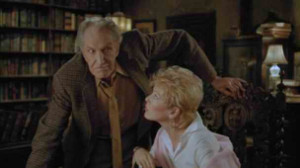
Still fro,m From a Whisper to a Scream (1987)Reportedly, Price had misgivings about the script and was unhappy with the final edit, feeling it too too extreme and devoid of the sense of nostalgia that drives his screen persona. His is a supporting role, no doubt due in part to his (clearly) failing health. Burr, co-writing with Mike Malone, Darin Scott, and Courtney Joyner, fires on all cylinders, without a weak link, and despite a relatively low budget. Obscure enough to rarely be listed, it’s more refreshingly original than the more familiar fare. Burr considers it as his only authentic film, having since been consigned to commission work.

275. THUNDERCRACK! (1975)

“God gave him a calling in life, and that was to make pornography.”–George Kuchar on Curt McDowell

DIRECTED BY: Curt McDowell

FEATURING: Marion Eaton, Melinda McDowell, Moira Benson, Mookie Blodgett, Ken Scudder, Rick Johnson, Maggie Pyle,

PLOT: On a dark and stormy night in the Nebraska hinterlands, several individuals on the road end up taking shelter at “Prairie Blossom”, an old dark house that is the dominion of alcoholic matron Gert Hammond (Eaton). Everyone present has secrets and obsessions that are brought to light, and pair off in various combinations for sexual liaisons. The group also finds itself trapped inside the house by a gorilla rampaging outside.

Still from Thundercrack! (1975)

BACKGROUND:

  • Producers John Thomas (who briefly appeared as country singer Simon Cassidy) and Charles Thomas were film students of Thundercrack! actor/writer George Kuchar, classmates of director Curt McDowell, and heirs to a fortune from the Burger Chef fast food chain, which they used to fund the movie. They also provided a rooms in their home for the shoot.
  • George Kuchar was a legend in the underground film industry, making hundred of short, campy avant-garde films together with his twin brother Mike. Noteworthy titles include Sins of the Fleshapoids and Hold Me While I’m Naked (both from 1966).
  • Actress Melinda McDowell was director Curt McDowell’s sister.
  • Kuchar and McDowell were rumored to be lovers.
  • The movie was shot for $9,000 and $40,000 in deferred costs.
  • Buck Henry used his clout as a judge to set up a (scandalous) screening at the 1976 Los Angeles Film Festival.
  • The original negatives disappeared and only five 16mm prints of the film were struck. One print was seized by Canadian authorities and three had been edited in an ineffectual attempt to make the film more marketable. The badly-damaged but uncut fifth print was primarily utilized for the transfer of the 40th anniversary Blu-ray release by Synapse Films.
  • El Rob Hubbard’s ((Fun Fact: actress “Maggie Pyle” and her husband (one of the crew members) were my landlords for a short time in San Francisco in the early 90’s.)) Staff Pick for a Certified Weird movie.

INDELIBLE IMAGE: Among the various obvious (and mainly pornographic) images to choose from, the one that sums up the spirit of Thundercrack! is the publicity photo of Gert and Bing in a melodramatic clinch—Bing in a wedding dress, Gert staring off into the horizon. It’s iconic, yet subversive, and pretty much encapsulates the film’s mood.

THREE WEIRD THINGS: Versatile cucumbers; pickled husbands; amorous bipeds

WHAT MAKES IT WEIRD: The collision of several elements: the lurid melodramatics along with the hardcore action, the visual stylization and the complex wordplay, all combine to make a film much more engaging and—dare I say it—innocent than one would expect from a mid 1970s hardcore sex parody film. Or, is it a parody film with porno elements? You decide…


Brief scene from Thundercrack!

COMMENTS: “What the heck is going on here—some sort of communal therapy group? Is that what this is?!!”—Bing

That’s probably a fair assessment of Thundercrack!, Curt McDowell’s Continue reading 275. THUNDERCRACK! (1975) →

LIST CANDIDATE: THE LOVE WITCH (2016)

The Love Witch has been promoted onto the List of the 366 Weirdest Movies of All Time. Comments on this post are closed. Please post any comments on the official Certified Weird entry.

Must See

DIRECTED BY: Anna Biller

FEATURING: Samantha Robinson, Gian Keys, Laura Waddel

PLOT: A California witch who casts magic spells to seek out her true love finds that her lovers keep dying.

Still from The Love Witch (2016)

WHY IT MIGHT MAKE THE LIST: The world created in The Love Witch is so obsessively unique—a blend of romance novels, perverse witchcraft fantasies, feminist dialectic, and Technicolor melodramas—that perhaps it can only rightfully described as “weird.”

COMMENTS: One main stylistic feature of The Love Witch is the campy acting—Samantha Robinson’s Elaine speaks as if she’s always lost in an interior world of hearts and unicorns, making her sound insincere even when she’s at her most heartfelt. Other actors take an overly broad, TV-melodrama approach. This technique helps sustain the film’s sense of otherworldliness, but the other, and far more impressive, stylistic feature is the unreal, anachronistic, and impressively detailed mise-en-scene. A girly-girl café where the clientele all dress in pink and white with flowery hats—looking more like bridesmaids than ladies out for a spot of tea—while ethereal blondes play harps and sing medieval love hymns. The local burlesque house, in a lustful red-on-red color scheme, where dancers with feather boas never take it all off but ensorcell the drooling males nonetheless. The Renaissance Faire run by witches, where Elaine and her date “accidentally” end up wed in a mock pagan ceremony. The minutiae of Elaine’s witchcraft rituals, which at one point involves her honoring a corpse with her urine and a used tampon. Clever details and decorative ideas abound in nearly every scene. Reversing the seduction stereotype, Elaine uses a comically oversized brandy snifter to decrease her conquests’ inhibitions. Trish finds Elaine’s witchcraft altar full of bizarre potions and magickal totems, then walks into her adjoining bedroom to discover, oriented in exact mirror image position, a vanity set out with wig, perfume, and makeup.

The smart script is not simplistic in its satire; it prides itself on creating and holding contradictory views. Elaine and her friends toss out ideas about femininity that are sometimes laughably old-fashioned, but are sometimes still with us today, and trusts us to sort out which are which. Witchcraft is shown as harmless New Agey neo-paganism, no more or less ritually ridiculous than Christianity, but it’s also a source of implied abuse and exploitation, and a real threat to the community. And of course, the biggest contradiction of all is Elaine, a mixture of idealism and ruthless cunning, who expresses naïve ideas with a simple conviction that no one can effectively refute, simultaneously a victim and a serial victimizer.

Because the stylistic world Anna Biller creates in The Love Witch is cinematically familiar—with its widescreen compositions, brazen color schemes, cigarette smoking femme fatales and square-jawed cops—many are tempted to go hunting for movie references and homages. Indeed, I was reminded of The Birds (in Elaine’s rear-projection convertible ride up the California coast),  (the nude witchcraft rituals), The Trip (the psychedelic kaleidoscope lens when Elaine seduces the hippie professor) and TV’s “Dragnet” (in the sappy hard-boiled dialogue of the police squad room); others cite , Valley of the Dolls and Beyond the Valley of the Dolls as inspirations. But none of the scenes Biller stages are outright allusions or in-jokes. She absorbs the period style—particularly its vivacious use of the full chromatic scale—-without simply referencing a checklist of favorite films; you’ll search in vain for nods to her specific influences. The Love Witch is a Sixties-era Technicolor B-movie that could have been, but in an alternate universe at a slight tangent to our own. The biggest compliment I can give Biller is to say that she does something for 1960s Technicolor spectacles similar to what did for silents and early talkies: she uses antiquated techniques to create a timeless, abstract setting that reflects her own personality. It’s gratifying to see her receive critical praise for this monumentally inventive and deceptively intelligent feminist statement dressed in Satanic sexploitation robes.

WHAT THE CRITICS SAY:

“The results are wildly over-the-top, in a ‘Beyond the Valley of the Dolls’-meets-‘Dark Shadows’ kind of way, but Biller’s commitment to her vision is weirdly endearing.”–Sean P. Means, The Salt Lake Tribune (contemporaneous)

CAPSULE: TESTUO II: BODY HAMMER (1992)

DIRECTED BY:

FEATURING: , Shinya Tsukamoto

PLOT: After receiving a mysterious injection and having his son killed by members of a cult, a man’s body starts to slowly transform into a weapon of flesh and steel as he tracks down the cultists and their leader, the “Metal Fetishist.”

Still from Tetsuo II: Body Hammer (1992)

WHY IT WON’T MAKE THE LIST: Body Hammer is a larger-budgeted, more conventional reinterpretation of the original Tetsuo that partially attempts to rationalize its world. By common standards, however, it’s still very much a weird movie, packed with bizarre images and occasional outbursts of the nightmarish industrial madness that defined the first. With the List’s increasingly limited slots and Body Hammer‘s more surreal predecessor already certified, there isn’t a lot of pressure to add this one.

COMMENTS: Shinya Tsukamoto’s first Tetsuo, whose status as a landmark of weird cinema and one of the most defining representatives of the Japanese Cyberpunk film movement is contested by few, was a truly unique, aggressively hyperactive, feverish industrial nightmare set in its own immersive realm. To the dismay of some fans, the sequel is clearly a very distinct effort to craft a more accessible movie, with a structured narrative and a focus on its dramatic plot, and more nuanced and realistic characters along with their emotions and motivations (the protagonist even gets a name). The most obvious departure from the first film’s style is the cold, sterilized color palette (with an emphasis on blue and white) that sets up a robustly clinical and artificial world. Before the transformations kick in, it seems like the humans we see are already machine-like and dehumanized, moving lifelessly through an imposing urban environment that dwarfs and assimilates them. Inevitably, the main character’s metamorphosis into a man-machine hybrid mechanism later on may look like a natural evolution in such surroundings.

The first scenes after the opening credits show Tomoo, Body Hammer’s version of the “salaryman”, waking up and having breakfast with his wife and child while discussing a dream from the previous night. These initial moments would be almost casual if it wasn’t for Tsukamoto’s insistence on unconventional angles and a fluid camera that freely hovers and rotates. After the family is assaulted in a mall by a group of mysterious skinheads who kidnap the son and trigger Tomoo’s transformation with an injection, setting the main plot course in motion, we get the first glimpses of the original story. It’s easy to say that the more expository approach of the sequel robs it of the magic and low-budget charm that made the first so memorable and unique, but the sensibility behind it is the same. To describe it simply, Body Hammer feels like an intersection between our familiar world and the alternative, hallucinatory logic that governs the first Tetsuo universe. As such, it’s more accessible, but there are never any signs of the auteur’s vision being hampered by the imperatives of telling a coherent story.

In fact, Tsukamoto’s directorial tics shine through the film. Sometimes, he interrupts the narrative’s course with bizarre montages mirroring Tomoo’s grotesque mutation. It helps that the film grows progressively stranger and closer to its predecessor’s insanely energetic pace, with furious imagery of sprawling wires, cables, pipes and random metallic parts that overpower and merge with fragile flesh, with the difference being that here they are lightly mediated by a contextual plot. As the movie approaches the climatic confrontation between Tomoo and the fetishist, it even presents us an explanatory flashback that clarifies the antagonist’s motivations and introduces a final twist related to his relationship with the main character. This sudden device comes completely unexpected, mainly because we would never guess that Tsukamoto would show such a preoccupation with the narrative’s background. Even this passage, however, is infused with his surrealistic style, and it may actually contain the film’s ultimate surreal set piece, culminating in a murder scene that manages to be simultaneously gory, dreamlike and touching.

The additions to the Tetsuo mythology, possible through the bigger budget, are also welcome. It is, for example, nice to see a whole cult of metal worshipers operating, instead of a sole maniac like the original, as well as further inventive variants of the bloody and biomechanical mutations of flesh, steel and rust.

The consensus on Body Hammer is positive, but a number of fans show discontent with what they see as an ill-fated attempt at making sense out of the perfectly irrational fable that was the original. To a certain extent, they are correct. But the decision to flesh out the character dynamics and lend emotional weight to the chaotic events on screen, works because it passively accepts and coexists with the absurdity of the film’s plot. In the end, Body Hammer is immersed in its mix of alien atmosphere and cold, fantastical reality, making it both a satisfyingly strange movie and a distinct enough one from the original.

WHAT THE CRITICS SAY:

“Tsukamoto’s preoccupations with meta(l)morphosis, body horror and unchecked masculinity remain firmly in place, as does the writer/director’s way with outrageous images and ideas.”–Anton Bitel, Eye for Film

Celebrating the cinematically surreal, bizarre, cult, oddball, fantastique, strange, psychedelic, and the just plain WEIRD!