The beauty of the 1970s is its obsession with multifarious genres and trends, but the hardly means all the movies are good. A case in point is Tobe Hooper‘s Eaten Alive, which jumps on the killer animal bandwagon started by Bruce the shark, who shows up here as a laughably fake big green scaly lizard. Naturally, Hooper taps into his own hayseed folk focus, which include Texas Chainsaw‘s tied-up Marilyn Burns, a very creepy Neville Brand, an almost unrecognizably made up Carolyn Jones, and a very kinky fellar named Buck, played by Robert Englund. Another 70s tendency, which would be unthinkable in the next decade, is the terrorization of tykes. Here, a poor little crippled girl gets to witness her doggy become gator bait. She’s further terrorized by dysfunctional parents, including a pappy lookin’ for a nonexistent eyeball (!) It’s a weird indie (but, by no means not List-worthy). Hooper is still in full exploitation mode before Spielberg ruined him with a professional filmmaking lesson for Poltergeist (1982)—not a bad movie per se, but with a few exceptions, it threw Hooper permanently off course.
No award will given for guessing what film Mako: The Jaws of Death (directed by William Grefe) is shamelessly ripping off. It stars Richard Jaeckel using sharks to exact revenge. Better is William Girdler’s Jaws-with-claws, Grizzly, which stars Christopher George and the busy Jaeckel (again). It’s an unadulterated rip-off, made all the better for its trashiness.
Jeff Liberman’s Squirm is a hoot. Think Jaws as a buncha earth worms. It’s roguish humor is winning. It was a video store favorite for years, usually found next to the sticky floor section.
Surprisingly Rattlers (directed by John McCauley) are a duller, less threatening lot than fish bait.
Frustratingly, The Rat Savior (directed by Krsto Panic) remains an elusive gem. It won several awards at genre festivals, was available briefly on beta-max, was shown rarely on television and in arthouse cinemas (where I caught it a quarter of a century ago), and is only available on YouTube, devoid of subtitles or dubbing. It has recently been released on a PAL DVD in its original Yugoslavian language, which will hopefully pave the path for an accessible statewide release. Based on the novel by Alexander Greene, it’s a rodent-infested variation on body snatchers crossed with John Campbell’s shape-shifting “Thing.” The nasty cheese-eaters kill and impersonate human victims. The resident scientist (Ivica Vidovic) develops his own pesticide. However, once the rats impersonate a human, there’s no way to differentiate them, and mistakes are bound to happen. The Rat Savior is allegorical, political paranoia; a one-of-a-kind film, awaiting rescue from obscurity.
Our weekly look at what’s weird in theaters, on hot-off-the-presses DVDs, and on more distant horizons…
Trailers of new release movies are generally available at the official site links.
IN THEATERS (LIMITED RELEASE):
Buster’s Mal Heart (2016): Buster has two (or maybe more) personalities, literally existing in two separate bodies: one a family man, the other a bearded hermit. This crime-mindbender earned mixed reviews. Buster’s Mal Heart official site.
A Dark Song (2016): A woman with ambiguous motives seeks the help of a dubious warlock to enact an occult ritual. Good reviews, but questionable weirdness. A Dark Song official site.
Catfight (2016): Two middle-aged women (Sandra Oh and Anne Heche) renew a decades-old grudge with a fistfight that gets out of hand. The fight scenes are reputedly brutal, and the Amazon reviews are littered with words like “odd,” “crazy,” “weird”… and “terrible” (admittedly, all of the reviewers probably came in with very mainstream expectations). Buy Catfight.
Tampopo (1985): A mysterious stranger helps a failing ramen shop owner conquer the local market in this “noodle western.” Offbeat satire with a few bizarre touches, this new Criterion Collection release ranks as a cult movie among Japanese arthouse devotees, and is in our reader-suggested review queue. Buy Tampopo.
“Camp John Waters”: In one of the stranger promotions we’ve heard of, 70-year old bad boy John Waters is hosting a summer camp. Featured activities include watching Waters’ one-man show, Hairspray karaoke, “Bloody Mary Bingo,” a Waters movie marathon, and that old camp standby, Scotch and cigars. Now for the bad news: it’s sold out. Before we could even report on it. Maybe Waters will add additional dates, considering how quickly this one filled up? Regardless, you can see the official announcement at Club Getaway.
What are you looking forward to? If you have any weird movie leads that I have overlooked, feel free to leave them in the COMMENTS section.
1976 is such an astoundingly productive year in exploitation and horror that we’re forced to divide it into two parts. Religious-themed horror takes front and center in this first part, beginning with Alfred Sole’s Communion [better known today as Alice Sweet Alice], one of the most substantial cult films ever produced. Beginning with a young Brooke Shields torched in a pew, dysfunctional Catholicism is taken to grounds previously unseen. Mantling the most pronounced trends of the 1970s, Sole plays elastic with multiple genres (slasher, psychological, religious, independent movies, horror) with such idiosyncratic force that the movie’s cult status was inevitable. It should have made Sole a genre specialist, but his career as a director never took off, and he only made a few more films. Surprisingly, critics have been slow in coming around to Communion. It’s essential viewing and we hope to cover it in greater detail here at a later date.
Larry Cohen’s God Told Me Toremains one of the most relentlessly original films of the 70s, already covered here and a solid List contender.
Richard Donner made a bona fide pop star out of a pre-pubescent antichrist with The Omen. It was a marketing bonanza, spawning endless sequels and a pointless 2006 remake. Sensationalistic, red-blooded, and commercially slick, in a National Enquirer kind of way, it’s predictably most successful incoming up with ways to slaughter characters—the most infamous of which is a decapitation by glass. In that, The Omen is a product of its time. The creativity in many of the later Hammer Dracula films was often solely reserved for ways to dispatch (and resurrect) its titular vampire. The Abominable Dr. Phibestook tongue-in-cheek delight utilizing the plagues of Egypt to annihilate everyone in sight. It was also the decade of Old Nick and deadly tykes. Throw in apocalyptic biblical paranoia, and The Omen is practically a smorgasbord of 70s trends.
The Omen is helped tremendously by Jerry Goldsmith’s score, which is reminiscent of Carl Orff and still remembered (and imitated). Three character performances stand out: Billie Whitelaw, who literally lights up as a nanny from the pit, David Warner as a photographer obsessively trying to avoid his predestined end, and Patrick Troughton as a priest who “knows too much” (and gets his own Dracula-like finish). Unfortunately, the film is considerably hindered by its two leads. Gregory Peck, nice fella that he was off screen, is his usual wooden self and poorly cast as Damien’s adoptive ambassador father. The role was first offered to Charlton Heston, whose old school conservative machismo and hammy charisma would undoubtedly have been a better fit. Alas, even though he rightly predicted it would be a major success, Heston objected to a film in which evil triumphed over good, and chose instead Continue reading 1976 EXPLOITATION TRIPLE FEATURE, PART ONE: THE OMEN & CARRIE→
PLOT: With the help of 400 pound maid Griselda, suburban housewife Peggy accidentally murders her deceptively bucolic husband and goes on the lam. A cop directs the fugitives toward a Pleasure Island for criminals called Mortville. Things go south with the village’s fascistic matriarch, until there’s a mutiny in the ramshackle town.
BACKGROUND:
Divine was originally intended for the role of Mole McHenry (eventually played by Susan Lowe), but could not back out of an alternate commitment. Desperate Living is the only film Waters made during Divine’s lifetime in which the hefty transvestite did not appear.
Waters did not cast regular David Lochary for the film due to the latter’s drug use. Lochary died soon after Desperate Living was released, either from a PCP overdose or from bleeding to death during an accident that occurred while he was tripping on PCP (reports differ).
The tagline was “It isn’t very pretty”—a radical understatement.
Budgeted at $65,000, this was Waters’ most expensive film to date. 1974’s Female Troublehad a budget of $25,000, while 1972’s Pink Flamingos cost a mere $10,000.
The extras of Mortville were homeless residents from the Baltimore skid row, bused in for a single day’s shoot.
According to Waters, lesbian groups in Boston protested the film, forcing its cancellation in Beantown.
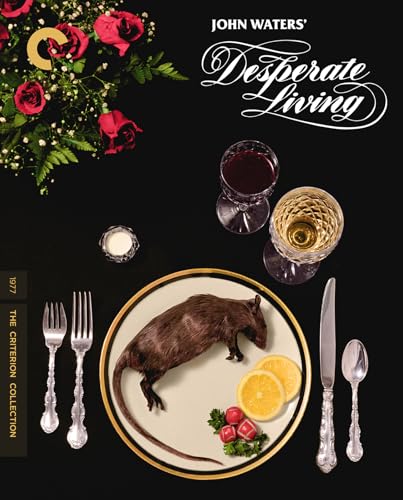
INDELIBLE IMAGE: The opening credit scene of a dead rat served on expensive china, salted, and eaten at a swank dinner party. It sets the table for what’s to come.
THREE WEIRD THINGS: Cross-dressing cop; toddler in the fridge; scissors self-castration
WHAT MAKES IT WEIRD: Waters outdoes Multiple Maniacs‘ “cavalcade of perversion” in this grunge fairy tale that includes systematic lesbianism, cross-dressing, odious hippie sex scenes, cannibalism, necrophilia, bat rabies, copious facial warts, and gap-toothed queen Edith Massey sexually serviced by leather-bound Nazis.
Opening credits for Desperate Living
COMMENTS: The finale in John Waters’ “Trash Trilogy,” Desperate Living is the most mean-spirited of his films, so much so that even Waters himself has claimed that he went too far with it (he criticized himself for not including a normal protagonist to offset Mortville’s outlaw denizens). Desperate Living, however, is a rogue burlesque with Waters at his most consciously surreal. Indeed, this is what Surrealism is supposed to be: provocative, revolting anarchy. Its première only lacked an actual riot, which is what the original Surrealists repeatedly aimed for (Luis Buñuel reportedly took a pistol to the movement’s early events, preparing to whip rioters with it). After Pink Flamingos and Female Trouble, the midnight circuit knew what to expect of Waters, and were perhaps too pacifistic to wreak havoc.
Waters’ posthumous self-disgust with Desperate Living is understandable, and explains his eventual move to nostalgia with Hairspray (1988). Despite, or perhaps even because of, Desperate Living‘s descent into a kitsch Gehenna, Waters inched towards becoming a more multi-faceted filmmaker after this (as much as he could while still remaining John Waters). Actually, sentimentality had always been an essential part of his Waters’ diet, having worshiped at such diverse altars as William Castle, Busby Berkeley (surprisingly to some), and The Wizard Of Oz as well as Doris Wishman, Russ Meyer and Herschell Gordon Lewis. There’s not even a sliver of that vital part of himself here, however. Rather, Waters retains a brilliantly narrow focus that expanded and buttressed the rotten punk fortress he had been shrewdly building for a dozen years.
In hindsight, we can see Desperate Living as Waters’ personal query. “It’s a fairytale for fucked-up children,” he once said. Visually, the film verifies that assessment, with the psychedelic sets of Mortville ((Fabulously designed by Vincent Peranio, who also was responsible for cooking the rat)) evoking ludicrous adolescent nightmares. There’s also the derelict hippie commune, the type of which we can imagine being constructed for the childlike followers of Charles Manson. Fauvist paintings, along with portraits of dictators Adolf Hitler and Idi Amin, decorate the plywood castle walls of Queen Carolotta. It’s the most ferociously idealistic of Waters’ films, but also the angriest. Self-proclaimed dystopian films are run-of-the-mill—and, given the current climate, we will undoubtedly see a renewed wave of the genre—but the pessimism of Desperate Living is internally authentic and, like Tod Browning before him, Waters’ ongoing obsession for crime aligns him with camp outcasts.
A film about desperation, Desperate Living is aptly named; a summation of everything Waters had been navigating toward. Having reached an apex here, possibly unwittingly, it becomes the filmmaker’s shrill, skid marked tightie-whitie. And we can locate the pulse of Waters’ sympathies; although here, that pulse was ultimately too faint, missing the puritan heart of Divine (no, that’s not a typo) and the sibling center of Lochary. Their absence casts a callous pall over the film. The initial takeaway is something akin to Freaks (1932), but without the redemptive postlude. It’s Waters’ most rewarding challenge, which apparently he can’t revisit. For those willing, Desperate Living has the potential to produce a maniacal euphoria. It’s far less offensive than the moralistic platitudes being bandied about in cinema (and culture) with the sincerity of a hypocritical shrug. Waters’ finale to his trash trilogy is not merely what Surrealism is supposed to be about; it’s a cinematic obligation.
G. Smalley adds: I actually disagree with those (including Waters himself) who think this is his “least joyous” (again, Waters’ words) film. Waters is certainly kinder to his actors here; in Pink Flamingos he asked them to do things he shouldn’t have, whether they were willing or not. (Although a couple of Desperate Living‘s scenes involving children just cross the line into irresponsible filmmaking, at least no chickens were killed, no friends go down on each other, and no one eats feces). No one can suggest that Peggy Gravel is a nastier character than Female Trouble‘s Dawn Davenport; Peggy at least has the excuse of mental illness. There are no jokes in Desperate Living crueler than the Marble’s scheme in Flamingos to rape and impregnate runaway girls and sell their children, or than Trouble‘s subplot where Edith Massey is caged in a birdhouse, only to have Divine cut off her hand. Nor could there be; Waters quickly found the limit of what he could achieve via shock in Pink Flamingos, and spent the rest of the “Trash Trilogy” refining his aesthetic to make it less shocking and more witty. Female Trouble does this by introducing an actual plot and focused satire. Desperate Living buffers its cruelties with the unreal fairy-tale plot, the gaudy production design, and, most importantly, with Waters’ best dialogue writing. Lines like “I don’t want no white man looking at my Tampax!,” ” Look at those disgusting trees, stealing my oxygen!,” and the exquisitely ironic ““I have never found the antics of deviants to be one bit amusing” are so ludicrous, and delivered with such hysteria, that they’re impossible to take seriously. Waters uses his camp ear to transform misanthropic harangues from the merely hateful into the realm of the transcendently droll—he takes the piss out of his own nihilist impulses. And Desperate Living drips with these maliciously delicious mal mots. The fact that this is Waters’ funniest movie makes it, to me, his most joyous film. I don’t think Waters stopped making shock films after Desperate Living because he had gone too far, but because he had finally gotten the formula just right. There was nowhere left to go; it was time to try a new challenge.
DVD INFO: The unrated New Line DVD (buy) is out of print but readily available. It contains the trailer and a commentary by Waters and Liz Renay (recorded separately). Waters is, as always, charming, and the aging Renay retains a saucy, offbeat charisma that makes it easy to understand why the director cast her.
Desperate Living is also available in the New Line editions packaged together with Polyester in the collectible “John Waters Collection #2” (buy) and the rare and expensive 8-disc “Very Crudely Yours, John Waters” set (buy) (where it appears alongside Pink Flamingos, Female Trouble, Polyester, Hairspray, A Dirty Shame, Pecker, and a disc of extra features).
Desperate Living is also available to rent or buy on-demand (courtesy of current rights-holder Warner Brothers).
Desperate Living is not currently available on Blu-ray, but with Warners holding the rights and the Criterion Collection expressing interest in canonizing Waters with their recent restoration and release of Multiple Maniacs, there is hope that it may someday join the high-def ranks.
UPDATE 6/22/2026
The Criterion prediction finally came true, many years later. The label has released a remastered Desperate Living on Blu-ray (buy) or Blu-ray + 4K UHD (buy). Extras include a recycled commentary track from Waters and Liz Renay (R.I.P.); an Italian dub (!); new interviews with Waters, Susan Lowe, Mary Vivian Pearce, Mink Stole, and production designer Vincent Peranio; a location tour; and of course, a booklet with essay.

 No award will given for guessing what film Mako: The Jaws of Death (directed by William Grefe) is shamelessly ripping off. It stars Richard Jaeckel using sharks to exact revenge. Better is William Girdler’s Jaws-with-claws, Grizzly, which stars Christopher George and the busy Jaeckel (again). It’s an unadulterated rip-off, made all the better for its trashiness.
 .
 The Omen is helped tremendously by Jerry Goldsmith’s score, which is reminiscent of Carl Orff and still remembered (and imitated). Three character performances stand out: Billie Whitelaw, who literally lights up as a nanny from the pit, David Warner as a photographer obsessively trying to avoid his predestined end, and Patrick Troughton as a priest who “knows too much” (and gets his own Dracula-like finish). Unfortunately, the film is considerably hindered by its two leads. Gregory Peck, nice fella that he was off screen, is his usual wooden self and poorly cast as Damien’s adoptive ambassador father. The role was first offered to


 – Waters’ memoirs outline his bad taste philosophy
 ) is out of print but readily available. It contains the trailer and a commentary by Waters and Liz Renay (recorded separately). Waters is, as always, charming, and the aging Renay retains a saucy, offbeat charisma that makes it easy to understand why the director cast her.
 ) and the rare and expensive 8-disc “Very Crudely Yours, John Waters” set (
 ) (where it appears alongside Pink Flamingos, Female Trouble, Polyester, Hairspray, A Dirty Shame, Pecker, and a disc of extra features).
 (courtesy of current rights-holder Warner Brothers).