IT CAME FROM THE READER-SUGGESTED QUEUE: HANSEL AND GRETEL (1983)

366 Weird Movies may earn commissions from purchases made through product links.

DIRECTED BY: Tim Burton

FEATURING: Michael Yama, Alison Hong, Andy Lee, Jim Ishida

PLOT: A young brother and sister lost in the woods find sanctuary in a candy-covered house deep in the forest, but the witchy proprietor proves equally dangerous.
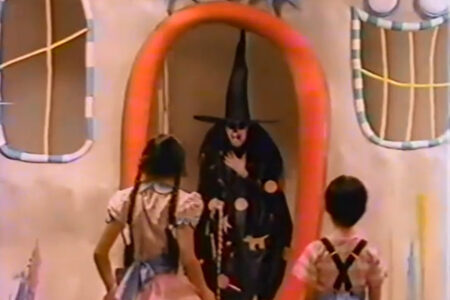
Still from Hansel and Gretel (1983)

COMMENTS: Several years ago, the 366 Weird Movies staff joined forces to debate the relative weirdness of the oeuvre of one Timothy Walter Burton. If one of his kooky gothic fairy tales might be inducted into the canon that had thus far eluded him, then perhaps one of us could make a compelling case for the film most worthy of the honor. (It should come as no surprise: Alfred Eaker’s pick won the day.) But in all that talk, not one of us even mentioned the very first live-action film ever crafted under Burton’s watchful eye. This turns out to be a significant oversight, because this small-scale retelling of a classic fairy tale is a true oddball by just about any yardstick. 

One reason “Hansel and Gretel” escaped our critical eye is because the film hardly had any eyes on it at all. It debuted on Halloween night in 1983, airing in the 10:30 p.m. slot on the Disney Channel as part of a special double feature hosted by Vincent Price, paired with Burton’s short animation “Vincent.” After being hidden in this near-invisible time slot, it was then buried even deeper, consigned to the Disney vault to never be seen again, eventually becoming the subject of rumors and doubt as to whether it was even real. Only when it resurfaced as part of a retrospective at New York’s Museum of Modern Art in 2009 were true believers rewarded with proof of its strange existence.

So now we have it—and while the story itself is pretty faithful to the version of the tale made famous by the Brothers Grimm (it’s number 327A on the Aarne-Thompson-Uther index of folklore), a handful of adjustments and adornments make Burton’s retelling unusual. For one thing, the director hired an all-Asian cast, an affectation which is progressive from a cultural-diversity standpoint but suggests a greater purpose that isn’t really explicated in the text. There’s also a stark emptiness to the set, with minimal decor and a hollow sound that suggests a vast soundstage mic’d up with a single boom. Where there is decor, however, it’s very Burton-esque, with toys that appear to have escaped from his animations and curlicue mountains straight out of The Nightmare Before Christmas. The confectionary house of the witch is especially bizarre, with walls and chairs that spurt colorful liquids when touched, and beds with cream-filled comforters that sprout hideous hands in the middle of the night.

Two performances are so eccentric that they make the case for weirdness all by themselves. Michael Yama’s dual-drag turn as both the wicked stepmother and the wicked witch leaves nothing on the table. (Any suggestion that they are one and the same character will only be met with vehement agreement.) Seriously, it’s the kind of performance that might make the contestants on “RuPaul’s Drag Race” tell him to take it down a notch. His stepmother is strictly bitchy, complaining about everything in an angry-Paul-Lynde cadence, greedily devouring hideous-looking food, and punishing the children just because she can. But it’s as the witch that he can really let his freak flag fly, with a candy-cane nose, an arsenal of sweet weapons, and a devilish affect that recalls Looney Tunes’ Witch Hazel. The other notably strange performance is Bam Bam, a misshapen, toothy gingerbread creature (puppeteered by future Pixar scribe Joe Ranft) who sings a parody of “Do Ya Think I’m Sexy” in an effort to persuade Hansel to eat him.

Hansel and Gretel suffers from a split tonal personality: the hideousness of the villains and Burton’s fondness for grotesque stylings, countered by good-natured innocence in the form of the blandly decent children and especially by Johnny Costa’s score, which feels exactly like his most famous work, the soothing tinkly piano stylings that underscored nearly three decades of “Mister Rogers’ Neighborhood.” As a fairy tale adaptation, it’s just okay. It works far better as a historical curiosity, a piece of juvenilia that Burton had to get past in order to realize his vision on a bigger scale. But it’s instructive to see his technique before the edges started to get sanded away, when skill and budget were the only things limiting his creativity. 

WHAT THE CRITICS SAY:

“I understand why Disney canned this thing after one airing. It’s not even so much that it’s too scary, but it’s just weird. Everything after Hansel and Gretel enter the witch’s house is just one strange creative decision after another… I have no clue if Burton wasn’t given enough money to work with, or was under the influence of some very strong hallucinogens, but this is truly bizarre and unprofessional. It’s easily the weirdest thing I’ve seen yet.”–Collin, Movie Match-Up

(This movie was nominated for review by Ari Srabstein, who dubbed it “a very strange and fascinating film in my opinion and truly unique.” Suggest a weird movie of your own here.)

POD 366: Giles Mysteriously Disappears in the Middle of Our Halloween Episode

366 Weird Movies may earn commissions from purchases made through product links.

Audio only link (Soundcloud download)

Quick links/Discussed in this episode:

Deadgirl (2008): Discussion begins. Read Pamela De Graf’s review. A 15th Anniversary special edition of the pseudo-necromaniac film, with new interviews from cast and crew and recycled audio commentary. Buy Deadgirl.

Fascination (1979): Discussion begins. Read Gregory J. Smalley’s review. Indicator continues its re-release of ‘s catalog with this non-vampire film that may be his most polished effort. Among the special features are two deleted sex scenes (now that’s a sales pitch!) Buy Fascination.

Lips of Blood (1975): Discussion begins. Read Gregory J. Smalley’s review. Another new Indicator/Rollin rollout, this time with vampires (and the Castel twins). Buy Lips of Blood.

Messiah of Evil (1973): Discussion begins. Read Shane Wilson’s Apocrypha Candidate review. From an outfit called Radiance comes this nice-looking release of the spooky/weird 70s horror, in a limited edition. We think this is the first time it’s appeared on Blu-ray. Buy Messiah of Evil.

Teenage Tupelo screening: Discussion begins. Read the official Apocrypha entry! After many years of unavailability, takes his imaginary rockabilly exploitation biography on a mini-tour. Unfortunately, we’re a week late posting this and the only one left you can possibly catch is in St. Louis tonight. If more dates are added, we’ll try to be more responsible! Teenage Tupelo at Arkadin Cinema, St. Louis.

“The Toxic Avenger Collection”: Discussion begins. A box set of ‘s pride and joy, containing all four Avenger movies, which start out mean-spirited and silly but just grow sillier with each installment. Released now in upgraded 4K versions to capitalize on the TA reboot with . Buy “The Toxic Avenger Collection.”

Waikiki (2023): Discussion begins. A struggling Hawaiian hulu dancer meets a mysterious homeless man. Described by its publicist as “ian,” but also a serious look at the dark side of paradise—native Hawaiians struggling to make ends meet amidst the wealthy tourists. Waikiki official site.

WHAT’S IN THE PIPELINE:

We have a tentatively scheduled guest for next week’s Pod 366: of Blood Tea and Red String (2006), who will hopefully have some updates on the progress of her upcoming stop-motion project, Seed in the Sand. In written reviews, Shane Wilson gets in the Halloween spirit with a real rarity that Came from the Reader-Suggested Queue: ‘s stop-motion version of Hansel and Gretel (1983), which only aired once; Giles Edwards tries to contain himself over‘s experimental Container (2006); and Gregory J. Smalley goes to Waikiki (see above). Onward and weirdward!

CAPSULE: LYNCH/OZ (2022)

366 Weird Movies may earn commissions from purchases made through product links.

Lynch/Oz can be rented or purchased on-demand.

Recommended

DIRECTED BY: Alexandre O. Philippe

FEATURING: Amy Nichols, , , , , ,

PLOT: Six directors and one critic give their thoughts on the connections between The Wizard of Oz and the complete works of .

Still from Lynch/Oz (2022)

COMMENTS: Director Alexandre O. Philippe has made a career out of making films about other filmmakers’ films: George Lucas, , and are among his previous subjects. This modestly structured doc—nothing but experts reading their own personal essays over film clips—tackles his weightiest subject yet. The Wizard of Oz is a massive icon in pop culture, and, within his sphere of influence, David Lynch is equally influential. The result is not as narrow and academic as you might fear; although the movie expects the viewer to have a working knowledge of Lynch and Oz, the topic is broad enough to serve as a jumping-off point for reflections about movies, American culture, and the artistic process itself.

The essays are roughly arranged in order from most to least enlightening. Nicholson’s opening chapter (“The Wind”) is, in my view, the best; I think her position as the only critic on the panel gives her the widest lens through which to view the subject. Rodney Ascher focuses on Oz as a perfect story template (it’s basically the Hero’s Journey with doppelgangers). John Waters is a mid-show change-of-pace: he doesn’t analyze Lynch’s films intensively, but plays to his talents as a raconteur, telling stories about meeting Lynch (and nuggets like the time he dressed as the Wicked Witch for a children’s Halloween party). Karyn Kusama gives us the most direct evidence of the connection: Lynch’s unelaborated response at a Mulholland Drive Q&A, “there is not a day that goes by that I don’t think about The Wizard of Oz.” Justin Benson and Aaron Moorhead dig into Lynch’s obsession with Judy Garland. David Lowery’s segment is probably the least on-topic—and the most concerned with his own personal output—but nevertheless contains fascinating theories about the purpose of childrens’ films (setting kids up to deal with the disillusionment of adulthood and the real world). Phillipe’s contribution is mainly in selecting the clips and images that illustrate and expand on the authors’ words, an exhaustive task that’s not as simple as just fast-forwarding to the appropriate spot in Oz or Wild at Heart; there are also archival Lynch appearances to sort through, and excursions into everything from Gone with the Wind to Star Wars to Videodrome.

“The fact that The Wizard of Oz and David Lynch can go hand-in-hand and communicate with one another,” Lowery explains, “the fact that we can have this conversation about ruby slippers and ‘,’ is one of the most beautiful things about this medium.” Indeed, Lynch/Oz is about the influence of one on the other, but it’s also about all sorts of creative cross-pollinations and new perspectives. Cinema, and the arts in general, are all about conversations between human beings over time. Lynch/Oz is obviously aimed at a select few cinephiles, but if your breadth of knowledge is wide enough, you’ll find plenty to get you thinking—and if not, you’ll discover plenty of new corridors to explore in the labyrinths of cinema.

WHAT THE CRITICS SAY:

“An enjoyable, if not entirely satisfying, look at a strange cinematic affinity…. Though frustratingly unfocused and sometimes overreaching (even compared to Philippe’s other docs, which are never what you’d call precision-crafted), the film is consistently enjoyable, with just enough flashes of insight to justify its existence.”–John Defore, The Hollywood Reporter (festival screening)

CAPSULE: EYES OF DREAD (2023)

366 Weird Movies may earn commissions from purchases made through product links.

Eyes of Dread can be rented or purchased on-demand.

DIRECTED BY: Andreas Marawell

FEATURING: Malin Saine, Luna Dvil, Karin Engman

PLOT: Nina is rumoured to be dead; her sister Anna doesn’t believe it and investigates in dreams, while the other sister, Julie, investigates in the physical world.

Still from Eyes of Dread (2023)

COMMENTS: Another reviewer groused that the strip club scenes in Eyes of Dread far too often featured far too clothed dancing. While most of his other remarks were on the mark (if perhaps phrased undiplomatically), he did miss a point here: this is an artistic dance club, featured in random intervals in an artistic movie. This is evidenced by the prevalence of red and blue lens filters; thwompy, but not overpowering, sound; and the appreciable use of mirrors, alleyways, candles, and foreign accents. It’s one of those films where any given screen capture might suggest it is interesting.

It is not. A big spooky delivery of “She… went into.. a building(!). That’s where she disappeared. She disappeared there. But I can’t tell you where it is…” is as good example of the dialogue (although I did like skeazy guy’s advice to Paul the photographer: “the alpha animal, he gets all the bitches”). Much of my grousing about the dialogue might have been avoided had the filmmakers written it in the actors’ language of choice. Funneling Z-grade English-language lines through non-native speakers can make for an odd and unsettling experience.

It does not. Not in Eyes of Dread. Digging around the more charitable corners of my mind, I will remark that the camera work is sufficiently interesting, taking advantage of the undisclosed Central/Eastern European’s nook-filled density with its understated meandering. But that may be all. Unnatural phenomena typically demand a naturalistic approach: the unspeakable needs some veneer of relatability, if not necessarily believability.

I did not believe any of these characters, in spite of their painted-on earnestness. And while I don’t mind—and often can take considerable delight in—narratives that flirt with incoherence, there needs to be an “aura” to the film, that difficult-to-describe combination of elements that trap the viewer like a dream. Writer/director Andreas Marawell takes a stab at it, but relies too heavily on vague facsimiles of stuff seen in other films. He captures images handily—and it might be best if he stuck with cinematography until he can whip up a better movie formula.

WHAT THE CRITICS SAY:

“I swear it was just some student film with thrown together scenes at times since there was no plot to speak of. ” — Justin Whippo, Jackmeats Flix (contemporaneous)

Celebrating the cinematically surreal, bizarre, cult, oddball, fantastique, strange, psychedelic, and the just plain WEIRD!