366 UNDERGROUND: THE DARK SISTERS (2023)

366 Weird Movies may earn commissions from purchases made through product links.

The Dark Sisters can be rented or purchased on-demand.

DIRECTED BY: Richard Bailey

FEATURING: , Edna Gill, Kristin Colaneri

PLOT: Two sisters reunite by a remote lake some time after a mutually-perpetrated crime.

COMMENTS: Thieves gonna thieve, amiright?

And whether you want him to or not, Richard Bailey is going to make his movies in his own way. Plenty of cryptic—or even patently incomprehensible—films cross our desk here, and we approach each title with an open mind and an eye on purpose. It was only during the final act of The Dark Sisters (and then, only after a politely brazen hint from the filmmaker) that I cottoned on to just what this movie is all about. Bailey is an ideas man, one who has things to say about life and mind, and he is keen to converse with the viewer.

On the surface, The Dark Sisters concerns two sisters attempting to bridge a gulf that has grown between them during intervening years of separation after a grisly experience. Kicking back lakeside for this reunion, things quickly become not what they seem, and even, if I may conjecture briefly, not even what they are. This is a story of two sisters; this is a story of vengeance; this is a story of redeeming the wicked; this is a story of reflections, doubles, synthesis, and the fusion between perception, reality, and memory. And it’s not even really about the sisters, for that matter.

With his poetic-essayical dialogue, lingering shots and scans of a delightful primordial lake, fractured plot structuring, and philosophical musings, Bailey tracks a number of things here. My own takeaway from this methodically furled string of musings and images is that The Dark Sisters is a story about the story—about the act of storytelling, touching on the facets of that that age-old phenomenon and attempting to present this nigh indescribable (and wholly human) pass-time (a designation I use with no sense of flippancy; time is what we have, and pass it we must). Through archetype, rumination, sonic cues, and honey-glazed nature, The Dark Sisters seeks the heart of what occurs when we gather to talk and make sense of ourselves and everything around us.

Listen to our interview with Richard Bailey about The Dark Sisters.

WHAT THE CRITICS SAY:

“In some ways The Dark Sisters reminds me of films like Mickey Reece’s Climate of the Hunter. Things aren’t normal, but they’re not full-blown weird or bizarre either. It’s as though everything simply shifted a few degrees away from what we expect them to be, and we have to figure out why.”–Jim Morazzini, Voices from the Balcony (contemporaneous)

IT CAME FROM THE READER-SUGGESTED QUEUE: UN PERRO LLAMADO DOLOR [A DOG CALLED PAIN] (2001)

AKA El artista y su modelo [The Artist and His Model]

DIRECTED BY: Luis Eduardo Aute

PLOT: A series of vignettes about seven legendary Spanish-speaking painters and their relationships with their models, united by a dog which shares a name with Frida Kahlo’s beloved pet.
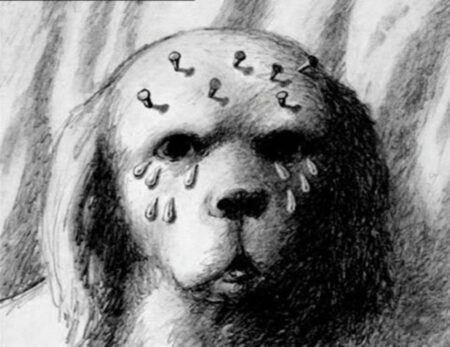
Imaged from "A Dog Called Pain" (2001)

COMMENTS: No doubt you’re all familiar with the Barbershop Harmony Society and the annual international barbershop quartet competition it hosts. Well, have I got news for you: just this past week, video of the 2023 finalists’ performances in Louisville earlier this year was posted online, so you now have the chance to see what the coolest kids in a capella close harmony are up to. In particular, you might want to check out the work of this year’s champion Midtown, who clinched the crown with a 12-minute mashup of “Old MacDonald Had a Farm” and the old “Spider-Man” cartoon theme, a performance which turns out to consist entirely of inside jokes. It’s so deep down the barbershop rabbit hole that the explanation merits its own playlist. And if the crowd’s response is any indication, the aficionados are eating it up with a spoon.

Now, why am I subjecting you to this bizarre-even-by-our-standards digression about an arcane and nearly forgotten musical subgenre? Because for weeks, I have been reckoning with what I think of Un perro llamado dolor, Luis Eduardo Aute’s hand-crafted fantasia on the lives and artistic stylings of some of the most famous painters who ever lived, and hearing this professional and utterly impenetrable barbershop performance proved to be a fitting analogue: it’s exceedingly skilled, breathtakingly beautiful in moments, and so far up its own ass that it threatens to cross dimensions.

Aute possessed a variety of talents, from composing chart-topping songs to headlining art shows across Europe to not only writing successful poetry but inventing new forms to increase the challenge. After a while, he began to combine his talents, uniting his artwork, songs, and poems around joint themes and even expanding into film, a medium he encountered early through a job he landed as a second A.D. on ’s Cleopatra. So here is a chance for all of his skills to come together.

It’s a mammoth undertaking. Aute created over 4,000 drawings in pencil and charcoal, often aping the styles of the greats he intends to honor. His assembly is barely animation (save for a couple computer-assisted shots late in the film, Un perro unfolds at a rate of about 3 seconds per drawing), but it flows smoothly through seven different portraits united only by the subjects’ profession and the titular dog. The dog is a curious companion. Named Pain (supposedly like one of Frida Kahlo’s actual dogs, although hers were Xoloitzcuintli and not the generic hound seen here), his presence hints at the constant agony all artists seemingly feel, but he is a loyal friend, protecting his masters and their models against all sorts of villains who would do them harm.

The dangers of both the making of art and the judgment of others seem to be foremost in Aute’s mind. We watch as crowds of celebrities (especially comic filmmakers) look on at Picasso’s Guernica like a Hollywood legend, but the artist himself needs reassurance from Man Ray that he’s done something worthwhile. is portrayed as unusually vulnerable, and his model even chops off one of his hands. Francisco Goya is attacked first by flying demons, then firing squads. Aute suggests that to be an artist is to endure trauma.

But maybe not. Divining Aute’s point is purely a guessing game. If you’re not an art historian, Un perro is a baffling collection of surreal images that convey the hauntings of a troubled soul but offer little interpretation. Even if you recognize Goya and his Maja desnuda, or intuit that it’s Leon Trotsky whom Diego Rivera stabs in the head with a Soviet sickle, there’s nothing to tell you why Aute brings them together. And those are just the artists I recognized. I found myself stopping the film frequently to peruse quick biographies of the subjects of Aute’s portraits in hopes of gleaning more insight into what was going on. (I have to confess that I was not familiar with Joaquín Sorolla at all, and his story in the film remains lost on me.) It’s the purest artist’s trope: let the work speak for itself. But what the work seems to be saying here is that it’s too smart for you.

My best hope for understanding comes from the title cards, which describe Un perro llamado dolor as a “libertarian fantasy based on the work and events of the lives of the artists portrayed.” It’s a curious label, given that the main characters in the film are in no way free. They are trapped by their obsessions, helpless in the face of fantastical fears, and able to defend themselves only with pencil or paintbrush. Aute may intend his film as a celebration of their persistence and fortitude, or he may seek to make them seem smaller, more human and fragile. It’s hard to know.

The obtuse nature of the film makes it a strange viewing experience, because it feels like it’s trying hard to push you away. Aute crafts something beautiful, but the experience locks you out, rather than inviting you in. Watching it in a room full of Spanish art historians would make for a very unusual experience. Much like being in an audience of barbershop quartet enthusiasts who laugh uproariously to drive home the point that they get all the jokes… and you don’t.

WHAT THE CRITICS SAY:

“The seven ‘portraits’ of assorted artists and their (usually nude) muses, starting with Goya and ending with Velasquez in no apparent chronological order, bear enigmatic titles like ‘There are no witches, but they do exist’ and proceed with a loopy, angst-filled dream logic that defies exposition.  A difficult, arcane film… will prove a hard sell outside the fest circuit, particularly since some of its profiled Spanish artists are virtually unknown here.” – Ronnie Scheib, Variety (contemporaneous)

(This movie was nominated for review by Wormhead. Suggest a weird movie of your own here.)

POD 366, EP. 47: RICHARD BAILEY’S BACK, BACK AGAIN; BAILEY’S BACK—TELL A FRIEND

366 Weird Movies may earn commissions from purchases made through product links.

Audio only link (Soundcloud download)

Quick links/Discussed in this episode:

The Dark Sisters (2023): Richard Bailey interview begins. Two sisters reconnect at a woodland retreat; a dark secret from the past resurfaces. Dreamlike drama/mystery (with brief animated scenes) from , now available on VOD. The Dark Sisters official FaceBook page.

Astrakan (2022): Discussion begins. Read Gregory J. Smalley’s review. This bleak and ultra-realistic French childhood drama with a surrealistic coda has been available on VOD, but arrives this week in a Blu-ray edition (with no special features advertised). Buy Astrakan.

Barbarella (1968): Discussion begins. Read the Canonically Weird entry! Arrow releases the grooviest, sexiest space opera of the 60s on 4K UHD. Be aware there are two options for purchase: a 2-disc Blu-ray set (movie + extras) or a a set with the film on 4K UHD and the same Blu-ray of extra features. Buy Barbarella (1968).

Bloodsucking Freaks (1976): Discussion begins. Read Gregory J. Smalley’s review. When you think of classic movies that need to be restored and memorialized in lavish 4K UHD special editions, Bloodsucking Freaks naturally tops the list. Buy Bloodsucking Freaks.

Godmonster of Indian Flats (1973): Discussion begins. Read the Canonically Weird entry! American Film Genre Archives restores and re-releases this bizarre Western monster movie on Blu-ray. The Legend of Bigfoot (1975) is included as a bonus feature, along with three shorts from the Something Weird archives. Buy Godmonster of Indian Flats.

Happer’s Comet (2022): Discussion begins. Read Giles Edwards’ festival capsule. The contemplative non-narrative experimental feature, ‘s followup to his strange narrative feature Ham on Rye, turns up on Blu-ray this week. Buy Happer’s Comet.

“WandaVision: the Complete Series”: Discussion begins. Read Shane Wilson’s review. Marvel’s sitcom take on superheros is likely to be the closest thing to “weird” that the studio ever attempts. Buy “WandaVision: the Complete Series”.

WHAT’S IN THE PIPELINE:

Director Andrew Rakich and producer Veronika Payton, of the upcoming period folk horror The Sudbury Devil, will be the guests on next week’s Pod 366. The following week we’ll have some guests on from video collective , before taking a Christmas break and coming back Dec. 28 with our 2023 wrap-up pod.

In written reviews, Shane Wilson endures another that Came from the Reader-Suggested Queue with the 2001 experimental Spanish art film A Dog Called Pain; Giles Edwards will write up his thoughts on this week’s Pod subject, The Dark Sisters (2023); and Gregory J. Smalley, back from his secret mission, plans to cover Deaf Crocodile’s latest crazed cartoon unearthed from behind the Iron Curtain, Visitors from the Arkana Galaxy (1981). Onward and weirdward!

APOCRYPHA CANDIDATE: IDENTIKIT (1974)

AKA The Driver’s Seat

366 Weird Movies may earn commissions from purchases made through product links.

DIRECTED BY: Giuseppe Patroni Griffi

FEATURING: Elizabeth Taylor, Gino Giuseppe, , Maxence Mailfort

PLOT: Having been fired from her job after a nervous breakdown, Lise travels to Italy to find the man of her destiny.

WHY IT MIGHT MAKE THE APOCRYPHA: The fractured narrative, which freely jumps back, forth, and freeze-frames, disorients the viewer ceaselessly as we try to figure out just what Lise is up to as she has random and unlikely encounters in a version of Rome which appears to have been cast into the Uncanny Valley by a miffed deity.

COMMENTS: Elizabeth Taylor brings the goods full to the fore as Lise, pivoting between blasé tourist, unhinged pixie woman, and ferocious lioness—all while sporting a rainbow-seared traveling dress. This dress, which is quite the eye-catching sight among many eye-catching sights, somehow manages to get the jump on us. Identikit opens from the neck up, so to speak, as the camera follows Elizabeth Taylor’s famous face gazing around an undefined space filled with aluminum-foil-topped mannequins. Then, a medium shot, and we see the dress, a dress I suspect is one of the more famous in motion picture history. Lise loves it! The German saleswoman tells her it also has been rendered stain resistant. Lise hates it! A fit ensues, a senior clerk is summoned, Lise is calmed with an untreated dress, and so an ambiguous adventure begins.

Identikit‘s somewhat odd beginning shifts into full-blown ambiguity during a scene at the  Hamburg airport. Shortly after advising an elderly woman which dime-novel might be “more exciting, more sadomasochistic,” Lise retrieves her boarding pass. The frame freezes on Lise’s face (and wild ‘do, which veers between being free-spirited and crazy), and a voiceover breathlessly communicates an Interpol investigation. Throughout, the director doesn’t shy away from further still shots, as well as copious timeline-ambiguating interviews between those who interact with Lise—airplane passengers, porters, a nobleman played by Andy Warhol, because it’s 1974 and why not?—and even the Italian police, who are also neck-deep in a sub-sub-plot investigation into terrorists, bombings, and a Middle Eastern royal in hiding.

The story isn’t illogical in its progression, but doesn’t make clear its arc until the final scene involving a young, mild-mannered Nova Scotian who wears a size nine shoe. Countless such details are dropped into the dialogue as Lise spends a hectic day in Rome before her assignation at a park pavilion. There, a delightfully chaotic mountain of park chairs graces the otherwise orderly park-scape, mirroring Lise’s coif. And even when the story becomes clear (enough), the purpose remains something of a cipher—mirroring Lise herself.

Elizabeth Taylor’s dedication to this character is apparent: from her wild hair, to her dramatic makeup, and down the length of the psychedelic dress. As an exercise in dramatic storytelling, Identikit keeps the viewer on their toes, with promise of a crime (or crimes) to be unearthed. But it is more a character study, dissecting a single frenetic day in the life of a woman who has obviously been much put-upon, and who has decided to let go of everything in order to determine existence on her own terms.

Indentikit is available as part of the “House of Psychotic Women” box set (reviewed here), or can be rented on-demand separately.

WHAT THE CRITICS SAY:

“…super-weird narrative… the star-power of Elizabeth Taylor drives this strange, yet fascinating project with remarkable verve.”–Eddie Harrison, film-authority (2023 Blu-ray)

Celebrating the cinematically surreal, bizarre, cult, oddball, fantastique, strange, psychedelic, and the just plain WEIRD!