Category Archives: Canonically Weird (The List)

15. STEPPENWOLF (1974)

“…it seems to me that of all my books Steppenwolf is the one that was more often and more violently misunderstood than any other, and frequently it is actually the affirmative and enthusiastic readers, rather than those who rejected the book, who have reacted to it oddly…”–Hermann Hesse in the 1961 prologue to Steppenwolf

DIRECTED BY:  Fred Haines

FEATURING: Max von Sydow, Dominique Sanda, Alfred Baillou

PLOT:  Harry Haller is a world-weary writer and intellectual in the Weimar Republic who is considering committing suicide soon.  One night he meets Hermine, a beautiful young woman, who shows unusual interest in him and makes him pledge obedience to her as she initiates him into the pleasures of the flesh, including jazz, drugs, and sex.  Eventually Hermine leads Harry to the Magic Theater, where a delirious dream about some aspect of his personality lurks behind every door—including, perhaps, his homicidal side.

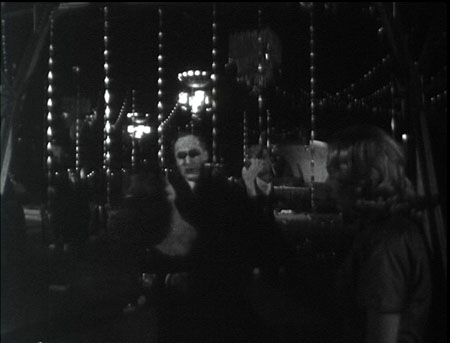
Still from Steppenwolf (1974)

BACKGROUND:

  • The movie was adapted from Nobel laureate Hermann Hesse’s classic 1927 novel Steppenwolf, which had been rediscovered and adopted by the 1960s counterculture because of its perceived revolutionary vision and apparent endorsement of free love and psychedelic drugs.
  • Michelangelo Antonioni (Blowup) was offered the chance to direct but turned it down because he thought the book was unfilmable.
  • This was the only film directed by Fred Haines.  He had previously been co-nominated for an Oscar for Best Adapted Screenplay for Ulysses (1967).
  • Co-producer and LSD-enthusiast Melvin Abner Fishman declared the Steppenwolf would be “the first Jungian film.”
  • The Czech artist Jaroslav Bradac created the wonderful animated sequence, “The Tractate on the Steppenwolf”; the artist Mati Klarwein (who was also responsible for classic album covers for Miles Davis and Santana) created the fascinating paintings that line the corridors of the Magic Theater.

INDELIBLE IMAGE:  For a movie that is so deliberately visionary, there’s not one single image that sticks out far above the others.  The most obvious choices are the images which show Harry simultaneously as a wolf and a man, a concept that is often chosen in numerous variations for covers of paperback editions of the novel.

WHAT MAKES IT WEIRD:  The heavy symbolism and feverish imagery of Hesse’s masterpiece, written while Freud and Jung’s theories of the unconscious mind were still novel and revolutionary, present some weird scenarios (such as Harry entering into dream debates with the ghosts of Goethe and Mozart). When this material is adapted through a 1974 lens, an era when cinematographers hadn’t yet come down from the LSD-inspired visual experimentalism of the late 1960s, it becomes even weirder. From the Magic Theater sequence on, Steppenwolf is truly trippy stuff.

Original trailer for Steppenwolf (1974)

COMMENTS: There’s a difficulty in reviewing movie adaptations of novels, in that the Continue reading 15. STEPPENWOLF (1974)

14. BLOOD DINER (1987)

“I mean, I don’t know how to describe it. But I just did. It’s just an insane f***in’ movie with insane parts. You’re watching it, it gives these curves that you didn’t see coming, until probably I just told you and showed you in the review. But it’s just I don’t even know how else to review it, you know, the, it’s just insane. It’s an insane f****in’ movie. Uncle Bill, you’re insane for liking it, and I’m insane for liking it too. It’s just insanity incarnate. But it’s a lot of fun.”–youtube fan review of Blood Diner

Beware

DIRECTED BY: Jackie Kong

FEATURING:  Rick Burks, Carl Crew

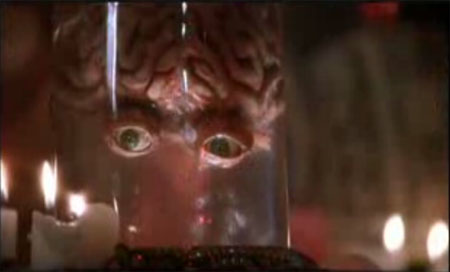
PLOT:  At the direction of their uncle Anwar, a talking brain in a jar, two restaurateur brothers assemble a vessel composed of body parts harvested from immoral women to receive the spirit of the ancient Egyptian goddess Sheetar.  They are opposed by a pair of mismatched cops and the owner of a rival vegetarian restaurant intent on stealing their secret recipe.  After many bloody murders, they must complete only the last ritual, a “Lumerian feast” where Sheetar will take the life of a virgin, along with the attendees at the banquet.

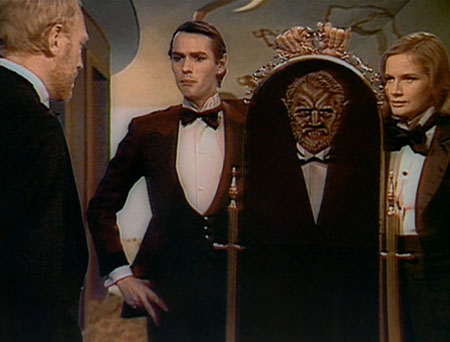
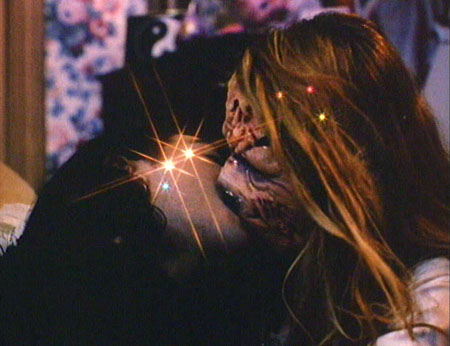
Still from Blood Diner (1987)

BACKGROUND:

  • Blood Diner was originally intended to be a sequel to Herschell Gordon Lewis’ transcendently bad Blood Feast (1963), but when the collaborators could not agree on a scenario the project was changed to a black comedy tribute in the spirit of Lewis’ movie
  • Blood Diner was originally banned in some Canadian provinces and in Iceland, and was heavily cut for release in other countries.

INDELIBLE IMAGE:  As drug-zombies rave and cultists in Egyptian dress attempt to channel the goddess into a stitched-together corpse, a punk band (composed of a singer in a Roman helmet, two backup singers in blue wigs, four sidemen dressed as Hitler and a pantomime horse roaming the stage) plays in the background.

WHAT MAKES IT WEIRD: Most movies featuring talking brains in a jar are weird, and Blood Diner is no exception.


Original trailer for Blood Diner

COMMENTS: There was little in female exploitation director Jackie Kong’s brief oeuvre to Continue reading 14. BLOOD DINER (1987)

13. KUNG FU HUSTLE (2004)

AKA Kung Fu, Kung Fu-sion

“It’s good to go over the line.  It’ll be boring if it doesn’t.  Following reality is not refreshing for me.”–Yuen Woo-ping, fight choreographer for Kung Fu Hustle

Recommended

DIRECTED BY: Stephen Chow

FEATURING: Stephen Chow, Qui Yuen, Wah Yuen, Siu-Lung Leung

PLOT: The Axe Gang, hatchet-wielding hooligans garbed in black-tie evening wear, terrorizes Shanghai in the 1930s. Only the poorest areas avoid falling under their thumb—neighborhoods like Pig Sty Alley, a tenement building where every other resident seems to have one-in-a-million kung fu powers.  When an incompetent ersatz gangster tries to extort protection money from the residents of Pig Sty Alley, he accidentally sets in motion a series of events that brings the Axe Gang into conflict with the poor fighters, with explosive results.
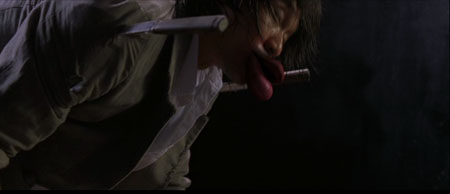
Still from Kung Fu Hustle (2004)

BACKGROUND:

  • Director Stephen Chow worked his way up from the trenches of the Hong Kong film industry, starting in television (including a stint as a children’s TV host). He became one of Hong Kong’s most popular comedians, specializing in a verbal style of comedy called “mo lie tau” (roughly, “nonsense”), which relies heavily on puns, wordplay, incongruities and non sequiturs. He began directing in 1994.
  • Chow’s previous film, Shaolin Soccer (2001), was supposed to be his breakthrough film in the West, but distribution was botched by Miramax and the picture became only a small cult hit on DVD.
  • Chow coaxed many older actors from the kung fu’s heyday out of retirement to star in major roles in Kung Fu Hustle. Qui Yuen (who played the part of “Landlady”) was one of the few female martial arts stars of the 1970s and had a small non-speaking role in the Bond film The Man with the Golden Gun. Wah Yuen (“Landlord”) has over one hundred acting credits, mostly from the late 1970s and early 1980s, and was at one time Bruce Lee’s stunt double. Siu-lung Leung (“The Beast”) was at one time considered third only to Bruce Lee and Jackie Chan as a martial arts star, and had been retired from the film business since 1988.
  • Kung Fu Hustle was the most profitable feature in Hong Kong cinema history. In its US theatrical run it opened as the #5 movie in the country and became the highest grossing foreign language film of 2005.

INDELIBLE IMAGE: There are so many memorable images in Kung Fu Hustle that it’s impossible to determine a consensus favorite.  The vision of two harpist assassins who strum their instruments to summon swords and warriors is a strong candidate, because their poetic menace draws a strong contrast to the lighter and less serious tone of the rest of the film.  Other contenders include the Axe Gang’s Broadway dance number, the Landlady’s whirling Road Runner legs, and a beatific Buddha in the clouds.

WHAT MAKES IT WEIRD: Kung Fu Hustle begins with a brutal and atypically realistic gangland slaughter on the neon-washed streets of Shanghai, and to celebrate gaining control of the city, the Axe Gang breaks into a carefully choreographed Busby Berkeley style fox trot, waving their tomahawks in the air. From this moment, the viewer realizes that they are in the hands of a maestro for whom reality is almost infinitely malleable, and who’s willing to switch cinematic styles at the drop of a hatchet to produce the effect he needs. Chow’s direction drives the movie through numerous stylistic incarnations, from absurd visual comedy through a ballet of breathtakingly beautiful and unreal violence, while quoting everything from Wong Kar Wai to The Shining and The Untouchables to Warner Brothers’ “Looney Tunes,” yet never loses its grip on the story or alienates the viewer with its madcap diversions.

U.S. release trailer for Kung Fu Hustle

COMMENTS:Kung Fu Hustle is likely to be the most commercially successful, mainstream Continue reading 13. KUNG FU HUSTLE (2004)

12. TROMEO AND JULIET (1996)

“Body piercing.  Kinky sex.  Dismemberment.  The things that made Shakespeare great.” –Tagline for Tromeo and Juliet

DIRECTED BY:  Lloyd Kaufman

FEATURING: , Jane Jensen, Lemmy, Debbie Rochon

PLOT:  Alcoholic Monty Que and unscrupulous Cappy Capulet have a long running feud dating back to their days as partners in a low-budget sleaze movie studio, and they have passed on their personal vendettas to the next generation.  Monty’s son, Tromeo, falls in love with Cappy’s daughter, Juliet.  The two young lovers must overcome the bloody gangland antics of their friends and family, Juliet’s upcoming arranged marriage to a self-mutilating meat-packing heir, and Cappy’s tendency to beat Juliet and lock her in a plexiglass box, among other crossed stars.

tromeojuliet

BACKGROUND:

  • Original drafts of the script had the parts played by costumed characters from other Troma studio releases: The Toxic Avenger, Sgt. Kabukiman, and so on.
  • Much of Shakespeare’s original dialogue was included in the rough cut, but most was removed after negative audience reaction.
  • Rock n’ roll cult figure Lemmy (of the band Motörhead) played the role of the narrator for free, and also donated the song “Sacrifice” to the soundtrack.  Several less famous bands also donated songs for free or for a nominal price.
  • Shakespearean actor William Beckwith played the role of Cappy Capulet under the pseudonym “Maximillian Shaun” because he was a member of the Screen Actor’s Guild and Tromeo and Juliet was a non-union film.

INDELIBLE IMAGE:  Many of the more memorable images in Tromeo and Juliet are too obscene to be depicted in stills.  The best sequence is when Juliet’s belly unexpectedly and rapidly distends and splits open to give birth to…  a surprise.

WHAT MAKES IT WEIRD: Redoing a classic Shakespearean tragedy as a low-budget, offensive farce is a promisingly weird, if obviously gimmicky, premise. Lloyd Kaufman and his Troma team were inspired by the concept, however, and put more creativity into the project than they did in their usual formula schlock fare. The typical Troma anarchy and bad taste reign again here, but the producers add a healthy dollop of bargain-basement surrealism (Juliet’s disturbing sex dreams) and some on-the-cheap arthouse effects (the lovemaking scene in a plexiglass box against a starry backdrop). The result is a movie that’s completely unpredictable, despite a plot known to every high schooler. Tromeo is revolting one moment, and oddly sweet and beautiful the next, an incongruity that only adds to the weird atmosphere.

Short promotional clip for Tromeo & Juliet

COMMENTS: Troma is a low-budget film producer/distributor formed in 1974 to promote Continue reading 12. TROMEO AND JULIET (1996)

11. JACOB’S LADDER (1990)

“Something weird is going on here.  What is it about us?  Even in ‘Nam it was always weird.  Are we all crazy or something?” –line in original screenplay to Jacob’s Ladder

Recommended

DIRECTED BY: Adrian Lyne

FEATURING: , Elizabeth Peña, Danny Aiello

PLOT:  Jacob Singer (nicknamed “Professor” by his army buddies due to his glasses and Ph.D.) is wounded in Vietnam after a harrowing, disorienting battle.  While he is on duty in Vietnam, his young son dies; years later, he works in New York City as a postman and has a sexy new girlfriend, Jezzie.  Jacob begins suffering flashbacks of the day he was wounded, along with hallucinations in which everyday people take on demonic forms—catching brief glimpses of tails, horns, and howling faces with blank features—and eventually discovers that the other members of his unit are experiencing similar symptoms.

jacobs_ladder

BACKGROUND:

  • The script for Jacob’s Ladder shuffled between Hollywood desks for years, impressing executives but not being viewed as a marketable project. The script was cited by American Film Magazine as one of the best unproduced screenplays.
  • Before he asked to direct Jacob’s Ladder, British director Adrian Lyne was best known for sexy, edgy, and profitable projects such as Flashdance (1983), 9 1/2 Weeks (1986) and Fatal Attraction (1987).
  • Screenwriter Bruce Joel Rubin (who later wrote Ghost [1990] and other commercial properties) says that his script was partly influenced by The Tibetan Book of the Dead.
  • Adrian Lyne states that some of the hellish visual cues in the film, including the whirring and vibrating head effect, were inspired by the woks of grotesque painter Francis Bacon.
  • Lyne deleted scenes and changed the ending after test audiences found the film to be too intense.

INDELIBLE IMAGE:  A blurred, whirring human head which shakes uncontrollably from side to side at tremendous speed, seen several times throughout the film.  The effect looks mechanical, as if the head were an unbalanced ball attached to an out-of-control hydraulic neck.  It was achieved by filming an actor casually shaking his head from side to side at four frames per second, which produced a terrifying effect when played back at the standard twenty-four frames per second.  The technique has been imitated in movies, video games, music videos, and even a porno flick since, but has never since been used to such fearsome effect.

WHAT MAKES IT WEIRD:  Like many psychological thrillers, Jacob’s Ladder strives to keep the audience disoriented and off-balance, wondering what is real and what is false. The movie achieves this effect wonderfully, but what gives it it’s cachet as a weird movie are two intense hallucination sequences: one at an horrifically orgiastic party intermittently lit by a strobe light, and one where the protagonist lies helpless on a hospital gurney as he’s wheeled down an increasingly bizarre and alarming hospital corridor. Both scenes are difficult to forget, equal parts creepy surrealism and visceral body-horror.

Original Trailer for Jacob’s Ladder

COMMENTS: I can’t watch Jacob’s Ladder without comparing it to Alan Parker’s Angel Heart.   The similarities are obvious: both were psychological thrillers with supernatural Continue reading 11. JACOB’S LADDER (1990)