Category Archives: Canonically Weird (The List)

10. ARCHANGEL (1990)

“And we are here as on a darkling plain

Swept with confused alarms of struggle and flight,

Where ignorant armies clash by night.”

Matthew Arnold, “Dover Beach” (quote originally intended to introduce Archangel)

Recommended

DIRECTED BY: Guy Maddin

FEATURING: , Kathy Marykuca

PLOT: In 1919, one-legged Canadian airman Lt. John Boles finds his way to the Russian port of Archangel in the endless night of Arctic winter. There, he meets Veronkha, whom he believes to be the reincarnation of Iris, his dead love. Veronkha has problems of her own, in the form of an amnesiac husband who wakes up every day believing this is the day they are to be wed, but Boles tries to woo her nevertheless as Archangel’s ragtag militia battles the Germans and the Bolsheviks without realizing that both World War I and the Russian Revolution are over.

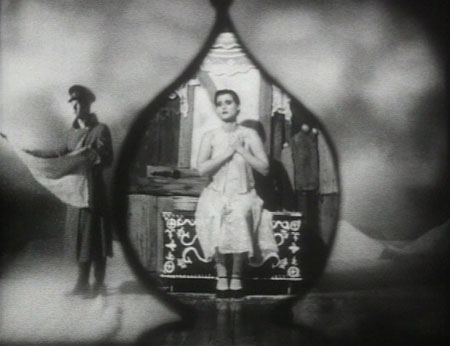
archangel

BACKGROUND:

  • The city of Archangel was the port of entry for Allied soldiers during World War I; therefore, soldiers from America, Canada, and the European allies might very well have been found gathered there (although probably not East Indians and Congolese, as depicted in the film). Many Allied soldiers were sent to Russia, partially to help assist the Imperial (White) Russians against the Bolshevik Communist rebels (Reds).
  • Some reports say that the version presented on the “Guy Maddin Collection” DVD is a different cut from the theatrical and original VHS version, with tinting and intertitles added. I haven’t been able to confirm whether differences exist.

INDELIBLE IMAGE:  As his dying act, a lifelong coward strangles a bestial Bolshevik with a length of his own intestine (which is obviously a sausage link).

WHAT MAKES IT WEIRD: The tale of an obsessive, grieving soldier who thinks he’s found the reincarnation of his lost love in a benighted Russian city where the citizens continue to fight a war that is over would be weird enough if told straight. Director Guy Maddin exaggerates the already dreamlike quality of this tale by clothing it in the archaic period dress of an early sound film, complete with intertitles describing the action, dubbed voices that are occasionally slightly out of sync, and casually disorienting jumps/glitches in the film. He pushes this inherently confusing story of terminally confused characters further into strange realms with deliberately surreal elements, such as women warriors going to the front dressed in elegant evening headwear, and even odder sights.

Short clip from Archangel (French subtitles not in original)

COMMENTS: The city of Archangel seems the perfect place to dream.  Isolated from the Continue reading 10. ARCHANGEL (1990)

9. HELP! HELP! THE GLOBOLINKS [HILFE! HILFE! DIE GLOBOLINKS] (1969)

“Headmasters never sing!” –line sung by the headmaster in Help!  Help!  The Globolinks

DIRECTED BY:  Joachim Hess, from a production of composer/librettist Giancarlo Menotti

FEATURING:  The Hamburg State Opera

PLOT:  In this children’s opera, the world has been invaded by bizarre alien creatures named Globolinks, who are allergic to music.  A bus full of children returning to boarding school breaks down in the middle of a lonely forest, and the students are surrounded by the alien creatures. Meanwhile, back at the school, the headmaster is infected by one of the aliens, meaning that he will soon turn into a Globolink himself.

globolinks

BACKGROUND:

  • Gian Carlo Menotti, the author of Help! Help! The Globolinks, was a well respected, Pulitzer Prize winning composer.  His most popular work is the Christmas opera Amahl and the Night Visitors, which was commissioned specifically to launch the “Hallmark Hall of Fame” television series, and which was shown annually in the United States on television during the Christmas season from 1951-1966.
  • Help!  Help!  The Globolinks, by contrast, was a flop and is rarely performed.  It is usually only mentioned in complete biographies of Menotti.
  • Menotti was a pioneer in adapting opera for telecast, and the film version of Help!  Help!  The Globolinks was originally shown on German television in 1968.

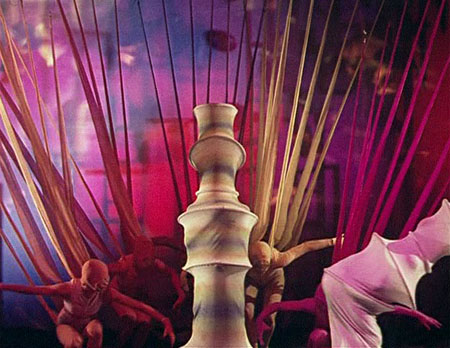
INDELIBLE IMAGE:  No doubt, it’s the Globolinks themselves (pictured above), who come in two varieties: one that looks like a wriggling rook from a chess set, and one that looks like an avant-garde ballerina dressed in a full-body dayglo bungee-jumping suit.

WHAT MAKES IT WEIRD:  A children’s opera about music-loathing aliens is already, presumptively, pretty weird.  But when the opera is made in 1968, at the height of the psychedelic sixties, and utilizes all the camera tricks, distorted electronic noises, and bizarre set designs Summer of Love filmmakers developed in an attempt to mimic the disorienting effects of LSD, there’s no more need for the presumption: we’re definitely caught in a very weird nook of film.

Scene from Help! Help! The Globolinks

COMMENTSHelp! Help! The Globolinks is one of the most obscure Continue reading 9. HELP! HELP! THE GLOBOLINKS [HILFE! HILFE! DIE GLOBOLINKS] (1969)

8. DONNIE DARKO (2001)

Gretchen: “You’re weird.”

Donnie: “Sorry.”

Gretchen: “No, it was a compliment.”

Must See (Theatrical Cut)

-or-
Recommended (Director’s Cut)

DIRECTED BY: Richard Kelly

FEATURING: Jake Gyllenhaal, , Mary McDonnel, , , Kathryn Ross

PLOT:  Troubled teen Donnie sees visions of a six foot tall demonic bunny rabbit named Frank, who demands that he commit acts of vandalism in a sleepy suburban town in 1988.  Donnie narrowly escapes a freak accident when a jet engine crashes into his bedroom after Frank has awoken him and called him away.  Frank tells Donnie that the world will end in 28 days, on Halloween night, and Donnie attempts to figure out what he can do to save the world while simultaneously dealing with a new girlfriend, bullies, a motivational speaker he sees as a cult leader, and ever-escalating hallucinations.

BACKGROUND:

  • This was the first feature film for writer/director Richard Kelly.
  • With Barrymore, Swayze and Ross attached, there was a tremendous buzz for the film going into the Sundance Festival.  The movie was not a hit at there, however, and was only picked up for limited theatrical distribution by Newmarket Films at the last moment.
  • Although Donnie Darko was initially a flop on its domestic release, a strong showing overseas helped it to nearly break even.  The film then became a cult hit on video, earning back more than double its production cost.
  • The director’s cut, containing about 20 minutes of extra footage and including pages from the fictional book “The Philosophy of Time Travel,”  was released in 2004.  It was controversial due to the added footage, which  caused some fans to complain that Kelly didn’t seem to understand his own movie.
  • Kelly created a website (now hosted at donniedarkofilm.com), which is structured like a puzzle.  Navigating the website can reveal supplemental material and backstory to the film.
  • Donnie Darko is one of the most talked about films on the Internet, with several competing fan sites and FAQ’s that attempt to clarify and explain the convoluted plot.
  • Followed by a poorly received direct-to-video sequel about Donnie’s sister called S. Darko (2009), which angered many fans.

INDELIBLE IMAGE: Frank, the six-foot tall man dressed in a twisted, metallic bunny suit, who only Donnie can see.

WHAT MAKES IT WEIRD: Donnie Darko at first appears to be a dizzying collision of genres, themes and ideas. For the first few reels of the film, the audience can have no conception where the film is heading. The director drops clues through these opening segments that appear at the time to be simply bizarre, but spark numerous “a-ha!” moments later, when incidents that seemed like throwaway moments or coincidences at the first glance turn out to make a sort of sense.  The identity of Frank, the demonic bunny, is the most thrillingly chilling such moment. Donnie Darko creates a sense of wonder and mystery throughout its running time, and sparks hope and faith in the watcher that all will be made clear before the curtain drops. It nests this expectancy inside a bed of genuine empathy for tormented Donnie and his colorful cast of supporting characters.  But perhaps the weirdest thing about Donnie Darko is that it asks us to take its plot at face value; it works very hard to try to convince us that what appear on the surface to be the hallucinations of a paranoid schizophrenic teenager are, in fact, real occurrences with a metaphysical explanation.

Trailer for Donnie Darko

COMMENTS: Even putting the mindbending plot aside for a moment (we’ll come back to Continue reading 8. DONNIE DARKO (2001)

7. EL TOPO (1970)

AKA The Mole (literal translation)

“Q: You’re creating this story right now.

A: Yes, this very moment. It may not be true, but it’s beautiful.”–Alejandro Jodorowsky in “Conversations with Jodorowsky”

Must SeeWeirdest!

DIRECTED BY:

FEATURING: Alejandro Jodorowsky

PLOT: El Topo, a figure dressed in black and carrying his nude son on horseback behind him, uses his supernatural shooting ability to free a town from the rule of a sadistic Colonel.  He then abandons his son for the Colonel’s Woman, who convinces him to ride deep into the desert to face off against four mystical gunfighters.  All of the gunfighters die, but El Topo is betrayed, shot, and dragged into a cave by a society of deformed people, who ask the outlaw turned pacifist to help them build a tunnel so they can escape to a dusty western town run by degenerate religious fascists.

el-topo

BACKGROUND:

  • El Topo is considered to be the first “midnight movie,” the first movie to be screened in theaters almost exclusively after 12 AM.  Although the heyday of the midnight movie has past, it was a clever marketing gimmick that stressed the unusual nature of the film and positioned El Topo as an event rather than just another flick.
  • El Topo was famously championed and promoted by John Lennon and Yoko Ono.
  • Due to an acrimonious dispute over ownership rights between Jodorowsky and Allen Klein, the film was withdrawn from circulation for 30 years, during which time it could only be seen on bootlegged VHS copies.  The scarcity of screenings vaulted El Topo‘s already powerful reputation into a legendary one.  Jodorowsky and Klein reconciled in 2004 and the film had a legal DVD release in 2005.

INDELIBLE IMAGE: El Topo is a continuous stream of unforgettable images; any frame chosen at random inflames the imagination.  My personal favorite is the lonsghot after El Topo kills third master gunfighter, where his body lies bleeding in his own watering hole while the rest of the landscape is littered with rabbit corpses.   The iconic image, however, is  El Topo riding off on horseback with a naked child sitting behind him, holding a black umbrella over his head.  This image is particularly representative because it shows not only Jodorowsky’s gift for composition, but his penchant for shamelessly borrowing from other sources of inspiration: the concept is pinched from the most surreal moment of Sergio Leone’s classic Spaghetti Western, The Good, the Bad and the Ugly.

WHAT MAKES IT WEIRD:  In the first scene, a man clad in black carrying an umbrella rides through an endless desert waste. Behind him in the saddle is a male child, naked except for a cowboy hat. The man stops his horse by a lonely hitching post in the sand, ties the umbrella to the post, and hands the boy a teddy bear and a locket and a photograph. The man says, “Today you are seven years old. You are a man. Bury your first toy and your mother’s picture.” He pulls out a flute and plays while the naked child follows his instructions. What makes El Topo weird is that this is the most normal and comprehensible thing that happens the film.

Trailer for El Topo

COMMENTS: In Judges 14, Samson (the Hebrew version of Hercules) is attacked by a Continue reading 7. EL TOPO (1970)