Category Archives: Capsules

CAPSULE: THE TEN (2007)

DIRECTED BY: David Wain

FEATURING: , Winona Ryder, , Famke Janssen, , A.D. Miles,

PLOT: A series of short comedic stories, each inspired by one of the Ten Commandments.

Still from The Ten (2007)

WHY IT WON’T MAKE THE LIST: It has a few bizarre moments, but The Ten is nowhere near consistently weird enough to number among the 366.

COMMENTS: It’s both easy and difficult to review an anthology movie like The Ten. There are ten mini-movies, so going in you realize that there are inevitably going to be hits and misses, and that spread over ninety minutes the quality is likely to average out. Actually watching the movie is just a matter of confirming that there’s neither exceptional brilliance or exceptional incompetence at work here, and that the whole does indeed converge towards the predicted mean. Although the segments span some stylistic territory, including one obscenely animated Commandment, there are more similarities than differences. Scripted by two of the co-creators of the MTV sketch comedy show “The State,” the pieces here don’t have a “short film” feel so much as a “TV sketch” sensibility, only with mild blasphemy, cuss words and (way too many) jokes about prison rape added to take advantage of the fact there are no advertisers to alienate. The sketches all begin with an absurd premise—a woman is erotically obsessed with a ventriloquist’s dummy, Jesus has returned for the Second Coming but is procrastinating about starting the rapture, a clueless doctor has a dimwitted excuse for killing one of his patients—and then develops it for seven to nine minutes before moving on to the next segment. Two of the ten stories are done in a radically different style. One is a spot-on parody of a -style scene involving urbane ex-lovers meeting on a Manhattan street. Then there’s the weirdest bit, an X-rated animated sequence (recalling Fritz the Cat) involving depraved anthropomorphic animals, including a heroin-dealing rhino who inexplicably poops flowers, ending in an interspecies orgy. The framing device involves a narrator whose domestic problems keep spilling over into his introductions, and the movie ends with the entire cast singing a musical recap (“I introduced each story, there were ten, you couldn’t have missed ’em/I was surrounded by gigantic prop tablets, but I didn’t heed their wisdom…”) To make The Ten seem less disjointed, some of the main characters from one tale play a supporting role in other stories. All of the sketches are irreverent, but there isn’t a consistent satirical outlook across the entire movie, and so the “Ten Commandments” hook never becomes more than a gimmick. The connection between the gag and the illustrative Commandment is often stretched; for example, “thou shalt have no God before me” inspires a silly spoof on celebrity worship. The writers managed to draw major talent to the project: Wynona Ryder features prominently in two of the stories, the late Ron Silver shows up in an actor’s dream vengeance role as a talent agent, Jessica Alba appears as a bimbo, and Oliver Platt gets the movie’s best bit as an impressionist who specializes in doing a mediocre Arnold Schwarzenegger (although it’s better than his Eddie Murphy). But despite the infusion of name-value movie stars, The Ten remains televisionesque; it’s missing that extra “oomph” needed to justify feature film status. Basically The Decalogue re-imagined as a grossout sketch comedy series, The Ten is sporadically amusing, but non-essential viewing.

Written by David Wain and Ken Marino, alumni from MTV’s minor cult hit “The State,” and featuring many of that series’ regulars, The Ten might have been banking on “State” fans showing up a decade after cancellation for what almost amounted to an uncensored reunion show. That didn’t happen, as the film debuted to tepid reviews and went on to recoup less than a million dollars of its $5.2 million budget at the box office.

WHAT THE CRITICS SAY:

“…a series of stone-tablet-based short films — from the gross to the surreal to the certifiably nuts… A ‘Decalogue’ for special-ed students, ‘The Ten’ leans too often toward the bizarre and the bewildering.”–Jeanette Catsoulis, The New York Times (contemporaneous)

(This movie was nominated for review by Kallisti, who conceded it “might not be the weird you’re looking for but it’s worth watching.” Suggest a weird movie of your own here.)

CAPSULE: KILL LIST (2011)

Recommended

DIRECTED BY: Ben Wheatley

FEATURING: Neil Maskell, MyAnna Buring, , Harry Simpson, Emma Fryer

PLOT: Jay the hitman, out of the game and down on his luck, takes up a new contract with his partner Gal to help support his wife and young son. As they start knocking people off a “Kill List,” Jay finds the targets challenging his principles, his relationships, and eventually, his grip on reality.

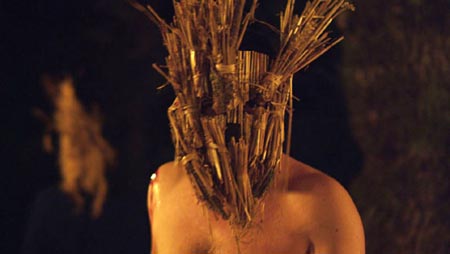
Still from Kill List (2011)


WHY IT WON’T MAKE THE LIST: Though it will be of great interest to art-house audiences and fans of weird movies, the film doesn’t take as many risks as it would like to claim. It’s full of symbolic echoes and studied ambiguity, but there are no outright challenges to our expectations or sensibilities.

COMMENTS: Kill List is an excellent genre-hopping horror thriller, full of smart directorial choices and technical chops. The atmosphere is both sanitized and gritty, in that special way you find in cinema verite, and the sense of dread and instability is overpowering. Jay is sometimes sympathetic and sometimes terrifying, and Neil Maskell nails the role in all its variation. When the violence comes, it’s brutal and unflinching, with no glorification, and in this violence, you get the most striking indication that Neil is dangerously damaged.

The film shows its technical merit early, with a succession of domestic scenes that allow us a rich sense of the main characters and their relationships. Jay is stuck in the inertia of unemployment after a bad experience in the army and a job that apparently went south in Kiev. His relationship with his wife is rocky, but not doomed, and if you were coming into Kill List with no expectations whatsoever, you could be forgiven for expecting Jay to go through a dramedy-style self-discovery that ends with the renewal of his marriage. During these opening scenes, you get moments of genuine tenderness, especially between Jay and his son. Jay becomes a great father when he spends time with Sam; furthermore, his friendship with Gal Continue reading CAPSULE: KILL LIST (2011) →

CAPSULE: DORORO (2007)

Recommended

DIRECTED BY: Akihiko Shiota

FEATURING: Satoshi Tsumabuki, , Kiichi Nakai

PLOT: A pickpocket follows a mysterious man on his quest to kill 48 demons—each of who

Still from Dororo (2007)

owns one of his body parts.

WHY IT WON’T MAKE THE LIST: It’s an oft-enthralling adventure with a fairy tale flavor, but it’s not strange enough for the List. Much of what, to the Western viewer, seems “weird” in Dororo is simply culture shock from seeing unfamiliar Japanese folkloric creatures (yōkai) on screen.

COMMENTS: Despite being picked up by Universal for home video distribution, Japan’s Dororo has been slow to find an audience in the West; this is a shame, as this picaresque demon-hunting epic should be counted among the upper ranks of 21st century fantasy adventures. Adapted from a series by manga god Osamu Tezuka, the mythic setup involves a ruthless daimyo who offers forty-eight demons the body parts of his unborn child in exchange for victory over his enemies. After the spirits have extracted their pounds of flesh, the child—a limbless, eyeless torso—is set adrift on a river in a basket and is eventually discovered by a sympathetic herbalist. À la Dr. Frankenstein, the shaman builds the boy a new body out of parts he scavenges from corpses; à la Mr. Miyagi, he then trains him in the arts of combat. Once this fairy tale-style prologue is finished, the film settles into a new groove, as wandering warrior Hyakkimaru sets out to reclaim his stolen body parts from the scattered demons. Tagging along is Dororo, the self-proclaimed best thief in the world (even her name is stolen); she’s waiting to grab Hyakkimaru’s demon-slaying sword the moment he’s slain his last enemy. Many battles with creatively designed but questionably CG-ed creatures follow (how does the one that’s half walking tree, half cherry-blossom-spitting doll’s head grab you?), until the pair of travelers stumble across the evil daimyo, against whom both have sworn revenge. With shape-shifting spirits, crossed loyalties, and samurai duels, Dororo contains just about everything you would want in an Asian fantasy adventure. The New Zealand locations provide beautiful, timeless landscapes for the actors to play against. Some clunky SyFy-level CGI aside, Dororo features thrilling action scenes and fight choreography that makes restrained use of wire-fu. But it’s the Platonic chemistry between the stoic hero and his comic relief, hand-drum beating sidekick—and their obsessive devotion to complex notions of honor, and to each other—that makes the movie touch the heart as much as it milks the adrenal glands. It doesn’t hurt that the fantastic premise accommodates exotic set pieces, including a talking mouse corpse, fetus-like flying goblins hovering around a tank containing a boy’s submerged body, and a giant spirit baby composed of the restless souls of slaughtered orphans. Dororo may not be Weird with a capital “W”, but it’s offbeat enough to catch your eye, and lovely enough to keep it trained on the screen. And hey, in what other movie can you watch a samurai kill a winged demon while flamenco music plays?

With many of the demons Hyakkimaru needed to kill to regain his original body still left undefeated at the end of Dororo, the end credits promised sequels; unfortunately, nothing has materialized to date. One feature of Dororo (at least in the movie’s Netflix streaming incarnation) that is wholly unsuccessful is its experimental subtitles. Instead than appearing in the expected location at the bottom of the screen, they show up in the left part of the frame—and, even worse, they’re extremely tiny. If you don’t believe me, then look at the still accompanying this review: it contains subtitles. Can you find them?

WHAT THE CRITICS SAY:

“The ‘48 body parts taken by demons, 48 fights to win them back’ tagline may appear an introduction to little more than absurd sequential ultra-violence, but Dororo takes the time to effectively establish its premise, ensuring a surprisingly solid verisimilitude to the world it inhabits and the proceedings therein.”–Joe Green, Total Sci-Fi Online (DVD)

(This movie was nominated for review by “Cthulhu.” Suggest a weird movie of your own here.)

CAPSULE: @SUICIDEROOM (2011)

Sala Samobójców, AKA Suicide Room

DIRECTED BY: Jan Komasa

FEATURING: Jakub Gierszal, Agata Kulesza, Krzysztof Pieczynski, Roma Gasiorowska-Zurawska

PLOT: When a spoiled rich boy is mocked after an embarrassing high school incident publicly reveals his homosexual desires, he retreats into a virtual world, a community called “suicide room” full of teens trying to work up the courage to kill themselves.

Still from @suicide room (2011)

WHY IT WON’T MAKE THE LIST: The hallucinatory virtual reality episodes that look like video captures from “Sims 3: Depressed Emo Kid Expansion Pack” add a novelty and curiosity factor, but @suicideroom isn’t weird at its core: it’s an earnest look at teen depression and suicide.

COMMENTS: Call it a gimmick if you must, but @suicideroom‘s animated sequences are the drawing card rather than a distraction in this teen depression drama. Without the virtual reality wrinkle, this Polish import would play a bit like a suicide-prevention after-school special with a budget, complete with almost comically uninvolved, clueless parents and an appropriately over-emoting tortured teen. The backstory is simple enough. Dominik is handsome, popular and privileged. He’s already got a date for the prom and a private chauffeur supplied by his absentee parents. He’s got everything a slightly-Bieberish looking kid could want, and is the last guy in his class who you’d expect to suffer from depression—but after a male-on-male dare-kiss goes viral, he quickly goes from heartthrob to pariah. And here’s where things get a little strange. Dominik retreats to his room, where after thrashing about a bit and beating his mattress in despair, a chat window pops up on his laptop and invites him to join an online community. After personalizing his avatar he finds himself set loose in an impossibly detailed virtual nightclub, chasing a comely toon with pink hair; they go to video chat and he meets Sylwia, a weepy blonde shut-in wearing a plastic mask who is also the proprietress of the “Suicide Room.” Sylwia is both a character in the real-life story and a symbol of the romantic allure of youthful melancholia; there is a mysterious, allegorical feel to her unlikely online recruitment/seduction of Dominik. Once Dominik is initiated into the secret suicide society, any pretense that this is a real virtual community disappears; the impossibly fluid and responsive world of Suicide Room follows the rules of an animated cartoon, not the clunky mechanics of online community like World of Warcraft. Characters fight ridiculously complicated anime-inspired duels seen through multiple angles and split-screens, sail over oceans of polygonal waves, and turn into howling banshees when they get angry. What we see is the online world as embellished by Dominik’s imagination, a wired existence that’s realer and more appealing to him than the harsh realities of the world outside his door. The stylistic strategy could be described either as “virtual magical realism” or “digital Expressionism.” Whatever you call it, it may be in fact too successful, since whenever we’re following Dominik’s “real” story we’re always looking forward to our next trip inside the dreamlike magical box for a peek at what the electronic pixies have been up to in our absence. Unfortunately, nothing good can last, and Dominik’s return to the real world when his Internet is pulled ends in tragedy, and with a phone number for a suicide prevention hotline. It’s not entirely clear whether the director means to criticize social media for encouraging isolation from the real world and allowing the spread of dangerous ideas like suicide-promotion support groups, or whether its prominence in the story simply reflects teen reality at this point in history. Regardless, such musings add a bit more interest to this well-intentioned, semi-successful, slightly odd drama that may resonate with the younger crowd.

While it’s a worthwhile watch, @suicideroom is a tough movie to market outside of its native Poland. In the U.S.A., emo went out of style in November 2011, exactly one year after silly bandz, and even the most depressed American teenager would watch that Katy Perry movie before tuning in to a subtitled Polish film with opera on the soundtrack.

WHAT THE CRITICS SAY:

“…helmer-writer Jan Komasa overplays his hand… ultimately creating an unsympathetic protagonist whose fate doesn’t inspire much interest… Replete with bizarre avatars, the pic’s slick animated segments convey the feeling of being inside an online sword-and-sorcery game.”–Alissa Simon, Variety (contemporaneous)

CAPSULE: MAY (2002)

DIRECTED BY: Lucky McKee

FEATURING: , ,

PLOT: A girl with a lazy eye grows up as a social outcast with a doll as her only friend; she gets corrective lenses as a young adult and is suddenly set loose on the dating world with no social skills and a dangerously loose grip on reality.

Still from May (2002)
WHY IT WON’T MAKE THE LIST: May, the character, is weird as hell; May, the movie, not as much, especially after it abandons the awkward character study of its first two thirds for a familiar slasher denouement.

COMMENTS: It’s easy to see why so many people relate to May. The film’s horror isn’t based on remote external threat of ravening psychos harvesting body parts, but on the uncomfortable internal reality of human loneliness. Angela Bettis, who strokes a stranger’s hand as he naps and grins inappropriately when she tells a story about a disemboweled dog, makes for an unforgettably awkward and desperate May. She can’t even stand up straight; she’s always quivering and tottering on her feet, a woman who can’t find a stable footing in the social world. Her “lazy eye” affliction, which is suddenly cured by modern advances in contact lenses, is a brilliant device to explain how this otherwise attractive girl could have grown up so gawky and socially damaged.

For this script’s purposes, May can’t just be a common fat ugly cow who never gets a second look. She can’t just be constantly rejected by everyone she meets, sitting alone in her room night after night talking to her doll Sally; she needs to be desirable and attractive enough to have potential paramours to play off of. She gets a terrific pair in an amateur horror director played by Jeremy Sisto, whose fascination with the macabre leads him into a dangerous flirtation with this creepy character, and in Anna Farris’ predatory lesbian party girl, who thinks she’s as kinky as May but has no concept of what it’s like to be genuinely twisted. The early reels show geeky May impressing a date with a home cooked meal of mac and cheese and Gatorade and trying to decide what to do when the guy doesn’t call her back after she misreads his social cues and wrongly assumes he’s into cannibalism. This part of the movie is excellent and uncomfortable; we genuinely root for the pathetic girl to find true friendship, while at the same time being relieved we’re not the ones who have to supply it.

Bettis plays May like a female Travis Bickle, but when she finally cracks, it’s the movie that loses it. All of May’s endearing, ungainly mannerisms suddenly fall aside as she becomes a confident killer enacting a weirdo’s revenge fantasy against the cool kids. The more competent and dangerous she becomes, the less creepy she is. What had been an engagingly freaky character study suddenly bows to psycho movie kill conventions, and we spend the last third of the movie just watching the secondary cast get slashed. Although the final scene restores May’s vulnerability and is gruesomely memorable, it doesn’t redeem the movie’s sin of abandoning its freak spirit for horror movie conventionality.

May is more of a “weirdo” movie than a “weird” movie; there are only a few scenes—blind kids crawling on glass, May crying blood, and a schizophrenic crack-up montage—that break with narrative realism in any meaningful way. It’s an above average horror outing sporting superior performances, but it’s not a revolutionary genre movie, and given the film’s socially ghoulish first two thirds, there is a sense of a missed opportunity to do something truly special. “I like weird, a lot,” says one of May’s would-be seducers. The joke is that he’s merely a tourist observing human oddity for a lark, and he’s not prepared to handle sincere, dangerous weirdness on May’s level. To some extent, the same thing can be said for the film; it’s fascinated by its weird character, but it’s not interested in descending into the ultimate depths of depraved weirdness.

The May DVD includes two separate commentaries, each hosted by director Lucky McKee but featuring different cast and crew members. The second commentary includes reminiscences by May‘s craft services provider (i.e. the film’s caterer), which turns out to be a funny concept (he reveals the secret to Jeremy Sisto’s heart—jalapeno poppers—and explains how you supply jujubees to a set on a non-existent budget).

WHAT THE CRITICS SAY:

“A bizarre (and sometimes repulsive) exercise that’s a little too willing to swoon in its own weird embrace.”–Robert Denerstein, Denver Rocky Mountain News (contemporaneous)

(This movie was nominated for review by “Br.” Suggest a weird movie of your own here.)