Category Archives: List Candidates

LIST CANDIDATE: FANDO Y LIS (1968)

Weirdest!

DIRECTED BY: Alejandro Jodorowsky

FEATURING: Sergio Kleiner, Diana Mariscal

PLOT: Fando carts and carries his paralyzed lover Lis across a ravaged landscape searching for the legendary city Tar.
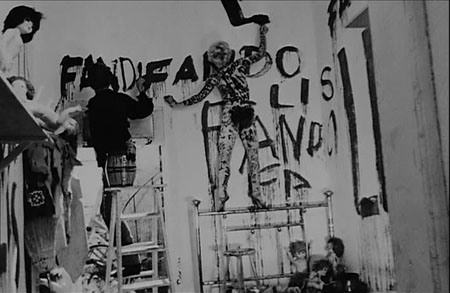
Still from Fando y Lis (1968)

WHY IT MIGHT MAKE THE LIST: If you’ve ever seen a Jodorowsky movie before, you know what to expect. Fando y Lis is a parade of fantastical, shocking imagery, including snakes that penetrate a baby doll and a man who begs for blood (he extracts a donation with a syringe and drinks it from a brandy snifter). That said, Fando & Lis is one of the least of Jodorwosky’s works, an early curiosity that is thoroughly weird, but not strongly conceived enough to make the List on the first ballot. (Plus, Jodo’s so well-represented here already we don’t feel at all bad about the possibility of leaving one movie off).

COMMENTS: Fando y Lis begins with a woman eating flowers while a siren wails. Later we will learn she is the paraplegic Lis, whose lover Fando will cart her across a bizarre post-apocalyptic landscape searching for the mystical city of Tar. Along the way they encounter a man playing a burning piano, mud zombies, a transvestite parade, and a gang of female bowlers led by a dominatrix, among other absurdities. There will also be flashbacks to both Fando and Lis’ childhoods, and unrelated fantasy sequences of the actors goofing around (posing in a graveyard, and painting their characters’ names on each other). And there’s quite a few more transgressions, both beautiful and clumsy, to be found in this rambling, overstuffed avant-garde experiment. Although Jodorowsky comes from an older bohemian tradition, at times Fando y Lis plays like something made by Mexican hippies, improvising scenes with random props in between hashish tokes.

The “spiritual journey” structure makes for an episodic film, but the ideas aren’t as stunningly realized or obsessively detailed as The Holy Mountain. Here, Jodorowsky has found, but not perfected, his unique voice: it’s as if he’s working with individual sentences, rather than complete paragraphs. It would have helped the movie feel more coherent and unified if the relationship between Fando and Lis was better done, but their dynamic is unpleasant. They unconvincingly profess eternal love for each other, but Fando is much better at conveying his irritation and annoyance at having to carry Lis everywhere, while her character is reduced to desperate, pathetic whining for most of the film.

In 1962 Jodorowsky, Fernando Arrabal and , feeling that Andre Breton and the old guard Surrealists had lost their edge and were no longer extreme enough in their embrace of absurdity, founded the Panic movement, which was mostly an experimental theater group. Fando & Lis was originally a play from this school, written by Arrabal and staged by Jodorowsky. This movie adaptation is not intended to be faithful; Jodorowsky instead described it as based on his memories of the play. When Fando y Lis premiered at the Acapulco Film Festival in 1968 it caused a riot (presumably due to its abundant nudity and mildly sacrilegious content) and was subsequently banned in Mexico. The film basically disappeared for years. Discovering Jodorowsky in the early 90s, when his films were only available in bootleg VHS versions, I was unaware that he had made a movie before El Topo; Fando wasn’t even a filmography entry. It wasn’t until 2003 that a DVD of this early work suddenly popped up.

WHAT THE CRITICS SAY:

“… pothead vaudeville all the way… A tumultuous cause celebre at festivals, it paved the way for the director’s rise from small-time poseur to big-time poseur with El Topo a few years later.”–Fernando F. Croce, Cinepassion

(This movie was nominated for review by “Zelenc” who called it a “must see film.” Suggest a weird movie of your own here.)

LIST CANDIDATE: STREET OF CROCODILES (1986)

DIRECTED BY: ,

FEATURING: Feliks Stawinsky

PLOT: After being brought to life by a spit-and-blood activated machine, a gaunt puppet explores a dreary landscape of smeared windowpanes, cryptic machines, and wraith-like tailors, simultaneously observing and observed by a young boy.

Still from Street of Crocodiles (1986)

WHY IT MIGHT MAKE THE LIST: Not content simply to be staggeringly creepy, the Quay brothers imbue this masterpiece of decayed memory with a great deal of pathos and philosophy. From any given screen-capture, it’s easy to see why this movie would be considered weird—watching this cloud of nightmare in motion is simultaneously unnerving, moving, and awe-inspiring.

COMMENTS: This stop-motion film opens with the unlikely use of a lecture hall and an actor counting ceiling lights before activating an apparatus. Drawing up a globule of spit, he lets the liquid drop inside the machine, setting off the first of the unsettling devices found throughout Street of Crocodiles. The film’s protagonist, a shabbily well-dressed man, begins bound by the wrist to a cord attached to a bell before the actor uses a pair of scissors installed in the converted kinetoscope. Once loosed from the ties that bind him, the suited puppet begins navigating his dark surroundings.

Like a reticent explorer, he warily observes machines, gated pathways, and windows to bizarre figures. Behind one is a barely humanoid figure that emits one of the few bright lights in the movie. Judged by his design and actions, this automaton seems to be an inventor of some sort, and he labors away. As the man continues to explore, his environment slowly starts dismantling itself. Screws come undone from the paneling and begin moving across the floor. A young boy, perhaps representing the man’s childhood, merrily travels around the dank cityscape, harnessing the inventor’s light with a pocket mirror, bringing objects to life with its beam. Things come to a muted crescendo when the man comes across a tailor’s shop along the dim street below a crocodile skeleton.

The Quay brothers capture so much in this tiny but unlimited world. The viewer sees things in frame, only to find a moment later that what he is seeing is a reflection (in some cases, a reflection of a reflection). The micro-cosmos created here is both stifling and vast, as if no matter how far the man may explore, he is still trapped, unable to break free and get a larger picture of the mystery around him. Eventually he discovers where his life went sideways after a literally transformative encounter with the tailors, the only entities who seem at home in this murky subconscious. Through them, we see the allure of a commercial world and the high price paid for succumbing to it.

Stephen and Timothy Quay interpret Bruno Schulz’s gritty memoir “Street of Crocodiles” with a combination of smeared perspective and macro-lensed attention to detail. Schulz’s source material is filtered through the Quay’s vision of pervasive but fungible memory. Much is explored during the scant 21-minute run-time, but its brevity is wholly counter-balanced by its depth, both literally and metaphorically. As the man’s world in the movie is folded uncomfortably on itself, Street of Crocodiles explores its subject matter with a compact precision that belies its length. After watching this, I felt that the twenty minutes may well have been hours. So goes time in the dream world. This film must be seen to be believed: my words are almost utterly incapable of parlaying the direct line the Quay brothers have with the subconscious world.

WHAT THE CRITICS SAY:

“… an ambient horror film in the vein of Eraserhead.”–Jake Cole, Movie Mezzanine

LIST CANDIDATE: BLIND WOMAN’S CURSE (1970)

Recommended

DIRECTED BY: Teruo Ishii

FEATURING: Meiko Kaji, Hoki Tokuda, Makoto Satô, Tatsumi Hijikata

PLOT: A female yakuza leader blinds an enemy in a sword fight, then years later is hunted by a blind woman seeking revenge.

Still from Blind Woman's Curse (1970)

WHY IT MIGHT MAKE THE LIST: Blind Woman’s Curse is an odd stir-fry of yakuza, samurai and ghost story genres with psychedelic seasoning. It’s also a good example of how Japanese genre films of the period had every bit of the style and technical prowess of their arthouse competitors like Kurosawa and Ozu, giving it a good outside shot at making the List.

COMMENTS: Teruo Ishii made Blind Woman’s Curse at Nikkatsu Studios only three years after the studio fired for making the “incomprehensible” yakuza pic Branded to Kill. Curse is not quite as bizarre as Suzuki’s notorious film, but it suggests that by this time the studio heads may have lightened up on their aversion to pop-surrealism—as long as the film in question also contained ample bloodshed, tattoo flaying, and a duel between sexy swordswomen. Still, the colorful, hallucinatory carnival sequence in the film’s first act may have raised some suit’s eyebrows: cat women in bikinis crawl on a bamboo roof, an old man fishes doll parts out of a hot wok, and a hunchback hops around while a woman simulates copulation with a dog wrapped in the Japanese flag. Other elements that smear the film with a disreputable weirdness include a blood-licking ghost cat, a thug in a thong, and a topless opium-smoking scene shot from under the floorboards.

But, besides the tangy surrealism, Curse‘s biggest asset is Meiko Kaji (the future Lady Snowblood) in one of her earliest leading lady roles. Kaji only sports one expression in this movie, but it’s a great one: dread wrapped in a mantle of determination. She’s beautiful, graceful, and handles a sword as well as she does a song (she sings the theme song). Kaji has an undeniable presence, and it’s no surprise she went on to cult stardom. She has a male counterpart in Makoto Satô, a wandering mercenary with a taste for justice, but the men are subsidiary here, relegated to subplots or secondary villains. Kaji’s primary antagonist (setting aside the black cat that stalks her) is Hoki Tokuda as the blind swordswoman; her stoic countenance is striking in a very different way from Kaji, making for a mythic contrast in the morally ambiguous final showdown. The incestuous mixing of genres, the arthouse technical skills combined with exploitation sensibilities, and the under-the-radarness make Blind Woman’s Curse a wet dream.

Blind Woman’s Curse was supposedly the third entry in Nikkatsu’s “Rising Dragon” series, although it’s a thematic connection only since the first two entries featured a different actress (Hiroki Ogi) with a different character name. Ishii also directed the first in the series, Rising Dragon’s Iron Flesh (1969).

WHAT THE CRITICS SAY:

“Ishii keeps the film straddling the border—quite successfully—between bizarre, surreal horror film and period yakuza tale.”–Chris D., “Gun and Sword: An Encyclopedia of Japanese Gangster Films 1955-1980”

LIST CANDIDATE: TWICE UPON A TIME (1983)

Recommended

DIRECTED BY: John Korty, Charles Swenson, Bill Couturié (“adult” version)

FEATURING: Voices of Lorenzo Music, Marshall Efron, Judith Kahan, James Cranna, Julie Payne, Hamilton Camp,

PLOT: With the help of a fairy godmother and a blundering superhero, two dreamland misfits try to stop the wicked Synonamess Botch from detonating nightmare bombs.

Still from Twice Upon a Time (1983)

WHY IT MIGHT MAKE THE LIST: The mix of a crazy dream/fairytale plot with luminous cutout animation that often evokes surrealist collage landscapes—the cartoon characters might find themselves inside a clock that looks like a Leonardo da Vinci notebook page, on a frozen beach with body parts sticking out of the sand, or attacked by office supplies—makes Twice Upon a Time a one-of-a-kind oddball adventure. The legendary backstory involving the film’s longtime unavailability, kid-unfriendly profanity, competing versions, and accusations of censorship (which turned out to be reverse censorship) doesn’t hurt Time‘s cult credentials, either.

COMMENTS: Coming out during Disney’s nadir, when cartoon features were out-of-fashion, Twice Upon a Time was simultaneously a throwback and an innovation. The movie was painstakingly animated through the never before (or since) used process of “Lumage,” where plastic cutouts are placed on a light table and filmed. The process makes the cutouts seem to glow at times, as well as creating planes that impart a weird three-dimensionality to the images. The effect has been compared to stained glass, although the movie’s soft palettes are more reminiscent of gently glowing pastel watercolors. Besides the immensely detailed painted backdrops, the cartoon characters of dreamland also frequently tromp on top of black and white stills representing the “real” world. The resulting work comprises shots of extreme beauty (the shadowy, tiered towers of Murkworks, contrasted with the construction-paper chaos of Frivoili) and wit (the camera pulls back to reveal that the hedges the villains are trotting through form a skull and crossbones, and the submersible tottering on top of a pile of junk is surely a tribute to stylistic precursor Yellow Submarine).

Structurally, the narrative can be charitably described as anarchic, with archetypal characters who are as two-dimensional as the plastic cels they’re made from. Our misfit heroes, a shape-shifting “all-purpose animal” and a mute esque Tramp, are joined by a Jewish fairy godmother (“FGM” for short), an aspiring actress, a superhero with a learner’s permit, and other jokey stock characters. Opposing them is nightmare tycoon Synonamess Botch (with “Nixon & Agnew ’68” tattooed on his chest), his fleet of  vulture bombers, a pet rat (presciently named “Ratatouille”), and “head scream writer” Scuzzbopper. Together, the opposing sides war for dominance in the minds of the monochrome denizens of our world, know to them as the “Rushers of Din” (as accurate a three-word summary of modern humans as I can imagine).

Many find the plot, which involves the necessity of stopping time by stealing a piece of a cosmic clock, confusing; but although the setup may be rushed, it falls far short of being truly baffling. Some very bad, rejected-for-a-Rocky-sequel 80s pop music over the credits detracts from the project’s artistic credibility, but helps fix it in its era. Despite minor reservations, Twice Upon a Time is a great, overlooked, imaginative oddity that is well worth rediscovering. It’s so strange that it’s hard to believe executive producer George Lucas ever gave the project his blessing (although it’s easy to see why Mr. Blockbuster didn’t champion it after it breezed through theaters, making barely a ripple in the public consciousness).

Twice Upon a Time‘s “censorship” flap merits an explanation. Per director John Korty, the story is that after the movie bombed, producer/screenwriter Bill Couturié  re-recorded some of Marshall Efron’s dialogue with “dirty” jokes (what today would amount to PG-13 rated scatology, mostly), with the studio’s blessing but without Korty’s knowledge or approval. The intent, apparently, was to re-position the flop as a cult movie for high school and college-aged kids. This “dirty” cut of the film originally played on HBO; when Korty discovered the fact, he supplied the network with the “clean” masters, which they then started airing. Angry viewers assumed that HBO had re-edited the film to remove the profanity and make it kid-friendly. Actually, it was a case of reverse-censorship: the racy material was inserted into the original to spice it up, not removed to appease the bluenoses. (And there was some mild profanity in the “clean” version, too). I prefer Korty’s cut (I don’t find fart noises all that funny), but they are not very different (the two versions are more than 95% identical). Still, the idea of a “blue” variation of an animated children’s movie is titillating. Wouldn’t it be a treat if studios went back and re-recorded a profane version of every flop kids’ movie?

WHAT THE CRITICS SAY:

“…in all honesty, it is never boring. Strange, confusing and color-convulsing, yes. Dull, never.”–Mike Watt, “Fervid Filmmaking“

LIST CANDIDATE: SOME CALL IT LOVING (1973)

AKA: Sleeping Beauty; Dream Castle

DIRECTOR: James B. Harris

FEATURING: , Tisa Farrow, Carol White, Richard Pryor, Veronica Anderson, Logan Ramsey, Pat Priest, Brandy Herrod

PLOT: Based on the John Collier short story “Sleeping Beauty.” A hedonistic millionaire, entranced by a carnival act involving a girl who has been asleep for years, purchases her and brings her home.

Still from Some Call It Loving (1973)WHY IT MIGHT MAKE THE LIST:  Far stranger than the synopsis would suggest, Some Call it Loving is a surreal, dreamlike take on relationship dramas. A precursor to the modern erotic thriller, it would make for an interesting double feature paired with Boxing Helena, or even Singapore Sling.

COMMENTS:  The entire genre of the “erotic thriller”—from such highlights as 9 1/2 Weeks, the steamy cable series “Red Shoe Diaries,” and Eyes Wide Shut all the way down to the low-level late night chum on Cinemax (or Skinemax, as it was nicknamed due to its reliance on such fare)—shares primary DNA with the not-as-well-known early precursor Some Call It Loving. Lead actor Zalman King would make it a cottage industry in the 80s and 90s, co-writing and producing 9 1/2 Weeks and directing Wild Orchid, Two Moon Junction and episodes of “Red Shoe Diaries” (the series he created), among others.

King’s character here, Robert, lives in a mansion with two women, Scarlett (White) and Angelica (Anderson). The three pass the time by indulging in role-playing “games” (seducing a widow, disciplining the maid, dancing nuns) that always lead to sexual situations. The only times Robert ventures into the “real world” is when he gigs as a session player with a jazz group at a bar and has conversations with his friend Jeff (Pryor), a musician who’s fallen into hardcore junkiedom.

During one of these excursions he goes to a carnival and discovers the “Sleeping Beauty,” Jennifer (Farrow), as a sideshow attraction, drugged to remain asleep. Patrons pay for one kiss to wake the Beauty—and more, it’s strongly implied. Robert decides to purchase her to take her back with him. Robert returns with Jennifer, who is accepted into the household; when she awakens, she’s also incorporated into the game-playing. But does this lead to a Happy Ending for all?

Although is provides the seed for later erotic thrillers, Loving can’t actually be classed as one. Instead, it’s a dark, fractured fairy tale in line with its source material (John Collier’s treatment of the “Sleeping Beauty” legend). In the story, the emphasis is on the man who purchases the Beauty. That holds true in Harris’ adaptation as well, but he goes further and deeper than Collier.

At the outset, Robert appears to be a “kept” man. Scarlett seems to be the wealthy benefactor, with Angelica being a recent addition to the family, and it appears that this setup has been in effect for some time. But while some may find this to be a fantasy come true, Robert is dissatisfied. His conversations with Jeff provide him with some distraction, but Jeff’s descent insures that he won’t be around for long.  Robert’s malaise is relieved by Jennifer’s arrival, but only for a short time. At first she enjoys the company and the game-playing, but it ends up in further dissatisfaction.PryorEtiquette Pictures, the uptown division sub-label of Vinegar Syndrome, made Loving their debut release in a Blu-Ray/DVD package in Summer 2015.  Done in a 2K restoration from the original negative, this is the best Loving has looked in any of its prior home video releases. Numerous extras are included, such as a commentary with writer/director Harris, a featurette on the making of the film, one on cinematographer Mario Tosi (Carrie, The Stunt Man), and outtakes featuring actress Millie Perkins, whose role was cut from the finished film.

Writer/director James B. Harris was ‘s producing partner for his early films The Killing, Paths of Glory and Lolita.