All posts by Bryan Pike

268. DEAD ALIVE [BRAINDEAD] (1992)

Known as Dead Alive in North America, Braindead elsewhere

“You know what they are saying about you don’t you? You’ve got funny in the head! A real bloody weirdo!”–Roger, Dead Alive

Recommended

DIRECTED BY:

FEATURING: Timothy Balme, Diana Peñalver, Elizabeth Moody, Ian Watkin, Stuart Devenie

PLOT: An explorer discovers a Sumatran “Rat-Monkey” on Skull Island; the creature is safely housed in a Wellington zoo. The animal escapes and bites Lionel’s overbearing mother, who becomes a zombie and infects anyone she comes across. Lionel then juggles the advances of the local shop owner’s daughter Paquita and the machinations of his blackmailing uncle with the zombies mounting in his basement.

Still from Dead Alive (Braindead) (1992)

BACKGROUND:

  • Written before the controversial puppet black comedy Meet the Feebles, but filmed afterward. This was the first script co-written with longtime Jackson collaborator and partner Frances Walsh. The story originated with the third credited co-writer, Stephen Sinclair, who originally conceived of it as a stage play satirizing New Zealand society.
  • Partly funded by taxpayer dollars through the New Zealand Film Commission.
  • The film won Best Screenplay at the New Zealand Film and Television Awards in 1993. It won Best Film (and Best Special Effects) at the 1993 edition of the Fantasporto Film Festival for genre pictures.
  • Released as Braindead in New Zealand, Australia, and other countries, but as Dead Alive in North America to avoid confusion with the practically identically titled 1990 horror film Brain Dead (directed by Adam Simon).
  • The uncut version was banned for extreme violence in several countries, including Finland, Singapore, and South Korea.
  • Came in it #91 on Time Out’s 2016 poll of the greatest horror movies.

INDELIBLE IMAGE: The Grand Guignol finale where Lionel cuts down a horde of zombies with a lawnmower. Three hundred liters of fake blood were used in this scene.

THREE WEIRD THINGS: Sumatran Rat-Monkey; zombie baby; the Lord’s ass-kicker

WHAT MAKES IT WEIRD: From the seemingly benign and placid surface of 1950’s New Zealand society, director Peter Jackson spews forth undead geriatrics consuming German Shepherds, amorous zombies who impregnate each other, sentient viscera, oedipal vaginal imagery on an epic scale, and an inexplicable excursion to the local park with a zombie baby. The invention and gory slapstick of this film are comparable to a Looney Tunes episode where Wyle E. Coyote falls into a spool of razor wire. Or perhaps the antics of and the Keystone Cops defending themselves from an undead invasion after ingesting speed-balls.


Original trailer for Dead Alive

COMMENTS: I fondly remember Braindead from my 1990’s adolescence, days of VHS and weekends spent with friends, trying to outdo Continue reading 268. DEAD ALIVE [BRAINDEAD] (1992)

LIST CANDIDATE: COLLECTIVE: UNCONSCIOUS (2016)

DIRECTED BY: Lily Baldwin, Frances Bodomo, Daniel Patrick Carbone, Josephine Decker, Lauren Wolkstein

FEATURING: Will Blomker, Ryan Cassata, , Tonya Pinkins

PLOT: In this experimental compilation, five filmmakers adapt each other’s dreams into short films.

WHY IT MIGHT MAKE THE LIST: As both a film depicting dreams and as a formal experiment, the project presents a pressing case for inclusion on the list of the weirdest films ever made. There are a number of arresting images within this film and some truly bizarre moments.

COMMENTS: Dreams have always proved a tantalizing subject for filmmakers. Arriving from the unfettered unconscious mind with surreal imagery and associations to codify our thoughts, feelings and memories, dreams have forever enticed filmmakers to realize these bewildering experiences on screen. However, translating this phenomenon presents a number of challenges. One is budgetary, because of the opulent settings and fantastical creatures that can be found in a dream. Another is sensory: despite film’s ability to engross us it remains an outside object, never as immersive as the internal, subjective experience of dreaming.

Successful translators of the experience, such as , recognize the limitations of film immersion and focus on pacing and juxtaposition of image and sound to recreate the atmosphere and “feel” of dreams. Surrealism as an artistic movement is deeply tied to the unconscious and dreams, so it is hardly surprising that one other successful interpreter is Surrealist filmmaker , who overcame budgetary restraints through jarring combinations of everyday objects and people in unconventional ways.

Film compilations also come with their own separate challenges. Unless there is a strong through line each segment will have a different tone and pace, and invariably some episodes will be more satisfying than others. Throw in some deeply personal dreams as subject matter and you could have a hotchpotch of cinema that doesn’t gel together as a whole. Despite the technical sophistication and invention of each filmmaker—none of whom are familiar to me, so I can’t comment on the clash/serendipitous mix of subject and filmmaking styles within—I’m afraid this is the case here.

The film opens with its linking device, a man addressing the camera and attempting to hypnotize us, luring us to sleep and imploring us to lower our resistance, as dream logic demands. It is an effective device to prep us for the experience, if, like most wraparounds, narratively weak on its own. There follows some pretty if perfunctory animation from Maya Edelman before the film begins proper with arguably its most successful segment, “Black Soil, Green Grass,” directed by Daniel Patrick Carbone from a dream by Lauren Wolkstein. Combining Lynch and Buñuel’s techniques, it successfully creates a surreal, dream-like atmosphere through unusual juxtapositions of the everyday: a watchtower that inexplicably pipes a recording of a man counting sheep through loudspeakers, a man encircled Continue reading LIST CANDIDATE: COLLECTIVE: UNCONSCIOUS (2016)

CAPSULE: KNIGHT OF CUPS (2015)

DIRECTED BY:

FEATURING: , , , Brian Dennehy, Wes Bentley

PLOT: A successful, hedonistic screenwriter lost in the indulgences and vacuity of Hollywood searches for love and meaning.

Still from Knight of Cups (2015)

WHY IT WONT MAKE THE LIST: While Malick’s approach to cinema remains characteristically unconventional, despite the philosophical narration and existential questions, the film still charts as a fairly standard dramatic narrative.

COMMENTS: “To be a philistine or not to be a philistine?” That is the question that troubles reviewers when approaching the films of Terrence Malick. When a film maker is consciously addressing questions such as the meaning of life –a question in which every person on this planet has a stake—if the reviewer’s response isn’t positive, they can find themselves asking the questions: did the film not speak to me because it was poorly executed, or because the message was over my head? Is it a load of pretentious rubbish, or did I simply not get it?

All questions of framing, scripting and pacing aside, the answer––particularly when it comes to films that address existential concerns like those of Malick, or —is always subjective. The film either meant something to you, or it didn’t. (I am thinking of this site’s controversial review for Possession, a film I personally loved but which the reviewer hated). Where I saw a visceral film with an impassioned performance from and unsettling, demonic imagery depicting a relationship imploding, the reviewer saw a pretentious, vapid stream of hollow images. Technique aside—which thankfully isn’t so subjective and can be argued—the film either spoke to you, or didn’t.

Did Knight of Cups speak to me? To perfectly honest, no. Does this mean I simply didn’t “get it”? Possibly, but again, considering how subjective a film experience is, not to mention how subjective and open-ended Malick’s images are, does it matter? Every filmgoer brings their own meanings to a film based on their own experiences, very often bringing associations that are far removed from the filmmaker’s original intent, if they’re even prepared to talk about that (and we all know how Malick has addressed this question: radio silence). Is Cups a load of pretentious rubbish? Again, the question of meaning-making is entirely dependent on the viewer. I was able to find meanings and recurring messages in the film, even if I didn’t particularly respond to the actual film experience.

So what is Cups about? On the surface, this is a straightforward tale of a successful screenwriter Rick (who doesn’t do a lick of actual writing in the film, mind you), who experiences inertia and nihilism among various mansion parties and trappings of Hollywood. He has relationships with six women, including his ex-wife (Cate Continue reading CAPSULE: KNIGHT OF CUPS (2015)

LIST CANDIDATE: SYMBOL (2009)

Shinboru

DIRECTED BY:

FEATURING: Hitoshi Matsumoto, David Quintero, Luis Accinelli

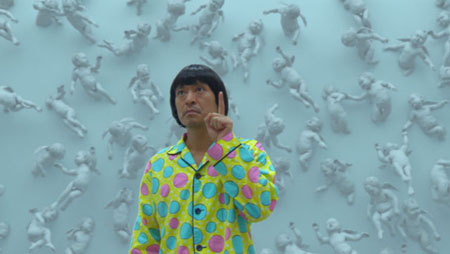
PLOT: A Japanese man wakes up in an enormous white chamber whose walls and floor are littered with cherubic phalluses; meanwhile a Mexican luchador, “Escargot Man,” prepares for a wrestling match.

Still from Symbol (2009)

WHY IT MIGHT MAKE THE LIST: The main narrative, following the action in the white room, is so absolutely removed from reality it demands a place on the List, while the Mexican wrestling scenes remain incongruous and weirdly exotic throughout.

COMMENTS: It’s difficult to talk about why Symbol is so arresting and oddly rewarding without spoiling details of the story or the reveals near the film’s end. Suffice to say the two seemingly unrelated narratives come together in a most unexpected and ridiculous way, and the torture experienced by the Japanese protagonist in the white room leads to a truly transcendent revelation by the film’s end.

The film is structured under three headings: “Learning, Practice and Future.” Learning refers to the rough education the Japanese man receives in the white room from the mischievous owners of the Cherubic phalluses, while the particulars of Practice and Future I’ll leave viewers to discover on their own.

Much of the early joy of the film involves watching Matsumoto interact with the white room and the objects released therein, seeing his mounting frustration at the “bait and switch” as the Cherubs deliver alternately helpful or useless items. They give him an endless stream of sushi rolls, but no soy sauce until after he’s eaten the very last one; 3D glasses direct him to press a particular button, only to have an enormous Cherub behind break wind on him. Another scene sees him releasing an endless pile of chopsticks before he finally presses a different phallus, sending an office trolley careening into his shin. This comedic torment in the vein of silent film comics like or Harold Lloyd continues until Matsumoto recognizes a means of escape…only to be led to earth-shattering alternatives.

There is very little to fault in this film; from its production values to its execution it is equally unique, vibrant and visually arresting. The pacing is surprisingly jaunty for an episodic film, and it actually rewards a re-watch to see how all the various threads build towards the film’s close. Some viewers may find the ridiculous payoffs a little too surreal to be satisfying; to them I can only recommend the consolation to be found in the philosophical treatise “In Praise of Silly,” the book never written by comedian Mike Myers’s father, who believed silliness “was our natural state, and we only get serious to get to silly.” Symbol contains moments of textbook Japanese cinematic weirdness.

A possible weak element of the film (other than two unnecessary moments of flatulence humor) could be identified in Matsumoto’s performance; while his timing is excellent and he works as a hapless, unassuming everyman, his constant screaming is often irritating. A more skilled slapstick performer like , Lee Evans or Rowan Atkinson could have made the physical comedy transcendent and ballet-like rather than merely solid and amusing. This is a rare case where I would not mind a U.S. remake.

I know little about director and star Matsumoto, other than he is one half of a comic duo—the boke or “funny man” of a team called “Downtown”—on Japanese television, just like his contemporary Takeshi “Beat” Kitano (Hana-bi, Violent Cop) was at the beginning of his career. The comparison to Kitano is apt due to the similar career trajectory the two men have followed, although Matsumoto only has four feature film directorial credits to his name and none of the Kitano’s international recognition—at least for the time being. Also, from a cursory YouTube glance, Matsumoto’s TV persona appears to be that of a histrionic, put-upon weed (the character he develops here follows a similar vein) whereas Kitano’s comedy always came from his role as bully.

WHAT THE CRITICS SAY:

“…one of the most bizarre, impenetrable films of the year. That doesn’t mean it is not funny, intriguing and visually impressive, just don’t expect to come out being anything less than baffled.”–Owen Van Spall, “Eye for Film” (contemporaneous)

(This movie was nominated for review by many people, but “Roy” was first when he advised us in 2010 “You gotta check out this flick ‘Symbol’ by the director of Big Man Japan.” Suggest a weird movie of your own here.)

CAPSULE: THE FEAR OF DARKNESS (2014)

DIRECTED BY: Christopher Fitchett

FEATURING: Penelope Mitchell, Maeve Dermody, Aaron Pederson

PLOT: A young psychologist treats the suspect in a bizarre murder case and confronts a dark supernatural force in the girl’s unconscious.

Still from The Fear of Darkness (2014)

WHY IT WON’T MAKE THE LIST: The only weird aspect of this horror film is the supernatural force of darkness. Otherwise this follows the naturalist form of the crime psychological thriller.

COMMENTS: If you believe in string theory, then in some parallel universe this film got all of its elements right and rose above the mediocre offering here. It probably even won an Oscar. First off, the alternate universe screenwriters would have researched the particulars of psychology rather than the Googled armchair-shrink efforts on display here—especially the vague experimental practices employed by Dr. Sarah Faithful to elicit trauma and screaming from murder suspect Skye Williams. Faithful’s Dr./cop friend defends these practices to unnerved observers with a dismissive “I trust her, she knows what she’s doing”.

Secondly, the producers would’ve hired a competent director who doesn’t pander to the hackneyed jump-scares that we’ve all seen a million times before, and who has a vision for the film beyond perfunctory soap opera camera set-ups and dark corners where special effects lurk. The kind of director who would have lifted the performances of seemingly credible actors, and who doesn’t make a genuine talent like Aaron Pederson look like he’s a year out of acting school. Again, screenwriters who deliver non-perfunctory dialogue would have assisted everyone in this department.

Through this combination of clever screenwriting and solid direction, tension would have been built and the audience would care about either Faithful or William’s fates, so that the M. Night Shyamalan-like twist ending of invented identity would hit home and register as deeply in the minds of the audience as the darkness is said to exist in Skye’s mind. Sadly we have no way of viewing that phenomenal parallel universe version of The Fear of Darkness, we only have the sad, wholly unremarkable version that exists in ours. Save yourself from the theoretical angst of “what could have been” and seek genuine scares in films like The Exorcist or The Haunting in Connecticut, films that succeed on their own terms rather than relying on the necessity of an infinite multiverse.

WHAT THE CRITICS SAY:

“…as sinister and surreal concepts earn increasingly frequent mentions, reminding audiences that all is not as it appears, the film relishes its foreseeable twists as much as it does its formulaic conventions.”–Sarah Ward, ArtsHub (contemporaneous)