All posts by Gregory J. Smalley (366weirdmovies)

Gregory J. Smalley founded 366 Weird Movies in 2008 and has served as editor-in-chief since that time. He is a member of the Online Film Critics Society, and his film writing has appeared online in Pop Matters and The Spool.

OSCAR WON’T, AND IF CANNES CAN’T, MAYBE MEXICO?

We almost never pay attention to the Academy Awards around these parts. When the weirdest film to get a “Best Picture” nomination in 2008 is The Curious Case of Benjamin Button, you know you’re dealing with one weird-hating Academy. The last film “Best Picture” winner with even smatterings of weird was Midnight Cowboy (1969). Just a pinch of weirdness, or even a mild, sub-weird flirtation with the experimental, is usually the kiss of death to Oscar.

The international and less commercial-minded Cannes Film Festival, on the other hand, has been much kinder to innovation in film. In 2000 Lars von Trier’s Dancer in the Dark managed to win the highest prize, the Palme d’Or, despite containing musical dream sequences.  Acknowledged weird classics like Wild at Heart (1990) and Barton Fink (1991) have also managed to break realism’s stranglehold on the top awards.

On May 24, 2009, Cannes announced the recipients of its jury prizes.  Let’s see how Cannes did in recognizing cinematic weirdness this year:

PALME D’OR:  The White Ribbon [Das weiße Band].  Black and white film set in Germany on the eve of World War I.  The synopsis says, “Strange accidents occur and gradually take on the character of a punishment ritual.  Who is behind it all?”  Although it appears to have a weird element in the form of an unsolvable mystery, at heart it looks like a standard allegorical art film.

GRAND PRIX (I.E., PALME D’OR RUNNER UP):  The Prophet [Un Prophete]:  An illiterate young Arab man is thrown into a French prison and becomes a gang kingpin.  Sounds about a weird as a plastic couple on a wedding cake.

JURY PRIZE (I.E., THIRD PLACE):  This year was a tie.  The first film recognized was Fish Tank, an unweird drama about a British teenager, her promiscuous mom, and her mom’s lout of a boyfriend.  The second awardee shows a little more promise: Thirst [Bakjwi], Chan-wook Park‘s take on the vampire legend, although reviews suggest the oft-weird director takes a conventional approach to the subject this time out.

OTHER FILMS IN COMPETITION:  A few interesting, potentially weird films were screened Continue reading OSCAR WON’T, AND IF CANNES CAN’T, MAYBE MEXICO? →

22. ERASERHEAD (1977)

“He showed me this little script he had written for Eraserhead.  It was only a few pages with this weird imagery and not much dialogue and this baby kind of thing.”–Jack Nance

Must SeeWeirdest!

DIRECTED BY: 

FEATURING: ,

PLOT:  Henry is a factory worker living in a dingy apartment in a desolate urban nowhere. His girlfriend Mary’s mother informs him the girl has given birth to his child—although Mary objects, “Mother, they’re still not sure it is a baby!” Henry and Mary get married and care for the monstrous, reptilian, constantly crying infant until Mary can take no more and deserts the family, leaving Henry alone to care for the mutant and to dream of the oatmeal-faced woman who lives inside his radiator and sings to him about the delights of heaven.

eraserhead

BACKGROUND:

  • Eraserhead was started with a $10,000 grant from the American Film Institute while Lynch was a student at their conservatory. Initially, the 21 or 22 page script was intended to run about 40 minutes. Lynch kept adding details, like the Lady in the Radiator (who was not in the original script), and the movie eventually took five years to complete.
  • When Lynch ran out of money from the AFI, the actress Sissy Spacek and her husband, Hollywood production designer Jack Fisk, contributed money to help complete the film. Fisk also played the role of the Man in the Planet.
  • Lynch slept in the set used for Henry’s apartment for a year while making the film.
  • After the initial screening, Lynch cut 20 minutes off of the film. Little of the excised footage survives.
  • Eraserhead was originally distributed by Ben Barenholtz’s Libra Films and was marketed as a “midnight movie” like their previous underground sensation, El Topo (1970).
  • Based on the success of Eraserhead, Lynch was invited to create the mainstream drama The Elephant Man (1980)  for Paramount, a huge critical success for which he received the first of his three “Best Director” nominations at the Academy Awards.
  • Jack Nance had at least a small role in four other Lynch movies, and played Pete Martell in Lynch’s television series, “Twin Peaks.”  His scenes in the movie adaptation Twin Peaks: Fire Walk with Me (1992) were deleted. Nance died in 1997 after being struck in the head in an altercation at a doughnut shop.
  • Lynch has written that when he was having difficulty with the direction the production was heading, he read a Bible verse that tied the entire vision together for him, although he has refused to cite the verse and in a recent interview actually claims to have forgotten it.
  • Winner of this site’s 2019 Mad Movie Tournament as the most popular weird movie ever made.

INDELIBLE IMAGE: The iconic image is Henry, wearing that expression permanently lodged between the quizzical and the horrified, with the peak of his absurd pompadour glowing in the light as suspended eraser shavings float and glitter behind him. Of course, Eraserhead is nothing if not a series of indelible images, so others may find the scarred man who sits by the broken window, the mutant infant, or the girl in the radiator to be the vision that haunts their nightmares.

WHAT MAKES IT WEIRD: Eraserhead is probably the greatest recreation of a nightmare ever filmed, a marvelous and ambiguous mix of private and cosmic secrets torn from the subconscious. Or, as Lynch puts it, it’s “a dream of dark and disturbing things.”


Clip from Eraserhead

COMMENTS:  When you tell people you are interested in “weird” movies, I’d wager at least half Continue reading 22. ERASERHEAD (1977) →

SHORT: THE THREATENED ONE (1999)

threehalfstar

DIRECTED BY:  Signe Baumane

PLOT: An impressionistic interpretation of a Jorge Luis Borges poem featurning a bunny rabbit, a fox, a man and a woman.

The Threatened One: Rated PG-13 for cartoon bosoms and symbolic sex


WHAT MAKES IT WEIRD:  The dreamlike imagery, especially the flower that ejaculates flowers.

COMMENTS:  Baumane worked with Bill Plympton (who gets a thank you shout in The Threatened One‘s credits) on I Married a Strange Person! The two animators seem to be kindred spirits: they share a “squiggly” style of animation, where even the still frames move and breathe, as well as an absurd sense of visual humor.  The Threatened One adopts a drawing style reminiscent of a children’s book (only with a sea of blood and topless scenes) to illustrate Borge’s bittersweet poem about the consuming power of love.  Love is depicted as a predator, a toothy fox, but having your fleshed ripped by it’s fangs doesn’t seem like such a horrible fate in the end. The short is witty and whimsical, and David Rovin’s music punctuates the atmosphere perfectly. The only slight complaint is that the narrator’s reading, while competent, isn’t as inspired as the rest of the production.

The Threatened One is available on the collection Ten Animated Films by Signe Baumane. More information can be found on Signe Baumane’s website.

WHAT THE CRITICS SAY:

“For Borges and Baumane, love triggers the death of the individual.”-Chris Robinson, Unsung Heroes of Animation

CAPSULE: THE TOXIC AVENGER (1984)

DIRECTED BY: Lloyd Kaufman & Michael Herz

FEATURING: Mitchell Cohen

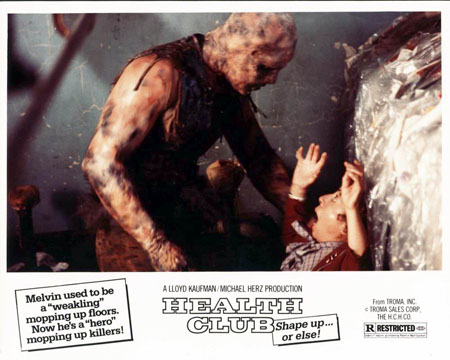
PLOT:  A nerdy teen janitor is tormented by his serial killer peers until he accidentally

Promotional card for The Toxic Avenger (1984) under it's working title, Health Club

falls into a vat of toxic waste and emerges as a mop-wielding, avenging mutant superhero.

WHY IT WON’T MAKE THE LIST: When a movie about a mutant janitor who fights transvestite thugs and, to add insult to injury, presses his wet mop into their heads after he disembowels them can’t find a place on a list of weird movies, you know you’re searching for a very refined brand of weirdness indeed.

COMMENTS:  The Toxic Avenger has just enough craziness going on to make it watchable, but it’s not nearly the classic its cult reputation might suggest. Although an absurd thread runs throughout to keep it sporadically interesting, its sniper-like focus on chesty chicks and cheesy kills keeps it squarely locked in on its target audience of males under 25. Others will find the goofy spoofery seldom funny and often offensive (for example, the hit and run killing of young boys and racial minorities for sport). There are few laugh-out-loud moments for grown-ups, although a scene in the middle of a crime-fighting montage where superhero Toxie helps a housewife with a stubborn jar lid does elicit a chuckle. The centerpiece hostage scene at a restaurant tells you all you need to know: a gang of robbers wearing performance art greasepaint burst in, shoot a blind girl’s seeing-eye dog, and prepare to sodomize her when Toxie arrives. Our hero fights a battle against a gangster with ninja skills who grabs a samurai sword off the wall (of a Mexican restaurant?), and in the end the mutant dweeb gruesomely and painfully dispatches them with a milkshake machine and a deep fryer. It’s a fantasy of nerd revenge against the upper crust of high school society, as Toxie dismembers obnoxious jocks (a justified act, since like all popular people, his tormentors are inhuman monsters who like to mow down kids in their cars and masturbate to the gory Polaroids afterward). The movie invites us to identify with and cheer for Toxie as, Michael Meyers-like, he stalks and kills half-naked girls (who are, of course, evil, and deserve to be dispatched for the good of Tromaville). Ultimately, this Columbine-esque wish fulfillment, where the beleaguered kid not only kills his bullies but becomes a beloved celebrity and gets the girl, creates a subtext that’s far more offensive than any of child killings or the pre-teen white slavery ring Kaufman and Herz try to shock us with.

The Toxic Avenger‘s blend of horror-movie gore, gross-out offensiveness, proudly lowbrow comedy, and absurd touches struck a nerve in the 1980s, when it bypassed the normal movie distribution channels to become one of the first cult videocassette hits. It was so successful that Troma studios has been remaking this same film, under a variety of titles, for the last 25 years.

WHAT THE CRITICS SAY:

“Like Airplane! for the antisocial set, or a Grimms fairytale gone horribly, horribly wrong, this weird-ass peek into the past proves that some high concepts are indeed eternal.”–Bill Gibron, DVD Talk (21st Anniversary DVD)

ARTSPLOITATION – THE BASTARD OFFSPRING OF “BLOOD OF A POET” AND “SEX MANIAC”

Every knows what “exploitation” films are: films that deliberately appeal to audiences baser nature, and try to lure in viewers with the promise of sex, nudity, violence, and moral degeneracy.

When a film tries to appeal to an audience’s higher nature, to their intellect and aesthetic sense, but at the same time promises plenty of sex, nudity, violence, and moral degeneracy, then you have an “artsploitation” film.

Not all art films which deal with sex or include nudity or violence qualify as artsploitation films.  There needs to be some gratuitous or sensationalist element to merit the “-ploitation” suffix.  There’s little truly exploitative about the way sex is treated in Sex and Lucia, for example; sex is a natural part of the character’s relationship and there are good plot and thematic justifications for each coupling.

Although the “artsploitation” genre can’t be reduced to a simple recipe, and does not necessarily involve remaking some sort of recognized formula film in an arty way, as a first step at identifying the category, here’s a short list of some art films that also fit neatly into a recognized exploitation film sub-genre:

  • EL TOPO (1970) = arthouse + Spaghetti Western
  • THE DEVILS (1971) = arthouse + nunsploitation
  • LIQUID SKY (1982) = arthouse + science fiction
  • GOTHIC (1986) = arthouse + horror
  • LAIR OF THE WHITE WORM (1988) = arthouse + horror
  • SANTA SANGRE (1989) = arthouse + serial killers
  • THE THIEF, THE COOK, HIS WIFE & HER LOVER (1989)= arthouse + gross-out cannibal film
  • DELLAMORTE, DELLAMORE [CEMETARY MAN] (1994) = arthouse + zombie film
  • KIDS (1995) = arthouse + juvenile delinquency
  • NOWHERE (1997) = arthouse + juvenile delinquency + drugsploitation + sci-fi B-movie

Another simple way to identify an artsploitation film: look for the name “Ken Russell” under director.

Exploitation films, which used to play at drive-ins, fleapits and grindhouses, and are now often released directly to video, are considered “trash cinema,” and distinguishable both from mainstream films and from art-house films.  They began as early as the 1930s, when Hollywood’s Hays Code created a lucrative gray market for films dealing with forbidden subject matter like prostitution, drug abuse, and revenge killings.  Cheaply made films such as Reefer Madness [Tell Your Children] (1936) (the famously campy anti-marijuana flick), Child Bride (1938) (which dealt with the “serious” problem of child marriage among hillbillies by having a 12 year old girl perform nude scenes), and Mom and Dad (1945) (which advertised itself as a “hygiene” film and showed the birth of an illegitimate baby in graphic, gaping detail) quickly stepped in to take advantage of Hollywood’s shyness about sex.  An alternative, parallel cinema of forbidden delights Continue reading ARTSPLOITATION – THE BASTARD OFFSPRING OF “BLOOD OF A POET” AND “SEX MANIAC” →