Tag Archives: Road movie

IT CAME FROM THE READER-SUGGESTED QUEUE: MARUTIRTHA HINGLAJ (1959)

AKA Hinglaj, The Desert Shrine

366 Weird Movies may earn commissions from purchases made through product links.

DIRECTED BY: Bikash Roy

FEATURING: Uttam Kumar, Sabitri Chatterjee, Anil Chatterjee, Pahari Sanyal, Bikash Roy

PLOT: A young man and woman are rescued in the desert by a group of pilgrims of various castes and faiths. 

Still from MARUTIRTHA HINGLAJ (1959)

COMMENTS: Movies about religion run similar dangers to those from any long-running franchise. Built as they are around a deep canon embraced by a particularly ardent regiment of hardcore fans, the producers must satisfy the expectations of devotees while extending an outreach to any potential converts. It’s hard to be all things to all people, especially when you’re relying on the moral rectitude of the universe.

Marutirtha Hinglaj, however, is not concerned with appealing to the unenlightened, and that’s honestly to the film’s benefit, because we heathens can appreciate the pilgrims’ passion and determination at face value. An understanding of the apparent tolerance between the Hindus and Muslims on the dangerous trek, familiarity with the unique powers of redemption granted by the goddess Durga, and even the finer points of why highborn girls aren’t supposed to run away with street-rat boys are all concerns you can set aside with this movie. Hinglaj is perfectly legible as a study of the human quest for forgiveness and emotional peace, no matter how much turmoil is required to achieve it. Christian travelers to Lourdes or even rock fans making the trip to Jim Morrison’s grave can relate.

The film was based on a popular travelogue of the time, and if we were just following this group as they made their way through the desert, it would be a fairly straightforward accounting of the journey. Director Roy’s major contribution to the narrative is the introduction of the forlorn couple whom the marchers rescue from the wastelands. Thirumal is a poor fortune teller tasked with predicting the future for well-off bride-to-be Kunti. They fall madly in love (the initial transgression) and then elope (compounding the problem), which is when tragedy finds them. Roving bandits attack the couple, robbing them and assaulting Kunti, a crime that they view as punishment for their earlier wrongdoing (a frustrating instance of culturally approved victim-blaming that is probably the most inexplicable belief for a 21st-century audience). It’s a lamentable fate, not least because Roy crafts a charming montage of the illicit pair’s moneymaking ventures on the road, demonstrating their overwhelming charm as he plays music while she dances. Thirumal beams with rapturous love for his wife, but we also start to see his palpable jealousy at onlookers’ attention, which foreshadows the madness that will soon overtake him as he pivots between passion and faith.

It is difficult but essential to understand the moral code on display here. The conditions for the march across the Indian wasteland are maddeningly difficult, but of course the challenge is what ennobles the effort. They have been promised complete forgiveness for their mistakes—some of which are revealed to be quite severe—but the future looks to be as bright as the present is dark. Even Kunti, who believes herself to be unpure as a result of both her actions and the cruelties forced upon her, comes to hope for the deliverance that reaching Hinglaj will bring. By contrast, Thirumal’s mania isn’t because he doesn’t believe in the possibility of healing, but because he’s certain that he doesn’t deserve it. His struggle is balanced by the kindness and sympathy of the traveling company. The weight of this conflict lifts Marutirtha Hinglaj out of the real world and into an elevated plane of moral debate. It’s a little strange to watch these intensely earnest travelers, and when shot against Roy’s dramatic backdrops, which deftly combine imperiously vast locations in the Makran desert with unusually authentic soundstage filming, the whole proceeding takes on a surreal quality.

Marutirtha Hinglaj isn’t out to convert anyone. It’s perfectly acceptable to look at the whole enterprise as proof of the madness of religious belief. Yet there is a beauty in the purity of these travelers’ moral code, and a dramatic correctness in the way that the story metes out an appropriate justice. The film makes a weird gamble on the drama of the mystery of faith, and seems to have earned a nod of approval from the gods.

WHAT THE CRITICS SAY:

“…I was moved by this film. It may be a bit dated, but there’s so much to think about here, that I will probably be dwelling on this story for some time… it hangs on urgent questions of life and death. The parallel moral journey is thus impossible to dismiss. When belief and devotion play out in extreme survival scenarios, it seems important to take them seriously.” – Miranda, Filmi~Contrast

(This movie was nominated for review by Debasish, who called it “a very existential movie with spiritual and surreal undertones.” Suggest a weird movie of your own here.) 

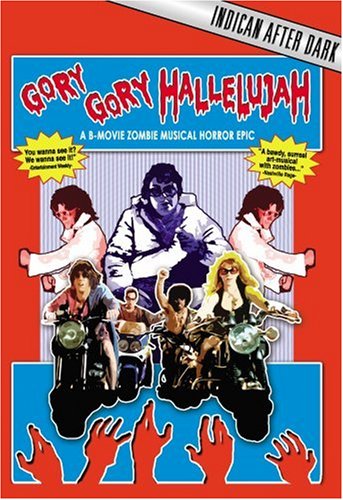
IT CAME FROM THE READER-SUGGESTED QUEUE: GORY GORY HALLELUJAH (2003)

366 Weird Movies may earn commissions from purchases made through product links.

DIRECTED BY: Sue Corcoran

FEATURING: Angie Louise, Tim Gouran, Jeff Gilbert, Todd Licea, Joseph Franklin

PLOT: Four aspiring actors on their way to New York run afoul of increasingly dangerous obstacles, including a group of rowdy Elvis impersonators, a backwards fundamentalist hick town, and a zombie apocalypse.

COMMENTS: Satire, the playwright and Algonquin wit George S. Kaufman opined, is what closes on Saturday night. Nevertheless, aspiring filmmakers frequently turn to satire as a means to walk the line between mass-appeal populism (near-parodistic references to familiar material) and fringe-appeal provocation (harsh critique of sociopolitical foes). All of which is to say, Gory Gory Hallelujah has the aspirational sweat of satire all over it. Unfortunately, Kaufman seems to have its number; Gory Gory bleeds out quickly.

Gory Gory has so many targets for its smug disdain that it plays like a sketch film. The opening salvo takes on the insular and pretentious world of theater, which is admittedly made even more amusing with the reveal that this delusional production of the Gospel is being staged in the theatrical mecca of Seattle. But that’s all forgotten once we set off on a road trip, a genre that revels in wacky mismatched personalities. From there, the targets are set up like the shooting gallery at a fair: here’s the crazy fight with a gang in a bar, here’s the hypocritically moralistic small town, here’s the evil lurking in the woods. The scenes are mileposts, rather than logical stops along the way.

This is a film that is not the slightest bit interested in nuance. Consider our central quartet of heroes, who check an impressive collection of boxes for character stereotypes: militant black man who nonetheless endures countless indignities; self-proclaimed feminist whose sexual and materialistic impulses frequently overrule the cause; nebbishy Jew who finds every opportunity to remind you of his faith; blissed-out hippie flower child whom the film wants to position as closeted, but who is actually ravenously omnisexual. That’s all there is to them; barely 24 hours after having watched the film, I’ve completely forgotten their names, and that’s just fine. They’re not characters; they’re trope delivery systems.

Title notwithstanding, Gory Gory Hallelujah isn’t really a horror film. The screwed-up small town feels like a low-rent retread of Nothing But Trouble, the witches’ coven is just an excuse to take a jab at man-hating lesbians, and the undead are lumbering actors with Green Goddess dressing smeared on their faces. I suspect if you asked director Corcoran and screenwriter Louise, they’d tell you they were making a comedy, a -esque everyone-is-awful romp that lets them flirt with edginess without having to catch any flack. Every once in a while, the film threatens to go somewhere truly daring, like the smarmy land baron’s reference to some “accidental lynchings” that hints at a truly vengeful motivation for the zombie uprising. Most of the time, though, the targets are only the most obvious, offering variations on the theme, “Aren’t these people just awful?” They are. It’s not a revelation.

The closest the film gets to a point-of-view comes in the admittedly unexpected finale, when the death of absolutely everyone presages a revival-hymn closing number that suggests we’ll all be equal in the great beyond. Whereas before everyone was greedily nasty to each other, now they’re all dancing arm-in-arm, united in brotherhood after they’ve cast off the pesky need to breathe. It would make for a solid mission statement if there’d been even a hint of it prior to the closing minutes of the film. As it stands, it’s just one more radical shift in tone for a movie that has already lurched awkwardly from one setpiece to the next. Gory Gory Hallelujah has a lot to be angry about, but just doesn’t have the heart for it. Maybe in the next life.

WHAT THE CRITICS SAY:

“Tripping over the line between silly and stupid, camp comedy “Gory Gory Hallelujah” — the title is the best part — emerges more sub-Troma than subversive…aims for bad-taste hipster satire in the John Waters vein. But co-creator/editor/thesps Sue Corcoran and Angie Louise should have left at least one job — screenwriting — to a third party.” Dennis Harvey, Variety (contemporaneous)

(This movie was nominated for review by Christopher Fox. Suggest a weird movie of your own here.)         

FANTASIA 2025: IT ENDS (2025)

366 Weird Movies may earn commissions from purchases made through product links.

Recommended

DIRECTED BY: Alex Ullom

FEATURING: Phinehas Yoon, Akira Jackson, Noah Toth, Mitchell Cole

PLOT: Four friends miss a turn on the road, and it appears their route will now go on forever.

WHY IT MIGHT JOIN THE APOCRYPHA: Riffing on The Exterminating Angel, four Gen-Z are trapped in much shabbier circumstances, and doomed to wonder when—or even whether—they end.

COMMENTS: It’s a simple, and pleasingly silly, little game: you choose two options for defense, and the two unchosen options are tasked with taking you out. The options are as follow: one man with a gun, 5 gorillas, 50 hawks, and 10,000 rats. Theoretical nonsense, of course, but not a bad way to spark conversation. James doubts the hawks’ merit, Fish thinks a lone gunman can’t amount to much, Day hasn’t been paying much attention (though later favors gorillas, after teaching them to shoot), and Travis wonders just why the heck he returned to town to catch up with his recently graduated high school buddies.

These friends are pleasant company, which is good: we viewers are trapped with them inside their Jeep for the better part of ninety minutes. Conversation becomes panicky, aggravated from time to time by mysterious forest dwellers, who swarm the vehicle whenever it stops, all of them screaming desperately for help. Inside the Jeep, it is safe. Kind of. Did you ever find yourself stuck in a car ride with someone and it went on a few hours too long? Imagine that extended across untold tens-of-thousands of miles along a generically forested highway, with the threat of violent death waiting just beyond the tree line.

It Ends is a simple movie, with one mobile set, and it runs a gamut of emotions. It goes on and on and on, its protagonists trapped and spurred by fear and boredom and the ever-so-rare flicker of hope. (Is it taking longer for the forest freaks to suss they’ve stopped? Is that another car off the side of the road? And… is it raining for the first time in months?) As with any road trip, particularly infinite ones, I suppose, things get cyclical. James, ever stoic, ever cerebral, and often a bit of a cold-blooded jerk, begins to wonder if that cycle is part of the key. Day, Fish, and Travis might be right, too, in feeling that an eternity of traveling down a highway is all that’s ahead. It Ends sprinkles comedy throughout, too, as the youths’ banter delightfully combines an entering adulthood flippant wit with  crumbling coping mechanisms.

The odd premise carried my interest, and if left to just that, perhaps I’d consider this to be some high-quality quirk. However, I’m inclined to pay substantial dues to a movie with a punchline, and this one hits hard, and sudden. Through tension, charm, and ambiguity, It Ends is a treat for film gabbers. Me, I’m choosing 50 hawks and 10,000 rats to watch my back. You?

WHAT THE CRITICS SAY:

“What begins as a casual late-night drive among recent grads quickly warps into a surreal nightmare… The film’s ambiguity works in its favor, leaving the story open to interpretation (although many are going to be frustrated by the finale).” — Louisa Moore, Screen Zealots (festival screening)

CAPSULE: UNIDENTIFIED OBJECTS (2022)

366 Weird Movies may earn commissions from purchases made through product links.

Unidentified Objects is currently available for VOD rental.

Recommended

DIRECTED BY: Juan Felipe Zuleta

FEATURING: Matthew Jeffers, Sarah Hay

PLOT: Peter, an irritable gay dwarf, reluctantly agrees to go on a last minute road trip with sex worker Winona, who believes she has a date to be abducted by aliens in Canada.

Still from Unidentified Objects (2022)

COMMENTS: Ralph Waldo Emerson could have made his famous declaration “it’s not the destination, it’s the journey” as a motto for the road movie genre. The road movie formula structures its plot as a series of challenges meant to reveal its characters, force them closer together as they overcome obstacles, and eventually rip them apart (before they reconcile in the finale). Unidentified Objects fits firmly within the road movie genre, with a couple of twists: it focuses on one of its two travelers much more than the other, and it’s spiked with hallucinatory sci-fi interludes.

Not to slight Sarah Hay—who is excellent as a sex worker Winona, a woman who appears wacky in her alien obsession yet is far more down-to-earth than her companion—but Unidentified Objects belongs to Matthew Jeffers. His portrayal of Peter perfectly embodies the script’s magnificent creation of a misanthropic, deeply depressed homosexual dwarf who’s an expert on Anton Chekov. If Jeffers had hit a single false note, the movie might have quickly come to a screeching halt. Fortunately, Jeffers is always a joy, prickly and sarcastic but achingly vulnerable. Peter is a natural hermit—a sort of homegrown alien in, as he complains, “a world with little to no patience for bodies not of a highly specific make and model”—so Winona’s main function is to give him an excuse to travel out into the world, as well as to challenge his cynicism. She’s a platonic pixie dream girl.

Along with their road encounters with drug-addled survivalist, lesbian cosplayers, and horny teens, two or three dream sequences provide serious character development for Peter. I’ll leave it to the viewer to discover the details for themselves, but the first major set-piece is effectively horrific and supplies backstory and motivation for his journey, while the second emphasizes his loneliness in a way that a real-life scenario never could. These scenes (and others) are accompanied by disco-pink lighting that emphasizes the tale’s otherworldly queerness. Although Winona sets a dreamlike tone early on by asking, “ever wake up from a dream and it’s like you’re still dreaming?,” in practice the movie does the opposite: it’s always clear when a dream has ended, but not when one has begun.

Some may complain that the ending, while not overly ambiguous, shies away from the cosmic promise of the premise—but remember, it’s the journey that matters, not the destination. Winona abducts Peter from his lonely apartment, where he feels like he has every reason to stay locked away from humanity with his volume of Chekov. His courage in choosing to face a harsh world that was not built with him in mind is ultimately a more impressive achievement than being chosen to be whisked away to some celestial paradise.

WHAT THE CRITICS SAY:

“Thankfully, this cinematic trip embraces its intimacy the further it ventures into colorfully surreal territory.”–David Lynch (not that one), KENS5 (festival screening)

THE SEVEN FACES OF JANE (2022)

366 Weird Movies may earn commissions from purchases made through product links.

The Seven faces of Jane is currently available for VOD rental or purchase.

DIRECTED BY: Julian Acosta, Xan Cassavetes, Gia Coppola, Ryan Heffington, Boma Iluma, , Ken Jeong, Alex Takacs

FEATURING: Gillian Jacobs, Joel McHale, , Emanuela Postacchini, Chido Nwokocha

PLOT: Jane experiences love, loss, joy, and bewilderment on a road trip mapped by eight different directors.

Scene from The Seven Faces of Jane (2022)

COMMENTS: To stimulate creativity, the early Surrealists created a game where one artist would build on a previous artist’s work without seeing it. They called the game “exquisite corpse” after a sentence born of this process, a sentence which is also the first thing the viewer sees in The Seven Faces of Jane: “Le cadaver equis boira le vin nouveau.” “The exquisite corpse shall drink the new wine.”

Jane is an exquisite corpse, a surrealist experiment. There are overtly surreal moments, such as the garishly eccentric diner patrons laughing at Jane (Gillian Jacobs) fighting her doppelganger. But the very design—8 directors contributing to the same story blind to what the other directors are doing—leads to Jane being the same but different in each segment, highlighting the nature of character as the collaborative product of writer, director, actor, and so on. With eight different directors, there are actually eight different Janes. (Seven segments plus bookends = eight.)

Jane drops her daughter off at camp and finds herself on a bizarre and unplanned road trip. The southern California backdrop ties the film together visually. Each director showcases it differently, but from the beach to the desert to mountain trails, from Mexican street vendors to early 20th century bungalow neighborhoods, So Cal is the mainstay in this ever-fluctuating movie.

Each segment explores someone Jane could be, or could have been. Most tell stories of love and loss and identity in straightforward or dreamy ways. But the last one, “The Audition,” directed by Alex Takács (AKA “Young Replicant”), takes the story right off the rails in the best kind of way. Set in a mausoleum and a sedan on the back of a car hauler, “The Audition” uses the absurd and the surreal to prod its character’s consciousness.

Jacobs, who is a steady force throughout, continues to deliver as someone on the brink of coming undone. Seemingly no longer able to sustain all the different versions of herself, she fights, gives up, regresses, and disappears, only to become who she needs to be when it’s time to pick her daughter up from camp.

Jane has some shortcomings. The quality of the segments is uneven, and because of the brevity of each piece, there’s no time to build sympathy for any character besides Jane. It is also a disconcerting juxtaposition to have such an ordinary subject for such an experimental movie. The Seven Faces of Jane has been called a “failed experiment.” And by the standards of a mainstream movie, maybe it is. But as an experiment, at least for the Surrealists (and this is a surrealist experiment), if the exquisite corpse stimulates creativity in the artists, it’s a success.

WHAT THE CRITICS SAY:

“The problem is that most of the segments are too tied to a bland realism and narrative cliche to create the collective sense of unease and/or delightful disorientation that the surrealists prize.”–Noah Berlatsky, Chicago Reader (contemporaneous)