Tag Archives: Science Fiction

REPORT: THE COMPLETE METROPOLIS [1927] (2010 RESTORATION)

DIRECTED BY: Fritz Lang

FEATURING: Brigitte Helm, Gustav Fröhlich, Rudolf Klein-Rogge, Alfred Abel

PLOT: The futuristic city of Metropolis is divided into a wealthy, hedonistic, and patriarchal

Restored still from The Complete Metropolis

above-ground, and the beaten-down workers who serve them below.  When the son of the city’s leader falls in love with a revolutionary worker, a chain of events is set in motion that ultimately sways the balance of power.

WHY IT SHOULD MAKE THE LIST: While its story is standard allegorical fare and the performances are often melodramatic, the sheer inventiveness and visual splendor of Metropolis warrants its status as quintessential science fiction.  It set the standard for a host of weird films that came after it and has several iconically bizarre scenes and characters.  Taking into account its importance in film history, it is certainly worthy of the Weird Movie List.

COMMENTS: In a futuristic society functioning solely on a complex network of machines, the workers are beaten down to the point of exhausted submission, while the leaders squander their riches on pleasures of the flesh.  Freder (Gustav Fröhlich), the son of the “Master of Metropolis” Joh Fredersen (Alfred Abel), leaves the pleasure garden cultivated for the spoiled sons of the elite and discovers the horrific conditions threatening his subterranean “brothers and sisters” who operate the machines.  His instant fairytale ardor for the saintly revolutionary Maria (Brigitte Helm) encourages him to become the prophesied Mediator, a man who will act as the “heart” between the brain above and the hands below.  When Joh Fredersen fears a workers’ rebellion, he enlists mad scientist and former romantic rival Rotwang (Rudolf Klein-Rogge) to disguise his newly-fashioned robot into a replica of Maria, so that the automaton can destroy their faith in a mediator.

Settling into my usual stage-right balcony seat at Cambridge’s historic Brattle Theatre, I felt privileged to see such a landmark early film on a big screen, and in its complete form, no less!  An introductory title card explained that the 30 minutes or so of missing footage found in a Buenos Aires museum were shot on 16 mm and would appear in different format than the rest of the remastered film.  The few scenes still unaccounted for would be described in similar title cards.  As the music swelled over a series of pumping pistons and grinding machinery, I was once again whisked away into the simultaneously dark and resplendent world of Fritz Lang’s Metropolis.

The new footage details much of the subplot involving the “Thin Man”, a devious fellow hired by Joh Fredersen to spy on his son.  In the prior version of the film he was a forgettable, barely relevant character, relegated primarily to expository title cards for his missing scenes.  Now he is integral to the stories of the stalwart Josophat (Freder’s assistant) and Georgy/11811, a worker who trades places with Freder.  One of the most impressive new scenes is a montage of Yoshiwara, the city’s pleasure district, in which Georgy traipses about the brightly-lit saloons with pearl-draped multi-ethnic women.  It’s a visually memorable scene with several shots merged together in a mosaic to capture the Las Vegas-like over-saturation of the place.

Unfortunately the new footage was not remastered before theater release, and while I appreciate the speed with which it was put together, I did bemoan the grainy, darkened quality of the restored scenes.  The main advantage is that it makes them noticeable so any viewer can ascertain what was missing from the more familiar version.  It’s also lamentable that the film was shown in a digital presentation, but I’m not sure if that applies to all theater screenings or just the Brattle’s.  All told these are minor complaints, and the overall effect of seeing a visionary classic in its near-complete form (about 5 minutes are still lost) is breathtaking on a big screen and required viewing for any fan of science-fiction, silent film, or just great movies in general.

Riddled with shifting loyalties and a large number of characters, Metropolis spreads its complex narrative across two and a half hours of ornate sets and meticulously-planned shots.  The lively orchestral and onomatopoetic score captures the mood of each moment perfectly, magnifying the enthusiastic performances.  Helm is mesmerizing in her dual role as Maria and her robotic doppelganger: alternately a glass-eyed saint and twitchy, devilish rabble-rouser.  Klein-Rogge is the other standout as the manic inventor Rotwang, twisting his metal hand into a claw and arching his eyebrows with mad fervor as he slithers around catacombs and dingy laboratories.

It could benefit from better pacing and a more organized plot structure, and the added scenes don’t help the already dragging and plot-holed story, but the sheer wonder and imagination with which Metropolis is filmed combine with intense performances and a heartfelt message to establish it as a true masterpiece of filmmaking.  Now that it is available in its most complete form, its weird visuals and ambitious story can be fully appreciated for all their muddled religious iconography, forward-thinking mechanics, impressive effects, and allegorical implications.

WHAT THE CRITICS SAY:

“…adds even more depth to a delirious, dreamlike class parable whose dystopia still feels exhilaratingly modern.”–David Fear, Time Out New York (restored version)

CAPSULE: DUNE (1984) [BLU-RAY]

366 Weird Movies may earn commissions from purchases made through product links.

DIRECTED BY: David Lynch

FEATURING: , Kenneth McMillan, , ,

Still from Dune (1984)

PLOT: As simply as I can put it: set in the year 10,191, inhabitants of three planets attempt to gain control of the “spice” Melange.  The substance extends life and allows space travel.  Whoever controls the spice controls the universe.  The planet Caladan, home of the House Atreides, is the main threat to the current emperor of the universe.  Duke Atreides son, Paul, appears to be the “chosen one” due to his special gifts of prophetic visions and skillfulness as a soldier.  Paul foresees the emperor’s plan to destroy the Artreides clan and sets out to take control of the spice and defeat their enemies.

WHY IT WON’T MAKE THE LIST: Dune is too confusing, an altogether jumbled mess, to give it any consideration for the List of the 366 Best Weird Movies ever made.  There are too many characters, words, names and ideas that occupy the screen.  Overt weirdness does flit about many times, but is marred by cheap-looking special effects and poor acting.  Disappointing, considering who was at the helm of the picture.

COMMENTS: First off, being a new contributor, I feel privileged to have been given the opportunity to cover three masters in the realm of weird cinema; Roeg, Cronenberg, and now David Lynch. Truth be told, Lynch is probably the greatest director in the pantheon of weird movies.  That said, this is the worst film David Lynch ever committed to celluloid.  I don’t think he would mind my saying so, as he too has publicly announced his hatred towards this film.  He refuses to talk about it in writings or interviews.  A production debacle, Lynch feuded bitterly with Dino de Laurentis to retain his artistic vision against the producer ‘s extravagance.  The film looks slapdash at times.  This problem likely stems from the complex source material: Frank Herbert’s 1965 cult sci-fi novel of the same name.  Lynch claimed  never to have read the book pre-production and to personally dislike the sci-fi genre.  For unclear reasons, he actually turned down the opportunity to direct Return of the Jedi to do this film.  I imagine Ewoks would have become much more menacing under the Lynchian lens.

Lynch came to direct only after several other directors bowed out due to differences and strife on the set.  One of the directors previously associated with the film was none other than Alejandro Jodorowsky, who planned on taking the film to new heights… a 14-hour epic!  Yeah, that didn’t fly.  What we are left with is a 137 minute hodgepodge of sci-fi jargon and mediocre direction.  Apparently different cuts exist; a 190 minute version has been aired in two parts for television.  The added material only caused more uproar with the legions of “Dune” fans, who thought the additional scenes and extended narration further stifled the already confusing flow of the theatrical cut.  Lynch has refused to release a director-approved cut, and demanded the pseudonym Jonas Booth replace his name on the extended television version.

There is way too much happening in this movie…all the time!  The multitude of characters, all with hard to pronounce names, come and go and never really make an impression.  The viewer is left wondering, “who is that?”, “are they important?,” and “what do they want?”  Ultimately, the answer to the last question is that they all want that damn spice.  Spice is cultivated on the planet Arrakis, or Dune, a desolate sand-covered planet; the only place where one can attain spice and thus total domination over the universe.  What protects the spice from any regular Joe-Schmoe getting at it?  Enormous man-eating worms, that’s what.  At least Lynch got to expand on his worm fixation.

I’ll refrain from putting in text the many characters that inhabit the different planets.  I will say the cast is fairly impressive and many went on to bigger and better roles.  The recognizable faces are: Patrick Stewart, Max von Sydow, Dean Stockwell, Sean Young, Virginia Madsen, and Eraserhead‘s own Henry, Jack Nance (almost unrecognizable without that pompadour).  The most impressive over-the-top performance comes from Kenneth McMillan as Baron Vladimir Harkkonen (see, I told you about the names).  He gets the chance to unspool some great weirdness in his role.  The disgusting pus-and-blood filled boils that crater his face; his ability to inflate his suit and hover around like a lumpy balloon; his crazed, madman line deliveries: he get props in the weird department.  He plays up his vileness quite nicely to cement his baddie status.

I don’t think Dune is complete garbage.  I’ve seen much worse.  The elaborate sets and ornate costumes are most impressive.  The Blu-ray picture quality is probably the best you’re ever going to get (is this the first Blu-ray film reviewed on this site?!?  Blu-ray is beautiful, and hopefully an expansion of weird titles is to come).  The colors are crisp and flaws are minimal.  Many of the set designs were created by the legendary H.R. Geiger of Alien fame (although he eventually dropped out of the production, many of his creations were still used).  Speaking of Alien, I saw many subtle similarities to other classic sci-fi films, with Star Wars leading the pack.  “May the force be with you” is changed to “may the hand of God be with you.”  Young Paul (MacLachlan) undergoes a training sequence very similar to the exercise blindfolded Luke Skywalker practiced on the Millennium Falcon; instead of a lightsaber, Paul uses some sort of laser gun to blast tips off harpoon spears that randomly thrust out of a fight simulator.

The action sequences and special effects are what bog this movie down to the depths of an over-blown ridiculous flop.  For as much money as this thing cost, it should have looked a whole lot better, even by 1984 standards.  The first action occurs when Paul trains in a battle simulation.  There’s a knife fight, but a force field shields the  combatants: it’s a box/cube that engulfs the person into something that looks straight out of Intellivision video games from three years earlier.  The final battle depicts heroic Paul in knife-combat with evil Harkkonen lackey Feyd, played by an insignificant Sting (looking like Sex Pistols-era John Lydon).  The fight is sloppily choreographed and lame.  Overall, a perfect descriptive term for this film… lame.

To get a final understanding of just how corny this movie can get, I’ll offer up three more tidbits in list form:

  1. A dog (a pug) features in several scenes.  Paul lovingly strokes its fur aboard a spacecraft.  His father, the Duke, carries it around like an ornament.  Most hilarious, though, is the scene in which Patrick Stewart’s character charges and screams in full-blown battle mode while cradling the mongrel in his arms.  Where’s a wookie when you need one?
  2. The guns that are controlled by screams and a certain pitch of voice.  A trigger needn’t be pulled.  Just yell.
  3. The potential effectiveness of the giant worms is completely squelched when Paul and his comrades mount, harness, and ride them into battle like horses.

I’m sorry David, your film is lame.  You know it.  I know it.  Still, you managed to get some devout followers.  I just can’t figure out why.

The Blu-Ray additional features include very rough deleted scenes that add nothing of significance.  Special features document the making of Dune and its sometimes cringe-worthy special effects.  There are also segments on the various models, miniatures, and costume designs, which I find to be the only saving grace of the film.

WHAT THE CRITICS SAY:

“…a brilliant mistake, misguided from the start but still aesthetically satisfying… Those who give it a chance…  will be rewarded with something surreal and strangely evocative…”–Bill Gibron, PopMatters (Blu-ray)

Dune [Blu-ray]
  • Factory sealed DVD

BORDERLINE WEIRD: STINGRAY SAM (2009)

DIRECTED BY: Cory McAbee

FEATURING: Cory McAbee, Crugie, David Hyde Pierce

PLOT: Ex-con/lounge singer Stingray Sam grudgingly joins his former partner the Quasar Kid

Still from Stingray Sam (2009)

in a quest to save a little girl, with frequent musical breaks featuring songs by The Billy Nayer Show. David Hyde Pierce narrates intermittent segments of animated collage that explain their futuristic society.

WHY IT’S ON THE BORDERLINE: It’s a wacky, memorable space musical with western flair, crisp black and white visuals, and imaginative, nonsensical notions of the future, but all that can be found in slightly more intriguing form in McAbee’s earlier work The American Astronaut, which better serves The List by being a feature-length movie (Stingray Sam is an hour-long serial).  But it certainly contains enough of its own charm and inventiveness to stand alongside its predecessor, and it shouldn’t be wholly dismissed just yet.

COMMENTS: Conspicuously sponsored by the fictional “Liberty Chew Chewing Tobacco” and excitedly asking what our heroes will be up to next at the end of every episode, Stingray Sam is a fitting tribute to old-fashioned serials, keeping many of the western and sci-fi elements of such shows while incorporating a wealth of inspired new ideas. There are several weird inventions and convenient technologies to place it in the futuristic space setting, but the sets are wonderfully low-key and familiar. McAbee’s incredible charm seeps through the screen in everything from his performance to the silly dialogue, aided along by the excellent musical numbers and gorgeous animated collage sequences.

By the time the second episode’s explanatory animated piece details the upper class invention of gender-determining drugs, male-on-male baby-making, and a delightful portmanteau naming system, what started out as a fairly straightforward quest to rescue a maiden quickly evolves into a madcap journey through McAbee’s unpredictable imagination.  The layers of references, backstory, character, and pseudo-science wrapped up in a musical comedy-adventure are impressively nuanced.  David Hyde Pierce’s articulate and tongue-in-cheek narration (which delights particularly in the word “Durango”) offers a range of ideas, inventions, and happenings that don’t always make sense but never fail to spark interest.  The first time around some of this information goes by too quickly, as viewers are hit with so many novelties and humorous animation at once, but subsequent watches prove McAbee’s involved story and unique futuristic vision to be unavoidably successful, if preposterous.

With catchy tunes that probably sit somewhere in the rock and roll spectrum yet manage to remain without a definable genre classification, The Billy Nayer Show (who also comprise several main cast members) craft a fun soundtrack that usually leads to manic dancing and wide smiles.  Each episode contains one song, which never encroaches on the action or comedy (and often increases the latter), along with a curt opening theme that reminds us “Stingray Sam is not a hero, but he does do the things that folks don’t do that need to be done.”  They serve to make the strange story even more memorable, describing stingray babies, entertainment on Mars, and peg-legged fathers, and add an extra element of goofy joy to the work.

Looking past the wonky sci-fi premise and western trappings (complete with cowboy hats and “yes ma’ams”), the heart of Stingray Sam lies in the unbridled glee the entire project exudes. As Sam, McAbee swings his way into everyone’s hearts with his jerky dance moves, easy smile, and affable demeanor, while Crugie keeps his cool as the Quasar Kid, offers some gruffer tunes, and frequently betrays a weakness for olives.  Their intricate secret handshake is just icing on this lovable, quirky cake of a partnership.  The beleaguered faces of many supporting cast members seem somehow twisted and plasticine, suiting the off-kilter atmosphere perfectly as they help or hinder our heroes’ proceedings.  There’s not much else like Stingray Sam.

Stingray Sam is currently only available directly from director Cory McAbee at his personal site (click here to purchase).  If the film follows the marketing plan of The American Astronaut, it will eventually be released via normal distribution channels as well.

WHAT THE CRITICS SAY:

“Sounds weird? You bet your ass… Cory McAbee manages to cram enough story and song in to each episode, each more ridiculous than the other and still come out with a coherent story and structure.”–Swarez, Twitchfilm

BORDERLINE WEIRD: SOUTHLAND TALES (2006)

Southland Tales has been promoted to the Apocryphally Weird list. Please read the official entry.

366 Weird Movies may earn commissions from purchases made through product links.

DIRECTED BY: Richard Kelly

FEATURING: Dwayne Johnson, Seann William Scott, Sarah Michelle Gellar, Justin Timberlake, , Miranda Richardson

PLOT: In an alternate-universe America controlled by a surveillance-happy government, the lives of several Los Angeles residents—including a disabled veteran, a police officer, an amnesiac movie star, and a cell of political revolutionaries—intersect on the eve of the apocalypse.

still from Southland Tales (2006)

WHY IT’S ON THE BORDERLINE:  Although its many subplots pile weird images and ideas on top of each other, many of them remain totally superfluous, and the film as a whole is a disappointing nexus of influences and half-baked premises rather than a cohesive work of art.  However, it does contain some moments of mesmerizing weirdness, and could have a chance of being certified weird in the future.

COMMENTS:  To follow up his impressive debut feature, Donnie Darko, Richard Kelly clearly wanted to challenge himself.  With Southland Tales, however, he bit off more than he could chew. All of Donnie Darko’s best and worst tendencies are on display (with an emphasis on the latter), but this time the showcase is twice as long, with enough intricate storylines and bizarre sci-fi subtexts to fill a dozen less ambitious movies.  With his second film’s epic size, Kelly lost the gently emotional touch that made Donnie’s coming-of-age so poignant; his fiery creative passion is still very perceptible here, but it’s obscured behind layers of apocalyptic razzle-dazzle, broad satire, and sophomoric humor.

In Southland Tales’ alternate timeline, Texas was struck by terrorist nukes in 2005, triggering World War III; this back story is filled in via a YouTube-style montage of video clips and hyperlinks.  It’s a genuinely original method of exposition, but alas, it’s a rare example of Kelly’s innovative spirit overcoming his love of non sequitur jokes and stunt casting.  While Donnie Darko just had Patrick Swayze’s unnervingly effective performance as a demagogic motivational speaker, Southland Tales crams in a disorienting array of surprise cameos and Continue reading BORDERLINE WEIRD: SOUTHLAND TALES (2006)

62. ALTERED STATES (1980)

366 Weird Movies may earn commissions from purchases made through product links.

Recommended

“You don’t have to tell me how weird you are. I know how weird you are… Even sex is a mystical experience for you. You carry on like a flagellant, which can be very nice, but I sometimes wonder if it’s me that’s being made love to. I feel like I’m being harpooned by some raging monk in the act of receiving God.”–Blair Brown to William Hurt in Altered States

DIRECTED BY: Ken Russell

FEATURING: William Hurt, , Charles Haid, Bob Balaban

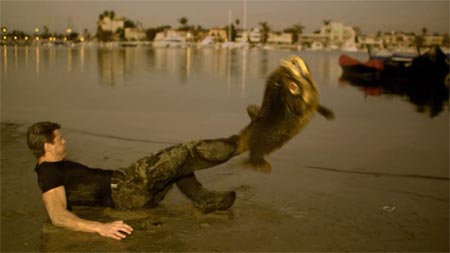
PLOT: Dr. Eddie Jessup is a Harvard physiologist who used to experience religious visions as a teenager and is now studying the phenomenon of hallucinations caused by sensory deprivation in isolation tanks.  His inquiries into the nature of consciousness eventually take him to an isolated tribe in Mexico who use a powerful psychedelic mushroom in ancient Toltec religious rituals.  When he combines the magic mushrooms and the isolation tank, he finds that the mixture causes him to regress to an earlier evolutionary state.

Still from Altered States (1980)

BACKGROUND:

  • The character of Dr. Jessup was based on the real life Dr. John Lilly, who invented the isolation tank and experimented with using hallucinogens in combination with it before moving on to research on communicating with dolphins.
  • Lilly tells the tale of a fellow researcher who took the drug ketamine and believed that he had turned into a “pre-hominid” and was being stalked by a leopard, which was presumably the kernel for the the idea of genetic regression.
  • This was William Hurt’s first starring role.
  • A young Drew Barrymore, in her film debut, briefly appears as one of Jessup’s children.
  • Paddy (Network) Chayefsky, the three-time Oscar winning screenwriter, adapted his own novel for the screen; he was so displeased with the final results that he had his name removed from the credits.  Chayefsky had originally written the story as a satire of the pretensions of the scientific community.  The original director, Arthur Penn, resigned after disputes with the writer.  Russell and Chayefsky reportedly argued on the set over the actors’ line readings and performances.  Chayefsky’s original novel is long out of print.
  • The seven-eyed lamb that appears in Jessup’s first vision comes straight from the Book of Revelations: “…in the midst of the elders, stood a Lamb as it had been slain, having seven horns and seven eyes…” (Rev 5:6).

INDELIBLE IMAGE:  One of the two major trip sequences (you can take your pick).  The crucified seven-eyed, seven-horned lamb from the first  is a popular favorite. In a sense, however, the quick-cut surrealistic montages play as a whole images that can’t be chopped up into constituent parts.

WHAT MAKES IT WEIRD: Ken Russell makes it weird. There’s no director more eager or better suited to make a science fiction movie about hallucinogenic drugs that bring about religious visions.  With its long, intense episodes of druggy delirium, Altered States may well be the greatest trip movie ever made (and it’s certainly the most expensive). Put it this way: you know the movie’s weird when the sight of a naked, simian William Hurt gnawing on a bloody gazelle is one of the film’s more humdrum visions.

Original trailer for Altered States

COMMENTS: There are fishes swimming in the sky behind William Hurt’s head.  He offers his Continue reading 62. ALTERED STATES (1980)