Tag Archives: Recommended

24*. KEEP AN EYE OUT (2018)

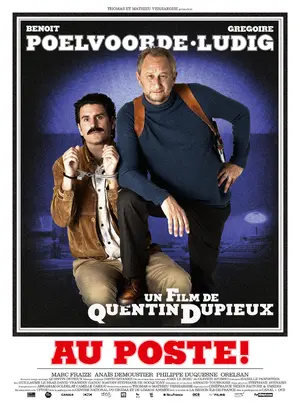
Au Poste!

366 Weird Movies may earn commissions from purchases made through product links.

Recommended

DIRECTED BY: Quentin Dupieux

FEATURING: , , Marc Fraize,

PLOT: Having discovered a dead body under not-very suspicious circumstances, Louis is brought in by the police for questioning. His account of the event arouses the suspicions of police commissioner Buron, but Louis is even more suspicious of the police because of their circular arguments, penchant for distraction, and curious behavior. Louis becomes concerned that he will bear the responsibility for an increasing number of unlucky events, and must recount his actions in fine detail in an effort to affirm his innocence.

Still from Keep an Eye Out [Au Poste!] (2018)

BACKGROUND:

  • This was native Frenchman Dupieux’s first feature actually produced in his home country.
  • The film’s original French title translates as “To the police station!” It can also be translated to mean “at the office.” It can also be interpreted to mean someone who is at their assigned spot (“at one’s post”), in much the way a call of “Places!” summons the actors to their marks at the start of a play.
  • Scenes at the police station were filmed in the headquarters of the French Communist Party, designed by acclaimed architect Oscar Niemeyer.
  • Alain Chabat is credited with providing “screams of pain.” Chabat appeared in Reality as a film director attempting to win an Oscar for the best wail of pain.
  • The film’s poster parodies that of the significantly more action-oriented Jean-Paul Belmondo crime thriller Peur sur la Ville (Fear over the City).

INDELIBLE IMAGE: Philippe, a hapless cop-wannabe, suffers from an unfortunate condition, and its reveal is a genuine shock. It’s not merely that he has only one eye. It’s that the whole upper quadrant of his face is smoothed over, as though the mere idea of an eye socket never existed. And once he begins espousing his hyper-preparedness for even the most surreal of accidents, it is absolutely inevitable that Chekhov’s Plastic Angle Square will fulfill its destiny.

TWO WEIRD THINGS: Near nude conductor; crunchy oyster

WHAT MAKES IT WEIRD: by way of with a healthy layer of Douglas Adams and a final punch of Sartre, Keep an Eye Out is a fantasia of absurdism. Dupieux and his actors seem to be engaged in a contest to see who can be the most deadpan, and the tone never wavers, neither in the face of escalating ridiculousness nor an unexpected and tragic conclusion.

Original trailer for Au Poste!

COMMENTS: We begin with an orchestra in a meadow, accompanying the opening credits under the baton of a mustachioed man clad Continue reading 24*. KEEP AN EYE OUT (2018) →
CAPSULE: ULTRASOUND (2021)

366 Weird Movies may earn commissions from purchases made through product links.

Utrasound is currently available for VOD rental.

Recommended

DIRECTED BY: Rob Schroeder

FEATURING: Vincent Kartheiser, Chelsea Lopez, Bob Stephenson, , Tunde Adebimpe

PLOT: After a car accident, a man spends a night at a couple’s remote house and—at the husband’s insistence—sleeps with his much younger wife, which leads to an increasingly strange series of events.

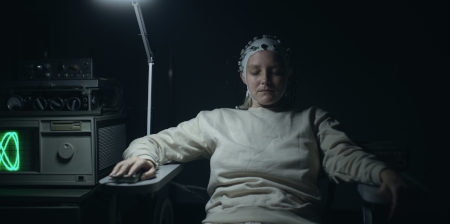
Still from Ultrasound (2021)

COMMENTS: Glenn blows out a tire in the rain returning from a remote wedding and takes shelter at the home of a strange couple. After an awkward evening between Glenn, heavyset “depressive” host Art, and his young wife, Cyndi, the scene suddenly switches to a new character, a woman swimming laps in a pool. She sometimes appears pregnant, and sometimes not.

“I don’t see the link between the two things,” says Glenn, much later, from a wheelchair. “It will all make sense as we go along, I promise” assures the therapist who’s guiding him through a roleplay exercise as a form of physical therapy.

Juggling multiple plots and subplots, the script basically keeps the promise suggested by the above line of dialogue. Characters will sometimes appear to change into other characters or locations into other locations, and their lives will take major turns without explicit explanations. Two pregnancies, which may or may not be pregnancies, supply part of the impetus for the title Ultrasound. Besides Art, Glenn, Cyndi, and the mysterious swimming woman, there’s a major conspiracy afoot, and a couple of other subplots running around, making for a movie that demands close attention if you want to figure it all out (a careful second viewing will, of course, make the timelines clearer, and allow you to catch otherwise obscure clues).

The acting is good, with veteran character actor Bob Stephenson a standout as the unassuming but subtly persuasive Art. (“Art has gotten so weird lately,” says one character, and another corrects her: “more emphasis on so weird.”) The score and sound design effectively increase the tension in moments when things seem “off” even though there is not much action onscreen. Although the sets and visuals aren’t lavish, first-time director Schroeder frames some clever compositions: in one shot, a countertop lines up with a refrigerator and a cabinet to create an imaginary line down the middle of the frame—a sort of in-camera split screen effect implying a world divided into different realities.

Still, it’s the script that’s the standout here. Ultrasound‘s profound paranoia resonates in our gaslit world of deepfakes, fake news, and fake claims of fake news. But it’s possible to puzzle our way through the illusions: the screenplay answers nearly all our questions, and what it leaves ambiguous is easily filled in by the savvy viewer. A satisfying outing for fans of reality-bending films who demand answers to the mysteries and aren’t afraid to do a little mental lifting to get them.

WHAT THE CRITICS SAY:

“Weird, disorientating, and complex, Ultrasound compels the viewer into a fugue state into which this darkly dangerous science-fiction can unfold and wrap around then. Some truly uncomfortable ideas around the ability to control others are told through an overtly science-fiction lens, but the potential truth within the film is what makes it a harrowing watch.”–Kat Hughes, The Hollywood News (festival screening)

23*. JULIET OF THE SPIRITS (1965)

Giulietta degli spiriti

366 Weird Movies may earn commissions from purchases made through product links.

“I remember I had some exaltation about color. I see colors not like they are normally – we see colors in the object. In this case, I saw colors, just as they are, detached from the object. I had for the first time the feeling of the presence of the color in a detached way.”–Federico Fellini

Recommended

DIRECTED BY:

FEATURING: , , Mario Pisu

PLOT: Juliet, a wealthy housewife, has reason to suspect her husband is cheating on her. She has always been attuned to the spirit world, and after a seance she begins seeing visions and hearing voices; one of the whispering entities tells her that her neighbor, the strange, sexually liberated Suzy, will be her teacher. As her marriage disintegrates, her visions become harder to distinguish from reality, until Juliet snaps and banishes the spirits.

Still from Juliet of the Spirits (1965)

BACKGROUND:

  • Fellini’s first feature-length color film (although his short segment for the 1962 anthology film Boccaccio ’70 was in color.)
  • Fellini took LSD (in a clinical setting) for inspiration in making this film. He found it “a little disappointing.”
  • Some of the biographical details of onscreen Juliet’s stories come from Giulietta Massina’s own experiences in her marriage to Fellini. The house seen in the film is the couple’s real house.

INDELIBLE IMAGE: Juliet of the Spirits parades a host of bizarrely costumed Felliniesque grotesques across the screen in its 130 minutes, but aside from the perpetually smiling eye-of-the-storm Masina, the one who makes the biggest impression is buxom, bodacious Suzy (Sandra Milo). In one of the movie’s unforgettable scenes, she disrobes (offscreen) in the blink of an eye to demonstrate one of the hedonistic accoutrements in her bordello-like haven: a slide winding directly from her bedroom to her personal post-coital swimming pool.

TWO WEIRD THINGS: Hermaphrodite swami reception; faceless purple nuns

WHAT MAKES IT WEIRD: Like his previous 8 1/2, Juliet of the Spirits is a Fellini trip where dreams and fantasies—the more baroque and colorful, the better—intrude into reality as a way to explore the psychology of the film’s protagonist.


Original trailer for Juliet of the Spirits (1965)

COMMENTS: Juliet of the Spirits is transitional Fellini—most obviously, in updating the director’s palette to the full color spectrum, Continue reading 23*. JULIET OF THE SPIRITS (1965) →

APOCRYPHA CANDIDATE: PENDA’S FEN (1974)

AKA “Play for Today: Penda’s Fen”

366 Weird Movies may earn commissions from purchases made through product links.

Recommended

DIRECTED BY:

FEATURING: Spencer Banks, John Atkinson, Georgine Anderson, Ian Hogg

PLOT: Shortly before his eighteenth birthday, Stephen Franklin must come to terms with his emergent homosexuality, lineage, and theological outlook.

WHY IT MIGHT JOIN THE APOCRYPHA: Strange visions and societal upheaval get the BBC treatment in Alan Clarke’s adaptation of David Rudkin’s densely packed narrative. While it is littered with theologically-leaning surrealism throughout (including a charming chat with a wry Edward Elgar), Penda’s Fen earns its recommendation from how its many layers, each differently profound, integrate, as Manichaeism, paganism, deep history, military corporatism, labor crises, and sexual awakening un-peel and reincorporate into this philosophical coming-of-age drama.

COMMENTS: Profundity comes crashing right out of the gate in Penda’s Fen, and never lets up. A young man’s voice intones a prayer, of sorts, in the opening minutes as the title card appears over various pastoral scenes: “Oh my country, I say over and over, I am one of your sons…” The protagonist is the seventeen-year-old son of a parson; the era is England at its nadir; and the classical references fly left, right, and center. Simultaneously, Penda’s Fen feels familiar: the story of a boy on the cusp of manhood, coming to terms with himself and his surroundings. The relatability of this awkward character, and the complaisant manner in which the story is told, are a testament to the talents of the leading actor, Spencer Banks, and the story crafters, Alan Clarke and David Rudkin. The gravity of the whole experience strikes deeply into our consciousness, simultaneously opening channels of fascination.

Stephen Franklin (Spencer Banks) is the quintessential goody-two-shoes. He excels in his studies; he enthusiastically partakes in military volunteer training; and he leads debates at school while attending municipal debates after hours. He loves the works of Sir Edward Elgar, particularly “The Dream of Gerontius,” a meditation on death and salvation. Stephen also has feelings for the young milkman, though is not quite aware of their nature. His parents, however, have sussed their son’s leanings for some time, and are accepting thereof—though the father can’t hide his amusement at the well-worn typicality of the recipient of his son’s affection.

As a back-drop to the sexual awakening, there is a local labor agitator who is also a playwright (and also, probably, a homosexual); a secret military installation being built under a nearby field; and ecclesiastical visions. This endless string of semi-colons and splashes of back- and side-story doubtless convey the difficulty in attempting to dissect Penda’s Fen in any brief-but-meaningful way. Discussing the father, with perhaps half an hour of shared screen-time, could fill a slender volume. A profound thinker, his erudite remarks hover along the believable side of esoteric, and coupled with his deeply human understanding of himself and his son, along with an awareness of England’s, and the world’s, pagan antecedents, make him both an unlikely parson, and an unlikely source of love and stability in his son’s life.

And there I go again, listing elements. Let’s change tack. Penda’s Fen was made for television (I shudder to think what appeared on United States television at the time), but this is no detriment. It shows a concise craft: brisk pacing that is never hasty; perfect accompanying music from Elgar; and a sense that the limitations of the screen and budget forced the filmmakers to convey their many (and complicated) messages in as simple, and distilled, a form as possible.

Alas, more semi-colons, more parentheses, more commas. Penda’s Fen is unlike anything I’ve seen before it, and its sprightly ninety minutes deeply explore more concepts and experiences than some of the artiest art-house meditations I’ve been forced to endure for hours on end.

Penda’s Fen is available on a single Region B Blu-ray (which won’t play on most North American Blu-ray players). It is one of the keystone films in Severin’s massive “All the Haunts Be Ours” folk-horror compilation. Another option for American viewers is to sign up for a BritBox subscription (free trial available).

WHAT THE CRITICS SAY:

“A highly popular play from the reliably weird David Rudkin, with a younger audience than Play for Today was used to, mainly due to its fantasy elements, it has since acquired a reputation as a cult piece of ‘telefantasy’ which, deserved though it is, belies its sophistication.”–TV Cream (DVD)

(This movie was nominated for review by Chris Reynolds, who described it as a “metaphysical journey of a young boy in rural England [wjo] encounters symbolic figures representing Britishness who begin to disrupt his notions of identity..” Suggest a weird movie of your own here.)

CAPSULE: SYMBIOSPYCHOTAXIPLASM: TAKE ONE (1968)

366 Weird Movies may earn commissions from purchases made through product links.

Recommended

DIRECTED BY: William Greaves

FEATURING: William Greaves, Don Fellows, Patricia Ree Gilbert

PLOT: Director William Greaves hires two actors to perform a short melodramatic dialogue in Central Park, then has another camera crew film his process of directing them, while yet another crew films the second crew.

Still from SYMBIOPSYCHOTAXIPLASM: Take One (1968)

COMMENTS:If you ever wished a movie consisted of all behind-the-scenes footage and no real content, here you go. William Greaves’ conceit is to repeatedly film a one-scene stage test for a feature that he never intended to make. As he guides the actors through their melodramatic line readings, a camera crew films his direction; a second camera crew films the first. They also film anything that happens on set, whether it be a crowd of gawkers, a homeless veteran who wanders out of the woods, or a policeman checking to see if they have permits to film in Central Park. Greaves wears the same distinctive green mesh shirt through the entire shoot, making it appear as if all the action takes place on a single day. Every now and then, the movie switches to split screens to show the crew and actors activities from different angles, and funky jazz (from Miles Davis’ classic “In a Silent Way” album) punctuates the action. If the act of observing a thing changes it, as the physicists say, then what does the act of observing oneself observing oneself do?

All this sounds like it could be unbearably self-conscious art exercise from stoned hippies, but it’s unexpectedly fascinating. It’s the “coup” staged by the crew, who take it upon themselves to film their own spirited private discussions where they wonder what the hell Greaves is up to, and why he seems to be playing at being incompetent, that ignites the film.  In 1968, they’re not a crew of jaded postmodernists: they sincerely discusses questions of reflexivity and artificiality versus reality, and try to find deeper meaning in the lines which they insist are drivel. They aren’t defensively ironic, as the tone would be were such a project made today; they are unafraid of seeming pretentious. This layer of revolt is essential to the film, supplying conflict and texture. And the viewer never knows if Greaves instigated (or even partly scripted) the crew’s spirited bull sessions, or simply lucked out when they took it upon itself to supply what becomes the most interesting part of the film. You wonder if Greaves is pulling some kind of Andy Kaufman-styled cinematic prank.

Shot in 1968, this movie was not exhibited until 1971, but slowly grew its legend through rare festival and museum screenings, gaining a series of influential champions among fellow filmmakers. This movement culminates in Symbiospsychotaxipalsm: Take 2 1/2, a sequel released in 2005 with the backing fans of and , which is included on the Criterion Collection disc. As far from a standalone feature as is possible to imagine, 2 1/2 starts with 30 minutes of unused footage from the first movie featuring two of the actors , then, after some reflections from the director and crew about the project, fast-forwards the story to see what has happened to these characters 35 years later (answer: they are still doing screen tests, and Greaves is still filming everything). The sequel is a worthwhile supplement, but mostly it serves to highlight the lightning-in-a-bottle success of the original. Youth has faded and the magic can only be remembered, not recreated.

WHAT THE CRITICS SAY:

“…a movie-within-a-movie at a time when most of the meta-cinematic action was coming from Andy Warhol and Jean-Luc Godard. But Greaves goes one better. He’s doing Godard doing Cassavetes.”–Wesley Morris, The Boston Globe (2006 revival)

(This movie was nominated for review by Russa03. Suggest a weird movie of your own here.)