Tag Archives: Postmodern

241. PIERROT LE FOU (1965)

“Velazquez, past the age of 50, no longer painted specific objects. He drifted around things like the air, like twilight, catching unawares in the shimmering shadows the nuances of color that he transformed into the invisible core of his silent symphony. Henceforth, he captured only those mysterious interpenetrations that united shape and tone by means of a secret but unceasing progression that no convulsion or cataclysm could interrupt or impede. Space reigns supreme. It’s as if some ethereal wave skimming over surfaces soaked up their visible emanations to shape them and give them form and then spread them like a perfume, like an echo of themselves, like some imperceptible dust, over every surrounding surface.”–opening lines of Pierrot le Fou, supposedly from the book on modern painters Ferdinand reads throughout the film

Recommended

DIRECTED BY:

FEATURING,

PLOT: Ferdinand, who is married to a wealthy Italian woman and has recently lost his television job, leaves a bourgeois cocktail party early and skips town with babysitter Marianne, with whom he had coincidentally had an affair years before. After knocking out an intruder, the two go on a crime spree and end up living on a remote island, but Marianne grows bored and wants to return to city life. Things get complicated when Marianne, who claims her brother is a gun runner, kills a man in her apartment, and the lovers are separated.

Still from Pierrot le Fou (1965)

BACKGROUND:

  • Pierrot le Fou is a (very) loose adaptation of Leonard White’s pulp novel “Obsession.” In the novel, the babysitter is much younger than the man she runs away with, creating a “Lolita” dynamic; when Godard decided to cast Belmondo and Karina, the nature of their relationship had to change.
  • “Pierrot” means “sad clown,” a stock character from commedia del arte. Pierrot is archetypically foolish, in love, and betrayed by his lover.
  • Two days before the film was to shoot, Godard still had no script. Some of the film was therefore improvised, although, according to Anna Karina, the extent to which the film was made up as it went along was later exaggerated.
  • Godard and Karina were married in 1961; by the time Pierrot was released, they were already divorced.
  • The film was booed at its debut at the Venice Film Festival, yet went on to do well at international box offices.
  • Director has a cameo as himself in the cocktail party scene, where he gives his theory of the essence of cinema.

INDELIBLE IMAGE: The despondent Ferdinand, speaking on the phone, grabs a paintbrush and begins daubing his face blue. Once finished, he goes out into the Mediterranean sun, carelessly swinging two bundles of dynamite—one red, one yellow—around his body. He’s off to end the movie.

THREE WEIRD THINGS: Topless cocktail party; scissored dwarf; Pierrot is blue

WHAT MAKES IT WEIRD: Inspired by a film noir plot, but shot in a sunny primary-color pop art style that banishes all shadows, Pierrot le Fou is a bittersweet contradiction, and a story that refuses to sit still: it’s a road movie, a romance, a comedy, an adventure, a musical, a satire, a meditation, a surreal fantasy, and a postmodern lark (sometimes, it’s all of these in a single scene). Godard’s personality holds it all together with a lighthanded unity that he would seldom pull off.


Video review of Pierrot le Fou from Lewis Senpai (MoviesEveryday)

COMMENTS: “Fou” means “crazy” in French. Ferdinand’s lover, Marianne, calls him “Pierrot” throughout the film, although he constantly Continue reading 241. PIERROT LE FOU (1965)

234. THE FORBIDDEN ROOM (2015)

“When they were filled, he said unto his disciples, gather up the fragments that remain, that nothing be lost.”–John 6:12

RecommendedWeirdest!

DIRECTED BY:  Guy Maddin,

FEATURING: , Clara Furey, Victor Andres Turgeon-Trelles, Caroline Dhavernas, Paul Ahmarani, Noel Burton, , , ,

PLOT: A lumberjack inexplicably appears inside a doomed submarine. While searching for their captain one of the crew shares the wayward lumberjack’s story and several more strange tales. Before and after the main narrative (such as it is), a man lectures on how to take a bath.

the_forbidden_room_1

BACKGROUND:

  • While researching Hollywood’s lost films, Guy Maddin learned that approximately 80% of silent films made have been lost; many are preserved in title only. Maddin became obsessed with the idea that there were all these films he would never be able to see. This obsession turned into an ongoing four year long project producing re-imagined versions of these forgotten treasures. It began as an installation where Maddin and Johnson shot a movie a day in public. Some of what was shot became The Forbidden Room; the rest will become an interactive project that the NFB (National Film Board) will host called “Seances.”
  • The title The Forbidden Room is itself taken from a lost film from 1914.
  • Co-director Evan Johnson was a former student of Maddin’s who was originally hired simply to do research, but his contributions to the project became so significant that Maddin felt he deserved a co-director credit.
  • The opening and closing segments are based on the title of a lost film called “How to Take a Bath,” made by none other than Maniac‘s .
  • The Forbidden Room won 366 Weird Movies’ readers poll for Weirdest Movie and Weirdest Scene of 2015.

INDELIBLE IMAGE: An indelible image in The Forbidden Room? The entire film is a collage of indelible images. Candidates include lumberjack suddenly appearing in a submarine, a sauntering lobotomized Udo Kier ogling ladies’ derrieres, insurance-defrauding female skeletons in poisonous leotards.

THREE WEIRD THINGS: Offal piling contest; talking blackened bananas; squid thief

WHAT MAKES IT WEIRD: The Forbidden Room is a collection of strange stories about bizarre characters weaved through a central plot involving a lumberjack attempting to rescue a kidnapped woman. The catalyst for this storytelling begins when the lumberjack suddenly appears on a submarine. Add a healthy dose of surreal, humorous imagery and some creative editing and shake well for a truly one-of-a-kind cocktail of weirdness.


Original trailer for The Forbidden Room

COMMENTS: The Forbidden Room opens with Louis Negin in a satin Continue reading 234. THE FORBIDDEN ROOM (2015)

GUY MADDIN’S DRACULA: PAGES FROM A VIRGIN’S DIARY (2002)

“Dracula” is a very old story. The first (and probably best) cinematic adaptation of Bram Stoker’s tale was ‘s Nosferatu (1922) with Max Schreck. Under ‘s direction, Hungarian actor personified Hollywood’s vision of the character in Dracula (1931). George Melford made what has become known as the “Spanish” Dracula (1931), which was more fluid than Browning’s version, but saddled with an absurdly inept vampire in Carlos Villarías. , as Alucard (spell it backward), a Count who needs to watch his carbs, seemed to have effectively staked the character for good in Son Of Dracula (1943). However, John Carradine made Dracula as a supporting character in the mediocre monster mash, House of Frankenstein (1944) and the even worse House of Dracula (1945).

By the mid-1940s, Bram Stoker’s vampire seemed as hokey, outdated, and timid as his penny dreadful precursor “Varney the Vampire.” The genuine horrors of the Second World War, Fascism, and death camps rendered a nightly bloodsucker toothless. Dracula (Lugosi for the second and last time) was resurrected, for laughs, in Abbott and Costello Meet Frankenstein (1948), which by then seemed apt. Since then, celluloid incarnations of Dracula resurface with occasional, albeit brief vitality.

‘s animalistic performance highlighted ‘s spirited takes on the character for the Dracula franchise (1958-1974). However, under other directors, Lee was the only redeeming quality in increasingly unimaginative films. By the time the series petered out, Lee wasn’t even that. and  succeeded with a remake of Nosferatu (1979) that can stand with the Murnau original. In 1992, and delivered a uniquely opulent interpretation, which, despite flaws, inspired an entire school of makeup and costume design. However, these were rare exceptions, and the bulk of films produced on the subject of Dracula (and vampires in general) only confirmed how dull, silly, and repetitive the mythology had become.

Just when it would seem that nothing new could be done with the character, along came ‘s Dracula: Pages From A Virgin’s Diary (2002). For those familiar with Maddin’s work, it should come as no surprise that his approach is completely revolutionary or that his postmodern originality springs from antiquated classicist art forms: silent film and the ballet.

Browning actually made an eccentric choice to use excerpts from Tchaikovsky’s ballet “Swan Lake” as incidental music in his Dracula. Forgoing actual ballet music, Maddin utilizes Mark Godden’s choreography (performed by the Royal Winnipeg Ballet), which instead utilizes excerpts from Gustav Mahler’s First and Second Symphonies. Not surprisingly, Mahler’s Freudian baggage is an asset. Set to the often violent and macabre dancing, Mahler’s music here seems more related to Bela Bartok’s perverse ballet  “Miraculous Mandarin” than to his own “Resurrection” Symphony.

Still from Dracula Pages from a Virgin's Diary (2002)Maddin is aware that silent cinema at its best is a stylishly erotic, poetic art form, awash in an otherworldly Art Noveau milieu. The theatrical makeup, lack of dialogue, and overwrought choreography transports us to a plane separate from reality. Maddin, dialed into rudimentary cinema, often invites television-fed audiences to question the validity of his art as a “real movie. Dracula is as much fugue as it is moving picture, akin to a theater of the absurd homage to silent film.

Maddin concentrates on the vampire’s seduction, with the first half devoted primarily to Lucy (Tara Birtwhistle). Dracula (dancer Zhang Wei-Qiang) is Asian, lusty, vulnerable, and agile. In the first part, Mina and Jonathan Harker are relegated to minor characters (we don’t miss them). Dr. Van Helsing (David Moroni) is, as usual, apt to spoil the fun. It has been said that all literature is about sex, death, and God. Maddin’s Dracula likens blood to semen, which of course inspires much melodramatic Christian apprehension in the chaste, xenophobic doctor. There’s plenty of symbolism, too, about lust for money, the hypocrisy of Christian capitalism, celibacy, and martyrdom.

Despite its familiar source, Maddin’s Dracula, crepuscular and icy, is as startling as the productions of Murnau and Herzog, and perhaps even more so. It is paradoxically the coldest and most fiery interpretation of Bram Stoker to date. Knowing our familiarity with the narrative, Maddin wisely does not set out to spin yet another retelling; rather, it’s all about the aesthetics, baby. Primarily black and white (mixed with blood red and various tints) and filmed on super 8mm, and 16mm, Dracula is a director’s film, employing every fetishistic gimmick from the Expressionist bag. The choppiness is intentional and frantic, much in the same vein as Maddin’s justifiably famous Heart of the World (2000—probably his best film). The dull naysayers and vampire fans are actually right about one thing: Dracula is not a moving picture as much as it an overtly erotic icon.

229. ROSENCRANTZ & GUILDENSTERN ARE DEAD (1990)

“No! I am not Prince Hamlet, nor was meant to be;
Am an attendant lord, one that will do
To swell a progress, start a scene or two,
Advise the prince; no doubt, an easy tool,
Deferential, glad to be of use,
Politic, cautious, and meticulous;
Full of high sentence, but a bit obtuse;
At times, indeed, almost ridiculous—
Almost, at times, the Fool.”
–T.S. Eliot, “The Love Song of J. Alfred Prufrock”

Recommended

DIRECTED BY: Tom Stoppard

FEATURING: , , , Iain Glen

PLOT: Two of Hamlet’s old school chums are summoned to Elsinore to glean what afflicts the moody prince. Along their journey they encounter a traveling troupe of Players, whose leader offers to a put on a performance for them. Magically transported to the castle from the Players’ stage, Rosencrantz and Guildenstern find themselves trapped within the convoluted machinations of the royal court, confused as to their own identities and struggling to keep their heads while discussing basic questions of existence and fate.

Still from Rosencrantz & Guildenstern Are Dead (1990)

BACKGROUND:

  • Adapted from his own 1967 hit play, Rosencrantz & Guildenstern Are Dead is the first and (so far) only film directed by accomplished playwright and screenwriter Tom Stoppard (who also contributed to Brazil).
  • The title comes straight from “Hamlet,” from the very last scene (Act V, Scene II). Arriving in Denmark to find nearly everyone in the royal court dead, the English ambassador bemoans, “The sight is dismal,/And our affairs from England come too late./The ears are senseless that should give us hearing,/To tell him his commandment is fulfill’d,/That Rosencrantz and Guildenstern are dead.”
  • Though it received tepid-to-positive reviews from contemporary critics (with most of the negative reviews comparing it unfavorably to the stage experience), Rosencrantz & Guildenstern did bag the top prize at the 1990 Venice Film Festival.

INDELIBLE IMAGE: I suspect I take no risk of spoiling the ending (the title itself gives something of a hint as to our heroes’ ultimate fate) by singling out the execution scene of Guildenstern and Rosencrantz. The former has a look of a man of reason who’s been broken by the illogical; the latter sports the complementary look of a man of whimsy who’s been worn down by niggling reality. Both accept their fate in states of differing exasperation.

THREE WEIRD THINGS: “Heads,” “heads,” “heads”…; am I Rosencrantz or are you Guildenstern?; play within a play within a play within a movie

WHAT MAKES IT WEIRD: Tom Stoppard’s semi-medieval world is one of modern wordplay, post-modern comedy, existentialism, tragedy, and ambiguous identity. As it stands, the movie is perhaps the only example to be found in the “Nihilistic Farce” genre of cinema.


Clip from Rosencrantz & Guildenstern Are Dead

COMMENTS: Sometimes it’s just better to stay home. This lesson is Continue reading 229. ROSENCRANTZ & GUILDENSTERN ARE DEAD (1990)

225. ADAPTATION. (2002)

CHARLIE KAUFMAN: I’ve written myself into my screenplay.

DONALD KAUFMAN: That’s kind of weird, huh?

Adaptation.

Must See

DIRECTED BY:

FEATURING: , , Chris Cooper, Brian Cox

PLOT: Screenwriter , fresh off the hit Being John Malkovich, is contractually and mentally trapped as he is forced to plow his way through an impossible project: “writing a movie about flowers.” Things go from bleak to bizarre as he finds himself competing with his endearingly oblivious twin brother, Donald, who also aspires to be a screenwriter. Charlie slips further and further past the deadline, until things come to a head in the film’s swampy denouement where he comes face-to-face with both the writer of and titular character from “The Orchid Thief,” the book he is adapting for the screen.
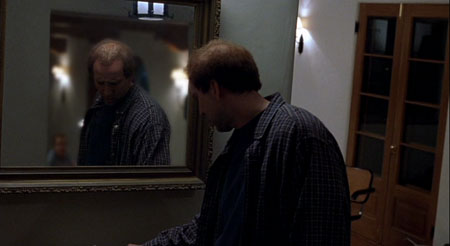
Still from Adaptation. (2002)

BACKGROUND:

  • The screenplay for Adaptation. was on Charlie Kaufman’s to-do list since the late ’90s. Tasked with adapting Susan Orlean’s novel-length essay “The Orchid Thief” and suffering the same problems as his doppelganger, he kept his progress secret from everyone other than Spike Jonze until 2000, when the movie was green-lit for production.
  • Screenwriting guru Robert McKee and his seminars are real. He personally suggested Brian Cox play him in the movie.
  • Adaptation. handily recouped the producers’ investment, with a return of $32.8 million worldwide on a $19 million outlay.
  • Nominated for four Oscars: best actor for Cage, supporting actor for Cooper, supporting actress for Streep, and adapted screenplay for Charlie and Donald Kaufman. Cooper was the only winner.
  • Though “Donald” Kaufman’s serial killer script The 3 was never shot, the idea may have inspired two subsequent movies, 2003’s Identity and 2006’s Thr3e.

INDELIBLE IMAGE: Returning from a misfired date, Charlie finds his twin brother already back home from a writer’s seminar, brimming over with newly adopted wisdom. As Charlie stands in front of his hallway mirror, Donald’s face is captured in the reflection as he expounds upon his own screenplay’s “image system” involving broken mirrors. Charlie’s expression goes from dour to disbelieving at this inanity, and the viewer sees the movie mock both itself and screenplay tricks. A further twist is added by the fact that the blurry reflection in the mirror is the face of the actual Charlie Kaufman talking to Nicolas Cage.

THREE WEIRD THINGS: Film-within-a-film-within-a-screenplay-within-a-screenplay ; Ouroboros; orchid-snorting

WHAT MAKES IT WEIRD: For all its unconventionality, Adaptation is amazingly self-deprecating. Spoilers unravel in opening scenes and are tossed aside, coastal city elites are presented as real people with the petty little problems real people have, and Nicolas Cage gains a bit of weight and loses a bit of hair to provide the compelling double performance as the Kaufman brothers. Events seem scattershot, only to have their purposes later clarified as the tightly structured flow keeps the viewer jumping from moment to moment, always questioning which parts of this convoluted tale are actually true.

COMMENTS: Between its thorough description of the protagonist Continue reading 225. ADAPTATION. (2002)