Tag Archives: Must see

CAPSULE: MYSTERIOUS SKIN (2004)

Must See

DIRECTED BY:

FEATURING: , Brady Corbet, Michelle Trachtenberg, Jeffrey Licon, Elizabeth Shue, Mary-Lynn Rajskub, Bill Sage, Chase Ellison, George Webster

PLOT: Brian, who is missing memories from part of his childhood, believes that he was abducted by aliens; his investigations lead him to Neal, a street hustler who may have had a similar experience.

Still from Mysterious Skin (2004)
WHY IT WON’T MAKE THE LIST: This searing and graphic drama about two damaged boys and their opposite approaches to dealing with trauma is Gregg Araki’s masterpiece, his best movie by a wide margin. Ironically, however, it’s also his least weird film, with only a few dreamlike moments thrown in to relieve the harsh reality.

COMMENTS: Alternating stories in the lives of two former Little League teammates, one now a teenage hustler and the other a UFO-abduction fanatic, Mysterious Skin plays something like Midnight Cowboy with a touch of “The X-Files.”

The performances of both young leads are astounding, and it’s actually a little unfortunate that Brady Corbet’s turn as nerdy, asexual Brian is overshadowed by Joseph Gordon-Levitt’s sexier performance as a prematurely dissipated teenage prostitute. Gordon-Levitt’s role interacting with the various johns, from lonely middle-aged businessmen to touchingly pathetic AIDS sufferers to the inevitable angry sadist, is simply meatier than Corbet’s, who only spars sexually with a frumpy fellow alien-abduction enthusiast. Gordon-Levitt, in his first major part after concluding his run as an alien inhabiting the body of a precocious kid in the sitcom “Third Rock from the Sun,” announces himself here as one of the great upcoming actors of his generation in his dark performance as a cocky boy-stud who isn’t nearly as in control of his life as he believes himself to be.

Each kid has a very different character arc, but they have more in common than it seems. The story’s big “secret” will probably become obvious very quickly, but the drama doesn’t come in the mystery of the big reveal. This is more of a dual character study depicting opposite but equally dysfunctional strategies for dealing with the unthinkable. It’s difficult to watch at times, but it’s played with exceptional compassion and insight that steers well away from survivor clichés—the hustler’s story, in particular, reveals a disturbing but credibly sick psychology. Scenes with cornfed Kansas grotesques finding mutilated cattle with their genitals removed make the Midwest look a little Lynchian; but, other than a misty shot of a Fruit Loop shower and hallucinatory glimpses of an actual UFO, Akari makes very few departures from raw reality here. The supporting performances are all excellent, as is the unobtrusive shoegaze score. This is filmmaking at its most humanistic.

Araki wrote the Mysterious Skin screenplay from Scott Heim’s novel. According to a Heim interview included on the Blu-Ray edition, the director consulted the original author on the adaptation, although Heim decided to get out of the way and not meddle unless asked after the contract was signed. Heim was then invited to tour with the cast and crew as they took the film on the festival circuit. The dynamic between the original author and the adapter here appears to be a model working relationship.

WHAT THE CRITICS SAY:

“The film has a weird buoyancy…”–Stephanie Zacharek, Salon.com

(This movie was nominated for review by “Tori.” Suggest a weird movie of your own here.)
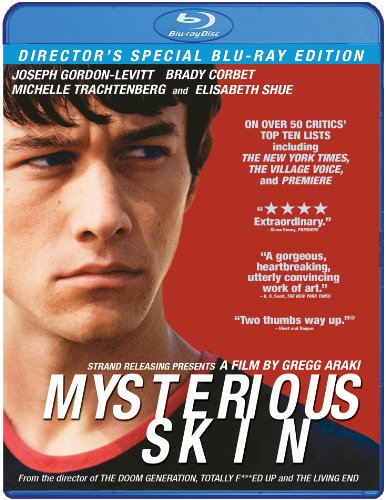
Mysterious Skin (Director's Special Blu-Ray Edition)

  • Factory sealed DVD

New starting from: 100.00 $

Go to Amazon

CAPSULE: THE BIRDS (1963)

Must See

DIRECTED BY: Alfred Hitchcock

FEATURING: , Rod Taylor, Jessica Tandy, , Veronica Cartwright

PLOT: Without explanation, birds begin attacking the quiet seaside town of Bogeda Bay, interrupting a burgeoning love affair between a socialite and a lawyer.

Still from The Birds (1963)
WHY IT WON’T MAKE THE LIST: A great movie, but only the raw inexplicability of the avian attacks makes this Hitchcock worthy of any particular weird notice.

COMMENTS: The crow has long been an omen of death, but never have our fine feathered friends been so conspicuously thantatotic as in Alfred Hitchcock’s first true horror (as opposed to suspense) film. Hitch’s typical plotting trick—beginning with one situation, then springing a twist in the movie’s first half that makes the opening irrelevant—has never worked as well thematically as it does here. Melanie and Mitch’s coy flirtations, cultured as they may be, are rendered ridiculous midway through the film in light of the raw realities of the assault from above. And yet, by the time the first wave of pecking finches swoop through the chimney, we’re invested in the pair. The birds—natural, inexorable, and inexplicable, brooding on their makeshift roosts—are the perfect images of death, looming for all of us. Thoughts of romance may occupy the early reels, but as the story moves on, the birds’ inevitable victory over our heroes becomes clear, and the tale turns to the desperate, if doomed, fight for survival.

Incredibly, you will sometimes hear people complain that the movie is flawed because it does not explain why the birds are attacking. Providing an explanation would have turned The Birds into the silliest type of B-movie fare. How unsatisfying would it be if  it turned out the birds had gone mad from drinking water contaminated with waste from an experimental nuclear reactor? The heart of The Birds‘ horror is the incomprehensibility of the attack, which reflects the incomprehensibility of our own mortality. The inconclusiveness of the scene in the restaurant where the townsfolk debate the cause of the catastrophe is the centerpiece of the film, dramatizing the residents’ utter failure to come to grips with the situation and the futility of their plight. One citizen theorizes that, unmotivated, the birds have suddenly declared war on humanity; a scientist absurdly spends her time explaining why what is happening can’t be happening; the crazy old coot in the corner warns that it’s the end of the world. (That last guess is probably the closest to being correct, though there’s no Biblical element to the story).

One woman assumes that, because there were no bird attacks before Melanie came to town, the disaster is the interloper’s fault. Perhaps; Melanie’s reaction (slapping the woman) suggests guilt. Melanie’s arrival stirs the Freudian pot between Mitch and his widowed mother, and brings schoolteacher Annie’s buried feelings back to the surface—she’s a destabilizing sexual force. (Curious that almost all the major roles in the film go to females, with Mitch alone at the center of a web of women). Besides those psychological teases, there’s also an inevitable Cold War subtext the film. When the birds strike and the family is holed up in their homes, seeking any news of the disaster on the radio, it surely must have struck a cord with American audiences still on edge from 1962’s Cuban Missile Crisis. The chilling final shot of a bird-strewn pre-dawn landscape is like a post-apocalyptic world covered in feathered fallout.

Universal’s 2014 Blu-ray release is essentially the single disc version of The Birds disc from the “Alfred Hitchcock Masterpiece Collection” 15-disc box set. It’s packed with extra features too numerous to list here; there are actually more minutes devoted to the bonuses than to the two-hour movie itself. Hitch’s blackly ironic trailer where he “lectures” on humanity’s historical relations with his fine feathered friends is typically droll and brilliant.

WHAT THE CRITICS SAY:

“Few films depict so eerily yet so meticulously the metaphysical and historical sense of a world out of joint.”–Richard Brody, The New Yorker

168. MR. NOBODY (2009)

366 Weird Movies may earn commissions from purchases made through product links.

“Oh, my God, and when you got up in the morning, there was the sun in the same position you saw it the day before—beginning to rise from the graveyard back of the street, as though its nightly custodians were the fleshless dead—seen through the town’s invariable smoke haze, it was a ruddy biscuit, round and red, when it just might as well have been square or shaped like a worm—anything might have been anything else and had just as much meaning to it…”–Tennessee Williams, The Malediction

Must See

DIRECTED BY:

FEATURING: , Toby Regbo, Sarah Polley, Natasha Little, , , , Linh Dan Pham

PLOT: In 2092, after all disease has been conquered through cellular regeneration technology, 119-year old Nemo Nobody is the last mortal man left in the world. He recounts his life story to a psychiatrist and a reporter, but his memories are wildly inconsistent and incompatible, and at times fantastic and impossible. In his confused recollections he is married to three different women, with multiple outcomes depending on choices that he makes in the course of his life; but which is his real story?

Still from Mr. Nobody (2009)

BACKGROUND:

  • The genesis of this story came from Jaco Van Dormael’s 1982 short film “È pericoloso sporgersi,” about a boy who must make an “impossible” choice between living with his mother or with his father.
  • According to Van Dormael the script took seven years to write, working about five and a half hours a day, every day.
  • Van Dormael published the Mr. Nobodoy screenplay (in French) in 2006, one year before production began and three years before the film was completed.
  • Despite being made in 2009, the movie was not released in the U.S. until 2013, and then only in an attempt to capitalize on the Oscar buzz surrounding Jared Leto’s performance in Dallas Buyers Club.
  • Leto temporarily retired from acting after Mr. Nobody, spending the next four years focusing on his band Thirty Seconds to Mars.
  • Mr. Nobody’s first name, Nemo, means “nobody” in Latin.
  • The movie is full of visual tricks and illusions, some of which are so subtle that they’re easy to miss. For example, watch for a scene where Nemo enters a bathroom then focuses on his own image in a mirror. When he turns around and the camera follows him back out of the room, we now see the perspective as if we had passed through the mirror; the reflection seamlessly swaps places with the real world.

INDELIBLE IMAGE: Mr. Nobody‘s essential image is of branching, criss-crossing railroad tracks; if you want something with a little more surreal zip, however, check out the scenes of a fleet of helicopters delivering slices of ocean, slowly lowering them into place on the horizon.

WHAT MAKES IT WEIRD: Essentially an experimental narrative film disguised as a big-budget science fiction extravaganza, Mr. Nobody, an epic fantasia in which the protagonist lives a dozen different lives and a dozen different realities, was doomed to be a cult film from its inception. Even with a healthy dose of romantic sentimentality and whimsy a la , it is far too rare and peculiar a dish for mainstream tastes. The opening is confusing, the moral ambiguous, and reality won’t sit still; it’s got unicorns, godlike children, helicopters delivering the ocean, a future world where everyone has their own genetic pig and psychiatrists are known by their facial tattoos, and a malformed sub-reality where everyone wears argyle sweaters. It’s unique, unforgettable, and utterly marvelous.


Original trailer for Mr Nobody

COMMENTS: One of the enigmatic Nemo Nobody’s many possible past identities is a TV science lecturer who explains such esoteric concepts as Continue reading 168. MR. NOBODY (2009)

167. RUN LOLA RUN (1998)

Lola rennt

366 Weird Movies may earn commissions from purchases made through product links.

“One of the big problems of the movie for me was always that I thought, how can we make the repetition idea become something spectacular and exciting, and not make it feel like ‘oh my God, it’s starting again, how boring.’ So this was really a big task for me, not losing the concentration of the audience and really having them care for what happens again and again. So we tried to really make it very exciting and very strange and different…”–Tom Tykwer, Run Lola Run DVD commentary

Must See

DIRECTED BY:

FEATURING: , Moritz Bleibtreu, Herbert Knaup, Nina Petri

PLOT: Lola’s boyfriend calls her on the phone: he needs 100,000 Deutschmarks in twenty minutes to pay off a gangster, or he’s going to be killed. Lola has no money and no transportation, but she formulates a plan in a split second, and takes off running. She arrives too late and the story ends in tragedy; but fortunately, she gets a do-over.

Still from Run Lola Run (1998)
BACKGROUND:

  • Lola‘s narrative structure is almost identical to Krzysztof Kieślowski’s 1981 film Blind Chance.
  • The film’s first epigram is a famous quote from T.S. Eliot’s “Little Gidding.” The second quotation, “Nach dem Spiel ist vor dem Spiel” (“after the game is before the game”) is from World Cup champion coach Sepp Herberger.
  • This fast-paced film contains 1581 cuts, averaging out to 2.7 seconds per shot.
  • Lola rennt swept the major categories at the 1999 German Film Awards, with the notable exception of Best Actress—Franka Potente was not even nominated. It won around twenty other awards from international critics associations, but was not nominated for an Academy Award.
  • Voted #86 on Empire’s List of the 100 Best Films Of World Cinema.

INDELIBLE IMAGE: Lola, running. Writer/director Tom Tykwer himself has said that the genesis of the film came from an image that sprang to his mind of a woman running through the streets; he constructed a scenario around the picture in his mind’s eye to explain where this vision was racing to. Since we’re interested in weirdness, we’ll focus on one specific iteration of the recurring image of Lola running: when she dashes out of her parents’ home, the camera circles around her mother’s room to catch a television set, where a cartoon version of Lola is flying down the spiral staircase.

WHAT MAKES IT WEIRD: Run Lola Run has the hip surreality of a music video. Stylized within a heartbeat of its life, Lola is as proudly and defiantly artificial as Franka Potente’s Strawberry-Shortcake-with-her-head-on-fire dye job.


Original trailer for Run Lola Run

COMMENTS: “Foreign movies come off really weird,” headlines one Amazon reviewer, who confesses that he got annoyed watching the opening and Continue reading 167. RUN LOLA RUN (1998)

157. NOSFERATU (1922)

Nosferatu, eine Symphonie des Grauens; Nosferatu, a Symphony of Horror

366 Weird Movies may earn commissions from purchases made through product links.

“It is commonplace to say that silent films are more ‘dreamlike,’ but what does that mean? In ‘Nosferatu,’ it means that the characters are confronted with alarming images and denied the freedom to talk them away.”–Roger Ebert

Must See

DIRECTED BY: F.W. Murnau

FEATURING: Max Schreck, Gustav von Wangenheim, Greta Schröder, Alexander Granach

PLOT: A young clerk named Hutter leaves his wife Ellen to travel to Transylvania with a deed for one Count Orlock to sign so he can purchase a house in Viborg. Orlock, however, is nosferatu, a vampire, and Hutter find himself a prisoner in the Count’s castle as Orlock ships himself to the German port in a coffin. When Orlock arrives the town is shut down for fear of plague, and the vampire takes an interest in Ellen…

Still from Nosferatu (1922)

BACKGROUND:

  • F.W. Murnau’s first seven films, made between 1919 and 1921, are all considered lost. Among them was an adaptation of “Dr. Jekyll and Mr. Hyde.” Nosferatu was his tenth movie.
  • Albin Grau, Nosferatu‘s co-producer, financier and production designer, was an occultist and a German rival of . His production company Prana intended to produce films promoting occultist beliefs, but the company went bankrupt after Nosferatu.
  • Nosferatu is an unauthorized adaptation of Bram Stoker’s novel “Dracula,” barely disguised by changing the names and moving the action from London to Germany. The Stoker estate successfully sued the filmmakers for copyright infringement after release, and the film was ordered to be destroyed (fortunately, many prints survived).
  • Ranked #21 on Empire Magazine’s List of Best Films of World Cinema.
  • ‘s 2000 film Shadow of a Vampire is about the making of Nosferatu, and plays on the notion that the actor Max Schreck might really have been a vampire (an idea fleshed out from a tongue-in-cheek suggestion made by the writer Ado Kyrou in his book “Surrealism in Cinema”).

INDELIBLE IMAGE: What else could it be but Max Schreck, the rat-faced herald of plague and pestilence and the screen’s most bestial bloodsucker? The scene where he rises unnaturally, stiff as a plank, from his coffin in the ship’s hold still presses the primal panic button.

WHAT MAKES IT WEIRD: The experimental use of negative images, sped up film stock, primitive stop motion photography, and the play of shadows to suggest a diabolical world coexisting with our mundane sunlit world creates an uncanny, nightmarish universe. The once new and startling techniques Murnau employs quickly became commonplace, but after nearly a century of disuse they have again become novel through their very archaism.


Trailer for a 2013 re-release of Nosferatu

COMMENTS: At the dawn of cinema, horror movies weren’t diversions meant to give teenage boys an excuse to put a comforting arm around their Continue reading 157. NOSFERATU (1922)