Tag Archives: Melodrama

IT CAME FROM THE READER-SUGGESTED QUEUE: A WOMAN’S FACE (1941)

DIRECTED BY:

FEATURING: Joan Crawford, , , Osa Massen

PLOT: Anna Holm stands accused of murder; during the course of her trial, the court learns of her unhappy past as a woman with a hideous facial scar that has led her into committing crimes against the populace that scorns her.

Still from A Woman's Face (1941)

COMMENTS: Anyone who thinks of Joan Crawford today is inclined to view her as a monster. A series of unfortunate films that concluded her career, including as Strait-Jacket, Berserk and Trog, could be to blame. It might be because of her role in the American Guignol What Ever Happened to Baby Jane? and her rivalry with , mythologized in “Feud: Bette and Joan.” But let’s not kid ourselves. It’s mostly Mommie Dearest. Daughter Christina’s nightmare account of her upbringing and Faye Dunaway’s subsequent portrayal of Crawford as a legendarily campy villain cemented her reputation as an icy devil with the veneer of Disney’s Evil Queen.

This makes watching A Woman’s Face a peculiar proposition, because it acts as a kind of retroactive rebuttal to all the gossip and the negative imagery. Crawford’s put-upon heroine knows what you think of her (one poster for the film blares, “They called her a scarfaced she-devil!”), and she would only be too happy to play the part, if only her soul wasn’t so pure and broken.

A Woman’s Face (based on a Swedish film starring Ingrid Bergman, which itself was adapted from a French play) is at its core an examination of what makes someone do bad things. This film’s argument is that Anna isn’t bad, she’s just drawn that way. Her disfigurement at a young age has provided her with a life of rejection and derision, and she instinctively responds in kind. It’s no wonder that she immediately melts for Veidt simply for doing her the courtesy of not recoiling at the sight of her. And most of the people we meet early on seem to deserve her scorn, particularly the duplicitous Massen, upon whom Crawford vents her anger in a thrilling display of violence.

Unfortunately, this premise means that, once Crawford’s visage is restored thanks to Douglas’ ministrations, the machinations required to push her into a far more reprehensible crime feel extremely forced. Crawford’s heart is never really in the murderous scheme pressed upon her, especially after she meets the precocious moppet who is to be her victim. (It’s a genuinely heartbreaking moment when the kid displays a typical example of youthful insensitivity, and she reaches instinctively to cover her repaired face.) Veidt, meanwhile, is entertainingly evil but not actually that persuasive, an issue director Cukor would resolve more effectively four years later in Gaslight. So you just have to take it on faith that she might do this awful deed, even though there’s nothing to outwardly indicate this. Further examples of the film not playing fair with the audience: witnesses are interrogated in an order designed for maximum delay and misdirection (in what universe does the defendant take the stand in the middle of the trial?), and a decisive piece of evidence is withheld until late in the third act and further hidden from the film’s characters until the closing minutes. 

A lot of this is silly carping on my part, because this is classic melodrama, pure and simple. The Phantom of the Opera-esque scar lends a veneer of strangeness to the formula (as does an amusingly odd Swedish folk dance that takes up a surprising amount of screen time), but the real centerpiece is Crawford deftly playing to both extremes of her reputation. Perhaps only she would be strong enough to wield a gun in the film’s climax while also weak enough to lash out at the perceived manipulations of everyone around her. Joan Crawford knows you think she’s a monster, and she’s not ashamed to shed a tear over it, either.

WHAT THE CRITICS SAY:

A Woman’s Face is magnificently daft, but the gorgeously photographed Crawford’s intense, persuasive star turn and Cukor’s attentive, crafted film-making work make it compelling.” – Derek Winnert, derekwinnert.com

OTHER LINK OF INTEREST: 

Six Degrees of Joan Crawford – Karina Longworth’s deservedly acclaimed Hollywood history podcast You Must Remember This devoted a sextet of episodes to Crawford’s career and her position as “the quintessential female star of the 20th century.”

(This movie was nominated for review by s, who calls it “pretty startling for a 1940’s ‘women’s picture’” and says “(t)he third act is a real stunner.” Suggest a weird movie of your own here.)

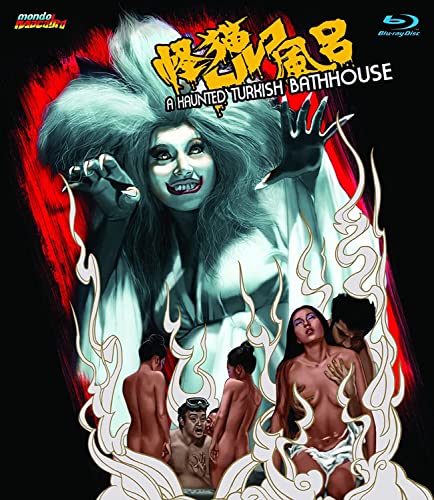
CAPSULE: A HAUNTED TURKISH BATHHOUSE (1975)

366 Weird Movies may earn commissions from purchases made through product links.

Bakeneko Toruko furo

DIRECTED BY: Kazuhiko Yamaguchi

FEATURING: Naomi Tani, , Tomoko Mayama, Misa Ohara,

PLOT: A prostitute reincarnates as a vengeful ghost cat to seek revenge on her abusive pimp husband.

Still from A Haunted Turkish Bathhouse (1975)

COMMENTS: A Haunted Turkish Bathhouse is the softcore/yakuza/melodrama/horror mashup obscurity you’ve been waiting for (if you’re the “you” in the above formulation, you’ll know it). This breathless nonsense hits its soapy plot points with ruthless economy as it rushes towards its demonic vengeance, with nothing to interrupt the flow except for gratuitous rape, torture, and sex scenes. The lavish sets and painted sunsets make it look as good as a mainstream film of the era, but make no mistake: this ain’t art, it’s overproof exploitation.

Japan’s 1957 ban on public prostitution supplies the initial plot hook, as brothel workers migrate from legal sex work to going undercover at a “Turkish bathhouse” serving as a front for prostitution. Only Yukino (Tani) refuses to make the switch, preferring to take this as an opportunity to retire and spend more time with her husband (and her black cat). Hubby (a scenery-chewing Murota) is no prize, however; he stages an elaborate ruse to fake a debt to the yakuza to convince Yukino to go back to work, then invites her virgin sister to live with the couple so he can rape her. He’s also somehow hiding the fact that he’s second in command at the brothel Yukino’s been working at for years, while simultaneously starting up an affair with the bathhouse madame and owner’s wife. After Yukino gets pregnant and refuses an abortion, he and the madame make sure she’s taken care of (in a very sick torture scene), walling up the corpse a la Poe. In the second act, Yukino’s disgraced sister shows up and goes undercover at the bathhouse looking for revenge, but when she proves the most popular courtesan, the other girls get jealous and decide to beat her, until Yukino’s cat flies (literally!) into the brawl to scratch up hooker faces. As you can see, there’s a lot of plot going on here, but nevertheless the script finds time about every ten minutes to squeeze in a scene of bathhouse girls lathered up with soap, rubbing their naked bodies over clients who mug for the camera with expressions of comical ecstasy. And so it goes until the third act, when the vengeful cat spirit finally arrives in all its Kabuki kitty glory, turning the final twenty minutes into an intense stalking scene (interrupted by only a single bubble bath sex romp). Having sliced up the evildoers with cat claws or burned them to a crisp, an angelic Yukino recedes into the painted sky. Roll credits.

Production values—the bright cinematography, imaginative camera angles, relatively extensive sets and costumes, and a screechy, psyched-out rock soundtrack—are vastly superior to what you would find in a Western sleaze movie. In the Japanese studio system, there was less of a budgetary distinction between, say, a historical drama and a raunchy “pink film.” With one studio (here Toiei) making both prestige and exploitation movies, productions shared casts, directors, crews, and sets; a stalwart like Taiji Tonoyama could act in an S&M-tinged pink movie like this in-between roles in films. This gives a quickie like Bathhouse an unusual aura of professionalism, for a movie that’s basically a wacky, hastily plotted romp designed to put butts in seats and boners in pants.

Mondo Macabro puts out another fine-looking, expensive-feeling disc. The main bonus here is a passionate commentary from film writer Samm Deighan, who provides a great deal of context and information about the Japanese industry, the players, and the history of the various subgenres colliding here (while also, I would say, overselling the movie as a serious artistic effort.) A couple of featurettes from Japanese cult movie historian Patrick Macias, one on horror at Toei Studios in general and one specifically devoted to A Haunted Turkish Bathhouse, further supplement Deighan’s extensive background information. About fifteen minutes of trailers, for Bathhouse and other sexy/violent Mondo Macabro titles, round out a presentation that makes for a satisfying night at the movies for those willing to overlook the violent misogyny inherent in the pink genre.

WHAT THE CRITICS SAY:

“…an outrageous horror-sex Toei production that packs more into 80 minutes than many viewers’ brains will be able to handle.”–Nathaniel Thompson, Mondo Digital (Blu-ray)

A Haunted Turkish Bathhouse

    List Price : 29.95 $

    Offer: 17.59 $

    Go to Amazon

    CAPSULE: PLEASE BABY PLEASE (2022)

    366 Weird Movies may earn commissions from purchases made through product links.

    DIRECTED BY:

    FEATURING: , , Karl Glusman

    PLOT: A gender-bending leather gang awaken unfamiliar desires in a beatnik couple.

    Still from Please Baby Please (2022)

    COMMENTS: Please Baby Please is queer, defiantly so, in both the new and the old senses of the word. This movie is proud to be what it is—which is a perverted, experimental non-binary comedy/melodrama/musical, or something like that. This is a film that describes itself as featuring “bisexual lighting,” and that somehow makes perfect sense when you see it. It seems like the script was written to answer the question, what would happen if the leather daddies from Scorpio Rising took over the set of West Side Story?

    That last connection is referenced explicitly in the movie’s opening scene, where a leather clad gang prowls the streets in finger-snapping rhythm. These aren’t the Sharks or the Jets, though, but the Young Gents, an ultra-macho bunch of reprobates with a dangerously non-hetero vibe. When happily (if platonically) married couple Suze and Arthur come across the gang standing over a couple of freshly beaten corpses on the street right outside their apartment, their libidos are separately ignited by the heart-pounding excitement. Please Baby Please doesn’t feature a lot of narrative; there is an arc to the couple’s journey, but most of it is revealed through oddball exposition (most of the characters in this movie talk like Dead End Kids enrolled in NYU’s Gender Studies masters’ program). Much of the rest comes in musical production numbers: Suze’s sexual awakenings are depicted in a series of musical fantasies, including one where the Young Gents take turns ironing her ass.  We’re also treated to interludes like a drag queen in a Bo Peep bonnet and flowery eyelids singing a love song in a phone booth. The fine musical accompaniment ranges from exotica to mellow acoustic bass jazz to poppy torch songs; the choreography is simple but effective, more dependent on the dancers’ outrageous wardrobes than on the moves they perform. True to the 1950s style, everything is repressed, and there’s little actual sex: we come upon two motorcycle dudes doing nothing more than hugging passionately in the men’s room. The characters do talk dirty, but in the context of gender roles rather than personal desires. Only the final scene breaks the no-onscreen sex rule.

    Please Baby Please is obsessed with masculinity. Arthur has built his entire life philosophy around how doesn’t want to be a man, doesn’t want the pressure of always having to be a contestant in a toughness competition with other males. That doesn’t mean he’s not attracted to masculine surfaces, though; to the rippling abs, mesh-clad pecs, and leathery bulges of the Young Gents. The motorcycle gang stands for the masculine ideal in all its muscly, sneering, rough-mannered charm. In 1953, Marlon Brando in The Wild One evoked an outlaw desires for rebellion and domination in female audiences; Tom of Finland was simultaneously (and more lastingly) co-opting the same biker imagery for the gay subculture.  Please Baby Please is aware how ludicrous a caricature of manhood all this chrome and black leather is; that’s precisely why it’s fascinated with this iconography. This objectifying beefcake spectacle is especially weird because it’s shot through multiple lenses: a female director looking at men through the homosexual male gaze.

    Handsomely geeky Harry Melling ably handles his duties of playing a closeted homosexual in a rewarding but familiar way, but much of the praise for Please Baby Please comes for Andrea Riseborough, whose over-the-top vamping wins over even the film’s detractors. Her acting choices all seem to be formed by asking the question, “how would Nic Cage play this scene if he were a housewife caught in a sexless marriage?” She gyrates in a corset, howls at the moon, breaks into a spontaneous Bert Lahr impersonation, and acts crazier and crazier (and more and more like a man) as the movie progresses. This risky material could sag limply if not aroused by hyperbole, so it’s hard to imagine the movie succeeding without Riseborough’s committed insanity setting the tone.

    ‘s cameo was much-hyped, but underwhelming; the most significant thing is the vote of confidence she casts by lending her name to this esoteric project. We did notice an old friend showing up as co-writer: . Please Baby Please is currently in a limited run exclusively in theaters; we’ll update you when it becomes more widely available.

    WHAT THE CRITICS SAY:

    “…the film’s over-the-top approach and awkward pacing prevent this defiantly bizarre concoction from resonating deeper than its surface fascination. “–Toff Jorgensen, Cinemalogue (contemporaneous)

    16*. BAD GIRLS GO TO HELL (1965)

    366 Weird Movies may earn commissions from purchases made through product links.

    DIRECTED BY:

    FEATURING: Gigi Darlene

    PLOT: Meg awakens beside her young husband, who leaves her alone in their apartment to go to a business meeting. Stepping outside her door to empty the trash, she is assaulted by the building’s janitor, and kills him while he’s trying to rape her. Fearing that no one will believe her story of self-defense, Meg gets on a bus to New York City, where she shacks up with a series of roommates.

    Still from Bad Girls Go to Hell (1965)

    BACKGROUND:

    • Background information about Doris Wishman can be found in the Indecent Desires Canonical entry.

    INDELIBLE IMAGE: It’s either the snarling face of a rapist or a woman in her underwear. (Or, I suppose, I random shot of a shoe.) We selected the moment when Gigi Darlene demonstrates her junior-high tumbling skills for her drooling lesbian roommate by crab walking across the apartment floor (in her underwear, of course).

    TWO WEIRD THINGS: Drunken belt-whipping; random plants, ashtrays, and feet

    WHAT MAKES IT WEIRD: Bad Girls Go to Hell has the visual sensibilities of a drunk and apathetic , the narrative talents of an Ed Wood, and the moral sensibilities of a 42nd Street raincoater; yet, somehow it creates a sense of alienation and dislocation reminiscent of Carnival of Souls .


    Original trailer for Bad Girls Go to Hell (mildly NSWF)

    COMMENTS: It’s amazing how barren a movie that clocks in at just Continue reading 16*. BAD GIRLS GO TO HELL (1965)

    9*. GEMINI (1999)

    Sôseiji

    366 Weird Movies may earn commissions from purchases made through product links.

    Recommended

    DIRECTED BY:

    FEATURING: Masahiro Motoki, Ryô

    PLOT: Yukio is a successful doctor, decorated for his service in the war. His wife Rin is an amnesiac. Yukio discovers he has an identical twin from whom he was separated at birth—a resentful and savage twin, bent on revenge.

    Still from Gemini (1999)

    BACKGROUND:

    • Tsukamoto adapted the story from a 1924 short story by Edogawa Rampo (“the Japanese Edgar Allan Poe”).
    • In an unusual move, fellow director assembled a 15-minute “making of” featurette to accompany the film on DVD.

    INDELIBLE IMAGE: Our first glimpse of the twin in the shadows. He looks just like Yukio, but wears ragged robes and a bizarre fur earmuff that covers half of his face. He shakes like he’s having a fit, then approaches the camera by doing cartwheels. It’s scary enough to give someone a heart attack.

    TWO WEIRD THINGS: Eyebrowless clan; somersaulting doppelganger

    WHAT MAKES IT WEIRD: Pulling back from the unbridled mania of Tetsuo: The Iron Man and similar body-horror experiments, Shinya Tsukamoto proves that he can generate cold sweats with a more subtle, purely psychological approach. With its deep shadows and determined pace, Gemini generates an uncanny horror that seeps into your bones.

    The opening minutes of “The Making of Gemini

    COMMENTS: Gemini begins with an abstract, ominous prologue. It Continue reading 9*. GEMINI (1999)