Tag Archives: Independent film

CAPSULE: JULIEN DONKEY-BOY (1999)

DIRECTED BY:

FEATURING: , , , Evan Neumann

PLOT: Scenes from the life of schizophrenic Julien and his bizarre family.

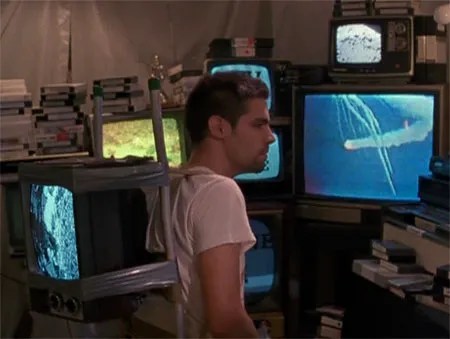
Still from Julien Donkey-boy (1999)


WHY IT WON’T MAKE THE LIST: Made between his startling debut Gummo (1997) and his acerbic comeback movie Trash Humpers (2009), Julien Donkey-Boy is the Harmony Korine experiment that falls through the cracks. Sure, it’s got its fertile weird moments—Korine puts Werner Herzog in a gas mask and has him swill cough syrup—but its indifference to narrative or structure makes for a lot of dry patches, resulting in a frequently dull movie that’s of interest to hardcore Korine-ophiles only.

COMMENTS: Switching from familial underwear wrestling matches to hidden camera thrift store excursions to snippets from a freakshow talent contest, with all the footage apparently shot by a drunk and edited by a psychotic, the movie Julien Donkey-boy is as schizophrenic as its protagonist. Julien himself is ably, if unpleasantly, portrayed by Scottish Ewan Bremner, who drools and slurs ridiculous monologues from behind a grill of gold teeth (presumably the source for the “donkey-boy” title reference). Julien’s brother is an aspiring wrestler; his sister practices ballet in her room at night, but she’s in her third trimester. Lording over this motley brood is pop Werner Herzog; he swigs cough syrup (from a slipper), listens to Dock Boggs and occasionally wears a gas mask. He has given up on Julien and his sister and focuses all his hopes and attention on their athletic brother. We absorb these relationships slowly as the movie weaves from one improvised incident to another. Julien spies on his sister dancing, then takes a bath and gibbers out a prayer, then the family has dinner and Herzog discusses the false-teeth cleaning habits of famous people, and so on. Other scenes are simply impressionist camera experiments, with out-of-focus, seasick handheld shots and experimental lighting. Korine keeps up his obsession with grotesqueries and freaks, finding ways to shoehorn a dwarf who plays drums with his feet, a rapping albino, and a human ashtray into the story. One bizarre, disconnected scene shows a nun masturbating. The deliberately undisciplined technique of stitching together sketches shot in various styles is carried over from Gummo, but the collage approach doesn’t work as well for painting a portrait of an individual as it did for a town. By repeating words like mantras and babbling nonsense syllables to fill in the empty spaces in his monologue stream, Julien’s speech resembles a real schizophrenic. But, like a real schizophrenic, although you feel sorry for him, you also don’t want to spend a lot of time with him. The character manages to be simultaneously irritating and boring, which are not the defining characteristics you want in a movie protagonist. In a key scene, Julien proudly recites a poem at the dinner table: “morning chaos eternity chaos midnight chaos noon chaos eternity chaos…” It goes on for several stanzas before Herzog interrupts, explaining he doesn’t like the poem because it’s too “artsy-fartsy.” He then describes the climax of Dirty Harry as his idea of great art. Korine seems to be mocking the public preference for meaningless exploitation over artistic ambition, but the irony is that anyone would consider Dirty Harry a greater achievement than Julien’s nonsense poem. Julien Donkey-boy emerges as the least interesting of Korine’s experimental features, which is a shame because it’s also his most humanistic pictures, and the only one where he seems to truly like his characters (Julien was based on Korine’s uncle). The scene where Sevigny pretends to be Julien’s dead mother while talking to him on the telephone is unexpectedly touching, and the shots of the pregnant blonde meandering through a golden field of sunlit grain while singing hymns counts as the most legitimately beautiful thing Korine has ever filmed. It’s too bad these few sympathetic moments are drowned out by a cascade of babble.

Julien Donkey-boy starts with a certificate (signed by ) proclaiming that the movie was produced in accordance with the Dogma 95 movement. Dogma was a set of rules set forth by von Trier and other Danish filmmakers intended to make filmmaking more naturalistic: i.e. there should only be handheld cameras, no music added, only natural lighting, etc. In practice, almost no Dogma film ever followed all of these arbitrary rules (although, as Armond White incisively pointed out, almost every amateur porn movie did). Julien Donkey-boy includes a non-diegetic musical score and lots of optical trickery that should have precluded it from being certified as a Dogma film.

WHAT THE CRITICS SAY:

“…Korine emerges more clearly this time as a filmmaker exploring the territory where the circus sideshow meets the avant-garde.”–Janet Maslin, The New York Times (festival screening)

(This movie was nominated for review by Eric SG, who rhapsodized that it was “frickin’ weird… Korine’s finest/weirdest accomplishment to date.” Suggest a weird movie of your own here.)

LIST CANDIDATE: JOHN DIES AT THE END (2012)

NOTE: John Dies at the End has been promoted onto the List of the 366 Best Weird Movies of All Time; the official Certified Weird entry is here.

DIRECTED BY:

FEATURING: Chase Williamson, Rob Mayes, , , Glynn Turman,

PLOT: A young paranormal investigator relates his strange and twisted backstory to a skeptical reporter. It involves alien creatures, a drug that gives its users heightened senses and psychic abilities, and a parallel universe whose twisted denizens are edging their way into our own.

John-Dies-at-the-End


WHY IT MIGHT MAKE THE LIST: Its labyrinthine plot and genre-bending themes make John Dies at the End an interesting experience, with plenty of bizarre characters and twists, but at times the film is just weird for the sake of being weird, forsaking good storytelling in the process.

COMMENTS: Blending the well-worn motifs of alien invasion, inter-dimensional travel, and the over-confidence of youth into a heady concoction of oddities, John Dies at the End isn’t easy to summarize, or even encapsulate. The narrative flits back and forth erratically as Dave (Chase Williamson) attempts to communicate his experiences to a bemused journalist played by Paul Giamatti. It all starts—sort of—with a late-night phone call from Dave’s excitable friend John (Rob Mayes), whose ingestion of an out-of-this-world drug known as “Soy Sauce” sends him down a time-traveling, mind-reading, future-predicting rabbit hole. Dave accidentally takes some Soy Sauce himself, and soon he is escaping from a hardened police detective (Glynn Turman) who suspects him of several gruesome murders, while trying to save John and two other high school friends who’ve been kidnapped by a demonic being from an alternate universe. And then a lot of other stuff happens, but not always in chronological order.

Without prior knowledge of the webserial/novel this is based on, John Dies at the End can only be a surprise. It rapidly transitions between wry humor, gross-out gore, paranormal mystery, hallucinatory freak-outs, and sci-fi adventure, all set amidst general confusion. This is the type of film that was made to be a cult classic, with little hope for or interest in appealing to a wide audience. At times this obvious intention to be weird means that the film’s comedic and mystery elements are sacrificed for nonsense, but if you’re looking for straight-up bizarre then it’s not a huge loss. The low-quality special effects are mostly excused by unique visual ideas and some well-placed animation.

With its nonlinear narrative structure and consuming focus on strange happenings, the film doesn’t spend too much time developing characters, and as the protagonist Dave is a little weak: for the most part Williamson just shows off his “Sarcastic Inner Monologue” expression or various reaction faces. He and Mayes are both very regular-seeming guys, the kind you probably knew in high school or college. They are surrounded by a charismatic supporting cast, including the lovably loudmouth Giamatti, the imposing Clancy Brown, the hardcore Glynn Turman, and the naturally creepy Doug Jones. Shuffled about by an intricate story and ever-uncertain motivations, they seem to relish the script’s absurdities.

John Dies at the End is uneven as a whole, driven to episodic distraction with an abundance of half-realized subplots and unanswered questions, but it has a way of worming itself into the brain that results in a kind of fascination. The twisted creatures, unexpected sight gags, colorful settings, and surreal visions create an idiosyncratic aesthetic that’s as funny as it is fantastic. Frozen meat comes to life, mustaches fly through the air, headless zombies attack, alien bugs take over unsuspecting drunk teenagers… By the time Dave and John leap into an alternate dimension populated by nude figures with eerie masks ruled by a giant hyper-intelligent spider monster, I was convinced of its Weirdness.

WHAT THE CRITICS SAY:

“Everybody pretty much gets weird throughout this trippy head-shaker of a movie. It’s hard to be sure if the film adds up logically — seems doubtful — but it’s so bizarre you don’t much care.” –Tom Long, The Detroit News (contemporaneous)

135. FORBIDDEN ZONE (1980)

366 Weird Movies may earn commissions from purchases made through product links.

RecommendedWeirdest!

“…[a] spontaneous creation without thought to logic, reason or consequences.”–Richard Elfman on Forbidden Zone

DIRECTED BY: Richard Elfman

FEATURING: , , Marie-Pascale Elfman, Phil Gordon, (as “Toshiro Baloney”), Viva,

PLOT: A curious girl wanders into the surreal “Sixth Dimension” located behind a door in her basement. There she encounters all manner of strange creatures and characters, including a lascivious dwarf king and his jealous wife, while her family members and a hapless schoolmate search for her. Numerous silly musical numbers are dispersed through their adventures.

Still from Forbidden Zone (1982)

BACKGROUND:

  • Forbidden Zone was initially developed as a short film project for the cabaret performance troupe Mystic Knights of the Oingo Boingo, which included brothers Richard and Danny Elfman. They wanted to capture the essence of their live performances at their most grandiose; afterwards, their musical style and stage show moved toward a smaller-scale, New Wave sound (at which point they shortened their name to just Oingo Boingo and became especially popular on 80’s comedy soundtracks, but that’s another story).
  • Composer and singer Danny Elfman, who also appears as the Devil, eventually went on to become a highly successful film composer, known especially for his collaborations with .
  • Several of the songs are reworkings of jazz and swing tunes from the 1920’s and 30’s, including songs by Cab Calloway and Josephine Baker.
  • Marie-Pascale Elfman, who stars as Frenchy, was married to director Richard Elfman at the time, and also designed the playful sets and backdrops.
  • The violent, rowdy school scenes are inspired by Richard Elfman’s Los Angeles high school, which is located in the same neighborhood where Boyz n the Hood later takes place.
  • Warhol superstar Viva was convinced to play the small role of the Ex-Queen because she was able to write her own lines, which mostly consist of a drawn-out monologue about her imprisonment.
  • Hervé Villechaize was once roommates with co-writer Matthew Bright (who plays siblings Squeezit and René) and had dated his co-star Susan Tyrrell. He helped fund the film through its constant financial woes, and in fact most of the actors fed their paychecks back into the production.
  • The film was met with controversy upon release due to its use of blackface and Jewish stereotypes, but eventually it gained cult status.
  • Richard Elfman has mentioned working on Forbidden Zone 2 since 2005, but nothing concrete has materialized—yet.

INDELIBLE IMAGE: A lot of scenes stand out in my mind, especially the musical numbers. While Danny Elfman’s “Squeezit the Moocher” sequence is a personal favorite, Susan Tyrrell’s solo song, “Witch’s Egg,” exemplifies a lot of the film’s visual ingenuity, sexual abandon, and lyrical fun.

WHAT MAKES IT WEIRD: Between the puzzling storyline, psychedelic sets and animated sequences, frequent gender-bending, old-timey jazz/new wave fusion musical numbers, lighthearted sado-masochism, laughably terrible acting, and strange creatures, it’d be more of a challenge to discuss what’s NOT weird about Forbidden Zone. Its cartoonish visuals, eclectic cast, and memorable musical sequences make for a compelling experience, peppered with utterly bizarre additives throughout.

Short clip from Forbidden Zone

COMMENTS: Opening on a lopsided two-dimensional house, Forbidden Zone‘s prologue explains in text-format that a dealer who stashed his drugs Continue reading 135. FORBIDDEN ZONE (1980)

THE BOOK OF DALLAS (2012)

The Book of Dallas, Season One is a 10 episode web series from KoldCast TV. The series comes from the production team of Joe Atkinson, , and Marx H. Pyle. Atkinson wrote the series in response to a crisis in faith. The directing is divided between the three producers.

Dallas McKay (Benjamin Crockett) is a young Catholic atheist (is there any other kind?). Dallas gets into a theological debate at a bar (something akin to theology on tap). His lack of belief offends the self-proclaimed Christians (surprise), then fate takes the upper hand when speeding vehicle meets Dallas on the street.

Still from The Book of Dallas Season1 (2012)Heaven is a coffee shop where Dallas meets a highly emotive St. Peter (David Ross) and a quirky God (Kristine Renee Farley). Yes, God is a girl who likes to eat lots of waffles. I knew it all along. With a mouthful of syrup, God asks Dallas to write a new bible, one which will not inspire people to judge and kill one another. After writing it, Dallas is to go on a book tour and sell it. Real simple.

Now back on Earth, Dallas needs some cash to get started. God gives him the winning lottery numbers. Dallas and his roommate Hank (Clay Evans) are on a mission from God. After finally finding a publisher, Dallas’ book, “The Word,” creates publicity and controversy. The evangelicals predictably hate Dallas, but he does attract a follower named Benjamin (Kevin Roach), who fills in for Dallas after a fundamentalist nut job sends Dallas back to heaven for a spell. Benjamin creates The Church of Unitism. Yes, a new religion.

The Book of Dallas starts off as an overly familiar revisionist look at the state of religion, the likes of which we have seen before (Dogma, Religioulous, et al). The best humor in the series is provided by actors David Ross and Kristine Renee Farley. Aside from these, the comedy is too subdued for this topic. More problematic are the plot solutions, which are too simplistic (a convenient lottery win, miraculous surviving of near-death experiences).

Something more complex would have been more rewarding. The fact that the protagonist survives his ordeals, virtually unscathed, nullifies any real questioning of his supernatural encounters (for Dallas and the audience—the only nonbelievers are the certifiable Christians of the film, which, come to think of it, is probably all too apt).

The biggest issue I take with the series is in “The Word” itself. What does “The Book of Dallas” actually say? We are never really privy to that information. Therefore, Dallas’ actual message is so vague that it fails to connect with us emotionally, intellectually, or theologically. Likewise, the fundamentalist outrage towards the book never quite registers beyond surface. The angry religious mob is merely taken for granted.

The Book of Dallas starts to live up to its complex potential by the 10th episode. Of course, every successful revolutionary movement faces the possibility of becoming  an institution. The Unitist movement veers dangerously close to that fatal error. Upon seeing this, the fire within Dallas is sparked. For the first time, close to the season finale, we sense the prophetic nature swelling within Dallas, along with narrative possibilities for richer, provocative exploration.

Atkinson’s sincerity and effort is to be applauded, despite the occasional “too safe” missteps. The series feels like an opening spark, which may reap rewarding challenges in the second season (and, hopefully, that second season will come to fruition).

Bilinski, a director previously covered here, directs the first, fifth and seventh episodes. The first episode has a texture and pacing similar to elements of his previous Shade of Grey (2009).


. “The Book of Dallas” trailer.

133. LOST HIGHWAY (1997)

366 Weird Movies may earn commissions from purchases made through product links.

Recommended

“In my mind, it’s so much fun to have something that has clues and is mysterious — something that is understood intuitively rather than just being spoonfed to you. That’s the beauty of cinema, and it’s hardly ever even tried. These days, most films are pretty easily understood, and so people’s minds stop working.”–David Lynch

DIRECTED BY:

FEATURING: , , Balthazar Getty, Robert Blake,

PLOT: Fred is a free jazz saxophonist who finds that mysterious videotapes are being dropped off on his doorstep. After an encounter with a ghostly pale man at a party, he blacks out finds himself accused of the murder of his wife. In prison Fred begins having headaches, and then one day he disappears and a completely different man—a young mechanic—is discovered in his death row cell.

Still from Lost Highway (1997)

BACKGROUND:

  • The screenplay to Lost Highway was co-written by Barry Gifford, who also wrote the novel “Wild at Heart” that Lynch adapted into a film in 1990.
  • Lost Highway received two “thumbs down” ratings from Siskel & Ebert’s “At the Movies” syndicated movie review program. Lynch insisted the movie poster be rewritten to highlight the critics’ dual pans, describing the bad ratings as “two good reasons to go and see Lost Highway.”
  • The film cost about 15 million dollars to make but grossed less than 4 million at the U.S. box office.
  • Lost Highway boasts a number of cameo roles, including rockers Henry Rollins as a guard and Marilyn Manson as a porn actor,  mainstay  in a voiceover, and Richard Prior as one of Pete’s co-workers.
  • This film marks the last onscreen appearance of , who appeared in all of Lynch’s films until his death in 1996.

INDELIBLE IMAGE: Robert Blake’s “Mystery Man,” an eyebrow-free, perpetually grinning pasty-faced ghoul who likes to crash L.A. cocktail parties and whose idea of small talk is to call himself on his cell phone to deliver obscure metaphysical portents of doom.

WHAT MAKES IT WEIRD: Imagine you’re on a desert highway. It’s long past midnight and you can’t see anything but the onrushing yellow traffic lines a few feet in front of the car’s headlights. is crooning “funny how secrets travel” from the stereo. David Lynch is at the wheel, he’s jittery from drinking too much coffee, and neither you nor he has no idea where you’re going. Strap yourself in. It’s going to be a wild ride.


Original trailer for Lost Highway

COMMENTS: Made five years after the divisive mixed blessing that was Twin Peaks: Fire Walk with Me, Lost Highway marks the beginning of the Continue reading 133. LOST HIGHWAY (1997)