Tag Archives: Horror

CAPSULE: A HAUNTED TURKISH BATHHOUSE (1975)

366 Weird Movies may earn commissions from purchases made through product links.

Bakeneko Toruko furo

DIRECTED BY: Kazuhiko Yamaguchi

FEATURING: Naomi Tani, , Tomoko Mayama, Misa Ohara,

PLOT: A prostitute reincarnates as a vengeful ghost cat to seek revenge on her abusive pimp husband.

Still from A Haunted Turkish Bathhouse (1975)

COMMENTS: A Haunted Turkish Bathhouse is the softcore/yakuza/melodrama/horror mashup obscurity you’ve been waiting for (if you’re the “you” in the above formulation, you’ll know it). This breathless nonsense hits its soapy plot points with ruthless economy as it rushes towards its demonic vengeance, with nothing to interrupt the flow except for gratuitous rape, torture, and sex scenes. The lavish sets and painted sunsets make it look as good as a mainstream film of the era, but make no mistake: this ain’t art, it’s overproof exploitation.

Japan’s 1957 ban on public prostitution supplies the initial plot hook, as brothel workers migrate from legal sex work to going undercover at a “Turkish bathhouse” serving as a front for prostitution. Only Yukino (Tani) refuses to make the switch, preferring to take this as an opportunity to retire and spend more time with her husband (and her black cat). Hubby (a scenery-chewing Murota) is no prize, however; he stages an elaborate ruse to fake a debt to the yakuza to convince Yukino to go back to work, then invites her virgin sister to live with the couple so he can rape her. He’s also somehow hiding the fact that he’s second in command at the brothel Yukino’s been working at for years, while simultaneously starting up an affair with the bathhouse madame and owner’s wife. After Yukino gets pregnant and refuses an abortion, he and the madame make sure she’s taken care of (in a very sick torture scene), walling up the corpse a la Poe. In the second act, Yukino’s disgraced sister shows up and goes undercover at the bathhouse looking for revenge, but when she proves the most popular courtesan, the other girls get jealous and decide to beat her, until Yukino’s cat flies (literally!) into the brawl to scratch up hooker faces. As you can see, there’s a lot of plot going on here, but nevertheless the script finds time about every ten minutes to squeeze in a scene of bathhouse girls lathered up with soap, rubbing their naked bodies over clients who mug for the camera with expressions of comical ecstasy. And so it goes until the third act, when the vengeful cat spirit finally arrives in all its Kabuki kitty glory, turning the final twenty minutes into an intense stalking scene (interrupted by only a single bubble bath sex romp). Having sliced up the evildoers with cat claws or burned them to a crisp, an angelic Yukino recedes into the painted sky. Roll credits.

Production values—the bright cinematography, imaginative camera angles, relatively extensive sets and costumes, and a screechy, psyched-out rock soundtrack—are vastly superior to what you would find in a Western sleaze movie. In the Japanese studio system, there was less of a budgetary distinction between, say, a historical drama and a raunchy “pink film.” With one studio (here Toiei) making both prestige and exploitation movies, productions shared casts, directors, crews, and sets; a stalwart like Taiji Tonoyama could act in an S&M-tinged pink movie like this in-between roles in films. This gives a quickie like Bathhouse an unusual aura of professionalism, for a movie that’s basically a wacky, hastily plotted romp designed to put butts in seats and boners in pants.

Mondo Macabro puts out another fine-looking, expensive-feeling disc. The main bonus here is a passionate commentary from film writer Samm Deighan, who provides a great deal of context and information about the Japanese industry, the players, and the history of the various subgenres colliding here (while also, I would say, overselling the movie as a serious artistic effort.) A couple of featurettes from Japanese cult movie historian Patrick Macias, one on horror at Toei Studios in general and one specifically devoted to A Haunted Turkish Bathhouse, further supplement Deighan’s extensive background information. About fifteen minutes of trailers, for Bathhouse and other sexy/violent Mondo Macabro titles, round out a presentation that makes for a satisfying night at the movies for those willing to overlook the violent misogyny inherent in the pink genre.

WHAT THE CRITICS SAY:
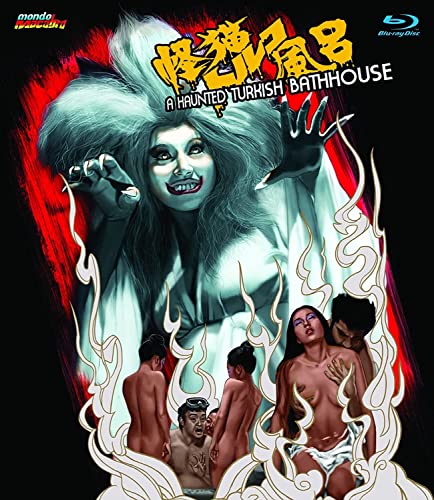
“…an outrageous horror-sex Toei production that packs more into 80 minutes than many viewers’ brains will be able to handle.”–Nathaniel Thompson, Mondo Digital (Blu-ray)

A Haunted Turkish Bathhouse

    List Price : 29.95 $

    Offer: 17.59 $

    Go to Amazon

    CHANNEL 366: JUNJO ITO MANIAC: JAPANESE TALES OF THE MACABRE (2023)

    366 Weird Movies may earn commissions from purchases made through product links.

    DIRECTED BY: Uncredited

    FEATURING:  Bill Milsap (English dub)

    PLOT: Twenty short, dreamlike horror stories from manga artist Junjo Ito, spread out over twelve episodes.

    Still from junjo ito maniac japanese tales of the macabre (The Hanging Balloons)

    COMMENTS: A woman’s sneering face appears in a monsoon of psychedelic mandalas, singing along to the raucous theme song as various scars and deformities flicker across her visage. A nail-chewing boy in a yellow raincoat climbs out of an abandoned refrigerator and into the vertical-hold challenged stories playing on a TV set across the alley.

    Those are the opening and closing sequences of “Junjo Ito Maniac,” and they set a maniacal tone that the content they bookend rarely matches. Not that the actual stories lack for deranged imagination; any anthology containing the tale of an angelic blond salesman in a bow tie who peddles mounds of deadly, addictive ice cream to children isn’t short on creepy inventiveness. But there are two basic problems with the series. One is the animation itself, which, despite the rambunctious promise of the opening and closing numbers, often isn’t really animated. It’s usually a succession of stills where only the characters’ mouths move. Ito’s images are often eerily beautiful, but the series comes off as too cheaply produced to do them justice. The other issue is that the majority of the stories, some of which run for just over five minutes, are often inconclusive, feeling like simple statements of surreal premises rather than fleshed-out horrors. Their brevity does, perhaps, makes them more dreamlike; their economy means they tend to serve best as bedtime snacks to fuel snippets of nightmares.

    The biggest exception is the one must-see episode in this collection, “Layers of Terror.” At a mere fifteen minutes, this twisted psychological parable about a mother who longs to return her child to a state of infantile dependency delivers its meaty anti-moral through a grotesquely literal (and bizarrely impossible) metaphor. Other highlights include “The Hanging Balloon,” about an unlikely apocalyptic plague of floating heads with nooses attached, and “Tomb Town,” a story that starts promisingly with a trip to a neighborhood completely overrun by tombstones. The series assays an effective variety of horror moods, from the prominent surreal horror to stories evoking the spirits of (“Library Vision”) and Charles Addams (“The Strange Hikizuri Siblings”) to ironically cruel fables (“The Bully”). Even though few of the entries are solid hits, the  diversity of textures coupled with the ultra-short format makes “Maniac” an assortment of poison bon-bons worth sharing with your best friend… or enemy.

    As a bonus, the conclusion of each episode includes a few short spoken sentences of a continuing story about a man driven mad by bugs that seem to be… well, you can find out for yourself. Aside from that perk, the episodes can be watched in any order, or selectively skipped.

    Junjo Ito is perhaps best known to readers here as the original author of the killer-spiral horror story adapted into the live action feature Uzumaki (2000). He’s a prolific manga storyteller in Japan, alternating between short story collections like these, longer works like “Uzumaki,” and collections featuring recurring characters (including the bewitching Tomei, who appears in one story here, and impish nail-chewing teen Soichi, who appears twice in “Maniac” and also anchors the closing segment.) “Junjo Ito: Japanese Tales of the Macabre” was created by Studi Deen, who had released a previous collection of Ito shorts in Japan, in collaboration with Netflix, who owns exclusive streaming rights.

    WHAT THE CRITICS SAY:

    “It’s humorous, terrifying, weird, beautiful, and disturbing all at once.”–Kate Sánchez, But Why Tho? (contemporaneous)

    APOCRYPHA CANDIDATE: BLOOD FOR DRACULA (1974)

    AKA Andy Warhol’s Blood for Dracula

    366 Weird Movies may earn commissions from purchases made through product links.

    DIRECTED BY: Paul Morrissey

    FEATURING: Joe Dallesandro, Udo Kier, Maxime McKendry

    PLOT: Count Dracula is dying for want of a virgin’s blood, and so sallies forth to Italy in an attempt to take advantage of its selection of religious-minded young women.

    Still from Blood for Dracula (1974)

    WHY IT MIGHT JOIN THE APOCRYPHA: A treatise on class struggle and it’s a softcore Eurotrash vampire gore movie? Thank you kindly, Misters Morrissey and Warhol.

    COMMENTS: Among many questions raised by Blood for Dracula are: what is to be done with the idle aristocracy now that it has served its purpose? Did it serve a purpose in the first place? What is a mid-’70s New York City tough guy doing as a handyman on a decayed Italian estate? And, what year is this movie set in, anyway? Paul Morrissey has a vision, I am certain, and it was put to screen in soothing verdigris, soft yellows, and spurts of crimson. The variegated colors emphasize the manifold oddities unspooling over the delicious palette, with performances one might politely describe as “eccentric” bringing to life the director’s singular vision of the vampire myth.

    The opening shot unveils the chromatic motif as the camera lingers on Count Dracula (Udo Kier), forlornly applying makeup. His vampirehood is revealed in the mirror in front of him—a mirror devoid of reflection. This ailing man is in need of virgin blood to continue on, and so his manic servant has hatched a plan of questionable merit. Dracula wishes to die, it seems, but is convinced instead to shuffle into a car and trundle off to the Italian countryside. There, he hopes to find a virgin’s blood to rejuvenate him—e’er he dies, forever.

    Udo Kier’s performance as the sickly Count is a standout among a number of unlikely choices. His two long stretches of vomiting impure blood, as well as his line delivery (which I suspect stem partly from an imperfect grip on the language), lay the groundwork for Nicolas Cage‘s own nuanced performance in Vampire’s Kiss. The patriarch of the Italian estate is a jolly old soul with a love for gambling matched only by his love for language (“Dracula? Drah-cule-ah. I like it!”). The lone servant on the grounds, Mario, is perhaps the only card-carrying member of the Communist party for miles around—at least I presume he’s card-carrying; what dialogue he has that doesn’t concern the overthrow of the aristos is typically, and unsettlingly, rape-y. And if you like sister-with-sister action, you’re in luck: this “art-house” rollick has got you covered.

    Yes, yes: this is a sexploitation feature alternating titillation with shlock violence (by the end, I was reminded of the infamous Black Knight), and I have no right to expect haut cinéma. But the little touches, heavy-handed though some were, are evidence that Morrissey is a dab hand at capturing compelling visuals. And even in his moments of regurgitative bombast, there is a dancer’s alacrity to Kier’s performance, showing there is a grim, lively past to this melancholy invalid. Maxime McKendry (in her sole film appearance) exudes a beautiful subtlety as an obviously English noblewoman filtered through an incongruous Italian accent. Come to this film with no demands other than for angst and spectacle, and you will not leave disappointed. If you come demanding logic and internal consistency, then you should perhaps hone your title-reading skills.

    WHAT THE CRITICS SAY:

    “It’s a strange film—sometimes a beautiful one—but it’s also the textbook definition of ‘not for everyone.'”–Ken Hanke, Mountain XPress

    CAPSULE: SKINAMARINK (2022)

    366 Weird Movies may earn commissions from purchases made through product links.

    DIRECTED BY: Kyle Edward Ball

    FEATURING: Dali Rose Tetreault, Lucas Paul, Ross Paul, Jamie Hill

    PLOT: Young Kevin and Kaylee find themselves in the house alone late at night, hearing bumps, seeing poltergeist activity, and eventually conversing with unseen voices.

    Still from Skinamarink (2022)

    COMMENTS: Everything you’ve heard about Skinamarink is true. Yes, it is made up of often-silent, oddly-framed, static-fogged shots of doors, lamps, and Legos. The sparse dialogue is occasionally inaudible. Items move mysteriously and gravity is briefly reversed, but the liveliest action comes from public domain cartoons. There are no clear explanations, and some of the information we do receive is contradictory. It’s boring, and it’s mesmerizing, and it’s tedious, and it’s terrifying. Even its most ardent defenders will likely concede that, at 100 minutes, it’s unjustifiably long. It may be best conceptualized as unedited, jumbled security camera footage from a child’s nightmare.

    Skinamrink defies analysis. It puts you into the point of view of a child dealing with a nighttime world that’s simultaneously familiar and strange, your mind coping with your lack of understanding by filling in details. As much as any film we’ve ever reviewed, Skinamarink invites you to create your own narrative, whether you view it as a supernatural haunting, a metaphor for abuse, or simply a feature length immersion in childhood fears. If you’re looking for clues, perhaps pay attention to the first line of clearly spoken dialogue, which occurs twelve minutes in—although even that nugget of information is capable of multiple interpretations.

    I can’t unconditionally recommend Skinamrink, but I can’t deny its power, either. As with all experimental cinema, your results will vary in proportion to your disposition, your patience, and the amount of work and imagination you’re willing to put into it. I will say that, if you’re not frightened off by excessive minimalism and the idea of murky visions, whispered conversations, and twisted nostalgia for a time when you were frightened of the boogeyman and monsters under your bed appeals to you, then you should definitely seek out Skinamarink.

    Skinamarink got an unlikely theatrical run for a microbudget film, generating good word of mouth, bad word of mouth, and bitter arguments among horror fans. Though falling well short of inciting a Blair Witch style audience mania, it’s safe to assume the project has more than earned back its $15,000 budget.

    WHAT THE CRITICS SAY:

    “The point of view that the camera shows is, seemingly, sometimes that of one or the other of the children, but the skewing and fragmentation of perspective suggests an attempt to recover the unworldliness and incomprehension of early childhood, the fragmentary incoherence of children’s experience, even the psychoanalytic substitution of heavily cathected and weirdly dominant minor objects or visions to stand in for much more momentous ones… Yet the movie’s horrors and uncanny aspects mostly remain at the theoretical level… The images appear to be the tip of an iceberg, but there’s no iceberg beneath them.”–Richard Brody, The New Yorker (contemporaneous)