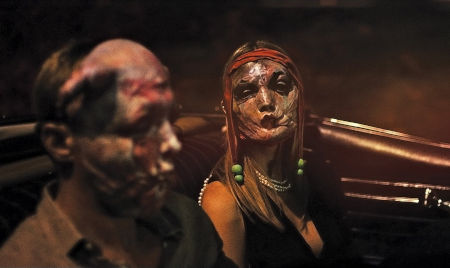
Two sisters sleep under a mosquito net to keep out the vampires that come at night.
Tag Archives: Horror
CAPSULE: MASKING THRESHOLD (2021)
366 Weird Movies may earn commissions from purchases made through product links.
Masking Threshold is currently available for VOD rental or purchase.

DIRECTED BY: Johannes Grenzfurthner
FEATURING: Voice of Ethan Haslam
PLOT: A man performs experiments in an attempt to find the source of the tinnitus that is driving him mad.

COMMENTS: It’s no surprise that Masking Threshold isn’t getting a big theatrical release; it’s more of a miracle that it was able to play in a few theaters at all. This has nothing to do with the film’s quality and everything to do with its style: this is a film that is (almost) entirely narrated by the protagonist, while the camera focuses (almost) exclusively on closeups of objects for the entire runtime. A movie that plays like a paranoid podcast illustrated with a succession of moving slides—sort of a contemporary feature-length version of La Jetée—is a hard sell in any climate, but particularly at a time when movie theaters are struggling to put butts in seats.
Fortunately, the scaled-back nature of the project means it will play well on small screens (although it would be nice to hear that crucial sound mix emanating from Dolby surround-sound speakers). Despite the fact that it may only be a MacGuffin for the protagonist’s deeper psychological issues, sound—the rustle of fabric, turning of pages, test tones the protagonist generates for his own reference—-provides the texture of the film. The movie quietly ushers us into the protagonist’s mind, as we hear none of his background tinnitus in the early going, but the hum slowly and subtly creeps into the soundtrack, scarcely noticed, until by the end we hear these subtones too. These minute variations in drones, unidentifiable rustlings and buzzings, and oscillations have tremendous significance to the protagonist, but to us they remain esoteric. The movie’s production values are low, so visuals cleverly rely on extreme closeups of carbon dioxide bubbles, slices of bread, algae, ants, and mouse corpses, supplemented by various charts, graphs, alchemical prints, blinking diodes, repurposed memes, and so on. The protagonist’s face is never clearly visible. The movie is presented as a YouTube diary by one of those “independent researchers” whose peculiar-to-insane preoccupations fail to strike a chord with a mass audience; his impassioned Reddit posts leave him the subject of trolling and lols.
This is a strange movie, in that the first-person monologue script would work just as well as a short story; in a way, Masking Threshold is nothing but multimedia-enhanced prose. But that makes it a triumph; a movie literally constructed from objects found around the house or bought at Home Depot, Best Buy, and Petco, is inspirational. The protagonist is erudite (the movie is full of fascinating trivia) and arrogant; his inner monologue is profound when discussing the philosophy of science, and myopic when interpreting the results of his own experience. His narrative voice put me in mind of the antihero of Poe‘s “The Tell-Tale Heart,” while the madness resulting from his investigation onto cosmic phenomena evokes any number of Lovecraft victims. (It’s noteworthy that both authors get a “thanks” in the credits). Not to say that Grenzfurthner’s script (co-written with Samantha Lienhard) lives up to those classic influences—but it does update that psychological horror template with timely references to Internet culture, Q-Anon, and “doing your own research.” Masking Threshold is a successful, immersive, and credible experiment in diving into one man’s particular rabbit hole universe.
WHAT THE CRITICS SAY:
CAPSULE: THEY CRAWL BENEATH (2022)
366 Weird Movies may earn commissions from purchases made through product links.

DIRECTED BY: Dale Fabrigar
FEATURING: Joseph Almani, Karlee Eldridge, Michael Paré
PLOT: A series of earthquakes has unleashed deadly nematodes, and Danny is forced to confront his lineage while awaiting rescue from this wormy menace.

COMMENTS: Upon finishing They Crawl Beneath, I discovered a message on my answering machine regarding a matter that required prompt attention. This effort took approximately eighty minutes to bring it—not quite—to a close. During my various intervals of being put on hold while I was shuffled around between departments, an unfortunate thought occurred: I was finding this mundane tedium far more satisfying than Dale Fabrigar’s film.
They Crawl Beneath has no respect for the audience’s attention, or intelligence. And a creature feature has no business being this slow, much less waiting until the midpoint (the first half ranking among the least pleasant 40 minutes I’ve endured in a movie) for the crawlers in question to fully mount their offensive. And speaking of offensive, I was nearly tickled with dismay at the character Doctor Wu, a definitely-Asian scientist who somehow has all the answers and, somehow, meets an off-screen death mentioned in one of the throwiest-away of throwaway lines I’ve ever heard. But I get ahead of myself: Jimmy the Cop is a good guy with a bad uncle and a dead dad, who gets trapped under a vintage car in a garage geographically situated in an earthquake-prone part of the world. He faces some worms and familial demons while his girlfriend hovers in the periphery—usually delivering lines in a monotone trance.
Sound cues do all the work for you, be they declarations of “Here there be melodrama!” or of “Here there be scary!” The heavy-handedness of the score bordered on ridiculous, but unfortunately maintained a heartfelt dalliance with boring bombast. Whatever they paid the actors, it was too much—and even more so, the screenwriter. It’d take someone with the B-movie charm of ten Bruce Campbells to compellingly deliver lines like, “Gwen, listen to me: I want to live. For you, and our baby” (oh yes, I had forgotten they threw in a truly random pregnancy to ratchet up the… something), or what I can only presume was an attempt at comedy, “I am definitely hallucinating.”
The movie did nothing well—my time could hardly be described as valuable, but even I felt insulted by this rotten attempt at storytelling. And though my game of phone-tag and being put on hold is, alas, not quite complete, I take considerable comfort in the fact that at least my experience with They Crawl Beneath is over with.
WHAT THE CRITICS SAY:
CAPSULE: HARPYA (1979) / APOCRYPHA CANDIDATE: BOBBY YEAH (2011)
(both films)
“You can do anything in animation” is a truism, a promise of unlimited potential that is frequently untapped beyond a surface-level dive into the unusual. Enough people stumble at “the animals can talk?” issue to make it unfair to expect more. However, it is also true that those filmmakers who are willing to go deeper into the realm of the possible do so with gusto. And so we arrive at a pair of short films that readily embrace the horror that ensues from making the wrong choice.
Raoul Servais’ legend in animation circles is due in large part to 1979’s Harpya. (The film won the Palme d’Or for short films at that year’s Cannes Film Festival.) The tale of a man who saves the life of a horrible-beautiful creature, only for it to methodically destroy his life, is a very simple demonstration of cause and effect.

When he intervenes to stop what looks like a cold-blooded murder, the action seems noble and moral. His decency continues when comes home with the near-victim, a giant, feathered, bare-breasted creature, but his good intentions immediately backfire. The house guest eats everything, denying the man even a morsel, and when he attempts to leave, the monster eats his legs for good measure. Even when he manages to distract the beast and escape the house, she pursues him and takes his food once more, leading him to attempt to murder her himself. It’s like a horror version of One Froggy Evening.
Servais’ technique is what lifts the movie into the rare air of our consideration. Using a method of his own invention, he shot live-action footage and projected animated settings onto the film using clear sheets. The result is something like a daguerreotype given life.
There’s a troubling undercurrent of misogyny in the film, however. In fairness to Servais, this is not explicit, but inherent in the mythological character he is invoking. (For his own part, Servais has described Harpya as a parody of a vampire tale.) If anything, it presents the danger of reading too deeply into a story; the harpy functions quite sufficiently as a movie monster, but it’s all too easy to infer a manifesto. In my research, I found at least one review that unironically celebrated the film as an attack on the shrewishness of women, which is pretty awful but speaks to the power of the piece.
Robert Morgan’s Bobby Yeah is less likely to garner sociological blowback, but only because it’s so much more obviously grotesque. Where Servais’ harpy was a lone example of a disgusting supernatural, everything in Bobby Yeah is bloody or slimy or both. That includes our ostensible protagonist, a bunny-eared, troll-faced creature who makes trouble for himself by literally pushing other people’s buttons.

The little rabbit guy is a classic protagonist who keeps stumbling from one terrible situation into another. Of course, he’s hideous, but he earns a tiny amount of sympathy by being the least hideous thing in the film. At every turn, he confronts a new bruised and twisted creature, often displaying unmistakably phallic characteristics and ready to attack the bunny guy for his most recent misdeed. (The film is replete with symbolism, particularly sexual, but it has significant impact even before you start to delve.) It’s an unrelentingly anxious 23 minutes, replete with violence, body horror, and building dread.
The eyes are often the giveaway in CGI animation, the evidence of unreality that disrupts the sense of reality. In Morgan’s production, the eyes have the opposite effect: disturbingly realistic eyes that peer out of misshapen doll faces, wall ornaments that resemble pizzas, and koosh-ball-headed serpents that stare out with unnerving authenticity. While the production design may seem to earn the title of “grossest film of all time,” it should be noted that the physical revulsion is easily matched by the psychic discomfort that lingers. Bobby Yeah isn’t just gross; it’s gross in very powerful ways.
As noted, you can do anything in animation, but what’s interesting is when a filmmaker really wants to do anything. Servais and Morgan both tap into primal fears that by turns intrigue and appall. Harpya packs a lot of horror and surrealism into its eight minutes, but it’s ultimately too slight to earn a place in the Apocrypha. Bobby Yeah, however, has the advantages of being longer and more viscerally unsettling. It’s a genuinely transcendent and transgressive work, and it’s worthy of future consideration as a candidate. Both movies, though, have a lengthy half-life in the brain, showing how a burst of animation can easily take up residence in your scared, scarred soul.
WHAT THE CRITICS SAY:
“‘…a fantastic surreal film…” – Dr. Grob’s Animation Review on “Harpya”
(“Harpya” was nominated for review by Absanktie and “Bobby Yeah” was nominated by Russ. Suggest a weird movie of your own here.)
29*. TITANE (2021)
366 Weird Movies may earn commissions from purchases made through product links.
WARNING: This review contains spoilers.

DIRECTED BY: Julia Ducournau
FEATURING: Agathe Rouselle, Vincent Lindon
PLOT: After having a metal plate inserted into her skull following a car accident, young Alexia develops an empathic relationship with cars. She grows up to inhabit two careers—modeling at car shows and murder—and ends up impregnated after a one-night stand with a muscle car, and on the run from authorities who suspect her in a series of killings. Alexia assumes the identity of Adrien, the long-missing son of fire chief Vincent, and forms a relationship with him.

BACKGROUND:
- In winning the Palme d’Or at the 2021 Cannes Film Festival, Ducournau became only the second female director to claim the festival’s top prize, and the first to win the award outright (Jane Campion won for the Piano in 1993, but shared the award with Chen Kaige/Farewell My Concubine.)
- Titane received four Cesar nominations, including for Ducournau as director and Rouselle as Most Promising Actress. Ducournau also earned a Best Director nomination at the BAFTA Awards. (Rouselle also won “Best Actress in a Weird Movie” in the 2021 Weirdcademy Awards, where readers also selected Titane Weirdest Movie.)
- The title is French for titanium, the material of which the plate in Alexia’s skull is composed and which seems to be part of the body of her newborn. The epigram above, from an interview with Ducournau about the goals of her film, hints at another meaning.
- Three of Titane’s characters share names with the leads in Ducournau’s previous film, Raw.
- The fiery vehicle with which Alexia has carnal relations is a 1984 Cadillac Coupe DeVille.
INDELIBLE IMAGE: Pregnancy can wreak havoc on a woman’s body, but the changes Alexia undergoes are especially acute. The rips in her skin revealing a metallic womb are quite unnerving, but nothing quite exemplifies Titane’s particular brand of maternal body horror as when she finds herself expressing motor oil through her breasts. Writhing in pain and oozing engine lubricant, her transformation is both disturbing and completely logical.
TWO WEIRD THINGS: Seduced by a Cadillac, bluegrass twerking
WHAT MAKES IT WEIRD: For its first half-hour, Titane is a perfectly unsettling account of a serial killer who has sex with cars. This would be game-set-match for many films hoping to earn a spot on our List, but the movie soon transforms into a meditation on gender identity, faith, and the ineffable pull of family. The sheer intensity of the characters’ pain and emotional burden is overwhelming, and Ducournau’s choice to filter these themes through outrageous story beats lends the film an operatic quality that heightens the entire tale.
Official English Language trailer for Titane
COMMENTS: For Vincent, the mere idea of a DNA test is absurd. Continue reading 29*. TITANE (2021)