Tag Archives: Documentary

IT CAME FROM THE READER-SUGGESTED QUEUE: VAKVAGANY (2002)

366 Weird Movies may earn commissions from purchases made through product links.

DIRECTED BY: Benjamin Meade, Andras Suranyi

FEATURING: Erno Locsei, Stan Brakhage, James Ellroy, Roy Menninger, Etuska Locsei

PLOT: Filmmakers discover a batch of home movies shot by a Hungarian family in the years following World War II; they set out to find surviving members of the family, while calling upon a group of expert viewers to help them interpret the footage.

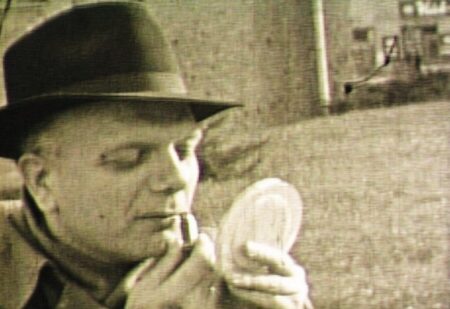
Still from Vakvagany (2002)

COMMENTS: For as long as there have been movies, there have been professionals who seek to deliver a story to a wider audience, and there have been amateurs who only wish to record personal moments for later reminiscence. When it comes to the latter, the idea that anyone beyond a very small circle might see the footage borders on absurd. To reach a mass audience, the film would have to present something of enormous significance, like the scene captured by Abraham Zapruder in Dallas in November 1963. Or perhaps it could be used to comment on current events, such as to understand the accused subjects of Capturing the Friedmans. But beyond that, a home movie seems of little public value outside of the home, and to watch one uninvited feels nosy at best and invasive at worst.

The directors of Vakvagany seem to feel they’ve backed into a Rear Window scenario. Someone has found some old home movies, they’ve watched them, and they’ve seen some surprising things: a couple sorting through a treasure trove of jewelry and other valuables. Unusually lengthy shots of a nude infant. Footage of a mother holding her toddler son’s penis as he attempts to urinate. “What’s going on here?” they must have asked themselves. “Is this immoral? Criminal, even?” Their snooping has led them to a possibly unsavory place, and now they feel compelled to know more.

In these discovered films, we meet the Locsei family, and the first facts we receive are unsettling. Mr. Locsei was evidently a functionary in the postwar Hungarian government. A neighbor suggests he may have overseen the collection of valuables from Jews who were deported to concentration camps during the war, which may explain that delighted sorting of valuables we witnessed. (On the other hand, it will be suggested later in the film that Mr. Locsei was actually saving these possessions to be returned to their owners.) We also see his wife cavorting with grapes, which matches with suggestions of alcoholism. Most importantly, we see the two Locsei children, who don’t relish being on camera, hardly surprising given some of the awkward moments to which they’ve been subjected. 

To help us out, the filmmakers have enlisted onscreen interpreters, who are shockingly confident in their impromptu reactions. Legendary experimentalist Brakhage, upon seeing a father embracing his squirming daughter, opines, “I don’t quite believe his hugs,” and later compares the son’s efforts to free his arm from his father’s grasp to a Nazi salute. (“Perhaps I’m reading too much into it,” he then admits.) Psychiatrist Menninger wryly notes the professional Continue reading IT CAME FROM THE READER-SUGGESTED QUEUE: VAKVAGANY (2002)

CAPSULE: ESCAPE TO THE SILVER GLOBE (2021)

Ucieczka Na Srebrny Glob

366 Weird Movies may earn commissions from purchases made through product links.

DIRECTED BY:

FEATURING: , Xawery Żuławski, Małgorzata Braunek, , Krzysztof Zanussi, Janusz Zaorski

PLOT: A documentary on the making of On the Silver Globe, Andrzej Żuławski’s adaptation of his great-uncle’s “The Lunar Trilogy.”

COMMENTSOn the Silver Globe is the other notorious Andrzej Żuławski film, although not yet as widely known as Possession. That’s not surprising, knowing the science fiction epic’s troubled production history. Globe was pivotal in many ways. Had it been completed on time, it would have been the largest science fiction film made in Europe at the time, and could have put Żuławski on a different career path had things worked out… perhaps.

Understanding that career path, which Kuba Mikurda lays out in detail, is key to everything in Escape. Via interviews with crew and family members (his brother and oldest son on camera; his ex-wife is heard on audio) and archival interviews with Żuławski, we see the director from his start as an assistant to Andrzej Wadja to directing his first two features. The second, Diabel [The Devil] (1972), got noticed by government authorities and resulted in Żuławski’s exile from Poland… for the first time. He returned to Poland in 1976 to make On the Silver Globe, a large scale sci-fi epic, during an economic crisis. Its cost made it a huge target in the political sphere. Escape does a good job making the political situation clear to audiences. Best of all, it features behind-the-scenes footage of Żuławski at work. It also doesn’t shy away from an unflattering portrait of Żuławski, recognizing him as a brilliant filmmaker, but a man with many issues when it came to interpersonal relations. Escape addresses the dissolution of his family during his first exile (which created the creative fodder for Possession), as well as giving insight on his later years.

Escape from the Silver Globe accomplishes several things. Besides serving as an in-depth look at a film that was just a legend for many years and is now ripe for discovery by audiences, it’s an approachable introduction, especially for Western audiences, to Żuławski and his work.

Escape will be released on Blu-ray by French distributor Le Chat Qui Fume (The Smoking Cat) as a stand-alone, and also as part of a long awaited boxset of Żuławski’s “Polish Trilogy” (The Third Part of the Night, The Devil and On the Silver Globe), which was previously available only in Japan. Unfortunately, it will not have English subtitles. That seems to also be the case with a German release from Camera Obscura. It has been confirmed that there will be a U.S. distributor, but no official announcement has been made at the time of this review.

WHAT THE CRITICS SAY:

“Oscillating somewhere between Andrei Tarkovsky’s cerebral sci-fi and Alejandro Jodorowsky’s intricate surrealist iconography, On the Silver Globe was all set to mark a critical turning point – not just for Żuławski and Polish filmmaking, but for international cinema at large… [Escape] never falls into the trap of boredom, simulating the contagious energy of a Żuławski picture, and the love and fascination at the heart of this project are truly palpable.”– Marina Ashioti, Little White Lies (festival screening)

DOUBLE CAPSULE: AM I NORMAL?: A FILM ABOUT MALE PUBERTY (1979) / FLOWERS AND BOTTOMS (2016)

366 Weird Movies may earn commissions from purchases made through product links.

Talking frankly about sex (without becoming lewd or lascivious) is among the most difficult tasks we as a society face, and arguably our failure to do so in a mature and productive manner is responsible for an unconscionable percentage of the world’s problems. And yet we continue to just not do it. Embarrassment and cultural taboos are the chief reasons, but a significant (if rarely discussed) cause has to be that we’re so bad at it. Not for nothing is there an award given annually for the worst description of sex in literature. 

Even in this rarefied air, the awkwardness and supreme un-coolness of the sex ed film is beyond calculation. And one such representative of this genre that has garnered cult recognition is a product of the Boston Family Planning Project that presumably ended up in schools across America at the start of the 80s and accomplished the goal of making sex an even less desirable topic of conversation. “Am I Normal?” lingers in the imagination four decades later because it is so strangely goofy at presenting the subject of sexuality in the adolescent male. We’re already primed to laugh at that which unsettles or disturbs us, like a boggart in the cupboard, so directors Debra Franco and David Shepard make the understandable decision to leaven the awkward nature of the topic with humor. Unfortunately, the nature of the silliness is so over-the-top that it rarely works as humor and barely works as education.

To its credit, the film recognizes its challenges, especially when it comes to teenagers. Having been caught with an untimely physical reaction to an invitation from Susie (Jennifer Adelson) to go to the movies, our protagonist Jimmy (Joel Doolin) and his wrestling champion-sized belt buckle wander around town looking for sex advice like the bird in “Are You My Mother?” He asks anyone and everyone for information about these strange new physical and emotional sensations, and his advisors are a motley crew, including his best pal who sits in the school locker room reading a book entitled Great Moments in Sex, a zookeeper who admits to seeing all kinds of penises in his job (“Animal penises!” he quickly clarifies), and his own father, who compares the private parts of men and women to a baseball bat and a catcher’s mitt. (No points for guessing which is which.)  

The information imparted is benign and actually kind of helpful. (Worth noting that Jimmy gets something closer to straight answers when he turns to authority figures who dispense knowledge, such as a librarian or the school nurse. Also interesting that they’re both women.) But the delivery of each nugget carries with it the blunt Continue reading DOUBLE CAPSULE: AM I NORMAL?: A FILM ABOUT MALE PUBERTY (1979) / FLOWERS AND BOTTOMS (2016)

CAPSULE: SR. (2022)

366 Weird Movies may earn commissions from purchases made through product links.

DIRECTED BY: Chris Smith

FEATURING: Robert Downey, Sr., Robert Downey, Jr.

PLOT: Father and son co-create a documentary chronicling Robert Sr.’s career and end of life, and Robert Jr.’s relationship with his father and coping with his imminent loss.

Still from Sr. (2022)

COMMENTS: Papa Downey wraps up a phone conversation with his son with the deadpan quip, “All right, that’s worthy of an evening’s nonsense.” Sonny Downey and his dad had just experienced a heartrending reminiscence, Junior choked up at one point, and this is among the many scenes in Chris Smith’s documentary Sr. that cuts to the heart of difference between these two men. Both were heavily involved in film throughout their lives, Sr. behind the camera and Jr., of course, prolifically in front of it. Jr. has tried hard all his life, being constantly “on” as a performer; Sr. is an inveterate observer, an artist whose main mission and reward is capturing the random elements of life (and art). Sr. typically utters no more than a quietly deflective quip or, on occasion, a simple, “that’s good, isn’t it?” when he feels he’s captured something worth sharing.

Sr. includes talking heads remarks from contemporaries (Alan Arkin’s observations are a particular treat) and “behind-the-scenes”-clips of Sr.’s underground productions. As a primer for Sr.’s oeuvre and professional trajectory—rising from nowhere to the heights of underground fame before crashing into drug addiction for about a decade—Sr. is probably the most efficient breakdown you can find. It also, by all appearances, is a genuine character study: not just for the proto-indie maestro, but also for one of the biggest film stars these past two decades.

Presuming the madness in Sr.’s movies works, it works because he goes with the creative current coursing through his mind. Improvisation, serendipity (planned and otherwise), and a sheer, burning desire to create stories and experiences in the medium of film all means his early output hit something right on the nose. Jr., of course, achieved astronomical success in his own way; not just through his innate talent, but, as remarked in Sr., through his willingness to accept direction.

This willingness seems to stem from a burning desire for approval, particularly from his father. The Sr. project began as a little thing for Junior and his pop to do to have fun together—a filmmaking father-son bonding experience. And even though Junior is “on” all the time, he’s none the less genuine for it. Throughout a number of interview-style exchanges between father and son, Jr. tries to guide Sr. to explain the meaning behind this or that event. Sr. never really obliges, however, and Jr.’s frustration is palpable. On his sickbed, Sr. watches a section of the doc-in-progress and observes, “It all looks sweetly narcissistic.” It is, but it is also entertaining and often moving. It is particularly satisfying to find Junior growing through the process, too. At the end, with his father’s passing, the son seems to accept, without tears or caveats, what life is all about: “We’re here, we do stuff, and we’re gone.” Sr. would doubtless be pleased by this summary.

Sr. streams exclusively on Netflix (for the moment).

WHAT THE CRITICS SAY:

‘Sr.’, much like the father and son duo, is a deep story coated in absurdist armor… This deeply personal project for Junior is wildly unpredictable, not unlike Senior’s approach to storytelling. Not only does this make it more captivating, but realistic… Senior never really cared for fame and fortune. In fact, he really had no intention of going to Hollywood and carving out a mainstream career. He was in it to do his weird thing with his weird friends.”–Emily Bernard, Collider (contemporaneous)

CAPSULE: SHIRKERS (2018)

366 Weird Movies may earn commissions from purchases made through product links.

Recommended

DIRECTED BY: Sandi Tan

FEATURING: Sandi Tan, Jasmine Kin Kia Ng, Sophia Siddique Harvey, Georges Cardona

PLOT: In the summer 1992, Sandi Tan and her friends filmed “Shirkers”, only to have their would-be feature debut spirited away by their enigmatic guru, Georges Cardona.

COMMENTS: A quick look at IMDb will show you that Georges Cardona was not involved in the production of Apocalypse Now. And though one of his protegés was involved in making Sex, Lies, and Videotape, Georges was not, nor was it possible that he was the basis of James Spader’s character Graham. Georges was not born on a ship heading out from Germany in 1949. What his life actually consisted of was stories, stories he would tell to anyone who would listen—and many did, including Sandi Tan. Something of an awkward teenager, Sandi felt repressed by her Singaporean upbringing, and felt liberated by the transcendental intellectual attraction and attention from Georges Cardona, a mysterious film teacher who believed in her as much as he probably believed in his own fabricated history.

But Shirkers is not about Georges Cardona. It is a movie memoir about Sandi and her friends Jasmine and Sophia, who did the unthinkable in Singapore in 1992. With no training and no money, but with superhuman drive and ever-percolating minds, Sandi & Co. filmed a story about a strange collector of people, titled “Shirkers.” Shirkers, the documentary about that film’s strange production history, is the director’s personal recollections and interviews with those involved, spliced with footage from the original project along with various contemporary private recordings, many featuring Georges Cardona: one of the most mysterious entities to grace a film, as well as a mystical influence in lives of many filmmakers and storytellers.

Shirkers is a masterful documentary. The facts behind the whole mystery-shebang would have been adequate to keep my attention without any bells, hooks, and whistles, but Sandi Tan proves as adept at spinning a yarn as she is at documenting her life over the past quarter century. The flow is constantly interrupted by asides, proliferating like branches of narrative that miraculously reconverge by the story’s end. Her narration suggests fragility, and at times resignation, but beneath her entire recounting one can hear a strength of character, forged in no small part by the fools-gold Svengali whom she met at her most impressionable stage in life. Sandi’s reunion with her two dear friends after so many years of intermittent contact feel genuine, because her friends pull no punches when reminiscing about that fraught and bizarre summer of their early adulthood.

Again, this isn’t the story of Georges Cardona. But he is the central prop—the elephant in the story that cannot be ignored, but cannot be perceived except in pieces, like in the parable of the blind men. Georges insinuated himself into the lives of young and talented raconteurs, but in the case of Sandi Tan, Shirkers is her story, and how she managed to live her own life despite this massive weight of egocentric mystery that encumbered her for decades.

Shirkers is a Netflix exclusive.

WHAT THE CRITICS SAY:

“There’s no counting the creative projects begun in youth that have been abandoned, forgotten, scrapped. Sandi Tan’s bears the weird and painful distinction of having been stolen.” -Sheri Linden, Hollywood Reporter (contemporaneous)