Tag Archives: Comedy

225. ADAPTATION. (2002)

CHARLIE KAUFMAN: I’ve written myself into my screenplay.

DONALD KAUFMAN: That’s kind of weird, huh?

—Adaptation.

Must See

DIRECTED BY:

FEATURING: , , Chris Cooper, Brian Cox

PLOT: Screenwriter , fresh off the hit Being John Malkovich, is contractually and mentally trapped as he is forced to plow his way through an impossible project: “writing a movie about flowers.” Things go from bleak to bizarre as he finds himself competing with his endearingly oblivious twin brother, Donald, who also aspires to be a screenwriter. Charlie slips further and further past the deadline, until things come to a head in the film’s swampy denouement where he comes face-to-face with both the writer of and titular character from “The Orchid Thief,” the book he is adapting for the screen.

Still from Adaptation. (2002)

BACKGROUND:

  • The screenplay for Adaptation. was on Charlie Kaufman’s to-do list since the late ’90s. Tasked with adapting Susan Orlean’s novel-length essay “The Orchid Thief” and suffering the same problems as his doppelganger, he kept his progress secret from everyone other than Spike Jonze until 2000, when the movie was green-lit for production.
  • Screenwriting guru Robert McKee and his seminars are real. He personally suggested Brian Cox play him in the movie.
  • Adaptation. handily recouped the producers’ investment, with a return of $32.8 million worldwide on a $19 million outlay.
  • Nominated for four Oscars: best actor for Cage, supporting actor for Cooper, supporting actress for Streep, and adapted screenplay for Charlie and Donald Kaufman. Cooper was the only winner.
  • Though “Donald” Kaufman’s serial killer script The 3 was never shot, the idea may have inspired two subsequent movies, 2003’s Identity and 2006’s Thr3e.

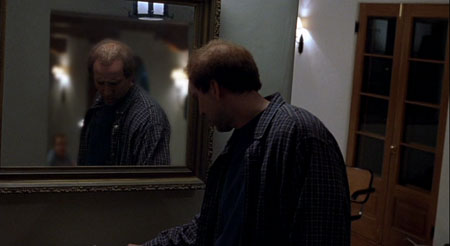
INDELIBLE IMAGE: Returning from a misfired date, Charlie finds his twin brother already back home from a writer’s seminar, brimming over with newly adopted wisdom. As Charlie stands in front of his hallway mirror, Donald’s face is captured in the reflection as he expounds upon his own screenplay’s “image system” involving broken mirrors. Charlie’s expression goes from dour to disbelieving at this inanity, and the viewer sees the movie mock both itself and screenplay tricks. A further twist is added by the fact that the blurry reflection in the mirror is the face of the actual Charlie Kaufman talking to Nicolas Cage.

THREE WEIRD THINGS: Film-within-a-film-within-a-screenplay-within-a-screenplay ; Ouroboros; orchid-snorting

WHAT MAKES IT WEIRD: For all its unconventionality, Adaptation is amazingly self-deprecating. Spoilers unravel in opening scenes and are tossed aside, coastal city elites are presented as real people with the petty little problems real people have, and Nicolas Cage gains a bit of weight and loses a bit of hair to provide the compelling double performance as the Kaufman brothers. Events seem scattershot, only to have their purposes later clarified as the tightly structured flow keeps the viewer jumping from moment to moment, always questioning which parts of this convoluted tale are actually true.

COMMENTS: Between its thorough description of the protagonist Continue reading 225. ADAPTATION. (2002) →

WOODY ALLEN’S MIDNIGHT IN PARIS (2011)

366 Weird Movies may earn commissions from purchases made through product links.

For the last fifteen years, with the release of any new album,  at least a dozen or so music critics begin their review with: “It’s his best work since ‘Scary Monsters.'” They will repeat themselves with his upcoming “BlackStar,” in contrast to Bowie’s long-held aesthetic of avoiding repetition.

Pedestrian critics are as commonplace as pedestrian artists (in whatever medium) so it was unsurprising when a plethora of reviews for Woody Allen’s Midnight In Paris (2011) opened with: “It’s his best film in years.”

Like Bowie, Allen has made an effort to avoid needless repetition, which is not the same as working through periods of purposeful repetition. Allen knows the difference because he is a great artist. Paradoxically, this 80-year-old filmmaker has been both experimental and given to nostalgia, a paradox evident throughout Midnight In Pairs, a time travel opus replete with famous character cameos: F. Scott and Zelda Fitzgerald (Tom Hiddleston and Allison Pill), Ernest Hemingway (Corey Stoll), Gertrude Stein (Kathy Bates), (), (Adren de Van), Pablo Picasso (Marcial Di Fonzo Bo), Paul Gauguin (Oliver Rabourdin), Josephine Baker (Sonia Rolland), Cole Porter (Yves Heck), Henri Toulouse -Lautrec (Vincent Menjou Cortes), etc.

The late avant-garde composer Pierre Boulez (who died at age 90 on Wednesday) once said: “Nostalgia is poison.” While Allen would hardly be that pronounced, in Paris he takes the rueful approach that has been increasingly distinctive in the second half of his oeuvre. This does not mean Midnight in Paris is without charm. To the contrary, as its title indicates, the film is awash in tenets of romanticism—albeit clear-eyed romanticism—which is an authentic approach.

Still from Midnight in Paris (2011)Gil () is an unsatisfied Hollywood hack writer. His engagement to Inez (Rachel McAdams, scion of an elite, right-wing family) is equally ill at ease. While vacationing in Paris, Gil is teleported every night to the city’s past, cira 1920. Smartly, Allen doesn’t waste narrative time with a silly, pointless explanation of just how the time travel works (or how Gil returns to the present). Starstruck, Gil hobnobs with the Lost Generation of the Golden Age (Zelda Fitzgerald, as to be expected, commands most of the attention until Hemmingway starts pontificating) and even gets Stein to read his manuscript. In one of his midnight excursions, Gil meets and falls for Adriana (). She is a welcome contrast to the materialistic Inez, who is carrying on an affair with depressingly pretentious college heartthrob Paul (Michael Sheen). However, for Adriana, the golden age is not Paris in the 20s, but rather, the turn of the century’s Beautiful Era (Belle Époque), which they visit together, encountering the likes of Gauguin, Degas, and Toulouse -Lautrec. Idealization gives way to the minor insight that art is born of a time and place. It cannot be duplicated. Gil has his own art, which is equally unique. Of course, there is nothing revolutionary to be found in a valentine, but the film’s lucid melancholy gifts an odd, feel-good enchantment, lensed to poetic perfection by Darius Khondji.

Wilson, Cotillard, McAdams, and Carla Bruni (in an amusing cameo as a tourist guide for the Rodin Museum) are all ideally cast. (of 2013 Blue Is The Warmest Colo) is a sliver of warm joy as Gil’s potential new love.

Next week: Zelig (1983)

LIST CANDIDATE: TWICE UPON A TIME (1983)

Recommended

DIRECTED BY: John Korty, Charles Swenson, Bill Couturié (“adult” version)

FEATURING: Voices of Lorenzo Music, Marshall Efron, Judith Kahan, James Cranna, Julie Payne, Hamilton Camp,

PLOT: With the help of a fairy godmother and a blundering superhero, two dreamland misfits try to stop the wicked Synonamess Botch from detonating nightmare bombs.

Still from Twice Upon a Time (1983)

WHY IT MIGHT MAKE THE LIST: The mix of a crazy dream/fairytale plot with luminous cutout animation that often evokes surrealist collage landscapes—the cartoon characters might find themselves inside a clock that looks like a Leonardo da Vinci notebook page, on a frozen beach with body parts sticking out of the sand, or attacked by office supplies—makes Twice Upon a Time a one-of-a-kind oddball adventure. The legendary backstory involving the film’s longtime unavailability, kid-unfriendly profanity, competing versions, and accusations of censorship (which turned out to be reverse censorship) doesn’t hurt Time‘s cult credentials, either.

COMMENTS: Coming out during Disney’s nadir, when cartoon features were out-of-fashion, Twice Upon a Time was simultaneously a throwback and an innovation. The movie was painstakingly animated through the never before (or since) used process of “Lumage,” where plastic cutouts are placed on a light table and filmed. The process makes the cutouts seem to glow at times, as well as creating planes that impart a weird three-dimensionality to the images. The effect has been compared to stained glass, although the movie’s soft palettes are more reminiscent of gently glowing pastel watercolors. Besides the immensely detailed painted backdrops, the cartoon characters of dreamland also frequently tromp on top of black and white stills representing the “real” world. The resulting work comprises shots of extreme beauty (the shadowy, tiered towers of Murkworks, contrasted with the construction-paper chaos of Frivoili) and wit (the camera pulls back to reveal that the hedges the villains are trotting through form a skull and crossbones, and the submersible tottering on top of a pile of junk is surely a tribute to stylistic precursor Yellow Submarine).

Structurally, the narrative can be charitably described as anarchic, with archetypal characters who are as two-dimensional as the plastic cels they’re made from. Our misfit heroes, a shape-shifting “all-purpose animal” and a mute esque Tramp, are joined by a Jewish fairy godmother (“FGM” for short), an aspiring actress, a superhero with a learner’s permit, and other jokey stock characters. Opposing them is nightmare tycoon Synonamess Botch (with “Nixon & Agnew ’68” tattooed on his chest), his fleet of  vulture bombers, a pet rat (presciently named “Ratatouille”), and “head scream writer” Scuzzbopper. Together, the opposing sides war for dominance in the minds of the monochrome denizens of our world, know to them as the “Rushers of Din” (as accurate a three-word summary of modern humans as I can imagine).

Many find the plot, which involves the necessity of stopping time by stealing a piece of a cosmic clock, confusing; but although the setup may be rushed, it falls far short of being truly baffling. Some very bad, rejected-for-a-Rocky-sequel 80s pop music over the credits detracts from the project’s artistic credibility, but helps fix it in its era. Despite minor reservations, Twice Upon a Time is a great, overlooked, imaginative oddity that is well worth rediscovering. It’s so strange that it’s hard to believe executive producer George Lucas ever gave the project his blessing (although it’s easy to see why Mr. Blockbuster didn’t champion it after it breezed through theaters, making barely a ripple in the public consciousness).

Twice Upon a Time‘s “censorship” flap merits an explanation. Per director John Korty, the story is that after the movie bombed, producer/screenwriter Bill Couturié  re-recorded some of Marshall Efron’s dialogue with “dirty” jokes (what today would amount to PG-13 rated scatology, mostly), with the studio’s blessing but without Korty’s knowledge or approval. The intent, apparently, was to re-position the flop as a cult movie for high school and college-aged kids. This “dirty” cut of the film originally played on HBO; when Korty discovered the fact, he supplied the network with the “clean” masters, which they then started airing. Angry viewers assumed that HBO had re-edited the film to remove the profanity and make it kid-friendly. Actually, it was a case of reverse-censorship: the racy material was inserted into the original to spice it up, not removed to appease the bluenoses. (And there was some mild profanity in the “clean” version, too). I prefer Korty’s cut (I don’t find fart noises all that funny), but they are not very different (the two versions are more than 95% identical). Still, the idea of a “blue” variation of an animated children’s movie is titillating. Wouldn’t it be a treat if studios went back and re-recorded a profane version of every flop kids’ movie?

WHAT THE CRITICS SAY:

“…in all honesty, it is never boring. Strange, confusing and color-convulsing, yes. Dull, never.”–Mike Watt, “Fervid Filmmaking“

RUSS MEYER’S BENEATH THE VALLEY OF THE ULTRA VIXENS (1979)

366 Weird Movies may earn commissions from purchases made through product links.

Beneath the Valley of the Ultra Vixens (1979) is the last authentic Russ Meyer film (he returned only to produce 2001‘s rarely-seen Pandora Peaks, which is, as to be expected, an idiosyncratic interpretation of the documentary genre). Co-written by (under his “R. Hyde” pseudonym), Meyer’s swan song is film as one additional cup size enhancement. It has charmed moments of Meyerisms, including his trademark spry editing, but adds erratic eroticism. Meyer once claimed it was the favorite of his own works (although he said the same of Beyond the Valley of the Dolls). This may be an echo of Paul Gauguin’s claim that the artistic process was more satisfying than the finished work. Coloring Meyer’s sense of nostalgia for the film was his admission that he constantly engaged in sex with star between takes. According to Meyer, the actress introduced him to multifarious taboos and was even more oversexed than he was.

As in Up! (1976), the plot is emaciated Surrealism. The relationship (so to speak) between Surrealism and pornography has been complex since the movement’s inception (works by Georges Bataille, Susan Sontag, and Theodor Adorno are among essential writings on the subject). Meyer’s brand of Surrealism is strictly visceral, which renders him closer to authentic Surrealism than to soft-core porn. For the Surrealists, porn’s lack of social acceptability amounted to an endorsement. However, its totalitarian simple-mindedness prevented a complete embrace, or mimicry. Rather, elements of pornography proved influential to the aesthetics and tenets of Surrealism.

Of course, Meyer did not associate himself with any –ism, and it’s doubtful that he gave much thought to categorizing his work. He simply stayed true to his sense of craftsmanship, making films that he would want to see. He voluntarily returned to the limits of independent budgets as opposed to compromising with Twentieth Century Fox, who any other indie filmmaker would have killed to work for. That anti-bourgeoisie, stubbornly rebellious streak invites a comparison to Surrealist bad boys such as Andre Breton, , or George Antheil. However, as much as Meyer was obsessed with breasts, he was equally preoccupied with cartoonish slapstick; another surrealist plane of identification. His films, especially his last two, are akin to a visualization of a Carl Stalling collage.

Still from Beneath the Valley of the Ultra-vixens (1979)The gossamer narrative revolves around Lavonia (Natividad) who is sexually unsatisfied with hubby Lamar (Ken Kerr). As the “Small Town USA Narrator” (Stuart Lancaster in a pickup truck) informs us, “Lamar, with a 37 IQ, is strictly a rear window man ((One might speculate as well how much of this plotline was semi-autobiographical. Meyer claimed that Natividad introduced him to anal sex, which she was apparently preoccupied with)).” Lamar’s fetish gets him fired from his job (no perverts allowed here), and drives Lavonia into the sheets with her vibrator. She follows this by having affairs with Mr. Peterbuilt (Pat Wright), teen meat Rhett (Steve Tracy) and lingerie salesman Semper Fidelis (Michael Finn). Oddly, wifey’s bonding with the battery powered machine drives Lamar into a far greater frenzy than her extramarital rendezvous.

With a slinky dress and gaudy wig from Semper, Lavonia hits the strip clubs under the stage name of Lola. Borrowing a plot from countless opera librettos, the husband comes across his disguised wife and does not recognize her. Lavonia’s ruse to trick her husband into good old fashioned vaginal intercourse utterly fails, driving Lamar to seek gay counselor Asa Lavender (Robert Pearson) and female Benny Hinn type-Eufaula Roop (Anne Marie) for conversion therapy.

Meyer’s camera work and editing is at it most -like, fixating on inanimate objects, most of which are utilized as phallic and vaginal symbols (such as a record player). He also employs extreme close-ups of Natividad’s sex parts paralleled, per the norm, with vivacious sound effects.

While much of Meyer’s work intersects sex and violence, there is virtually none of the latter here and, with no real antagonist, Beneath deliriously celebrates the joy of sex. Meyer had once planned a film titled The Bra Of God, which for various reasons did not come to fruition. However, in that planned title and this film we locate the pulse of Meyer’s inseparable art and life. Existential questions are banished. Like the birds, bees, ants, and fish, the relevance of life pertains primarily to pleasure found in sexual union. We share that with the beasts and primitives. The sole difference is we do not, or should not, divorce love (and appreciation of beauty) from sex. For Meyer, pursuit of power, acquisition of dyed green paper, and the quest to find an invisible deity are pursuits for the unenlightened.

Russ Meyer's Beneath The Valley Of The Ultravixens [4K UHD]
  • An unwashed look at Small Town, U.S.A., complete with faith healers, war criminals, bosom buddies and the loin-girding quest for sexual salvation.

CAPSULE: ANOMALISA (2015)

Recommended

DIRECTED BY: ,

FEATURING: Voices of , ,

PLOT: A motivational speaker attending a business conference is dissatisfied with his humdrum existence, until he meets a seemingly average woman who, to him, is different than everyone else in his life.

01ANOMALISA2-facebookJumbo

WHY IT WON’T MAKE THE LIST: While many of Charlie Kaufman’s films are shoo-ins for any list of weird movies, Anomalisa is comparatively straightforward. The weird factor is there, but limited, with most of the film focusing on small details of human interaction.

COMMENTS: Michael Stone (voiced by David Thewlis) is a renowned expert in customer service, middle-aged and settled in, married with a young son, but his apparent career and familial success have not brought him happiness. He feels isolated from those around him, exemplified by their voices, which all sound the same. He reconnects with an old flame who lives in the city where he’s staying for a conference, but their meeting only leads to further estrangement. Michael’s hopelessness is finally lifted when he hears Lisa (voiced by Jennifer Jason Leigh), a shy, self-conscious sales representative attending the conference. Her voice is distinct, and thus she is distinct, and he immediately falls for her simply for her difference. They spend the night together and Michael hopes to begin a new life with her, but their connection is not as solid as he thinks.

Animated in an incredibly detailed stop-motion style with 3D-printed figures, Anomalisa is a film that opens itself up gradually, reveling in small tics and awkward moments and everything left unsaid. Whether intentionally or inadvertently, Michael has cut himself off emotionally from everyone around him, keeping his headphones in as he walks through the airport, unwillingly engaging in small talk with his cab driver, and acting uncertain around the polite staff of his hotel. His few attempts at connection are somewhat awkward and ill-conceived, most noticeable in how he sputters his way through a drink with a former girlfriend, whom he left for no stated reason, who is still getting over the loss of him, and still questioning herself because of it. Though he seems rueful, Michael is unable to explain himself, and they leave one another disappointed. Later, he finds a “toy” store that’s open late, looking for a gift for his son but eventually realizing this shop has more adult fare. He ends up purchasing a mechanical Japanese doll shaped like a geisha, perhaps an unconscious stand-in for the multiple women he no longer loves, preferring a robotic replacement for their human inadequacies. That Michael’s professional life is centered around customer service expertise is a blatant irony, but that knowledge allows viewers to see how he must put on an act when he is with other people, much like the sales representatives he advises. He must play at being a warm, sociable human being, despite hating the sound of every voice he hears, even with his wife and son. With Lisa, he can stop acting, and Continue reading CAPSULE: ANOMALISA (2015) →